

Chromium, molybdenum, and manganese: three overlooked trace elements
The essentials at a glance
Chromium, molybdenum, and manganese are considered essential trace elements in the specialist literature. Nevertheless, they almost never appear on a test result.
The reason is noteworthy: The caution is found in the sources themselves. For one of the three, even its inclusion on the list is explicitly called into question.
You will read a fact-check of three common statements, the quoted source passage verbatim, three documented facts, a comparison of the three elements, and an assessment of what belongs on a panel and what does not.
What to expect in this article
1. Three names that rarely appear on a test result
2. Three statements fact-checked
3. Chromium: the source itself expresses doubt
4. The documented source
5. Molybdenum: rarely documented
6. Three facts about the three elements
7. The core point in one sentence
8. Manganese: what the source says and what it does not
9. The three in comparison
10. Why these three are not included in the panel
11. Who can benefit from a nutrient panel
12. What a capillary blood test can show here
13. Limitations: what this article also leaves open
14. What matters about these three
Frequently asked questions
Sources
Three names that rarely appear on a test result
The MSD Manual, professional edition, lists nine trace elements as essential: chromium, copper, fluoride, iodine, iron, manganese, molybdenum, selenium, and zinc (as of May 2025).
Four of them come up regularly. Iron, iodine, selenium, and zinc appear in panels, guides, and on packaging. Three others practically never appear: chromium, molybdenum, and manganese.
The obvious explanation would be that they are overlooked. This article examines whether that is true and reaches a different conclusion.
The caution is found in the sources themselves. It is not a gap in our knowledge about these three elements, but the current state of knowledge about them.
Three statements fact-checked
These three statements come up whenever less commonly mentioned trace elements are discussed.
Checked against the evidence
Common
“Essential means that it should be measured.”
Documented
In the same chapter in which the MSD Manual lists chromium as essential, it writes: It is unclear whether chromium should be considered an essential (necessary) trace element (as of May 2025). Being included on the list and being reliably measurable are two different things.
Common
“A deficiency of these elements is widespread.”
Documented
Regarding molybdenum, the MSD Manual states: Genetic and dietary molybdenum deficiency have been documented in rare cases (as of May 2025). Regarding manganese, it says that deficiency has not been conclusively established.
Common
“Chromium helps build muscle.”
Documented
The MSD Manual sums it up in a brief statement: Chromium supplements increase neither muscle size nor muscle strength (as of May 2025).
Chromium: the source itself expresses doubt
Chromium is the most unusual case because the same source both lists it and calls it into question.
Regarding its function, the MSD Manual states: Chromium potentiates insulin activity (as of May 2025). Symptoms of deficiency listed there include weight loss, confusion, impaired coordination, and impaired glucose tolerance.
And in the same chapter is the sentence that puts everything into context: However, it is not clear whether chromium should be considered an essential (necessary) trace element (as of May 2025).
The source is both clear and restrained regarding supplementation. It states that it is not known whether chromium picolinate supplementation is beneficial in diabetes mellitus, and continues: Patients with diabetes should not take chromium supplements unless their use is supervised by a diabetologist (as of May 2025).
We reproduce this warning verbatim because it is a warning. This article does not make a recommendation for or against any supplement.
The order of the statements in this chapter is noteworthy. First, a function is identified; then deficiency symptoms are listed; this is followed by a caveat about classifying it as an essential element; and at the end there is a warning against supplementation. Anyone who reads only the beginning takes away a different message than someone who reads to the end.
For the question of a measurement result, this means: A chromium level could be measured, and the source even specifies a range for it. What is missing is an answer to what should follow from a result within or outside that range.
The documented source
The clearest sentence in this entire field appears in the chapter on manganese, and it is four words long.
Documented source
“Manganese deficiency is not conclusively established.”
MSD Manual, professional edition
Manganese deficiency, Johnson LE, complete review May 2025
A reference work that has a separate chapter titled Manganese Deficiency begins that chapter by stating that the described condition is not conclusively established.
This is not negligence but precision. The source describes what is known about an element while also marking where the evidence ends.
That exact sentence is why manganese does not appear on any standard nutrient panel. Without a documented deficiency state, there is no basis against which the measurement can be assessed.
Molybdenum: rarely documented
The evidence regarding molybdenum is different. There is a described deficiency state, but it is exceedingly rare.
Regarding its function, the MSD Manual states: Molybdenum is a component of coenzymes necessary for the activity of xanthine oxidase, sulfite oxidase, and aldehyde oxidase (as of May 2025).
Regarding prevalence, it states: Genetic and nutrition-related molybdenum deficiency have been documented in rare cases (as of May 2025). The cases described involve, on the one hand, genetic defects in the synthesis of the molybdenum cofactor and, on the other, long-term parenteral nutrition without molybdenum supplementation.
Both situations are far beyond what a self-test is designed for. They are identified and treated in a clinical setting. Anyone receiving artificial nutrition through a vein is already under close medical supervision, and an inherited enzyme defect usually becomes apparent early in life.
It is also noteworthy what the diagnosis in the documented case was based on: high sulfite and xanthine levels and low sulfate and uric acid levels in blood and urine. Not on a molybdenum level.
Three pieces of information about the three elements
Three pieces of information from the sources reviewed. They provide context and do not constitute a diagnosis.
Documented information
9
Trace elements are classified as essential: chromium, copper, fluoride, iodine, iron, manganese, molybdenum, selenium, and zinc (MSD Manual, professional edition, as of May 2025)
0,05–0,50
mcg/L are the stated normal plasma values for chromium, corresponding to 1.0–9.6 nmol/L—a range in micrograms per liter, while other values are given in milligrams (MSD Manual, as of May 2025)
5–10 %
the absorption rate for manganese is, with an average intake of 1.6–2.3 mg per day (MSD Manual, as of May 2025)
The second figure deserves a second look. A reference range that starts at 0.05 micrograms per liter places different demands on a laboratory than a value in the milligram range.
And as with every laboratory value, the relevant reference range is the one stated on your own report, because reference values can vary from one laboratory to another (IQWiG, as of April 2, 2025).
The core point in one sentence
This is where the topic can be brought together.
A value is only a finding when there is a condition it can indicate.
For iron, this situation is described, named, and quantified. For manganese, it is not conclusively documented according to the cited source.
A manganese level would therefore be technically possible but clinically uninformative. It would appear on paper without allowing anyone to say what follows from it.
Manganese: what the source says and what it does not
So that this article does not overstate matters in the other direction: The source does say something about manganese.
Regarding its function, it states that manganese is important for healthy bone structure and is a component of several enzyme systems (as of May 2025). It gives an intake of 1.6 to 2.3 milligrams per day and an absorption rate of 5 to 10 percent.
Regarding the evidence, it contains the sentence from the quotation above, followed by a reference to an experimental study in which severe manganese restriction led to dermatitis and low cholesterol levels (as of May 2025).
What the source does not provide here is a diagnostic procedure. It says nothing about diagnosing or interpreting the significance of a blood manganese level, which is the key point when considering a panel.
The three in comparison
The table places the three elements side by side and adds an element commonly included in panels for comparison. It provides context and does not constitute a diagnosis.
| Element | Function according to the source | Evidence for deficiency | What this means for a measurement |
|---|---|---|---|
| Chromium | Chromium potentiates insulin activity (MSD Manual, as of May 2025) | Symptoms have been described; at the same time, it is unclear whether chromium should be considered an essential trace element | A value in the range of 0.05–0.50 mcg/l without a reliable interpretation |
| Molybdenum | Building block of coenzymes for xanthine oxidase, sulfite oxidase, and aldehyde oxidase (MSD Manual, as of May 2025) | Genetic and diet-related deficiency have been documented in rare cases | The documented diagnosis was based on sulfite, xanthine, sulfate, and uric acid, not on a molybdenum value |
| Manganese | Important for healthy bone structure; building block of several enzyme systems (MSD Manual, as of May 2025) | Manganese deficiency has not been conclusively established | Without an established deficiency state, the value lacks a point of reference |
| Iron (for comparison) | Component of hemoglobin and other proteins (MSD Manual, as of May 2025) | Iron deficiency is a separately described, common medical condition | Several established values, including ferritin, iron, and transferrin |
The final line is the benchmark. It shows how much documentation, prevalence, and measurement methodology must be available for an element to earn a place on a panel.
Why these three are not included in the panel
This is where a sentence belongs that a guidebook article rarely contains.
Chromium, molybdenum, and manganese are not included in any of the blood tests reviewed from mybody®x (MYBODY Lab GmbH). Anyone looking for one of these three values will not find it in our portfolio.
Based on what this article says, this is not an oversight. A value belongs on a panel when three things come together: a described condition that it indicates, a method that measures it reliably, and an interpretation that makes something of it. According to the cited sources, at least one of these three elements is missing in each case.
An additional value on a report is not inherently beneficial. It is beneficial when something can be inferred from it, and a burden when it merely adds a number without a point of reference.
What a value without a point of reference does
The last point sounds abstract but has a very concrete aspect. Reference ranges are generally established using measurements from many healthy people, with the limits set so that 95 percent fall within the range (IQWiG, as of April 2, 2025).
This leads to a figure worth knowing: 5 percent of people have results outside the reference range even though they are healthy (IQWiG, as of April 2, 2025). This applies to every individual value in a report.
For a value such as ferritin, this is manageable because a result at the edge of the range is interpreted in the context of other values and how the person feels. For a value for which no deficiency state has been described, this context is missing, leaving only a flagged deviation without an interpretation.
That is precisely the difference between a complete report and a lengthy report. A longer report produces more flagged results but does not answer any more questions.
Who can benefit from a nutrient panel
The comparison concerns whether a panel with the established values will help you.
Useful for you if …
You want to know where your levels stand for nutrients with documented deficiency states.
You want to bring several figures from one sample to a consultation at your doctor’s office.
You want to establish a baseline before considering any supplementation.
You have changed your diet and want to document your current status.
Probably not if …
You are looking for chromium, molybdenum, or manganese. They are not included in our tests.
You expect more values to automatically mean more informative results.
You are already undergoing evaluation. In that case, the practice that started it should continue it.
You expect a diagnosis. That comes from a medical practice, not a self-test.
What a capillary blood test can show here
A capillary blood self-test does not provide a diagnosis. What it can do is document the values for which an established method of interpretation exists.
VitalCheck tests two of the nine essential trace elements, namely selenium and zinc, as well as iron with ferritin and transferrin. Chromium, molybdenum, and manganese are not among them, which is consistent with the sources cited in this article.
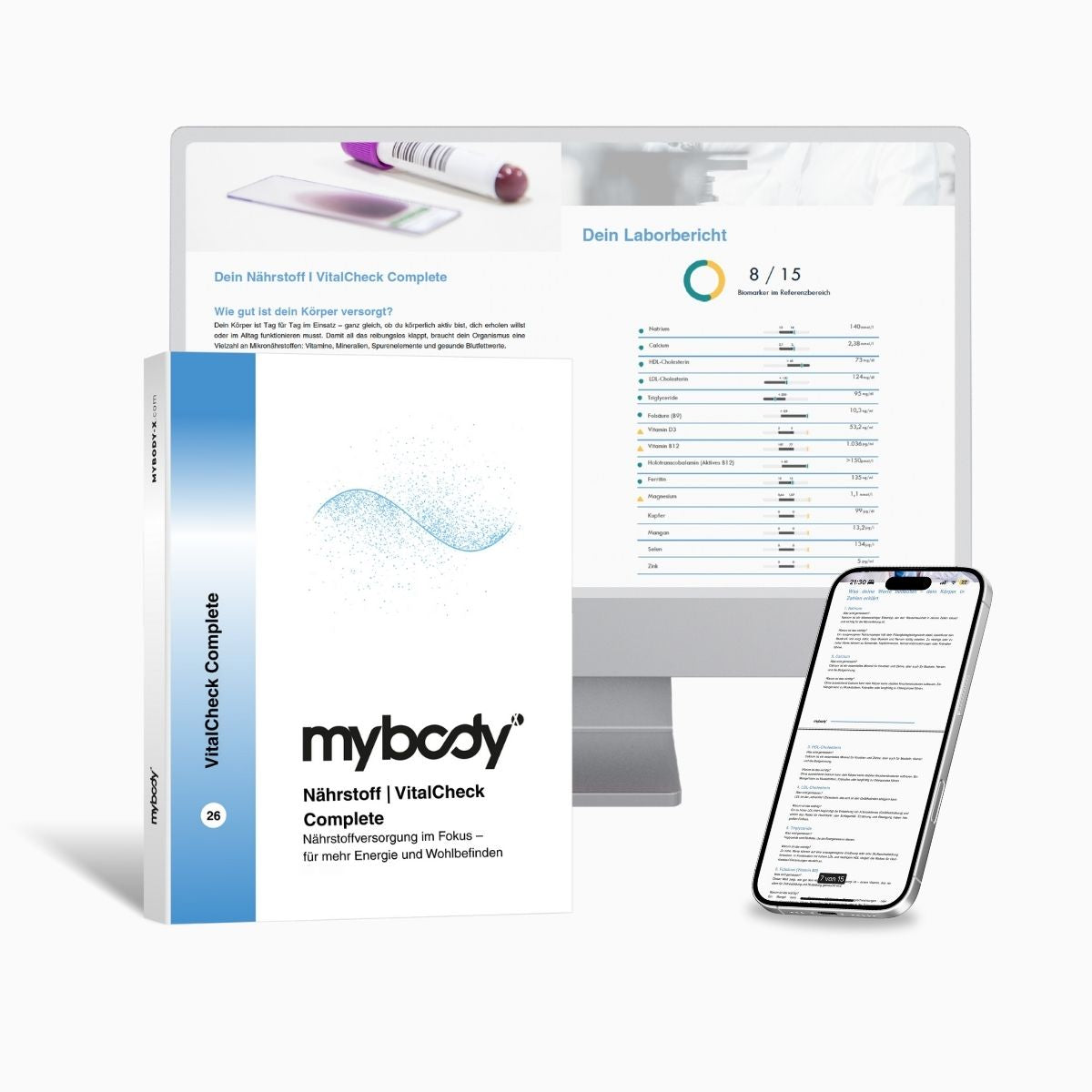
Capillary blood test
VitalCheck | Complete Nutrient & Mineral Test
Tests 18 values from the same sample, including selenium, zinc, iron, ferritin, transferrin, calcium, magnesium, phosphate, 25-OH vitamin D3, vitamin B12, folic acid, albumin, CRP, long-term blood sugar, as well as total cholesterol, HDL, LDL, and triglycerides. What the test does not provide: chromium, molybdenum, and manganese are not included. It does not recommend a supplement, specify an amount, make a diagnosis, or replace a medical examination.
Laboratory analysis 3–5 business days after sample receipt
Product page information, accessed 17 August 2026
Chapter at a glance
A capillary blood test documents the values for which documented deficiency states and established procedures exist. According to the cited sources, chromium, molybdenum, and manganese are not among them and are therefore not included.
Limitations: what this article also leaves open
The first boundary is time. All statements in this article reflect the status of the cited sources in May 2025. The evidence may change, in which case this article will receive a new date.
The second limitation is selection. The MSD Manual chapters on chromium, molybdenum, manganese, and the overview of minerals were reviewed, along with an IQWiG explanation of reference ranges. Other sources may emphasize different aspects.
The third limitation concerns the individual case. The fact that a deficiency state has rarely been documented does not mean that it occurs in no one. It means that it cannot be clarified through a home testing panel.
The fourth limitation concerns diagnosis. All the classifications in this article provide context; they do not constitute a diagnosis. A diagnosis is made in a medical practice based on several components, and no self-test can anticipate it.
What matters for these three
If you take away just one thing from this article, let it be this: Sometimes, the fact that an element does not appear on any panel is the more accurate answer.
According to the cited source, manganese deficiency has not been conclusively established. Molybdenum deficiency states have been documented in rare cases, and diagnosis in those cases relied on other values. The same source openly questions whether chromium belongs among the essential trace elements at all (MSD Manual, as of May 2025).
It was initially suspected that these three might be overlooked. After reviewing the evidence, the opposite remains true: They do not appear on test reports because the sources say exactly what this article says about them. The interpretation of each result belongs in a medical practice.
Frequently asked questions
Which trace elements are considered essential?
The MSD Manual, professional edition, lists nine: chromium, copper, fluoride, iodine, iron, manganese, molybdenum, selenium, and zinc (as of May 2025). However, the same source notes that it is unclear whether chromium should be considered an essential trace element.
Can manganese deficiency be detected in the blood?
The MSD Manual states: Manganese deficiency has not been conclusively established (as of May 2025). The chapter contains no information about a diagnostic procedure or the significance of a blood manganese level. Without a described deficiency state, a test result lacks a reference point.
How common is molybdenum deficiency?
The MSD Manual states: Genetic and dietary molybdenum deficiencies have been documented in rare cases (as of May 2025). The cases described involve genetic defects in the formation of the molybdenum cofactor and long-term intravenous artificial nutrition without molybdenum supplementation. Both conditions are identified in a clinical setting.
What does the medical literature say about chromium supplements?
The MSD Manual states that it is not known whether supplementing with chromium picolinate is beneficial for diabetes mellitus, and adds: People with diabetes should not take chromium supplements unless their use is supervised by a diabetologist (as of May 2025). Regarding sports, it says that chromium supplements increase neither muscle size nor muscle strength. This article does not recommend for or against any product.
Are these three values included in a home blood test?
Not in the mybody®x tests reviewed. VitalCheck measures selenium and zinc as trace elements, along with iron, ferritin, and transferrin. Chromium, molybdenum, and manganese are not included, and according to the sources cited in this article, each lacks at least one of the necessary prerequisites.
Next step
See the values that provide insight
VitalCheck measures 18 values from capillary blood, including selenium, zinc, iron, ferritin, and transferrin. Chromium, molybdenum, and manganese are not included. The test does not recommend a supplement, specify an amount, provide a diagnosis, or replace medical evaluation.
To VitalCheckRead more
You might also be interested in this
A documented association and a metric that does not exist.
Why both values are measurable yet still difficult to interpret.
Sources
- MSD Manual, Professional Edition: Overview of minerals, Johnson LE (last full review May 2025) – msdmanuals.com
- MSD Manual, Professional Edition: Chromium deficiency, Johnson LE (last full review May 2025) – msdmanuals.com
- MSD Manual, Professional Edition: Molybdenum deficiency, Johnson LE (last full review May 2025) – msdmanuals.com
- MSD Manual, Professional Edition: Manganese deficiency, Johnson LE (last full review May 2025) – msdmanuals.com
- IQWiG: Understanding laboratory values correctly, as of 2 April 2025 – gesundheitsinformation.de
The list of the nine essential trace elements is taken from source [1]. The statements on insulin activity, normal plasma levels, symptoms, chromium picolinate, care by a diabetologist, muscle size, and the statement about essentiality are taken from [2]. The information on coenzymes, the rarity of documented cases, and the laboratory values of the documented case is taken from [3]. The verbatim quotation on manganese deficiency and the information on function, intake, absorption, and the experimental study are taken from [4]. The explanation of the reference range is taken from [5]. Information on price, values, sample type, and laboratory comes from the mybody®x product page, accessed on 17 August 2026; processing times follow the central specification for blood tests. All sources were accessed and checked on 17 August 2026.

mybody®x Editorial & Expert Team
Laboratory diagnostics Blood analysis interpretation Nutritional science Nutrigenetics
This article was created by the mybody®x editorial and expert team. The team combines laboratory diagnostics, nutritional science, and the interpretation of blood analyses. Contributors are listed on the authors page.
Published on 17 August 2026 · Last updated on 17 August 2026
The content is for general information only and does not replace medical advice, diagnosis, or treatment. Reference ranges depend on the laboratory, method, and age; the information on your laboratory report is always authoritative.




Share now:
fT3 and fT4 alongside TSH: what they add
Ferritin shows iron stores; iron shows the current level.