

Ferritin shows the stores; iron shows the moment
The essentials at a glance
Both values appear one below the other on a report and have almost the same name. Nevertheless, they answer completely different questions.
When it comes to the iron level, the source is unusually clear: On its own, it has little significance because it fluctuates considerably throughout the day. Ferritin, by contrast, reflects the iron stores—and this value has a catch, too.
You will read about four values compared side by side, the quoted source in its original wording, three common statements fact-checked, three documented facts, and why inflammation shifts ferritin levels.
What to expect in this article
1. Two numbers, one element
2. What ferritin is
3. Four values in an iron panel
4. What the iron level measures
5. The documented source
6. Why the timing of the blood draw matters
7. Three statements fact-checked
8. The key point in one sentence
9. The catch with ferritin
10. Three documented facts
11. How the specialist literature establishes the diagnosis
12. Who may benefit from measuring several iron values
13. What a capillary blood test can show here
14. Limitations: what both values leave open
15. What matters about these values
Frequently asked questions
Sources
Two numbers, one element
Anyone looking at a report with iron values will see at least two lines: iron and ferritin. Sometimes transferrin is included as well.
The obvious assumption is that these lines show the same thing from different angles. If both are within range, everything is fine, and if one is abnormal, something is wrong.
That is not how it works. The two values differ in the time span they represent, and this difference is so substantial that it reverses the interpretation.
IQWiG describes iron as an essential trace element (as of 03/20/2025). How its level is assessed depends on which of the two numbers you read.
What ferritin is
The name sounds like a form of iron, but refers to something else: a protein.
IQWiG writes: Ferritin is a protein that can bind iron (as of 03/20/2025). The same source describes it as an iron store.
Thus, a ferritin level does not measure the iron itself, but rather the container for it. This is why it says something about a longer time span than a snapshot of the iron in the blood.
For the reference ranges, the same source gives 9 to 140 µg/l for women over 18 and 18 to 360 µg/l for men over 18 (as of 03/20/2025). The ranges are strikingly broad and differ considerably between the sexes.
Four values in an iron panel
The table compares four values that are mentioned in connection with iron. It provides context and does not constitute a diagnosis.
| Value | What it reflects | Time axis | What shifts it |
|---|---|---|---|
| Serum iron | The concentration in the blood at the time of sampling; reference range 40–150 μg/dl for women and 60–160 μg/dl for men over 18 (IQWiG, as of 20 March 2025) | Hours | The time of day and a meal—the value temporarily rises after eating something |
| Ferritin | The protein that can bind iron, referred to as an iron store; reference range 9–140 µg/l for women and 18–360 µg/l for men over 18 (IQWiG, as of 20 March 2025) | Weeks to months | Inflammation—there is then more ferritin in the blood to inhibit bacterial growth |
| Transferrin | The protein produced in the liver that transports iron in the blood to the organs (IQWiG, as of 20 March 2025) | Days to weeks | The body's iron status—elevated values usually occur with significant iron deficiency |
| Transferrin saturation | A derived value that the MSD Manual lists alongside complete blood count and serum ferritin for diagnosis (Johnson, as of May 2025) | Days to weeks | Anything that shifts iron or transferrin—it inherits both sensitivities |
The Time axis column is the most important. It explains why two values from the same sample can look different without either being incorrect.
What the iron level measures
Serum iron is the value most people consider decisive. The source sees it differently.
For women over 18, IQWiG gives a range of 40 to 150 μg/dl, and for men over 18, 60 to 160 μg/dl (as of 20 March 2025). In that respect, it is a value like any other.
The sentence that puts it into context follows in the next chapter of the original. The short version: This value fluctuates so much that a single measurement tells you little.
This is not an argument against measuring it. It is an argument against interpreting it on its own—and that is precisely where it differs from ferritin.
The documented source
The sentence underpinning this article appears in a public source and is remarkably direct.
Documented source
“The iron level has little significance on its own, as iron levels fluctuate considerably over the course of a day.”
Institute for Quality and Efficiency in Health Care
IQWiG, gesundheitsinformation.de, Iron, as of 20 March 2025
What is remarkable about this sentence is where it appears: in an article that explains this value. The source describes a laboratory value and, in the same breath, marks its limitation.
The word alone carries the entire statement. The value is not meaningless, but meaningless on its own.
What it lacks is context. On a test result, that context is provided by a second value with a different time frame.
Why the time of the blood draw matters
The source gives a specific reason for the fluctuation, and it is more commonplace than expected.
IQWiG states: The iron level can fluctuate considerably over the course of a day. For example, it temporarily increases after eating something (as of 03/20/2025).
This means that a single iron number depends on two details that are rarely documented: the time of day and whether anything was eaten beforehand.
A practical rule follows for comparing results over time: Anyone who wants to compare two iron levels should have them measured under conditions that are as similar as possible. This requirement is considerably lower for ferritin because it reflects a longer time frame.
What this means for two test results taken at different times
Anyone who measures a second time after a few months is actually comparing two different things, even though the same lines appear on the sheet both times.
With ferritin, the comparison is reliable because the stores change slowly. A change between two test results is a signal there, not merely noise.
With the iron level, the opposite is true. If the same value fluctuates considerably over the course of a day on its own, then a difference between two test results may simply mean that the two samples were taken at different times or at different intervals after a meal.
That is why it makes sense to note the time next to every iron value. Two values with the same time are comparable; two values without a time are two numbers without a shared basis.
For tracking over several months, ferritin is therefore the more suitable value, while the iron level adds a snapshot. That is exactly how the two are intended to be used on a test result.
Three statements fact-checked
These three statements come up as soon as an iron test result is on the table.
Checked against the available evidence
Common
“My iron level is good, so I have enough iron.”
Documented
IQWiG states: The iron level has little significance on its own because iron levels fluctuate considerably over the course of a day (as of 03/20/2025). It describes a moment, not a reserve.
Common
“High ferritin means that the stores are full.”
Documented
Not necessarily. During inflammation, there is more ferritin in the blood to inhibit bacterial growth; elevated levels can therefore indicate either iron overload or inflammation (IQWiG, as of 03/20/2025).
Common
“One value is enough for an assessment.”
Documented
The MSD Manual lists three tests side by side for diagnosis: complete blood count, serum ferritin measurement, and transferrin saturation (Johnson, as of May 2025).
The core in one sentence
This is where the topic can be brought together.
One value answers what things look like right now. The other shows what they have looked like over the past few weeks.
Anyone who confuses the two will turn a correct value into incorrect information. A good iron value after breakfast says nothing about the preceding weeks.
Conversely, a ferritin value says nothing about how much iron is currently circulating in the blood. That is why both appear on the same test report, and why neither is redundant.
The catch with ferritin
To avoid making ferritin seem like the perfect value, this article needs to include its caveat here.
IQWiG notes that during inflammation, more ferritin is present in the blood to inhibit bacterial growth, and that elevated levels may indicate either iron overload or inflammation (as of March 20, 2025).
The MSD Manual describes the consequence for assessment: Chronic inflammation increases serum iron by reducing the use of iron to produce red blood cells, thereby causing anemia of chronic disease and making it more difficult to assess iron status (Johnson, as of May 2025).
This leads to a practical recommendation for reading a test result: A ferritin value becomes more meaningful when an inflammation marker is listed alongside it. On many test reports, this is the CRP value.
The article CRP in the blood: what it indicates explains what the CRP value itself can and cannot show.
Three documented pieces of information
Three pieces of information from the reviewed sources. They provide context and do not constitute a diagnosis.
Documented information
< 50 mcg/l
ferritin levels are generally in deficiency states, and transferrin saturation is often below 20% (MSD Manual, professional edition, Johnson, as of May 2025)
9–140
µg/l is the stated ferritin reference range for women over 18; for men over 18, 18–360 µg/l is given (IQWiG, as of March 20, 2025)
3
The MSD Manual lists the following tests side by side for diagnosis: complete blood count, serum ferritin, and transferrin saturation (as of May 2025)
The ratio of the first two figures is striking. A value of 40 µg/l falls within the IQWiG reference range for women while also being below the threshold the MSD Manual cites for deficiency.
This is not a contradiction between the sources, but a difference between two questions. A reference range describes a distribution in a population, while a diagnostic threshold describes a finding. And as with every laboratory value, the relevant range is the reference range stated on your own report, because reference values can vary from one laboratory to another (IQWiG, as of 04/02/2025).
How the medical literature builds a diagnosis
The structure of the medical literature shows the role each value actually plays.
The MSD Manual names three tests: the complete blood count, serum ferritin measurement, and transferrin saturation (Johnson, as of May 2025). The individual serum iron value does not come first in this list.
Regarding the ranges, it states: In cases of deficiency, ferritin levels are generally low, below 50 mcg/l, and transferrin saturation is often below 20 percent (as of May 2025).
In rare cases, according to the same source, an examination of the bone marrow for iron may be necessary. This is the opposite of any notion that a single value could settle the question.
The order in this list is also noteworthy. At the top is the complete blood count—not an iron value, but the question of how the red blood cells are doing. Only afterward do the values describing the supply follow.
This sequence makes sense when read as a chain: First, the question is whether something affected the result, and then what might be causing it. A nutrient panel addresses the second question.
For a finding from capillary blood, this results in a clear division of roles. It provides building blocks, not a diagnosis, and putting them together is a medical task.
Who can benefit from several iron values
The comparison concerns whether several iron values from the same sample can help you.
Useful for you if …
So far, you have only known a single iron value and cannot interpret it.
You want to see ferritin, iron, transferrin, and an inflammation marker from one sample.
You want to bring dated figures to a conversation at the practice.
You want to establish a baseline before changing something about your diet.
Probably not if …
You expect a finding to settle the question. It does not.
You need a complete blood count. That is not included in this test.
You are already undergoing diagnostic evaluation. In that case, follow the practice that started it.
You expect a diagnosis. That is provided by a medical practice, not a self-test.
What a capillary blood test can show here
A capillary blood self-test does not provide a diagnosis. What it can do is place several iron values from the same sample and with the same date side by side.
For this topic, that is the actual benefit. VitalCheck by mybody®x (MYBODY Lab GmbH) measures ferritin, iron, and transferrin, as well as the CRP value, which can be used to assess the caveat from Chapter 9.
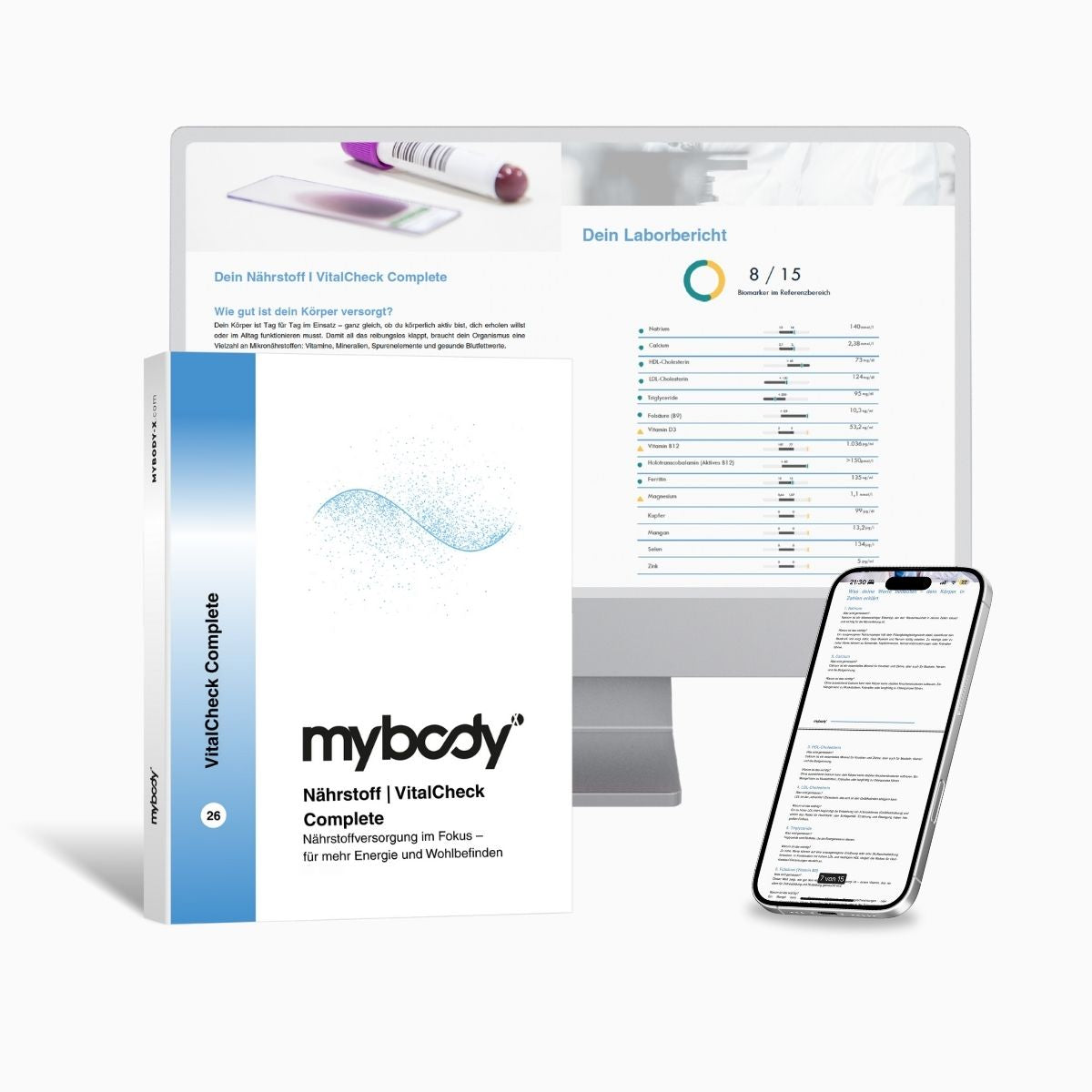
Capillary blood test
VitalCheck | Complete Nutrient & Mineral Test
Measures 18 values from the same sample, including ferritin, iron, transferrin, and CRP, as well as 25-OH vitamin D3, vitamin B12, folic acid, calcium, magnesium, phosphate, albumin, selenium, zinc, long-term blood sugar, and the cholesterol profile. What the test does not provide: no complete blood count, no diagnosis, no recommendation for a supplement, no dosage, and no substitute for a medical examination.
Laboratory analysis within 3–5 business days after receipt of the sample
Product page information, retrieved August 18, 2026
Chapter at a glance
A capillary blood test measures ferritin, iron, transferrin, and CRP from the same sample, making both time frames and the inflammation caveat visible at the same time. A complete blood count is not included, and the overall assessment belongs in a medical practice.
Limitations: what both values leave open
The first limitation is the iron value itself. On its own, it has little significance because levels fluctuate considerably over the course of a day (IQWiG, as of March 20, 2025), and a single number without a time is difficult to interpret.
The second limitation is inflammation. It shifts ferritin upward and, according to the MSD Manual, makes it more difficult to assess iron status overall (Johnson, as of May 2025).
The third limitation is scope. The MSD Manual lists the complete blood count first for diagnosis, and a nutrient panel does not include it.
The fourth limitation is diagnosis. All the assessments in this article provide context and are not diagnoses. A diagnosis is made in a medical practice based on several components, and no self-test can anticipate it.
What matters about these values
If you take away just one thing from this article, let it be this: The two values differ in their time frame, not in their accuracy.
The iron level describes a moment and fluctuates throughout the day, including after a meal (IQWiG, as of March 20, 2025). Ferritin is the protein that can bind iron and reflects the iron stores. Both are measured correctly and answer different questions.
The practical takeaway is neither surprising nor complicated: An iron test result is an overall assessment, not a single number. The MSD Manual names three tests to consider together, and the caveat concerning inflammation is part of that assessment. Interpreting the results together is a medical task.
Frequently asked questions
What is the difference between iron and ferritin?
The time axis. The iron level describes the concentration in the blood at the time the sample is taken; IQWiG notes that it has little significance on its own because iron levels fluctuate considerably over the course of a day (as of March 20, 2025). Ferritin is a protein that can bind iron, and the same source describes it as an iron store.
Why does the iron level fluctuate so much?
IQWiG cites an everyday reason: Iron levels can fluctuate considerably over the course of the day—for example, they temporarily rise after eating something (as of March 20, 2025). For comparisons over time, iron levels should therefore be measured under conditions that are as similar as possible.
Can a ferritin level appear normal despite iron deficiency?
This is possible in the presence of inflammation. IQWiG notes that inflammation increases the amount of ferritin in the blood, and elevated levels can indicate either iron overload or inflammation (as of March 20, 2025). The MSD Manual states that chronic inflammation makes it more difficult to assess iron status (Johnson, as of May 2025). An inflammation marker measured alongside the ferritin level helps with interpretation.
What values does the medical literature cite for diagnosis?
The MSD Manual lists three tests: a complete blood count, a serum ferritin test, and transferrin saturation (Johnson, as of May 2025). Regarding the approximate levels, it states that in deficiency conditions, ferritin levels are generally low—below 50 mcg/l—and transferrin saturation is often below 20 percent.
Which ferritin reference range applies?
For women over 18, IQWiG gives a range of 9 to 140 µg/l, and for men over 18, 18 to 360 µg/l (as of March 20, 2025). The reference range on your own test report is always decisive because reference values can vary from one laboratory to another. A reference range describes a distribution in a population and is not the same as a diagnostic threshold.
Next step
Both timelines on one sheet
VitalCheck measures 18 values from capillary blood, including ferritin, iron, transferrin, and CRP from the same sample. It does not include a complete blood count, does not provide a diagnosis, and does not replace medical evaluation.
To VitalCheckRead more
You may also be interested in
Why the level says little about absorption.
The value that belongs next to ferritin on the report.
Sources
- Institute for Quality and Efficiency in Health Care (IQWiG): Iron, as of 03/20/2025 – gesundheitsinformation.de
- IQWiG: Ferritin, as of 03/20/2025 – gesundheitsinformation.de
- MSD Manual, Professional Edition: Iron Deficiency, Johnson LE (full review May 2025) – msdmanuals.com
- IQWiG: Transferrin, as of 03/20/2025 – gesundheitsinformation.de
- IQWiG: Understanding laboratory values correctly, as of 04/02/2025 – gesundheitsinformation.de
The verbatim quote about the significance of the iron level, the description of iron as an essential trace element, the reference ranges for iron, and the information about fluctuations after a meal come from source [1]. The description of ferritin as a protein and iron store, the ferritin reference ranges, and the statements about inflammation come from [2]. The three tests mentioned, the figures below 50 mcg/l and below 20 percent, the sentence about chronic inflammation, and the note about bone marrow examination come from [3]. The description of transferrin and the statement about elevated transferrin levels come from [4]. The explanation of the reference range comes from [5]. Information about the price, values, sample type, and laboratory comes from the mybody®x product page, accessed on 08/18/2026; processing times follow the standard policy for blood tests. All sources were accessed and reviewed on 08/18/2026.

mybody®x Editorial & Expert Team
Laboratory diagnostics Blood analysis interpretation Nutritional science Nutrigenetics
This article was created by the mybody®x editorial and expert team. The team combines laboratory diagnostics, nutritional science, and the interpretation of blood analyses. Everyone who contributes to it is listed on the authors’ page.
Published on 08/18/2026 · Last updated on 08/18/2026
The content is intended for general information and does not replace medical advice, diagnosis, or treatment. Reference ranges depend on the laboratory, method, and age; the information on your report is always authoritative.




Share now:
Chromium, molybdenum, and manganese: three quiet trace elements
A value without a previous value is just a point