

Which DNA test is right for me? Five analyses, one way to choose
The essentials at a glance
The choice does not begin with the test, but with your goal. Someone who wants to lose weight needs different reports from someone who wants to tailor their training or skin care. The analysis method behind them is always the same; the difference lies in the structure of the evaluation. That is why the selection comes down to three questions: What for, how comprehensive, and at what price.
This article compares five DNA analyses according to the same criteria and openly explains what none of them can do. It also tells you when an entirely different type of test would be a more suitable answer to your question.
You will first learn what to base your choice on, followed by an overview and the five goals individually. At the end, you will find decision-making guidance, limitations, and the most frequently asked questions.
What to expect in this article
1. What to base your choice on
2. The five DNA analyses at a glance
3. What all five analyses have in common
4. Five goals, five structures
5. When a DNA test makes sense and when it does not
6. The two endpoints of the range in detail
7. What none of the five tests can do
8. What matters when choosing
Frequently asked questions
Sources
What to base your choice on
The search for the right DNA test almost never begins with the word DNA. It begins with a concern: Your weight is not changing despite your discipline, your training is delivering less than expected, or your diet feels more like guesswork than knowledge.
This concern is precisely the first selection criterion. A DNA analysis is chosen based on the structure of its report, and that structure follows the objective. A report on fat-metabolism traits helps with weight loss, while a report on recovery traits helps with training.
Behind this lies a common objection, and it is justified: Are the recommendations really derived from my findings, or are they the same for everyone? The answer lies in transparency. Before purchasing, you can read in the DNA Lexicon which genetic variations an analysis examines and what each one means, entry by entry. A test whose contents can be reviewed in advance must be held accountable to them afterward.
The second thing many people want to clarify before choosing: Is my topic included at all? The lexicon is the fastest way to find out. If you cannot find your topic there, you can avoid taking the wrong test—and that is a better outcome than receiving a disappointing report.
The second criterion: the scope of the evaluation
The five analyses differ significantly in scope. The smallest evaluation covers 18 reports across around 40 pages, while the largest covers 74 reports across around 240 pages. Both have their place: If you have a specific question, you do not need twelve chapters. If you want the big picture, you will be frustrated by a slim report.
The third criterion: the price within the range
Prices range from 169 euros to 369 euros, as of 24 August 2026. The range is explained by the scope: From the smallest to the largest test, the price does not quite double, while the number of reports triples. Calculating the price per report gives you the lowest figure for the largest test, but you pay the highest total amount.
Key message
The largest DNA analysis is not the right one; the right one is the one whose reports you actually use in everyday life.
For distinction: Two older articles address test selection from a different angle. Best DNA Test answers the question of which provider to choose, while DNA Metabolism Tests Compared places several tests side by side. This article sorts exclusively by your goal within one range.
The five DNA analyses at a glance
The table compares the four analyses in the range side by side, using the details from the product pages accessed on 24 August 2026. The fifth test follows directly below because it falls outside the range.
| Criterion | WeightLoss | SLIM | Fitness | VITALITY | NutriCare | INFINITY | Longevity | ALL IN ONE |
|---|---|---|---|---|
| Focus | Weight loss and metabolic type | Training, performance, and recovery | Nutrition and nutrient utilization | Overall picture covering nutrition, lifestyle, and skin |
| Gene variations | more than 80 | more than 100 | more than 140 | more than 170 |
| Reports and scope | 24 reports, 5 chapters, around 140 pages | 32 reports, 6 chapters, around 160 pages | 54 reports, 8 chapters, around 200 pages | 74 reports, 12 chapters, around 240 pages |
| Assessment of more than 1,000 foods | no | yes | yes | yes |
| Price as of 24 August 2026; subject to change | 169.00 euros | 197.00 euros | 269.00 euros | 369.00 euros |
The fifth test is Anti-Aging | SKINCARE DNA test with 33 gene variations, 18 reports, and around 40 pages for 197.00 euros, as of 24 August 2026. It costs as much as VITALITY and is considerably narrower. The reason is its specialization: it answers questions exclusively about the skin—and in greater depth than a chapter in a comprehensive report could.
SKINCARE contains no food assessment, nor does SLIM. If you want this feature, choose VITALITY, NutriCare, or Longevity.
Read the table from the perspective of your goal, not the price. The row showing the focus determines whether a test is even suitable; only then is it worth looking at the scope and price. Anyone who does the opposite and starts with the price can easily end up with a report that only touches on its actual topic.
What all five analyses have in common
All five tests use a saliva sample that you collect at home and send to the laboratory. Kit shipping takes 1 to 3 business days, and laboratory analysis takes 15 to 25 business days after your sample is received. These are separate time frames, not a combined total.
The process is the same for all five: You order the test kit, collect the saliva sample at home according to the enclosed instructions, and send it back in the prepared envelope. The laboratory then takes over, and the process ends with a digital evaluation report containing explanations and recommendations. The guide to the process shows what sample collection looks like in detail.
The underlying procedure is SNP genotyping covering more than 700,000 individual positions in the genome. This is not whole-genome sequencing: predetermined locations at which people are known to differ are read, not the entire genome. This is exactly the appropriate scope for nutrition and lifestyle questions.
Your DNA does not change. That is why one test is sufficient for life, and why none of the five includes a retest interval. Research will continue, and in the future more can be learned from the same data. This does not change your result; only the knowledge surrounding it grows.
What such an analysis actually achieves in everyday life should be assessed honestly. In 2022, the German Nutrition Society summarized the evidence on personalized analyses:
Documented source
“Analyses for personalization, such as genetic and blood analyses or microbiome data, generally did not produce statistically verifiable improvements in eating behavior or lifestyle.”
German Nutrition Society (DGE)
Press information “Personalized Nutrition Reconsidered,” 2022
However, the same text also cites moderate effects resulting from increased motivation. That is the honest benefit of a DNA analysis: it does not change your behavior on its own; it provides a reliable rationale and a starting point. What you do with it is up to you.
The shared foundation also includes how the sample is handled. The analysis is carried out in an ISO-certified laboratory in Germany, the samples are pseudonymized, and both the saliva sample and DNA sequence are completely destroyed two months after the analysis is completed.
Chapter at a glance
All five DNA analyses use a saliva sample, SNP genotyping covering more than 700,000 individual positions, and laboratory analysis taking 15 to 25 business days after the sample is received. A result remains valid for life because DNA does not change. According to the German Nutrition Society (2022), such analyses do not automatically improve eating behavior; moderate effects through increased motivation have been demonstrated.
Five goals, five packages
The following five sections start with the goal, not the product. Each one names the appropriate package, what it is suited for, and where its weakness lies.
The field behind it is called nutrigenetics—the study of how genetic variants affect the way nutrients are processed. You do not need to know anything about this to make your choice. It simply helps explain why the same analysis platform can produce such different reports depending on the package.
Weight-loss goal: WeightLoss | SLIM
SLIM is the entry-level option in the range. Its 24 reports across five chapters focus on metabolic type and nutrition strategy, including responses to saturated and unsaturated fats and to carbohydrates.
Best for
People whose only open question concerns their weight and who want to know why previous attempts have required more effort than expected.
Why choose it
The lowest price in the range and a focused package that contains nothing to distract from weight loss.
Why not
No assessment of individual foods and no chapters on training or skin. Anyone with multiple questions will quickly outgrow it.
Positioning: the right test for a single, clearly defined question. It does not predict weight-loss success; no DNA analysis can do that.
Training goal: Fitness | VITALITY
VITALITY examines over 100 genetic variants relating to performance, recovery, and nutrient requirements in sport, presented as 32 reports across six chapters.
Best for
Athletes from beginners to ambitious competitors who want to align their training and nutrition with their own predisposition rather than someone else’s plan.
Why choose it
Includes an assessment of over 1,000 foods and combines training and nutrition characteristics in a single report.
Why not
Anyone who does not train at all pays for chapters they will not read. And training success remains a matter of stimulus and recovery, not predisposition alone.
Positioning: the choice if exercise is already a regular part of your everyday life or is intended to become one.
Important distinction: Fitness | VITALITY is a saliva-based DNA test, not a blood test. Anyone who wants to measure their current nutrient levels should look for a different product, even if the names in the shop sound similar. Predisposition and a snapshot in time are two different kinds of information.
Nutrition goal: NutriCare | INFINITY
NutriCare, with over 140 genetic variants and 54 reports across eight chapters, is the range’s nutrition specialist. Its verified compatibility section covers four reports: alcohol metabolism, caffeine metabolism, lactose metabolism, and gluten intolerance.
Just as important is what it does not include: there is no report on protein or protein requirements. Anyone who wants to know how much protein they need each day will not get an answer from this test.
Best for
People who want to change their diet permanently and are looking for a foundation suited to how their body processes nutrients.
Why choose it
The most in-depth nutritional focus in the range, including food assessment and the four evidence-based tolerance reports.
Why not
If a genuine allergy is suspected, an IgE test is the recognized diagnostic method—not a DNA analysis. And this test does not determine protein requirements.
Positioning: the test for making a meaningful dietary change, not for allergy diagnostics.
Skin focus: Anti-Aging | SKINCARE
With 33 gene variants and 18 reports, SKINCARE answers one question: Which skincare and nutrients suit your skin's predispositions? It is deliberately focused and goes deeper into its subject than the skin chapters in the larger tests.
Best for
People who spend a lot of money on skincare products and finally want to know which approach suits their own skin.
Why choose it
Specialization instead of a collection of reports: the entire analysis budget goes toward one topic.
Why not
The same price as VITALITY, with one-third of the gene variants and no food assessment. Anyone with questions beyond skin will be better served by a more comprehensive test.
Positioning: useful as a specialist, unsuitable as the only test for a broad concern.
Overall picture: Longevity | ALL IN ONE
With more than 170 gene variants, 74 reports, and twelve chapters, Longevity brings together all the topics in the range—from nutrition and metabolism to skin. It's the test for people who don't want to answer just one question, but want to align their overall lifestyle with their own predispositions.
Your DNA doesn't change. That's why one test is enough for a lifetime.
Best for
People who love tracking data, want to tackle several areas of life at once, and plan to use the report as a reference work for years.
Why choose it
The most comprehensive package in the range and the lowest price per report. It includes all the topics covered by the four smaller tests.
Why not
The highest total price, and 240 pages to read. Anyone with just one question is buying a lot of answers to questions they never asked.
Positioning: the reference work among the five, designed for the long term. A test that doesn't become outdated.
When a DNA test makes sense—and when it doesn't
Before choosing among the five, one thing needs to be clarified first: whether a DNA test is actually the right type of test for your question. A DNA analysis shows predisposition—in other words, what never changes. It does not show your current state.
Anyone who wants to know what their blood values are today needs a blood test. Anyone who wants to understand their digestion needs a gut microbiome analysis. And anyone with acute symptoms should not take a test, but make an appointment with a doctor.
The three test types can be viewed as three different speeds. DNA never changes, blood values change over months, and the gut microbiome changes within weeks. A DNA test is therefore worthwhile precisely when your question concerns what lasts: the predisposition that every change must work with.
Often, the most honest answer is to combine them with some time in between. First, the DNA analysis clarifies the why; later, a blood test shows whether the changes are reflected in your results. Buying both at the same time is rarely necessary; understanding one first and then measuring the other is almost always more sensible.
A DNA test makes sense if …
you want to understand why nutrition or training affects you differently from others and are looking for a one-time foundation that remains valid over time.
you are planning to make changes anyway and want to tailor them to your predisposition rather than follow a general rule.
you are ready to derive your own steps from a report. The analysis provides the rationale; implementation is up to you.
Probably not if …
you are seeking a diagnosis or have acute symptoms. In that case, your question belongs in a doctor's office, not in a self-test.
you are interested in your current condition, such as nutrient or hormone levels. A blood test shows that, not a predisposition analysis.
you expect the report to name a diet that is guaranteed to work. A DNA analysis cannot do exactly that.
If you are undecided between two tests after this chapter, the DNA test product finder can help with a few questions. The DNA encyclopedia with over 170 explained genetic variations shows which topics the analyses cover in detail.
The two key points of the range in detail
mybody®x (MYBODY Lab GmbH) is behind all five analyses, active since 2016 and with its consumer offering since 2022. The analysis is carried out in Germany in an ISO-certified, GDPR-compliant, professionally reviewed process. You can read how other customers experienced their tests on the customer reviews page.
As a representative overview of the range, here are the two key points: the entry-level option for a single question and the complete package for everyone.
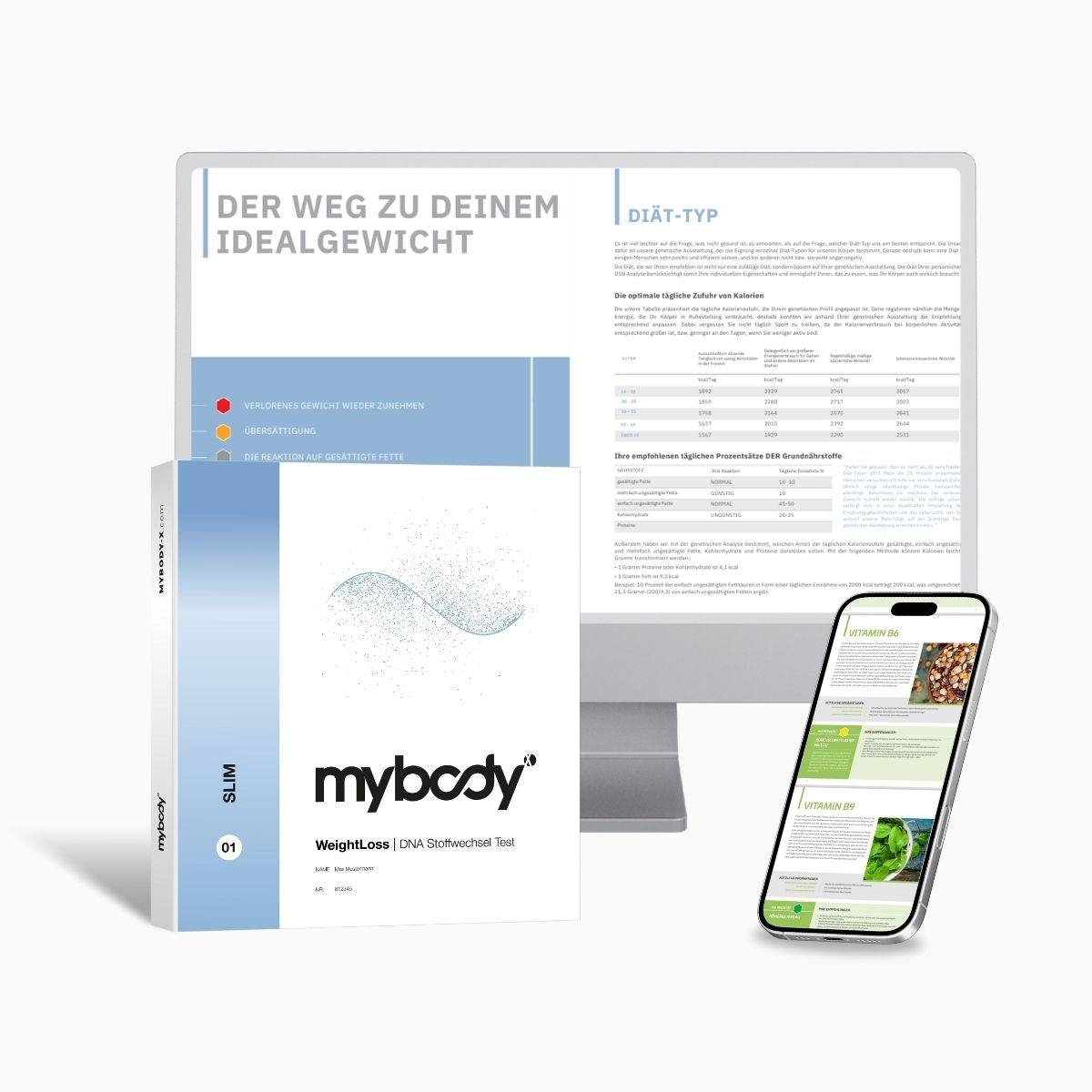
DNA test from saliva
WeightLoss | SLIM DNA Test
More than 80 genetic variants, presented as 24 reports in five chapters on metabolic type and dietary strategy. What the test cannot do: It does not assess individual foods, provide a diagnosis, or predict weight-loss success.
Laboratory evaluation 15–25 business days after sample receipt
Product page information, accessed 24 Aug 2026

DNA test from saliva
Longevity | ALL IN ONE DNA Test
More than 170 genetic variants, presented as 74 reports in twelve chapters, including an assessment of more than 1,000 foods. What the test cannot do: It is not a diagnostic procedure and does not replace a medical examination. Predisposition is not destiny.
Laboratory evaluation 15–25 business days after sample receipt
Product page information, accessed 24 Aug 2026
VITALITY, SKINCARE, and NutriCare lie between the endpoints. Those who end up there have usually already recognized their goal in Chapter 4.
A word on the order of the decision: The price gap between the endpoints appears large, but disappears once you spread it over the period of use. A report that remains valid for life is not paid for annually, but just once. The key question therefore remains the one from Chapter 1: How many of the reports will you actually read and put into practice?
What none of the five tests can do
None of the five analyses provides a diagnosis. The DNA analysis is intended for nutritional and lifestyle counseling; it is not a diagnostic procedure, does not predict disease, and does not replace a medical examination or consultation.
Genetic variants describe probabilities in population groups, not fixed outcomes for individuals. Someone who knows that their sense of satiety is genetically less pronounced understands why portion control requires more effort from them than from others. Whether they make that effort is decided by everyday life, not by the gene.
The question of behavior also remains open; see the German Nutrition Society’s assessment in Chapter 3: An analysis does not automatically improve dietary behavior. It provides structure and an anchor for motivation; no one promises more here.
And finally, the limitation of the test type itself: predisposition rather than current state. A DNA report does not tell you what your iron level is today. Blood tests are used for that, and there is a separate analysis for the gut microbiome.
One more distinction, because it is often confused: The five analyses here are lifestyle assessments. Predictive genetic tests for diseases are something else; for them, the Genetic Diagnostics Act requires medical information and counseling, and that is where they belong. Anyone seeking such an examination should consult a human genetics specialist, not use a self-test.
What matters when choosing
If you take away one rule, let it be this: Choose based on the question you really have. One question, one specialized test. Several questions or a long time horizon? Then the comprehensive report is worthwhile because it does not become outdated.
The second consideration is an honest look at the type of test. Predisposition answers the question of why. For the present—for example, current blood values—a different test is responsible, and for symptoms, a doctor's practice.
It began with the question of which DNA test suits you. After five tailored options, the answer is: the one whose reports relate to your next specific step. If you are unsure which one that is, the consultation is free, and it does not sell you anything.
Frequently asked questions
Which DNA test is suitable for weight loss?
For the goal of losing weight, the WeightLoss | For the goal of weight loss, the WeightLoss SLIM DNA test is the right fit, with more than 80 gene variations and 24 reports, for €169.00, as of August 24, 2026. If you also want individual foods to be evaluated, you need one of the three larger analyses, as the SLIM does not include this feature. None of the tests can predict weight-loss success.
What distinguishes the five DNA analyses from one another?
The difference lies in the scope of the analysis, not the method: all five use the same SNP genotyping with more than 700,000 individual positions. The range extends from 18 reports in the SKINCARE skin specialist to 74 reports in twelve chapters in Longevity | ALL IN ONE. In between are SLIM for weight loss, VITALITY for training, and NutriCare for nutrition.
How often does a DNA test need to be repeated?
Not at all: A DNA test is taken once in a lifetime because DNA does not change. This distinguishes it from blood tests, which show your current condition and are sensibly repeated every 6 to 12 months. New research findings do not change your test result; they only expand what can be determined from it in the future.
How much does a DNA test cost at mybody®x?
The five DNA analyses cost between €169.00 for WeightLoss | SLIM and €369.00 for Longevity | ALL IN ONE, as of August 24, 2026; subject to change. In between are Fitness | VITALITY and Anti-Aging | SKINCARE for €197.00 each, as well as NutriCare | INFINITY for €269.00. The tiered pricing depends on the scope: more reports, higher price.
Can a DNA test detect diseases?
No. The five analyses compared here are intended for nutrition and lifestyle counseling and are not diagnostic procedures. The Institute for Quality and Efficiency in Health Care also points out that even a changed gene does not mean that a person is ill (IQWiG, 2026). If you have symptoms or suspect an illness, consult a doctor.
Next step
When your goal is clear but the test isn't
The product finder guides you to the right fit with just a few questions. It provides advice but does not sell anything, and you can return to the overview at any time.
Go to product finder View all DNA testsRead more
You might also be interested in this
The foundational article on this type of test, from the process to data protection.
The honest question of benefits to ask before choosing the right fit for you.
Sources
- German Nutrition Society (DGE): Rethinking personalized nutrition, press release (2022) – dge.de
- Institute for Quality and Efficiency in Health Care (IQWiG): What happens during a genetic test? (as of August 5, 2026) – gesundheitsinformation.de
The verbatim quotation on the evidence regarding individualized analyses and the statement about moderate effects on motivation are taken from [1]. The explanation that a changed gene is not equivalent to a disease comes from [2]. All information on gene variations, reports, chapters, pages, food ratings, the laboratory, and prices comes from the mybody®x product pages, accessed on August 24, 2026; processing times follow the central specification for each test type. All sources were accessed and reviewed on August 24, 2026.

mybody®x Editorial & Specialist Team
Nutrigenetics Nutritional science Laboratory diagnostics
This article was created by the mybody®x editorial and specialist team. The team combines nutrigenetics, nutritional science, and laboratory diagnostics. The people who contribute to it are listed on the authors page.
Published on August 24, 2026 · Last updated on August 24, 2026
The content is intended for general information and does not replace medical advice, diagnosis, or treatment. The DNA analysis is intended for nutrition and lifestyle counseling; it is not a diagnostic procedure and does not predict disease.




Share now:
Training in a calorie deficit is reflected in several metrics
Which genes does a DNA test examine? The scope explained honestly