

What does a metabolic analysis really cost? Your guide to the prices
Are you wondering how much a metabolic analysis costs? It is simple: Prices range from around €90 for a simple respiratory gas analysis to more than €350 for an in-depth DNA test. What is right for you depends primarily on how deeply you want to explore and understand how your body functions.
A quick overview of the cost of a metabolic analysis
You do not have to spend a fortune to understand your metabolism. At the same time, it is important to know exactly what you are getting for your money. The price range for metabolic analyses is wide because each method measures very different aspects and offers a different depth of information.
Some tests provide a snapshot of your current calorie consumption. Others decode your genetic predisposition—which remains with you for your entire life. The price often reflects the technological effort, the laboratory's accuracy, and, of course, the scope of your personal evaluation.
The following chart provides an initial overview of the price range of the most common methods.
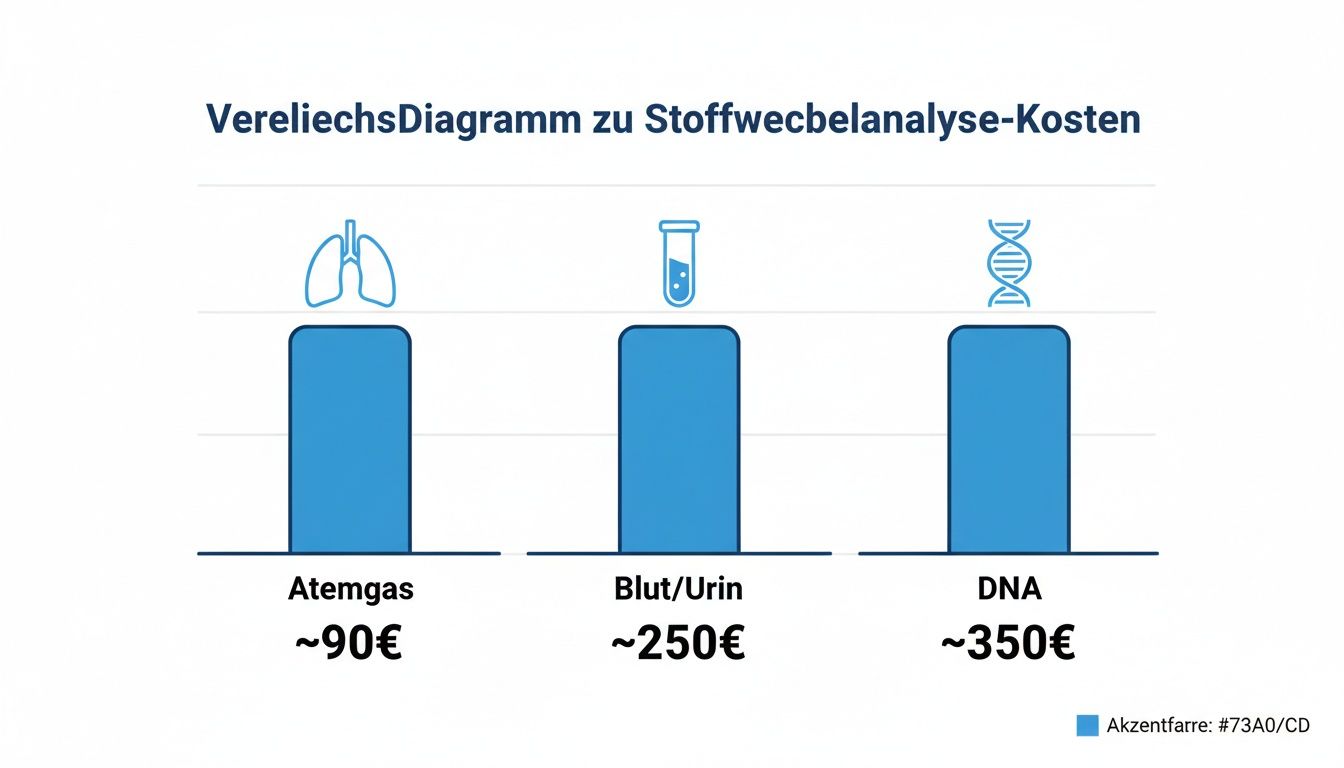
As you can see, respiratory gas analyses are an affordable starting point. DNA analyses, on the other hand, are a larger investment, but they provide by far the deepest and most comprehensive insights into your body.
What has the greatest impact on the price?
Clearly, the more complex the analysis, the higher the price. But essentially, there are three factors that really determine the cost:
- The type of analysis: Measuring your resting metabolism using respiratory gases is technically much simpler than sequencing your DNA in a laboratory. This is reflected in the price.
- The laboratory standard: Certified laboratories that work according to the highest scientific standards cost more, but they also guarantee precise and reliable results. This is not where you should cut corners.
- The scope of the evaluation: Do you only receive a page of raw data? Or a detailed, easy-to-understand report with specific recommendations for nutrition and exercise? Professional analysis and consultation make the biggest difference in terms of value—and price.
A good metabolic analysis is more than just a test result. It is a guide that helps you correctly interpret your body's signals and finally make informed decisions about your health.
DNA tests in particular offer an invaluable advantage here because they provide you with a foundation for your health decisions that remains valid throughout your lifetime. If you are interested in the topic in greater depth, take a look at our guide, which explains how much a DNA test costs and what to look for when choosing one.
From Breath Gas to DNA: What Analysis Methods Are Available
The term “metabolic analysis” is actually a collective term for many different methods. Each one looks at your body from a different perspective and provides its own unique pieces of the puzzle. So, to understand how much a metabolic analysis costs, we first need to look at which type of test makes sense for you.
Think of it as a toolbox for your health: There is a suitable tool for every task. Four methods have proven particularly effective. However, they differ greatly in what they measure, how they work, and, of course, their price. Everything is included, from a quick snapshot to a genetic blueprint valid for a lifetime.
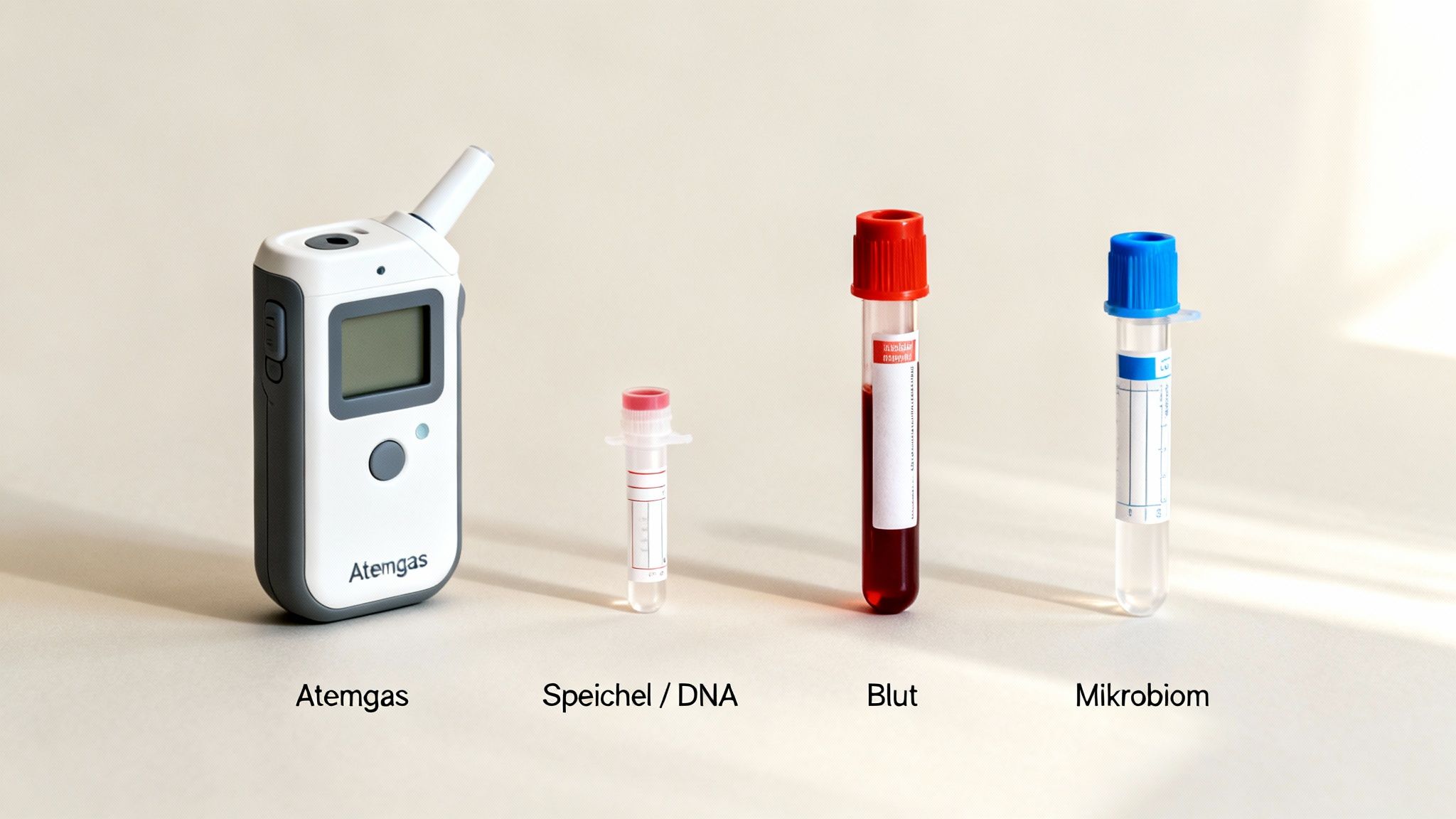
Breath gas analysis for your current state
Breath gas analysis, also called spirometry, is often the fastest and most affordable way to gain insight into your current metabolism. You breathe into a special device for a few minutes, and it measures how much oxygen your body consumes and how much carbon dioxide it releases.
These values can be used to calculate your resting energy expenditure (basal metabolic rate)—that is, how many calories your body burns when completely at rest. The analysis also shows whether you are currently relying more on fats or carbohydrates for energy.
- Advantage: Quick, straightforward, and relatively inexpensive.
- Disadvantage: It is only a snapshot. What you ate last night or whether you are stressed can already affect the result.
- Ideal for: Athletes who want to manage their training or people looking for a reliable basis for their daily calorie needs.
A breath gas analysis is like looking at your car’s speedometer: It shows you your current speed, but not what potential lies under the hood.
Blood and urine analyses for detailed insights
Laboratory analyses of blood or urine go one step further. They specifically measure biomarkers such as hormones (e.g., thyroid levels), vitamins, minerals, or inflammation markers. These values reveal very precisely whether certain metabolic processes are running smoothly.
For example, such tests can uncover a hidden nutrient deficiency that is slowing down your energy metabolism. They are significantly more precise than a breath gas analysis, but here too, they generally reflect only the condition of the past few days or weeks.
Microbiome analysis for the gut
Your gut is one of the most important players in your metabolism. A microbiome analysis examines the composition of your gut bacteria, usually using a stool sample. It tells you whether your gut flora is in balance and how efficiently it can process nutrients.
An imbalance can not only cause digestive problems, but also directly affect your metabolism and body weight.
DNA analysis for the genetic foundation
DNA analysis is the most in-depth method of all. Instead of providing a snapshot, it gives you a blueprint of your body that remains valid for life. It looks directly at your genes to decode your personal, innate metabolic predisposition.
For example, you can learn how your body naturally processes fats, carbohydrates, and proteins, or which type of athlete you are genetically. If you want to understand exactly which methods are available, you can find more valuable information in our guide to the types of metabolic analyses. These insights form the basis for a truly personalized nutrition and lifestyle strategy—one based not on guesswork, but on your unique genetics.
What is really included in the price of a metabolic analysis?
You’ve looked around and are wondering: Why does one test cost only 100 euros, while another costs over 400 euros? The huge price range is confusing at first glance, but the answer lies in the details. It’s not just about what is measured, but above all about how it is measured and what you can ultimately do with the results.
A low price is naturally tempting. But often, all you get is difficult-to-understand raw data and are left alone with the results. The true value of an analysis lies in its professional preparation and interpretation—in other words, what the numbers really mean for you and your everyday life.
The three pillars that determine the price
Essentially, there are three key building blocks that shape the final price. If you understand how they work together, you can much better assess what constitutes a fair investment in your health.
-
Sample type and analysis effort: There is a huge difference between blowing into a tube and providing a saliva sample for a DNA test. Sequencing genes in the laboratory is a highly complex process that requires state-of-the-art technology and specialized professionals. The deeper the analysis delves into your biology, the greater the technical—and therefore financial—effort.
-
Laboratory standards and quality: A reputable provider does not send your sample to just any laboratory. They work exclusively with certified partners that, for example, have been tested according to ISO standards. Such standards guarantee the highest precision, reliable results, and secure handling of your sensitive data. Low-cost providers often cut corners precisely here—at the expense of accuracy.
-
Evaluation and personal support: This is the most important point, and it is where the wheat is separated from the chaff. Do you receive only a PDF with columns of numbers, or a comprehensive, easy-to-understand report with specific recommendations tailored to you? Does it perhaps even include personal advice from an expert, such as a nutritionist?
Professional interpretation transforms mere data into actionable knowledge. It helps you truly understand the results and successfully integrate them into your everyday life, rather than leaving you alone with technical terms.
So the cost reflects not only the laboratory work itself, but above all the level of support you receive afterward. A good analysis does not just answer the question “What is going on?” but, above all, “What does this mean for me, and what can I do now?”.
If you are specifically interested in genetic tests and want to learn more about the background, take a look at our article on genetic test prices. There, we explain in detail what you should look for when making your choice.
What you get for your money
If you are considering investing in a metabolic analysis, you are probably wondering: What exactly does it include? It is far more than just a few numbers on paper. You are paying for an understandable roadmap to your health—a complete package that supports you from your initial curiosity through to practical implementation.
It all starts conveniently from home. The price almost always includes a test kit that is sent directly to you. It contains everything you need to collect your sample easily and painlessly, whether it is saliva, a small drop of blood, or a stool sample. Clear, easy-to-understand instructions ensure that nothing goes wrong.
From sample to personalized report
Once you have collected your sample, you send it in the prepaid return envelope to a specialized laboratory. Experts there examine your sample and carry out the actual analysis. This is the technical core of the process—and this is precisely where quality is crucial.
But the most exciting part comes afterward. Instead of receiving a cryptic laboratory report, you get a detailed and personalized results report. It translates the scientific data into clear, understandable language and explains exactly how your metabolism works, where your strengths lie, and what genetic characteristics you may have.
A good report is like a personal handbook for your body. It provides not only data, but also specific, actionable recommendations that truly suit you—without generic advice or diet myths.
More than just a result: advice and support
The best providers do not leave you on your own with your report. The real value often lies in the services that go beyond the results themselves and are usually already included in the price:
- Specific recommendations for action: You learn which foods are ideal for you, what type of exercise suits you, and how you can optimize your lifestyle in a targeted way.
- Personal consultation: Many high-quality analyses include a conversation with an expert, such as a nutritionist, who reviews your results with you and answers all your questions.
- Digital platforms: Often, you also get access to an app or online portal—with personalized recipes, shopping lists, and workout plans perfectly tailored to your metabolic type.
The cost of a genetic metabolic analysis in Germany, for example, is often between €300 and €400. The Dr. Kurscheid practice in Cologne, for instance, offers a comprehensive analysis including consultation for a total of €329. In return, you receive an almost 100-page report with personalized nutrition tips. You can also learn more about the different options and what they include in our guide to metabolic analysis.
Ultimately, you are investing not just in a test, but in a complete system that helps you achieve your health goals sustainably and in your own way.
When investing in your health is truly worthwhile
A metabolic analysis is more than just a test—it is an investment in yourself. But as with any investment, you naturally ask yourself: Is it really worth it for me? The answer depends entirely on where you are right now and what you want to achieve.
Perhaps you have already tried countless diets, repeatedly struggled with the yo-yo effect, or often felt low on energy without knowing why. In moments like these, it can feel as though you are groping around in the fog. This is exactly where an analysis can make the crucial difference. It gives you a clear, scientifically grounded map of your body.
Break free from the endless cycle of trial and error
Imagine being able to skip all those frustrating and costly attempts that fail. Many people spend years paying for ineffective diet programs, unsuitable training plans, or supplements their bodies do not need. A metabolic analysis helps you use that money in a targeted and effective way.
Instead of blindly chasing trends, you make decisions based on your unique biology. Knowing your genetic metabolic type is like a compass that helps you find the direct route to your goals—whether that means sustainable weight loss, more energy in everyday life, or better athletic performance.
From knowledge to lasting success
But the true value of an analysis lies not only in the insight itself, but in putting it into practice. When you understand how your body works, you can finally change your habits sustainably.
-
Weight loss example 1: You learn that your body processes carbohydrates very efficiently but is sensitive to fats. Instead of following a strict low-carb diet that only makes you tired and unhappy, you deliberately incorporate the right carbohydrates into your plan—and finally see results on the scale.
-
Fitness example 2: The analysis shows that you are genetically an endurance type. Instead of struggling with heavy weights at the gym, which you do not enjoy anyway, you focus on running or cycling and suddenly notice your performance skyrocketing.
A metabolic analysis is not a magic pill, but a powerful tool. It gives you back control and empowers you to make informed decisions about your health—today and for the rest of your life.
It’s about no longer seeing your body as an opponent, but as a partner. When you understand what it really needs, you can stop fighting it and start supporting it in a targeted way. This investment in knowledge pays off in the long term through well-being, energy, and quality of life—a benefit that goes far beyond the cost of the analysis itself.
How to find a reputable provider for your analysis
The market for metabolic analyses is huge, but not every offering delivers what it promises. Since this concerns your very personal health data, trust and transparency come first. But how can you recognize a provider where you are truly in good hands?

You should not rush your decision about a provider. It is not just about how much the metabolic analysis costs, but above all about the quality and security of the entire process. With the right checklist, you can quickly find out whom you can entrust with your health.
What you should definitely look out for
Before deciding on a test, it is worth checking a few basic points. These criteria help you separate the wheat from the chaff and ensure that your data is in the best hands.
- Certified laboratory: This is probably the most important point. Does the provider work with a laboratory certified according to recognized standards such as ISO 15189? This is the only way to be sure that the results are scientifically sound and truly reliable.
- GDPR-compliant data protection: Your genetic data is extremely sensitive. The provider must clearly explain how it protects your data, pseudonymizes it, and deletes it again after the analysis. Transparent handling in accordance with the GDPR is an absolute requirement, not an optional extra.
- Qualified consultation: Who evaluates your results and explains them to you? Are they qualified experts such as ecotrophologists, doctors, or certified nutritionists? Professional interpretation is invaluable so that you can truly use the results to your advantage.
A reputable provider does not simply sell you a test, but a reliable service. This includes the highest laboratory standards, uncompromising data protection, and competent support that does not leave you alone with your results.
Transparency is key
Take a close look at the provider’s website. Can you easily find understandable information about the analysis process, the laboratory, and the team of experts? A trustworthy company like mybody-x makes this information available because it has nothing to hide.
Another good indicator is communication. Do you receive clear and understandable answers to your questions? Pay attention to these details, because they reveal a lot about how seriously a provider takes its responsibility toward you. This protects you from dubious providers and ensures that your investment in your health really pays off in the end.
Still have questions? Here are the answers
Finally, we'd like to clarify a few typical questions that come up time and again in everyday life when it comes to metabolic analyses and their costs. Hopefully, this will give you the final clarity you need to make your decision.
Does health insurance cover the analysis?
In the vast majority of cases, the answer is no. Statutory health insurance providers generally consider metabolic analyses a preventive lifestyle service and therefore do not cover the cost. A rare exception may apply in cases of severe overweight (obesity), if a doctor provides a medically sound justification for the analysis. Private insurers are often somewhat more accommodating.
But here's a little tip: Many health insurance providers subsidize professional nutritional counseling that may follow such an analysis. So it's definitely worth simply asking your insurer what options are available.
How often should you repeat an analysis?
That depends entirely on which method you choose. A DNA analysis is a one-time investment—your genes do not change throughout your life. The result therefore remains valid forever.
Other tests, such as a breath gas analysis that measures your current calorie expenditure, can certainly be repeated when useful. This makes sense, for example, if your weight has changed significantly. This way, you can see your progress in black and white and adjust your strategy for the future.
Are inexpensive tests from the internet just as good?
Caution is advised here. If you're wondering how much a metabolic analysis should cost, you shouldn't look only at the price. Tests based solely on a simple questionnaire are often inaccurate and little more than a nice gimmick. For analyses involving a real sample—whether saliva or blood—the quality depends heavily on the laboratory standards and the scope of the evaluation.
More expensive analyses usually come at a higher price for good reason: They often include a much more in-depth evaluation and, even more importantly, personal consultation with experts. These are precisely the components that help you translate raw data into concrete, practical measures for everyday life. Because what good are the best results if you don't know what to do with them?
Are you ready to finally correctly interpret your body's signals and take control of your health yourself? At mybody-x, you'll find scientifically sound analyses that you can easily carry out from home.
Discover the analysis that's right for you now at mybody-x.com



Share now:
How Health Analysis Works for Your Everyday Life
Health Optimization Options: Personalized Paths to Greater Vitality