

Why am I not losing weight despite a calorie deficit: 7 reasons
You consciously eat less, move more—and yet the number on the scale doesn’t budge at all? This frustration is not only understandable but also extremely common. But most of the time, it is not a sign of failure. Often, it simply means that the assumed calorie deficit does not actually exist in reality or that your body has cleverly adapted to the lower energy intake.
Understanding the mystery of a weight-loss plateau
Almost everyone who has ever tried to lose weight knows this feeling all too well: At first, the pounds drop off, but then—nothing. You’re stuck, and the nagging question starts to eat away at you: “Why am I not losing weight even though I’m in a calorie deficit?” The good news first: You’re not alone, and you’re probably not doing anything fundamentally wrong.
Your body is not a simple calculator where you just subtract calories and expect a fixed result. It is a highly complex system that tirelessly tries to maintain balance. A weight plateau, also known as a weight-loss plateau, is often simply the logical consequence of biological adaptations and small, unnoticed everyday habits.
One particularly important misconception involves inaccurately tracking calorie intake. Many of us systematically underestimate how many calories we consume, especially because of “hidden” calories in sugary drinks, supposedly healthy snacks, or that extra splash of oil while cooking. Since your basal metabolic rate alone accounts for 60–75% of daily energy expenditure, it can easily happen without careful monitoring that you only believe you are in a deficit.
The following diagram shows the three main areas that play a role here: calories, metabolism, and hormones.
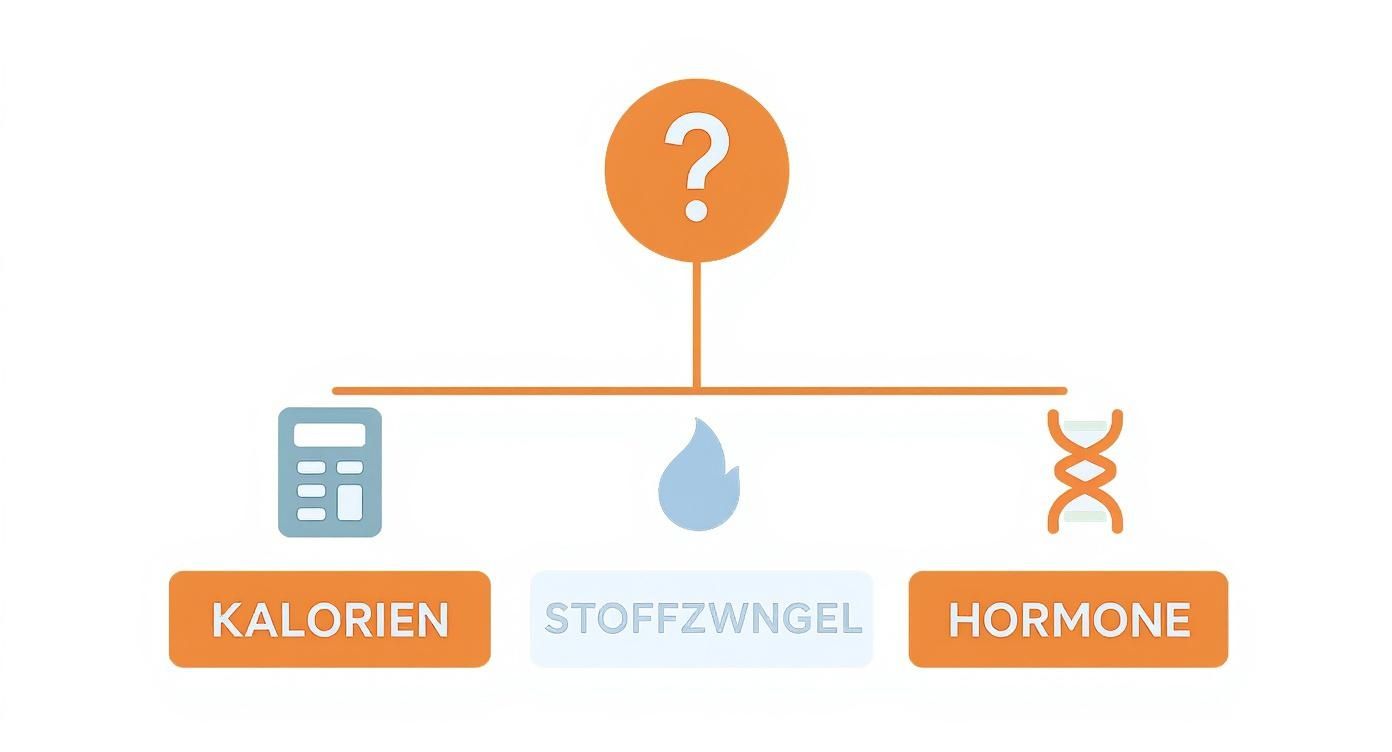
As you can see, these three pillars are interconnected. If one of them falls out of balance, it can block your entire progress.
The real reasons for stalled progress
In this guide, we take a close look at the most common causes of a weight-loss plateau. It’s about understanding your body better and uncovering the actual obstacles.
Among other things, we explore:
- Hidden calories: How inaccurate tracking can wipe out your calorie deficit.
- Metabolic adaptations: Why your body switches into a clever energy-saving mode.
- Hormonal influences: The role played by the thyroid, cortisol, and more.
- The true role of exercise: Why physical activity alone is often not enough.
“A weight-loss plateau is not an endpoint, but a signpost. It shows you that it’s time to take a closer look and adjust your strategy, rather than simply eating even less or exercising more.”
By the end of this article, you will have a clear picture of what is really holding you back. You will receive concrete, practical tips to remove the obstacles and finally achieve your goal. Our article on healthy weight loss provides an excellent foundation for this. Let’s shed some light on the issue together.
Reason 1: Hidden calories and the nonexistent deficit
The most common and simultaneously most frustrating reason for the scale not moving is surprisingly simple: The calorie deficit you are firmly convinced you have often does not actually exist. This is not a reason to blame yourself, but an everyday trap that almost everyone has fallen into at some point.
Our brains are masters at overlooking small indulgences and misjudging portion sizes. Think of your calorie budget like a bank account. You think you are withdrawing only enough each day to have something left at the end of the week. But the unnoticed little expenses—the quick coffee to go or the “fees” for paying by card—add up, and by the end the account is empty or even overdrawn. That is exactly what happens with hidden calories.

The most common calorie traps in everyday life
It is rarely the large, deliberate meals that sabotage your deficit. Rather, it is the many small extras that add up unnoticed and, by the end of the day, make the difference between losing weight and hitting a plateau.
Here are the usual suspects:
- Liquid calories: The splash of milk in your coffee, the spoonful of sugar in your tea, or your morning glass of juice. These are often not perceived as “real” food, but they can easily provide an extra 50 to 150 calories.
- Fats used in cooking: A generous splash of olive oil in the pan can easily add more than 100 calories. Salad dressing at a restaurant is often a real calorie bomb too, turning a light meal into a heavy one.
- Snacks between meals: A handful of nuts is healthy, but also extremely high in calories. The cookie with your coffee or a bite-sized taste while cooking can likewise add up to a substantial amount.
- Inaccuracies in apps: The databases of tracking apps are not always precise. A “medium-sized apple” can vary considerably in calorie content depending on the variety and size. Without weighing food accurately, discrepancies can quickly arise.
Many people systematically underestimate their daily calorie intake. Studies show that actual intake is often hundreds of calories higher than estimated—enough to completely cancel out a planned deficit.
How to regain clarity
To find out whether you’re really in a deficit, it’s not about perfectionism but about being brutally honest with yourself. It’s time to become a detective of your own diet for a little while.
Your most important tool? A simple kitchen scale. It doesn’t lie and shows you, without sugarcoating, how large a portion really is. You’ll be surprised to see what a supposedly small portion of pasta or rice actually looks like on the scale.
Your action plan for greater precision:
- Keep an honest food diary: For one week, write down everything you eat and drink. Be brutally honest—even that small piece of chocolate or sip of cola counts.
- Weigh everything: Invest in a digital kitchen scale and consistently weigh your main ingredients throughout this week. This will give you a much better sense of actual portion sizes.
- Pay attention to preparation: Remember to include oils, butter, dressings, and sauces. One tablespoon of oil already contains around 120 calories.
- Compare and learn: After a week, you’ll have a realistic picture of your calorie intake. Compare this figure with your calculated requirements. Are you really in a deficit?
This process may sound laborious at first, but it is incredibly informative. It helps you close the gap between your assumptions and reality. Often, it only takes a small adjustment—such as consciously accounting for oil or weighing your granola—to end the plateau and get the scale moving in the right direction again.
Reason 2: Your body switches to low-power mode
Your body is a survival expert. If you give it less energy than it actually needs over an extended period, it doesn’t simply respond with steady weight loss. Instead, it activates an ancient protective program that has kept it safe from famines for thousands of years: it switches to energy-saving mode.
Experts call this phenomenon adaptive thermogenesis. Think of your metabolism like the heating system in your home. When resources become scarce outside—that is, when fewer calories are coming in—your body turns down the thermostat to conserve energy. It becomes more economical, so to speak, and learns to get by with less “fuel.” This means your basal metabolic rate decreases.

The result is frustrating. The calorie deficit that worked so well at first suddenly isn’t a deficit anymore. You’re still eating diligently, but the number on the scale isn’t changing—simply because your body has become more efficient.
The yo-yo effect rears its head
Things get especially tricky after multiple diets. Many people repeatedly start new attempts to lose weight. The problem with every crash diet is that you lose not only fat but also valuable muscle mass. And muscle is your most important calorie burner.
When the diet is over and you return to your old habits, a lower basal metabolic rate meets your old calorie intake. The result is the dreaded yo-yo effect. The pounds quickly return, often with a few extra on top.
Your body adapts. It reduces its energy expenditure to cope with the limited calories. So your deficit shrinks without you changing a single thing about your diet.
If you feel like your engine is only sputtering, don’t worry. There are highly effective strategies to get it running smoothly again. You just need to show your body that there’s no famine and that it can afford to be more generous with energy again.
How to break out of conservation mode
Simply cutting your calories even further would be exactly the wrong approach now. It would only reinforce conservation mode. The solution is to outsmart your body’s internal energy-saving program.
Here are three strategies that really work:
- Diet breaks (planned breaks from dieting): Give yourself a break. For one to two weeks, eat exactly as many calories as you burn—your maintenance calories. This signals to your system that the danger has passed and can help bring your metabolism back to a normal level.
- Refeed days (planned higher-calorie days): Add one or two days per week when you deliberately eat more—especially carbohydrates. This can boost the production of important metabolic hormones such as leptin and give your body the kick it needs.
- Strength training as your top priority: Muscles are your metabolic engine. Focus on strength training to maintain or even build muscle mass. More muscle means a higher basal metabolic rate, even when you’re just lying on the couch.
These methods aren’t excuses to overeat; they’re strategic tools. They help you outsmart the underlying metabolic adaptation and finally see results again. Want to dive deeper and understand exactly how your energy expenditure works? Our guide explains your metabolism in simple terms.
Reason 3: When your hormones take control
Sometimes the answer to the question “Why am I not losing weight despite a calorie deficit?” lies deeper than expected—in your hormonal system. Hormones are your body’s invisible managers. They control almost everything, from your mood and energy balance to fat storage.
When this delicate balance is disrupted, it can seriously sabotage your weight-loss efforts, even if your diet and exercise seem perfect. Your calorie deficit then effectively evaporates because your body is working against you internally.
Imagine trying to start a fire with wet wood. No matter how hard you try, it simply will not burn properly. In the same way, a hormonal imbalance can slow down your metabolism—your inner fire. Let us take a closer look at the three most important hormonal troublemakers.
The Thyroid: Your Metabolic Thermostat
Your thyroid is a tiny organ with a huge impact. It produces the hormones that set the pace for your entire metabolism. When it functions optimally, your engine runs smoothly and burns energy efficiently.
However, if it produces too few hormones—a condition called underactive thyroid (hypothyroidism)—it slows down your entire energy expenditure. Your body switches to low-power mode, similar to adaptive thermogenesis, but caused by hormonal factors. The result: You feel constantly tired, get cold easily, and gain weight even though you hardly eat anything.
Typical signs of an underactive thyroid include:
- Unexplained weight gain or an inability to lose weight
- Constant fatigue and lack of energy
- Dry skin and brittle hair
- A strong sensitivity to cold
An undiagnosed underactive thyroid is one of the most common hormonal causes of a frustrating weight-loss plateau. If these symptoms sound familiar, seeing a doctor is the next logical step.
Cortisol: The Stress and Fat-Storage Manager
Chronic stress is pure poison for your weight-loss goals. Under constant strain, your body releases more of the stress hormone cortisol. In the short term, this is a useful survival response, but persistently elevated cortisol levels sabotage your efforts on several fronts.
First, cortisol promotes water retention, which makes you weigh more even though you may have already lost fat. Second, it increases your appetite, especially for sugary and fatty “comfort foods.” Your body craves quick energy to withstand the perceived constant stress.
Thirdly, a high cortisol level promotes the storage of belly fat, which is considered particularly harmful to health. Stress and emotional eating often create a vicious cycle that wipes out your calorie deficit. Find out more about how elevated cortisol levels affect women specifically in our article about high cortisol symptoms in women.
Insulin: The Sugar Traffic Controller with Pitfalls
The hormone insulin has an important job: It transports sugar (glucose) from the blood into your cells, where it is burned for energy. If you eat a lot of simple carbohydrates, your blood sugar level shoots up, and your body responds by releasing a large amount of insulin.
The problem arises when this happens constantly. Over time, your cells can become desensitized and no longer respond properly to the insulin signal—this condition is called insulin resistance. The sugar remains in the blood, and in desperation the pancreas produces even more insulin to try to get the cells to open.
Persistently high insulin levels have two fatal consequences for weight loss:
- Fat burning is blocked: As long as there is a lot of insulin in the blood, it signals to the body: “Enough energy is available!” Fat breakdown is stopped.
- Fat storage is promoted: Excess sugar that no longer fits into the cells is converted directly into fat and stored primarily around the abdomen.
So if you’re not losing weight despite all your efforts, it may really be worth examining the hormonal side of things. Often, these invisible counterforces are exactly what prevent success.
Recognizing hormonal blocks and their symptoms
An overview of common hormonal disorders that can make losing weight more difficult, their typical symptoms, and which laboratory values can provide insight.
| Hormonal disorder | Typical symptoms alongside weight problems | Relevant laboratory values (examples) |
|---|---|---|
| Hypothyroidism | Fatigue, sensitivity to cold, dry skin, hair loss, depressed mood. | TSH, free T3 (fT3), free T4 (fT4), thyroid antibodies (TPO antibodies, TG antibodies) |
| Elevated cortisol (stress) | Sleep disturbances, inner restlessness, cravings for sweet or salty foods, abdominal fat, susceptibility to infections. | Salivary cortisol (daily profile), DHEA, cortisol in 24-hour urine collection. |
| Insulin resistance | Constant hunger, fatigue after eating, excessive thirst, concentration problems, “sugar crashes.” | Fasting blood glucose, fasting insulin, HbA1c (long-term blood glucose), HOMA index. |
A simple blood test at the doctor’s office can quickly provide clarity here. Properly interpreting your body’s signals is the first and most important step toward identifying the real obstacles and finally overcoming them.
Reason 4: The true role of exercise and physical activity
Many of us know the mantra: An hour of sweat-inducing exercise must surely make a huge dent in our calorie balance, right? But if you’re wondering, “Why am I not losing weight despite a calorie deficit and exercise?”, the answer is often rooted in unrealistic expectations. Exercise is incredibly important, no question. But its role in pure calorie expenditure is often massively overestimated.
The truth is that actual calorie expenditure is usually significantly lower than fitness trackers or the displays on cross-trainers would have us believe. These devices can only roughly estimate your individual metabolism and how you are feeling that day, which can quickly result in a discrepancy of hundreds of calories.
Your body’s invisible compensation
Your body is not only a master of metabolic adaptation but also a clever energy saver in everyday life. When you challenge it with an intense workout, it tends to unconsciously compensate for that effort elsewhere. This phenomenon is called NEAT (Non-Exercise Activity Thermogenesis).
NEAT describes all the calories you burn through everyday movement outside of structured exercise: walking around the office, climbing stairs, tapping your feet, or even gesturing while talking. After a strenuous session, it is completely normal to be unconsciously less active. You might take the elevator after all, collapse onto the couch in the evening, or simply move less because your body wants to recover.
Your body often unconsciously compensates for the calories burned during exercise by reducing everyday activity (NEAT). As a result, your net calorie expenditure at the end of the day is often much lower than hoped.
Why a small snack can undo your workout
To make this more tangible, let’s look at an example. A 30-minute jog burns around 300 to 400 calories, depending on intensity and body weight. That sounds good at first, but this deficit is offset again faster than you might think.
- A large latte macchiato with syrup? approx. 250 kcal
- A handful of nuts as a reward? approx. 200 kcal
- A small protein bar after exercising? approx. 180–250 kcal
You can see how quickly the hard-earned deficit is offset by a small reward, often considered “healthy” or “deserved.” Experts at the Technical University of Munich confirm that exercise alone, especially for beginners, is not a very effective way to create a meaningful calorie deficit. While well-trained athletes can burn up to 1,000 kcal per hour when running, untrained people often burn only 300–400 kcal—and frequently compensate for this afterward by increasing their calorie intake. You can find more information about these findings in this summary from TUM.
Strength training beats cardio in the long run
This should absolutely not mean that you should give up exercise! Its health benefits are undeniable. However, for sustainable weight loss, it is crucial to choose the right type of exercise.
While cardio training primarily burns calories during the activity, strength training has a much more lasting effect. Muscles are your most important metabolic engine. Every kilogram of muscle mass increases your basal metabolic rate—that is, the number of calories you burn while completely at rest.
By focusing on strength training, you are building an infrastructure that helps you burn more energy around the clock. This makes your calorie deficit more sustainable and protects you from the dreaded yo-yo effect. Nutrition remains the strongest lever, but strength training is your most important ally. You can read more about the perfect interplay of exercise and nutrition for weight loss in our in-depth article.
Reason 5: Why Sleep, Stress, and Nutrients Are the Real Game Changers
Unfortunately, losing weight is not simply a matter of calculation. Even if you have your calorie deficit perfectly under control, there are three powerful opponents that are often overlooked but can sabotage your success all on their own: sleep, stress, and nutrient intake. These three factors influence your hormones, energy, and willpower much more than you might think.
Imagine trying to build a house (shape your body), but the foundation (your lifestyle) is unstable. No matter how good your blueprints (your diet) are, the result will be shaky. Let us take a closer look at this foundation now.

The Hidden Saboteur: Sleep Deprivation
Are you wondering, “Why am I not losing weight despite being in a calorie deficit?” The answer may lie in your pillow. Even mild sleep deprivation completely disrupts your hormonal balance and makes losing weight an uphill battle. While you sleep, your body regulates the two most important hormones for hunger and satiety.
- Ghrelin: This is your hunger hormone. When you are sleep-deprived, its levels skyrocket and fuel your appetite uncontrollably.
- Leptin: This is the satiety hormone. Its levels drop when you do not get enough sleep. So you feel hungrier and take longer to feel full.
This hormonal double whammy almost inevitably leads to intense cravings, especially for high-calorie, unhealthy foods. Studies prove this impressively: People who sleep only 5.5 instead of 8.5 hours are not only hungrier, but also burn up to 55% less fat and instead lose valuable muscle mass.
Your Body in Emergency Mode: Stress
Chronic stress, whether at work or in your personal life, puts your body in a permanent state of alarm. As we have already discussed, this leads to increased release of the stress hormone cortisol. Persistently elevated cortisol levels not only promote the storage of belly fat and water but also drive you toward so-called emotional eating.
Under stress, your brain cries out for quick energy and reward. This often ends in an uncontrolled reach for sweets or fatty snacks. In this way, the calorie deficit you worked so hard to build can be wiped out within minutes, without real hunger being the trigger.
Recovery is not a luxury but a crucial part of the weight-loss process. Without enough sleep and effective stress management, you are constantly fighting against your own biology.
The underestimated factor: Micronutrients
Calories are not everything. Your metabolism is a complex clockwork mechanism that depends on countless small gears—vitamins, minerals, and trace elements—to function smoothly. A calorie-restricted diet always carries the risk that your intake of these essential micronutrients will fall short.
A deficiency in certain nutrients can directly hinder your weight-loss efforts:
- Iron deficiency can lead to fatigue and lack of motivation. That kills any motivation for exercise and physical activity.
- A vitamin D deficiency is repeatedly linked to slowed metabolic function.
- Magnesium is involved in more than 300 metabolic processes. If you lack it, your energy metabolism can quickly grind to a halt.
So if you feel low on energy and the scales remain stuck despite all your efforts, an undiscovered nutrient deficiency could be the real cause. A targeted blood test can provide clarity.
So it is crucial to take a holistic view. Your body is an interconnected system. Recovery through sleep, managing stress properly, and a nutrient-dense diet are not side issues but the central pillars of your long-term success.
Conclusion: Break Through the Standstill with Knowledge and Patience
The weight-loss plateau is a frustrating moment that almost everyone knows. You have now learned the most common reasons for it—and that very knowledge is your sharpest weapon for finally breaking through the standstill. Now it is time to move from understanding to action. See the following points as your very own roadmap for getting the scales moving again.
The path to your comfortable weight is rarely a straight line. Rather, it’s an ongoing dialogue with your body, in which you learn to interpret its signals correctly and adjust your strategy. The most important insight is this: You don’t need to fight even harder—you simply need to proceed smarter.
Your Personal Action Plan
Instead of turning everything upside down right now, focus on small but targeted adjustments. Start with an honest assessment of your current situation, then work through it step by step.
-
Track brutally honestly for one week: Grab a digital kitchen scale and an app. For one week, record everything—absolutely everything—you eat and drink. The answer to “Why am I not losing weight despite being in a calorie deficit?” is often hidden right here in the details.
-
Give your metabolism a break: If you’ve been in a calorie deficit for a long time, it’s time for a deliberate diet break (“Diet Break”). Eat at your maintenance calories for 7–14 days. This signals to your metabolism that the famine is over and it can ramp up again.
-
Make recovery a priority: Sleep and stress management aren’t optional extras. Set yourself the goal of getting 7–8 hours of sleep per night. Build set rituals into your daily routine that help you unwind—whether it’s a walk in the woods, a short meditation, or simply reading a good book without distractions.
-
Rethink exercise: Focus on strength training to preserve valuable muscle mass, which helps keep your basal metabolic rate high. At the same time, increase your everyday movement (NEAT). Take the stairs instead of the elevator, walk to run small errands, and fit short walks into your day.
Patience isn’t a sign of weakness, but of a deep understanding of your body. Real, lasting changes simply take time. Be kind to yourself and celebrate the small successes too.
Your body is unique and deserves a strategy tailored to it. Radical measures rarely lead to success. It’s the small, consistent adjustments that ultimately make the biggest difference. Listen to your body more closely, give it the nutrients it truly needs, and it will start working for you again—instead of against you.
Do you finally want clarity about which nutrients you’re lacking or how your metabolism really works? mybody-x.com offers scientifically backed at-home lab tests. Find the true causes of your weight-loss plateau and receive personalized recommendations that really work. Discover the right analyses now at https://mybody-x.com.



Share now:
7 scientifically proven principles for your optimal dietary transition
Low-Fat Diet: Your Guide to Greater Well-Being