

Vitamin B12 on a vegan diet: the question of timing
The key points at a glance
What makes this value unusual is not its level but its timeline. According to the MSD Manual, the liver stores cover requirements for three to five years when intake is absent (as of August 2024).
This leads to the practical peculiarity of this value. Years may pass between a change and a possible change in the blood, and during this time, how you feel reveals nothing.
You’ll first read what the serum value describes. Then come the figures from the authoritative sources, three common statements examined in a fact check, a broad gray area, and the two values that the professional literature also mentions.
What to expect in this article
1. What the serum value describes
2. The sentence that quantifies the timeline
3. What three to five years means in practice
4. The figures from the authoritative sources
5. The gray area between 200 and 350
6. Three statements in the fact check
7. Two values that provide further insight
8. Why how you feel is of little help here
9. What the source says about infants
10. Comparing the values
11. What an individual strategy means here
12. Who may benefit from testing
13. What a capillary blood test can show here
14. Limitations: what the serum value leaves open
15. What matters about B12
Frequently asked questions
Sources
What the serum value describes
The usual B12 value on a test report is a serum level. It describes how much of the vitamin is circulating in the blood.
The MSD Manual, Professional Edition, gives a clear threshold: a vitamin B12 level below 200 pg/ml, corresponding to below 145 pmol/l, indicates vitamin B12 deficiency (as of August 2024).
The same source also relates this to dietary pattern: inadequate vitamin B12 intake is possible in vegans but otherwise unlikely (as of August 2024).
That clarifies the starting point. What distinguishes this value from others is covered in the next chapter.
The sentence that quantifies the timeline
The real significance of this value lies in a single sentence in the professional literature, which explicitly mentions the vegan case.
Documented source
“The liver’s vitamin B12 stores cover physiological needs for 3–5 years when vitamin B12 intake is absent (e.g., in people following a vegan diet)”
Larry E. Johnson, MD, PhD
MSD Manual, Professional Edition, Vitamin B12 Deficiency, as of August 2024
Three to five years is an unusually long time span for a laboratory value. By comparison, a cholesterol level fluctuates within 24 hours, while CRP returns to normal within a few days after a stressor.
The same sentence mentions a second case. If there is no capacity for enterohepatic reabsorption, the stores last only for months or up to a year (as of August 2024).
The difference between these two figures is significant, and it is not related to diet but to absorption. That is why any time frame given here always comes with a condition.
What three to five years mean in practice
The storage duration has two consequences, and both are regularly overlooked.
The first concerns the timing of a measurement. Anyone who changed their diet six months ago is measuring a value that primarily reflects the period before the change.
The second concerns the period of stability afterward. A normal value today does not rule out a change two years from now if intake remains unchanged.
What this means for planning
A dated value is more meaningful for this vitamin than for most others. It marks a point on a very long timeline.
We did not find a general recommendation in the sources reviewed for how often testing should be repeated. The interval is determined by the practice interpreting the result, and this article does not specify a number.
The figures from the key sources
Three pieces of information from the same source. They provide context and do not constitute a diagnosis.
Documented information
below 200
pg/ml, equivalent to below 145 pmol/l: indicates a vitamin B12 deficiency (MSD Manual, professional edition, current as of August 2024)
200–350
pg/ml, equivalent to 145 to 260 pmol/l: values within or only slightly below the normal range (current as of August 2024)
3–5 years
the liver stores cover physiological needs when intake is absent (current as of August 2024)
And as with every laboratory value, what matters is the reference range shown on your own test result, because reference values can vary from one laboratory to another (IQWiG, current as of April 2, 2025).
The gray area between 200 and 350
The second of the three figures deserves separate consideration because it is the relevant range for many findings.
The MSD Manual describes cases in which vitamin B12 levels are within or only slightly below the normal range, and gives the range as 200 to 350 pg/ml or 145 to 260 pmol/l (current as of August 2024).
A value in this range is therefore neither a clear finding nor a clear all-clear. It is a reason to look more closely, and the source names two additional values for that purpose.
Three statements fact-checked
These three statements come up regularly when discussing B12 and plant-based diets.
Checked against the available evidence
Commonly believed
“After changing your diet, you quickly notice whether anything is missing.”
Documented
The liver stores cover physiological needs for three to five years when intake is absent (MSD Manual, professional edition, current as of August 2024). On this timeline, a rapid onset of symptoms is not to be expected.
Commonly believed
“A normal blood count rules out a B12 deficiency.”
Documented
The same source explicitly warns: It is important to remember that severe neurological disease can occur without anemia or macrocytosis (as of August 2024).
Commonly believed
“A value within the reference range is conclusive.”
Documented
The specialist literature describes a range of 200 to 350 pg/ml in which values are within or only slightly below the normal range (as of August 2024). For this range, it recommends additional tests rather than offering reassurance.
Two values that help
For the gray area, the specialist literature identifies two additional measures, and they differ in one crucial respect.
Regarding methylmalonic acid, the MSD Manual, Professional Edition, states: An elevated serum methylmalonic acid level supports the diagnosis of vitamin B12 deficiency (as of August 2024). It also states: Methylmalonic acid levels remain normal in folate deficiency.
Regarding homocysteine, the same source states: Levels can be elevated in both vitamin B12 deficiency and folate deficiency (as of August 2024).
This allows one value to distinguish between two possibilities, while the other combines both. Anyone who knows both can assess a situation that cannot be inferred from the serum level alone.
Why your sense of well-being is of little help here
At this point, the core of this article can be summed up in one sentence.
The reservoir lasts for years. That is why your own sense of well-being is the worst guide for this value.
For most laboratory values, there is a rough feedback loop between condition and perception. With this value, a reservoir lies in between and buffers the effects for years.
The specialist literature also points out that severe neurological disease can occur without anemia or macrocytosis (as of August 2024). The blood count, therefore, is not a reliable indication either.
What follows from this is not alarm, but an order of steps. With this value, measurement comes before perception, and interpretation comes from medical practice.
What the source says about infants
A passage from the specialist literature is reproduced here because it concerns a distinct group.
The MSD Manual, Professional Edition, states: Breastfed infants of vegan mothers can develop vitamin B12 deficiency at four to six months of age. It also states: Infants of vegan mothers should receive vitamin B12 supplements from birth (as of August 2024).
This is a statement from the cited source, not a recommendation from this article. Everything concerning pregnancy, breastfeeding, and infants belongs exclusively under the guidance of a doctor or midwife.
We reproduce the passage here because it shows that the specialist literature distinguishes between groups for this vitamin. A finding in an adult does not provide information about a child.
The values compared
The table compares four measures mentioned in connection with vitamin B12. It provides context and does not make a diagnosis.
| Measure | What it describes | When it is helpful | What it leaves unresolved |
|---|---|---|---|
| Serum vitamin B12 level | The amount in the blood; below 200 pg/ml indicates a deficiency | When the values clearly point in one direction or the other | The range from 200 to 350 pg/ml, in which values are within or only slightly below the normal range |
| Methylmalonic acid | An elevated level supports the diagnosis of vitamin B12 deficiency | In the gray area, because it remains normal in folate deficiency | The cause of inadequate supply |
| Homocysteine | Can be elevated in both vitamin B12 and folate deficiency | As an additional measure alongside the others | The distinction between the two types of deficiency |
| Blood count | Anemia and macrocytosis as possible accompanying findings | When these changes are present | A lot—severe neurological disease can also occur without anemia or macrocytosis |
All information in this table comes from the MSD Manual, professional edition (as of August 2024). The last row is the most important entry because it dispels a widespread assumption.
What having your own strategy means here
The term strategy sounds like a plan involving supplements. What is meant is something more matter-of-fact.
What distinguishes this value from others is the timeline. A dated value is therefore the actual subject, regardless of what is decided afterward.
Whether and how anything should be supplemented is decided by a medical practice. This article makes no recommendation and specifies no amount.
Why measuring first and then deciding is generally sensible for nutrients is covered in the companion article Measure first, then supplement.
Who may benefit from a measurement
The comparison refers to the serum level as the baseline value.
Worthwhile for you if …
You follow a plant-based diet and do not yet have a dated B12 result.
Your last measurement was years ago and your diet has not changed since then.
You want to bring a dated number to a consultation at the practice.
You want to see the result together with folate and ferritin from the same sample.
Probably not, if …
You already took a measurement a few weeks ago. Little changes over this timescale.
You hope to make a decision about a supplement based on the result. That decision should be made by a medical practice.
It concerns pregnancy, breastfeeding, or a child. This requires medical supervision.
You are expecting a diagnosis. That is provided by a medical practice, not a self-test.
What a capillary blood test can show here
A capillary blood self-test does not diagnose anything or determine whether supplementation is needed. What it can do is provide the serum level with the date and reference range.
The VitalCheck by mybody®x (MYBODY Lab GmbH) measures vitamin B12 together with folate, the second value used for differentiation, and ferritin from the same sample.
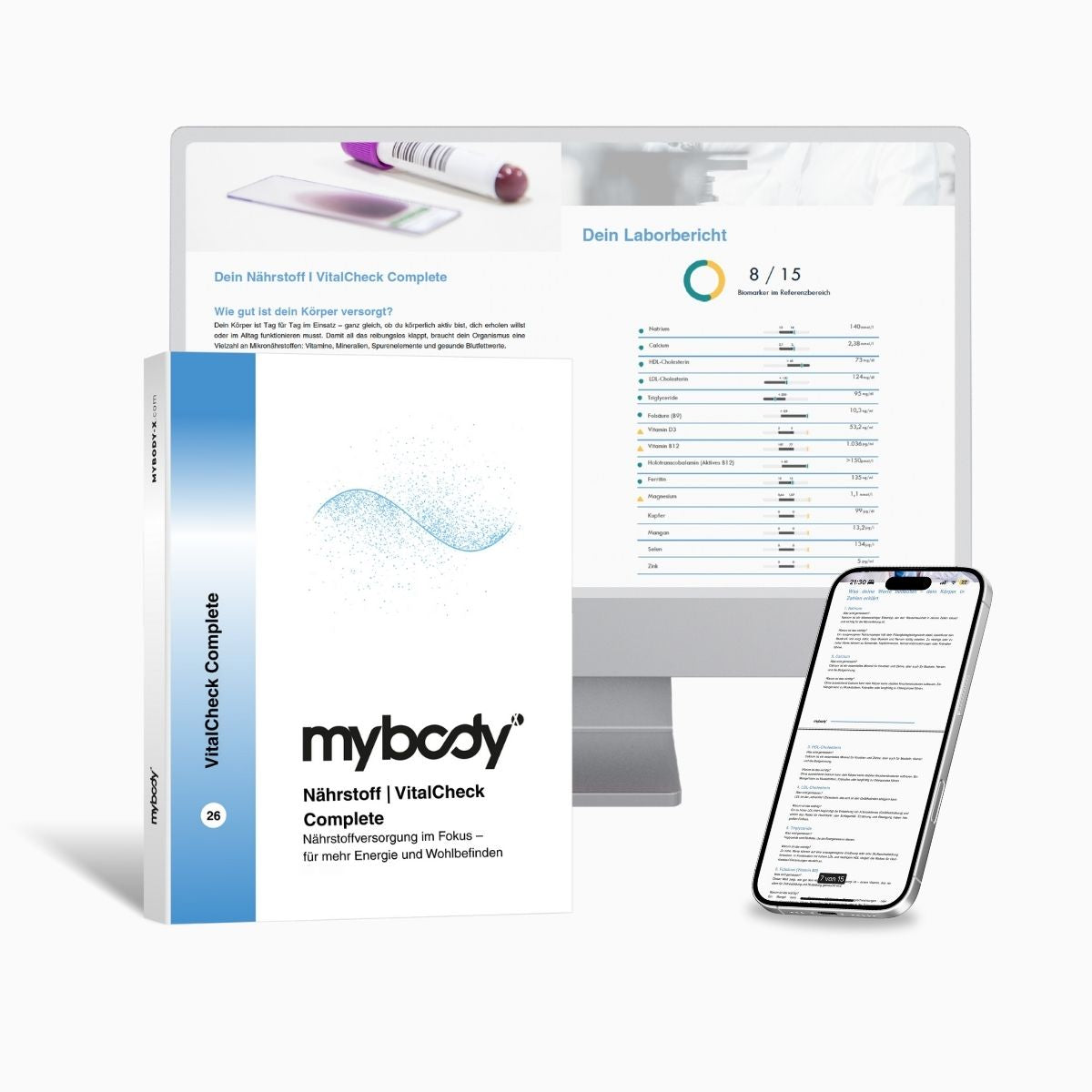
Capillary blood test
VitalCheck | Nutrient & Mineral Test Complete
Measures 18 values, including vitamin B12 and folate from the same sample. It also measures ferritin, iron, transferrin, vitamin D, calcium, magnesium, phosphate, selenium, zinc, albumin, HbA1c, CRP, and the cholesterol profile. What the test does not do: it measures neither methylmalonic acid nor homocysteine, the two values that the specialist literature recommends for the gray area. It does not determine whether supplementation is needed, diagnose anything, or replace a medical examination.
Laboratory analysis 3–5 business days after sample receipt
Information from the product page, accessed 08/15/2026
Four points determine whether a B12 value becomes useful information.
Record the date
On a time scale spanning years, the date is half the information.
Know the gray area
For values between 200 and 350 pg/ml, the source recommends additional tests.
Consider folate alongside it
The two values are diagnostically related.
Discuss the interpretation
What follows from a value is determined by a medical practice.
Chapter at a glance
A capillary blood self-test provides the B12 serum level with the date and, alongside it, the folate level, but it does not diagnose anything or determine whether supplementation is needed. Four points are decisive: record the date, know the gray area, consider folate alongside it, and discuss the interpretation.
Limitations: what the serum value leaves open
The first limitation is the gray area. According to the specialist literature, values between 200 and 350 pg/ml are within or only slightly below the normal range (as of August 2024), and it recommends additional tests for this range.
The second limitation is the blood count. A serious neurological disorder can also occur without anemia or macrocytosis (as of August 2024). An unremarkable blood count is therefore not an all-clear.
The third limitation is the missing interval. We found no general indication in the sources reviewed of how often a repeat test makes sense, and this article provides none.
The fourth boundary is diagnosis. All the interpretations in this article provide context; they do not constitute a diagnosis. A diagnosis is made in a medical practice based on several factors, and no self-test can anticipate it.
What matters about B12
If you take away just one thing from this article, let it be this: This value is time-dependent.
The liver stores cover the body’s needs for three to five years when intake is absent. Along this timeline, current well-being says little, and a single value without a date says almost nothing.
It began with the question of developing a strategy of one’s own. The sober answer is: a dated value, folate alongside it, and interpretation in a medical practice. What comes after that is not a question for an article.
Frequently asked questions
How long do B12 stores last on a vegan diet?
The MSD Manual, Professional Edition, states: The liver’s vitamin B12 stores cover physiological needs for three to five years when vitamin B12 intake is absent, for example in people following a vegan diet (current as of August 2024). If enterohepatic reabsorption capacity is lacking, the same source gives a period ranging from months to one year.
At what level is it considered a B12 deficiency?
The MSD Manual states: A vitamin B12 level below 200 pg/mL, corresponding to below 145 pmol/L, indicates vitamin B12 deficiency (current as of August 2024). The same source describes values between 200 and 350 pg/mL as within or only slightly below the normal range. The reference range on your own lab report remains decisive.
Which values help clarify borderline cases?
The medical literature identifies two. An elevated serum methylmalonic acid level supports the diagnosis of vitamin B12 deficiency, while methylmalonic acid levels remain normal in folate deficiency. Homocysteine levels can be elevated in both vitamin B12 and folate deficiency (MSD Manual, Professional Edition, current as of August 2024).
Can you tell from a blood count if you have a B12 deficiency?
Not reliably. The MSD Manual explicitly warns: It is important to remember that severe neurological disease can occur even without anemia or macrocytosis (current as of August 2024). An unremarkable blood count therefore does not rule out a problem, and interpretation belongs in a medical practice.
What applies during pregnancy and breastfeeding?
This article does not make a recommendation on that. The cited source states: Breastfed infants of vegan mothers can develop vitamin B12 deficiency at four to six months of age, and children of vegan mothers should receive vitamin B12 supplements from birth (MSD Manual, Professional Edition, current as of August 2024). Everything else belongs under medical or midwifery supervision.
Next step
Mark a point on the timeline
For a value whose stores last for years, a dated number is the real benefit. VitalCheck tests vitamin B12 together with folate and 16 other values from capillary blood. It does not decide whether supplementation is needed, provide a diagnosis, or replace medical evaluation.
To VitalCheckRead more
You might also be interested in
Which values belong on a list and why.
What IQWiG writes about the benefits of dietary supplements.
Sources
- MSD Manual, Professional Edition: Vitamin B12 Deficiency, Johnson LE (fully reviewed August 2024) – msdmanuals.com
- Institute for Quality and Efficiency in Health Care (IQWiG): Understanding laboratory values correctly, as of 02/04/2025 – gesundheitsinformation.de
- IQWiG: Dietary supplements – what should be considered?, as of 03/09/2025 – gesundheitsinformation.de
The verbatim quotation concerning a storage period of three to five years, the addition regarding enterohepatic reabsorption, the threshold below 200 pg/ml, the range from 200 to 350 pg/ml, the statements on methylmalonic acid and homocysteine, the note about severe neurological disease without anemia or macrocytosis, and the passages on breastfed infants and children of vegan mothers are taken from source [1]. The explanation of the reference range comes from [2]. Source [3] is discussed in the companion article on the order of testing and supplementation and is cited here as evidence that this article does not recommend any supplements. We found no general information on a sensible interval between two measurements in any of the sources mentioned; this is explicitly stated in the text. Information on price, values, sample type, and laboratory comes from the mybody®x product page, accessed on 15/08/2026; processing times follow the central guideline for blood tests. All sources were accessed and reviewed on 15/08/2026.

mybody®x Editorial & Expert Team
Laboratory diagnostics Blood analysis interpretation Nutritional science Nutrigenetics
This article was created by the mybody®x editorial and expert team. The team combines laboratory diagnostics, nutritional science, and the interpretation of blood analyses. Everyone involved is listed on the authors page.
Published on 15/08/2026 · Last updated on 15/08/2026
The content is intended for general information and does not replace medical advice, diagnosis, or treatment. Reference ranges depend on the laboratory, method, and age; the information on your test report is always authoritative.




Share now:
Thyroid and weight: what the sources show
Measure first, then supplement: why it makes sense