

Measure first, then supplement: the case for it
The essentials at a glance
IQWiG answers the question of whether dietary supplements are beneficial in three words: generally not (as of September 3, 2025).
However, the same source mentions an exception, and this exception is the reason for the sequence in this article’s title. It requires something, namely.
First, you will read a fact check of three widespread statements. This is followed by a comparison of four approaches, the exception verbatim, the question of maximum amounts, and what all this means for the sequence.
What to expect in this article
1. The question behind the sequence
2. Three statements in a fact check
3. IQWiG’s position
4. Four approaches compared
5. Legally, they are foods
6. The exception verbatim
7. What this exception requires
8. The core idea in one sentence
9. The issue of maximum amounts
10. Three points that support this sequence
11. Why measuring is the more difficult half
12. Who can benefit from a measurement
13. What a capillary blood test can show here
14. Limitations: what a measurement still leaves open
15. What matters about the sequence
Frequently asked questions
Sources
The question behind the sequence
Measuring first and then deciding sounds self-evident. In practice, things often happen the other way around.
A supplement is quickly obtained, whereas a test result requires an appointment or a kit. And a supplement promises an action, while a test result initially provides only a number.
This article examines what the evidence has to say about this sequence. It does not recommend or discourage any supplement and does not specify any amount.
What it provides is the cited source’s position verbatim, including the exception it itself mentions.
Three statements in a fact check
These three statements come up regularly when the subject is dietary supplements.
Checked against the evidence
Widespread
“It can’t hurt.”
Supported by evidence
IQWiG writes: Dietary supplements may cause the body to absorb much more of the substances they contain than would be possible through a normal diet. Such an overdose can be risky (as of September 3, 2025).
Widespread
“There are clear requirements for the maximum amount.”
Supported by evidence
The same source states: At present, there are no binding recommendations for maximum amounts in either Germany or other European countries (as of September 3, 2025).
Widespread
“Supplements protect against diseases.”
Supported by evidence
IQWiG writes about whether dietary supplements protect against diseases: It found no sufficient evidence (as of September 3, 2025). Regarding their overall benefit, its answer is: Generally not.
IQWiG’s position
The cited source takes an unusually clear position on this question, and does so in several places.
Regarding the initial question about benefits, it answers: Generally not. And as justification: Many people do take dietary supplements in the hope of promoting their health and preventing illness (as of September 3, 2025).
Regarding the evidence, it says that the research findings disproved the assumption that antioxidant dietary supplements helped people live longer, and that there was insufficient evidence regarding whether they protect against disease (as of September 3, 2025).
And as a basis: Those who eat a balanced and varied diet get all the nutrients their body needs (as of September 3, 2025).
Four approaches compared
The table compares four approaches taken to this question. It provides context and does not constitute a diagnosis.
| Approach | What supports it | What the sources say about this | What remains open |
|---|---|---|---|
| Take it as a precaution | It is quick to do and feels like taking action | As for benefits: generally not; there is insufficient evidence that they protect against disease (IQWiG, as of September 3, 2025) | Whether anything is missing at all—the question remains unanswered |
| Decide based on symptoms | It relates to something tangible | For vitamin B12, liver stores cover the need for three to five years if intake is absent (MSD Manual, as of August 2024) | The classification—over such long time scales, how you feel says little |
| Measure first, then decide | It answers the preliminary question before a decision is due | The IQWiG exception explicitly mentions targeted correction of deficiency states (as of September 3, 2025) | The decision itself is made by a medical practice |
| Do nothing at all | It avoids any overdose | Those who eat a balanced and varied diet get all the nutrients their body needs (IQWiG, as of September 3, 2025) | Whether anything is missing in an individual case—this question also remains unanswered |
What stands out is what the first and last lines have in common. Both approaches leave the same question open, even though they lead to opposite actions.
Legally, they are foods
One point is rarely mentioned and explains a great deal: the legal classification.
IQWiG writes: According to the law, they are classified as foods (as of September 3, 2025).
This means that different rules apply to dietary supplements than to medicines. Legally, a preparation is therefore closer to a packet of pasta than to a tablet from a pharmacy.
This does not constitute a judgment on individual products. It explains why expectations of a preparation and its legal classification often diverge.
The exception in the original wording
After so many cautious statements, the same source names an exception, and it is the actual subject of this article.
Cited source
“Sometimes, taking dietary supplements temporarily may be useful—for example, to specifically correct deficiencies such as iron deficiency.”
Institute for Quality and Efficiency in Health Care
IQWiG, gesundheitsinformation.de, Dietary supplements – what should be considered?, as of September 3, 2025
Three words in this sentence carry the entire message: sometimes, temporarily, and targeted.
Sometimes, the exception distinguishes the general rule from the usual case. Temporarily describes a period with an end. And targeted means that a goal must be known.
The example given is not accidental. Iron deficiency is a condition that can be identified because there are values for it.
What this exception presupposes
This is the logical core of the entire topic, and it is rarely stated.
Specifically correcting a deficiency requires that the deficiency be known. Without this knowledge, taking a supplement is not targeted but precautionary, and for the precautionary case, the same source takes a cautious view.
Thus, the order is already contained in the wording of the exception. First, something must be known; then something can be done in a targeted manner.
The source does not explain here how this knowledge is obtained. What can be said is that a dated laboratory result is one possibility, and interpreting such a result belongs in a medical practice.
The core in one sentence
At this point, the topic can be brought together.
A supplement does not answer any question. It presupposes that the question has already been answered.
This sentence is not a judgment on supplements. It describes where they stand in a chain.
And it explains why the reverse order remains unsatisfactory. Anyone who starts without any indication knows just as little afterward as before, regardless of how good a product is.
The issue of maximum amounts
A second point in the source concerns the amount, and it surprises most people.
IQWiG states: Currently, there are no binding recommendations on maximum amounts in Germany or in other European countries (as of September 3, 2025).
And regarding the risk: Dietary supplements may cause the body to absorb much more of the substances they contain than would be possible through a normal diet. Such an overdose can be risky (as of September 3, 2025).
Taken together, the two sentences provide the second reason for this order. If you do not know how much is present, you cannot know how much should be added.
Three points that support this order
Three pieces of information from the sources reviewed. They provide context and do not constitute a diagnosis.
Documented information
none
binding recommendations on maximum amounts, neither in Germany nor in other European countries (IQWiG, as of September 3, 2025)
3–5 years
the liver's vitamin B12 stores meet the body's needs when intake is absent—for that long, how you feel says little (MSD Manual, professional edition, as of August 2024)
over 85%
of the iron in the average diet is the less readily absorbed form—so the amount says little about absorption (MSD Manual, as of May 2025)
The three figures come from different contexts and show the same thing. With these topics, neither how you feel nor the calculation can tell you what is actually present.
And as with every laboratory value, the decisive factor is the reference range shown on your own test report, because reference ranges may vary from one laboratory to another (IQWiG, as of April 2, 2025).
Why measuring is the more difficult half
To prevent this article from overstating the case in the other direction, a counterbalance is needed.
Measuring is not the easy half of this sequence. Several values mentioned in connection with nutrients come with their own difficulties.
For zinc, the MSD Manual, professional edition, notes that laboratory diagnosis is difficult and requires special collection techniques (as of May 2025). For selenium, the same source family states that blood tests to detect a deficiency are currently unavailable (patient edition, as of July 2025).
A test result is therefore not an automatic system that produces answers. It is a starting point, and the interpretation arises in conversation.
The reservations that apply to these two values are discussed in the companion article Selenium and zinc: two values with a measurement problem.
Who can benefit from a measurement
The comparison concerns whether measuring something before making a decision is worthwhile.
Makes sense for you if …
You are considering taking a supplement and so far have no indication of whether anything is lacking.
You have been taking something for a long time and have never had a baseline value measured.
You want to bring dated figures to a consultation at the practice.
You want to see several values from the same sample rather than individual reports from several years.
Probably not if …
You expect a finding to make the decision for you. That decision is made by a medical practice.
You are already undergoing evaluation. In that case, the medical practice that initiated it will guide you.
You are looking for a recommendation for a specific product. This article does not provide one.
You expect a diagnosis. That is provided by a medical practice, not a self-test.
What a capillary blood test can show here
A capillary blood self-test does not provide a diagnosis or determine whether supplementation is appropriate. What it can do is put numbers to the preliminary question that comes before any decision.
The VitalCheck by mybody®x (MYBODY Lab GmbH) measures several of the values mentioned in this context from the same sample. It says nothing about supplements, and neither does this article.
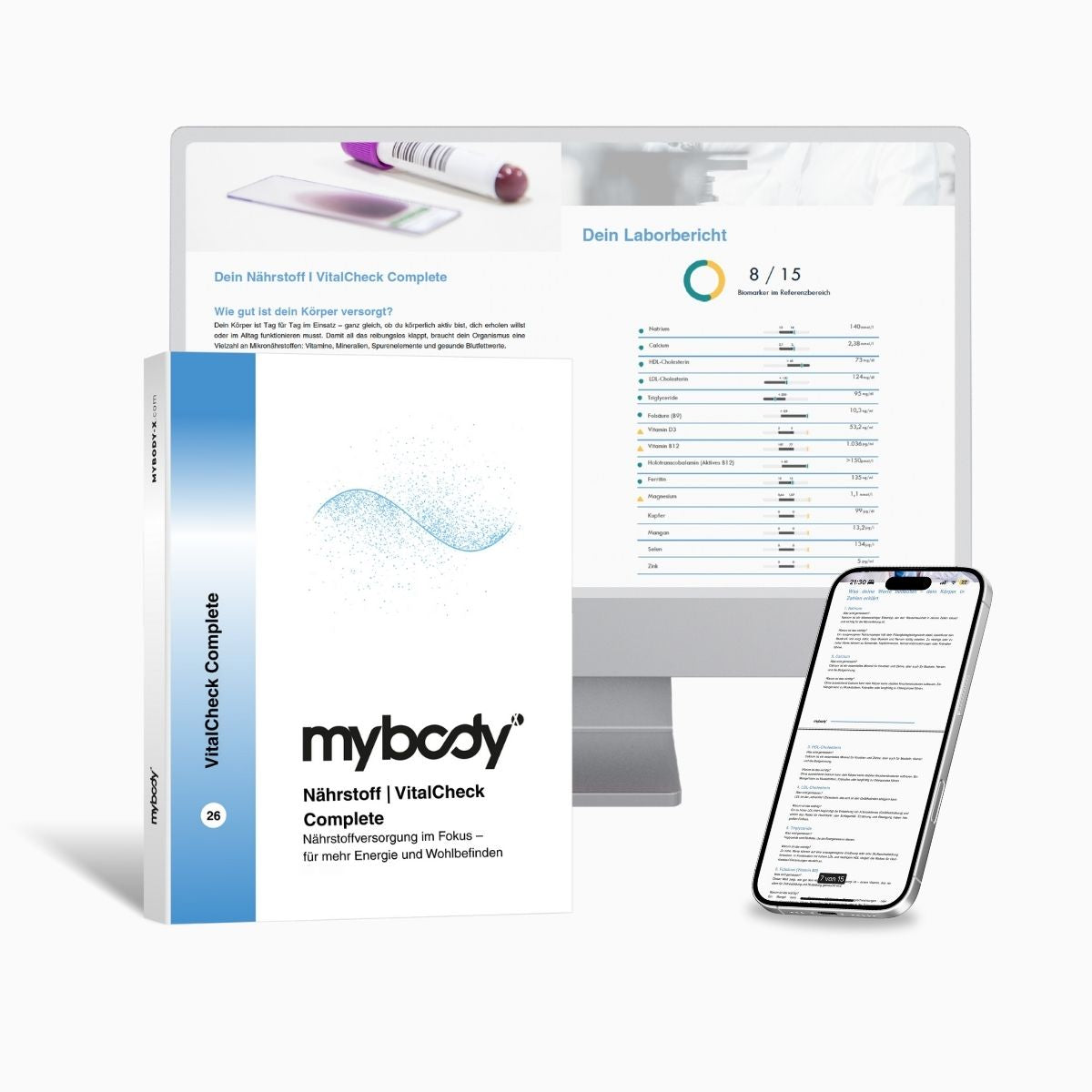
Capillary blood test
VitalCheck | Nutrient & Mineral Test Complete
Measures 18 values from the same sample: 25-OH vitamin D3, vitamin B12, folate, ferritin, iron, transferrin, calcium, magnesium, phosphate, selenium, zinc, albumin, long-term blood sugar, CRP, as well as total cholesterol, HDL, LDL, and triglycerides. What the test does not do: It does not recommend a supplement, specify an amount, assess any dietary pattern, provide a diagnosis, or replace a medical examination. The caveats stated in our articles apply to individual values.
Laboratory analysis 3–5 business days after receipt of the sample
Product page information, accessed August 15, 2026
Four points determine whether the sequence produces a benefit.
Preliminary question first
Targeted supplementation requires a known objective.
Establish a baseline
A baseline cannot be established retrospectively.
Know the caveats
Not every nutrient value is equally easy to interpret.
Leave the decision to a medical professional
What follows from a finding is decided in a medical practice.
Chapter at a glance
A capillary blood self-test answers the preliminary question with numbers and does not make a decision about a supplement. Four points are decisive: address the preliminary question first, establish a baseline, know the caveats, and leave the decision to a medical professional.
Boundaries: what a measurement still leaves open
The first boundary is the decision itself. A finding indicates where a value lies. Whether anything follows from it is decided in a medical practice, and this article makes no recommendation in that regard.
The second boundary concerns the values themselves. According to the specialist literature, laboratory diagnosis for zinc is difficult; for selenium, blood tests to detect a deficiency are currently unavailable.
The third boundary concerns quantities. There are currently no binding recommendations on maximum amounts in either Germany or other European countries (IQWiG, as of September 3, 2025). A measurement does not change that.
The fourth boundary is diagnosis. All classifications in this article provide context and do not constitute a diagnosis. A diagnosis is made in a medical practice based on several components, and no self-test can anticipate it.
What matters about the order
If you take away just one thing from this article, let it be this: The order is already contained in the wording of the cited exception.
Specifically correcting deficiencies requires knowing that a deficiency exists. Without this knowledge, taking a supplement is not targeted, and for the untargeted case, the same source's answer is: generally not.
The question of the order came first. The answer appears in a subordinate clause of a public source, and it is less spectacular than any advertising claim: know first, then decide. The decision itself is made by a medical practice.
Frequently asked questions
Do dietary supplements have any benefit?
IQWiG answers this question: Generally not. Regarding the evidence from studies, it states that there was insufficient evidence on whether dietary supplements protect against illness (as of September 3, 2025). However, the same source cites an exception for specifically correcting deficiencies.
When does IQWiG consider taking them worthwhile?
The source states: Sometimes, temporarily taking dietary supplements can make sense, for example, to specifically correct deficiencies such as iron deficiency (as of September 3, 2025). Three words carry this sentence: sometimes, temporarily, and specifically. Targeted action requires knowing the condition.
Are there binding maximum amounts?
IQWiG writes: Currently, there are no binding recommendations for maximum amounts in either Germany or other European countries (as of September 3, 2025). Regarding the risk, the same source states that dietary supplements may cause the body to absorb considerably more than would be possible through a normal diet, and that such an overdose can be risky.
Are dietary supplements medicines?
No. IQWiG states: By law, they are classified as foods (as of September 3, 2025). They are therefore subject to different rules than medicines.
Is it enough to listen to your own body?
Not for some values. For vitamin B12, the liver stores cover physiological needs for three to five years if intake is absent (MSD Manual, Professional Edition, current as of August 2024). On such a timescale, how you feel is a late and unreliable indicator.
Next step
Answering the preliminary question
Targeted supplementation requires knowing what you are targeting. VitalCheck measures 18 values from capillary blood, providing a dated baseline. It does not recommend a product, specify an amount, make a diagnosis, or replace medical evaluation.
Go to VitalCheckRead more
You might also be interested in
Which values belong on a list and why.
Why how you feel is the worst guide for this value.
Sources
- Institute for Quality and Efficiency in Health Care (IQWiG): Dietary Supplements—What Should Be Considered?, as of 03.09.2025 – gesundheitsinformation.de
- MSD Manual, Professional Edition: Vitamin B12 Deficiency, Johnson LE (fully reviewed August 2024) – msdmanuals.com
- MSD Manual, Professional Edition: Iron Deficiency, Johnson LE (fully reviewed May 2025) – msdmanuals.com
- MSD Manual, Professional Edition: Zinc Deficiency, Johnson LE (fully reviewed May 2025) – msdmanuals.com
- MSD Manual, Patient Edition: Selenium Deficiency, Johnson LE (last updated July 2025) – msdmanuals.com
- IQWiG: Understanding laboratory values correctly, as of 02.04.2025 – gesundheitsinformation.de
The verbatim quote about temporary use, the response generally not being the case, the statements on the state of research, overdose, the lack of binding recommendations for maximum amounts, the legal classification as a food, and the sentence about a balanced diet are taken from source [1]. The information on a storage period of three to five years comes from [2]. The figure of more than 85 percent non-heme iron comes from [3]. The statement about the difficulty of diagnosing zinc deficiency in the laboratory comes from [4]. The statement that blood tests for detecting selenium deficiency are currently unavailable comes from [5]. The explanation of the reference range comes from [6]. Information on price, values, sample type, and laboratory comes from the mybody®x product page, accessed on 15.08.2026; processing times follow the central specification for blood tests. All sources were accessed and reviewed on 15.08.2026.

mybody®x Editorial & Expert Team
Laboratory diagnostics Blood analysis interpretation Nutritional science Nutrigenetics
This article was created by the mybody®x editorial and expert team. The team combines laboratory diagnostics, nutritional science, and the interpretation of blood analyses. Contributors are listed on the authors page.
Published on 15.08.2026 · Last updated on 15.08.2026
The content is intended for general information and does not replace medical advice, diagnosis, or treatment. Reference ranges depend on the laboratory, method, and age—the information on your test report is always authoritative.




Share now:
Vitamin B12 on a vegan diet: the question of timing
Magnesium in Serum and Whole Blood: Two Statements