

Thyroid and weight: what the sources show
The essentials at a glance
There is a documented connection, and it is described as smaller than most people expect. The MSD Manual, professional edition, lists slight weight gain as a symptom of hypothyroidism and gives the reason for it in the same parenthesis (as of June 2024).
In older people, the direction even reverses. The same source lists loss of appetite and weight loss as signs of hypothyroidism in this group (as of June 2024).
You will first read a fact check of three common statements. This is followed by the source for the weight information, what the word “slight” means there, a comparison of underactive and overactive thyroid function, the figures from the key sources, and what remains unresolved. You will not find a recommendation for losing weight here.
What to expect in this article
1. Why the question is asked so often
2. Three statements in the fact check
3. What the thyroid has to do with metabolism
4. The source for the weight information
5. What “slight” means in this source
6. The direction that is rarely discussed
7. Why the symptoms are so nonspecific
8. Four levels compared
9. What the sources say about treatment
10. The figures from the key sources
11. What this means for the order of steps
12. Who may benefit from testing
13. What a capillary blood test can show here
14. Limitations: what we could not substantiate
15. What matters when it comes to weight
Frequently asked questions
Sources
Why the question is asked so often
The connection between the thyroid and weight is one of the most enduring narratives surrounding blood test results. It has a real basis, but it is regularly overstated.
The real basis lies in the organ’s function. Thyroid hormones affect various metabolic processes in the body (IQWiG, as of March 20, 2025), and metabolism is a word that immediately seems relevant when discussing weight.
The overstatement begins when an influence becomes an explanation. This article therefore examines how substantial the influence is according to the sources reviewed.
What you will not find here: a recommendation for losing weight, a diet plan, or the claim that treatment helps with weight loss. The sources provide no basis for this, and we do not invent anything.
Three statements in the fact check
These three statements regularly appear whenever the thyroid and weight are mentioned together.
Checked against the evidence
Widespread
“An underactive thyroid makes you significantly heavier.”
Documented
The MSD Manual, professional edition, lists slight weight gain as a symptom of hypothyroidism and cites fluid retention and reduced metabolism as the reasons (as of June 2024). IQWiG refers to slight to moderate weight gain (as of April 24, 2024).
Widespread
“With hypothyroidism, you always gain weight.”
Documented
In older patients, the same work lists loss of appetite and weight loss as signs of hypothyroidism (as of June 2024). The direction is therefore not always the same.
Widespread
“If the scale stays the same, it is because of the thyroid.”
Documented
IQWiG notes that many symptoms of hypothyroidism can also have other causes, and that blood tests are therefore performed to establish a definitive diagnosis (as of April 24, 2024). The sequence runs from testing to classification, not from conjecture to explanation.
What the thyroid has to do with metabolism
The basis of this connection is undisputed and nevertheless warrants precise wording.
IQWiG describes the effect of free thyroid hormones as follows: They can exert their effects in the body and regulate various metabolic processes (as of March 20, 2025). For free triiodothyronine, the same source gives heart rate as an example.
For hyperthyroidism, the MSD Manual, Professional Edition, describes a condition characterized by hypermetabolism and elevated levels of free thyroid hormones (as of May 2025).
This documents the effect on metabolism. What remains open is how strongly it affects weight, and that is precisely what the next chapter addresses.
The source for the weight information
The decisive entry appears in the symptom list for hypothyroidism, and it includes its own explanation.
Documented source
“slight weight gain (due to fluid retention and reduced metabolism)”
Laura Boucai, MD
MSD Manual, Professional Edition, Hypothyroidism, as of June 2024
This short entry contains three pieces of information. One describes the extent, namely slight. And two give the causes, namely fluid retention and reduced metabolism.
Fluid retention means retained water. This is different from built-up fatty tissue, even though both look the same on the scale.
IQWiG describes the same extent in different words and identifies mild to moderate weight gain as a possible symptom (as of April 24, 2024).
What “slight” means in this source
An honest note belongs in the text here: We did not find a figure in kilograms in the sources we reviewed.
What appears there are words: slight in the MSD Manual, mild to moderate according to IQWiG. Both formulations classify the extent, and both omit a number.
We will not fill this gap. An invented kilogram figure would be the most serious mistake one could make in a text about weight.
What can still be said
Two points can be inferred from the wording without going beyond the source.
First: The professional literature describes weight gain as an accompanying symptom in a list of symptoms, not as the main symptom. It appears there alongside cold intolerance and hypothermia.
Second: Some of it is fluid. This is a substantive statement about the nature of the weight change, and it is explicitly stated in the source.
The direction that is rarely discussed
This is where the finding that most clearly challenges the common narrative appears.
Hypothyroidism can shift weight. It rarely explains on its own why the scale remains unchanged.
The MSD Manual, professional edition, describes hypothyroidism in older people differently from that in younger people. It mentions loss of appetite and weight loss (as of June 2024).
The same source notes that hypothyroidism can manifest oligosymptomatically and atypically in older patients, and that older patients have significantly fewer symptoms than younger patients, with symptoms and signs often being subtle and vague (as of June 2024).
Thus, the sources do not consistently support the equation hypothyroidism equals weight gain. It applies in one age group and is reversed in the other.
Why the symptoms are so nonspecific
A second reason makes attribution difficult, and it affects all symptoms equally.
The MSD Manual, professional edition, states: The signs and symptoms of primary hypothyroidism are often mild and nonspecific (as of June 2024). It continues: The symptoms and complaints of primary hypothyroidism develop gradually.
Gradual onset means that no specific point in time can be identified when something began. That is precisely why it is difficult to attribute a change in weight retrospectively.
IQWiG draws the following practical conclusion: Because many symptoms of hypothyroidism can also have other causes, blood tests are performed to establish a clear diagnosis (as of April 24, 2024).
Four situations compared
The table compares four situations and summarizes what the reviewed sources say about weight in each case. It provides context and does not make a diagnosis.
| Overview | What the sources say about weight | What else it says | Evidence |
|---|---|---|---|
| Hypothyroidism | Slight weight gain due to fluid retention and reduced metabolism; mild to moderate increase | Cold intolerance, hypothermia; symptoms are often mild and nonspecific | MSD Manual, as of June 2024; IQWiG, as of April 24, 2024 |
| Hypothyroidism in older people | Loss of appetite and weight loss—the direction is reversed | Oligosymptomatic and atypical; significantly fewer symptoms than in younger people | MSD Manual, as of June 2024 |
| Hyperthyroidism | Weight loss, together with increased appetite | Hypermetabolism, increased oxygen consumption, elevated free hormone levels | MSD Manual, as of May 2025 |
| Latent hypothyroidism | No statement about weight in the sources reviewed | Defined as elevated TSH with sufficient hormone production and no symptoms | IQWiG, as of April 24, 2024 |
The fourth line is the least conspicuous yet most practically significant. The condition discovered incidentally most often is explicitly defined as occurring without symptoms, and nothing is stated there about weight.
What the sources say about treatment
This question arises immediately, and the sources’ answer is cautious.
IQWiG summarizes the current evidence on latent hypothyroidism as follows: It is unclear whether treating latent hypothyroidism has any benefits (as of April 24, 2024). It also states: In latent hypothyroidism, experts disagree on whether it should be treated.
We found no figures in the sources reviewed specifically on study results relating to weight. There was neither a figure indicating how much weight changes during treatment nor one indicating the time period.
This is where the article deliberately ends. Only a medical practice can decide on treatment, and this text makes no recommendation in that regard.
The figures from the key sources
Three frequency figures, each with its source and date. They provide context and do not constitute a diagnosis.
Documented frequencies
5 out of 100
People in countries such as Germany have an underactive thyroid; women and older people are particularly often affected (IQWiG, as of April 24, 2024)
15 %
of older women and 10 percent of older men have subclinical hypothyroidism (MSD Manual, professional edition, as of June 2024)
2–5 out of 100
Each year, people with latent hypothyroidism develop hypothyroidism with symptoms (IQWiG, as of April 24, 2024)
What stands out is what all three figures refer to: the frequency of the disorder, not weight. We did not find a figure in the sources reviewed that directly links weight and the thyroid.
And as with every laboratory value, the decisive factor is the reference range stated on your own test report, because reference ranges can vary from one laboratory to another (IQWiG, as of April 2, 2025).
What this means for the order
A practical consequence follows from what has been said so far, and it concerns not the weight but the approach.
Anyone who starts with a change in weight and reasons backward to the thyroid is working with a nonspecific sign. According to the specialist literature, the symptoms are often mild and nonspecific, and many also have other causes.
Taking the reverse approach makes things easier. According to the MSD Manual, TSH is the most sensitive parameter for assessing thyroid function (as of February 2024) and answers the question about the organ independently of the scale.
What a value within the reference range means in that case is covered in the companion article Normal TSH Level Despite Symptoms.
Who can benefit from a measurement
The comparison concerns measuring thyroid values, not a question about weight.
Makes sense for you if …
You have never had your thyroid values measured and want to check that question off your list.
You want to establish a baseline value with a date against which something can be compared later.
You want to bring numbers to a consultation instead of a suspicion.
You want to see the thyroid values together with other values from the same sample.
Probably not, if …
You hope the result will explain your weight. No thyroid value can provide that explanation.
You want to derive a treatment decision from the result. That belongs in a medical practice.
You are already receiving treatment. In that case, the practice that prescribed it should carry out the monitoring.
You expect a diagnosis. That is provided by a medical practice, not a self-test.
What a capillary blood test can show here
A capillary blood self-test cannot answer a question about weight. What it can do is put numbers to the question of thyroid function instead of leaving it as a suspicion.
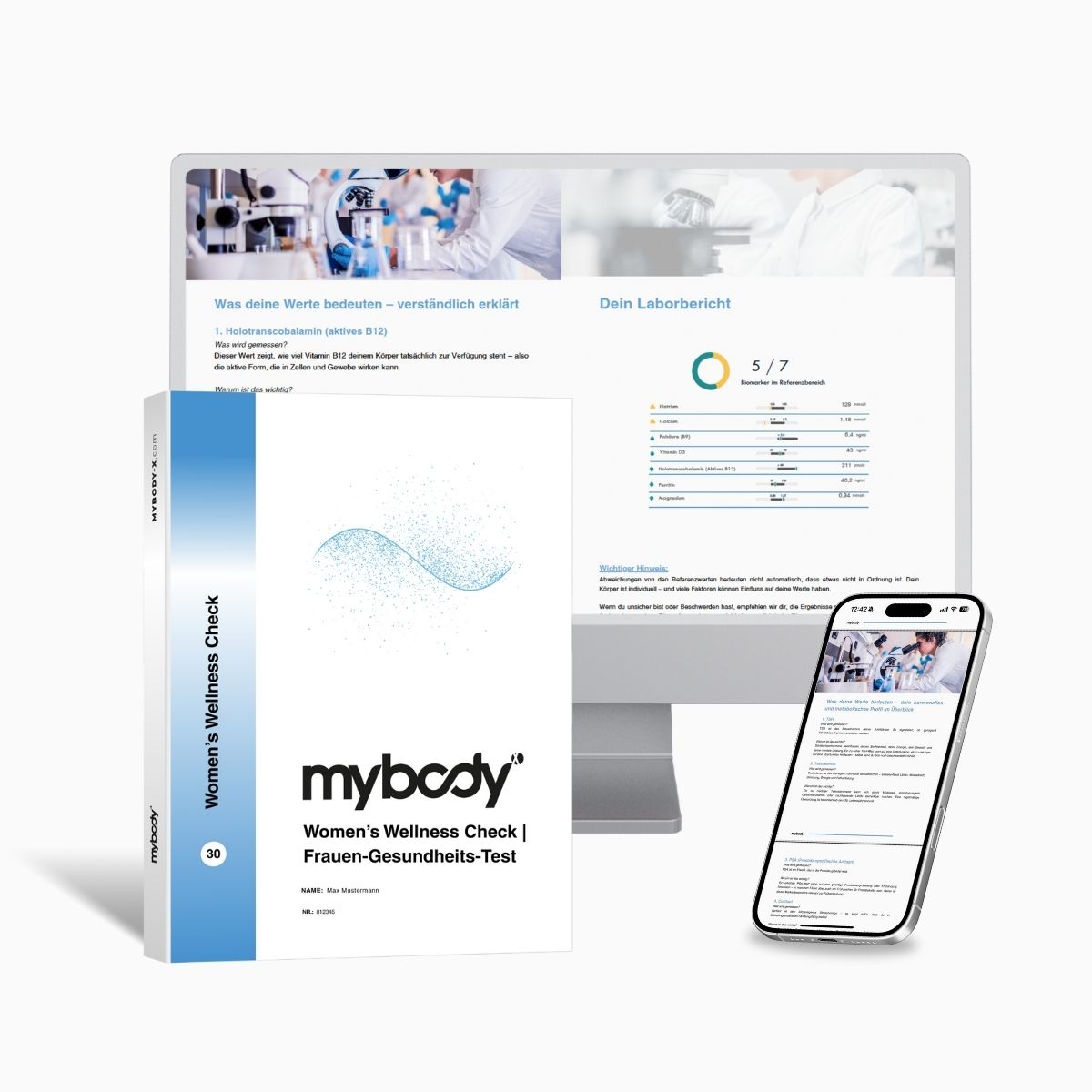
The mybody®x (MYBODY Lab GmbH) Women's Wellness Check measures TSH, fT3, and fT4 from the same sample. None of these three values says anything about weight.
Capillary blood test
Women’s Wellness Check | Women’s Health Test
Measures 18 values, including TSH, fT3, and fT4. It also measures cortisol, prolactin, SHBG, ferritin, vitamin B12, vitamin D, gamma-GT, GPT, cystatin C, long-term blood sugar, CRP, as well as total cholesterol, HDL, LDL, and triglycerides. What the test does not do: It does not explain weight, replace weight counseling, say anything about the success of a dietary change, provide a diagnosis, or replace a medical examination.
Laboratory analysis within 3–5 business days after sample receipt
Product page information, accessed 15 August 2026
Four points determine whether a thyroid finding becomes useful information.
Separate the question
The question about the thyroid is not the question about weight.
Keep the extent in mind
The sources describe it as slight or mild to moderate.
Consider age
For older people, the source mentions loss of appetite and weight loss.
Discuss the interpretation
What a finding means is determined by a medical practice.
Chapter at a glance
A capillary blood self-test provides TSH, fT3, and fT4 with a date and does not answer any question about weight. Its purpose is to replace a suspicion with figures. Four points are crucial: separate the question, keep the extent in mind, consider age, and discuss the interpretation.
Limitations: what we could not substantiate
The first limitation is the lack of a figure. We found no kilogram figure for weight gain with an underactive thyroid in the sources reviewed. They use words instead: slight and mild to moderate.
The second limitation concerns treatment. We found no figures on study results specifically concerning weight during treatment, and according to IQWiG, it is unclear whether treating subclinical hypothyroidism provides any benefits at all (as of 24 April 2024).
The third limitation is attribution. The symptoms of hypothyroidism are often mild and nonspecific and develop gradually (MSD Manual, professional edition, current as of June 2024). It is therefore difficult to attribute a change in weight retrospectively to a specific cause.
The fourth limitation is diagnosis. All the assessments in this article provide context and do not constitute a diagnosis. A diagnosis is made in a medical practice based on several components, and no self-test can anticipate it.
What matters when it comes to weight
If you take away just one thing from this article, let it be this: The connection is documented, and it is described as small.
The specialist literature describes the effect as slight, names fluid retention as one of the two reasons, and reverses the direction for older people. Nowhere is a figure in kilograms given.
At the beginning was the question of whether there is a connection. The honest answer is: there is one, but it rarely acts alone. Whether you have a thyroid dysfunction is answered by a lab value. It does not explain what accounts for your weight.
Frequently asked questions
Do you gain weight if you have an underactive thyroid?
The MSD Manual, Professional Edition, lists slight weight gain due to fluid retention and reduced metabolism among the symptoms (as of June 2024). IQWiG cites mild to moderate weight gain as a possible symptom (as of April 24, 2024). For older patients, however, the MSD Manual cites loss of appetite and weight loss.
How many kilograms is it?
We found no figure in kilograms in the sources reviewed. They use words instead of numbers: slight in the MSD Manual, mild to moderate in IQWiG. We do not insert a number here because there is no evidence for one.
Is the weight gain fat or water?
The cited source gives two reasons in parentheses: fluid retention and reduced metabolism (MSD Manual, Professional Edition, as of June 2024). Fluid retention means retained water. The source does not specify how the two components are divided.
Does treatment change weight?
In the sources reviewed, we found no figures specifically on study results regarding weight during treatment. For latent hypothyroidism in general, IQWiG states that it is unclear whether treating latent hypothyroidism has benefits, and experts disagree about whether it should be treated (as of April 24, 2024). Treatment is decided exclusively by a medical practice.
Should I have my thyroid tested if I have weight problems?
A medical practice, not an article, answers this question. What can be said is that IQWiG notes that many symptoms of an underactive thyroid can also have other causes, which is why blood tests are performed to establish a clear diagnosis (as of April 24, 2024). A test result answers the question about the organ, not the question about weight.
Next step
Replacing a suspicion with numbers
The question of the thyroid can be answered, but the question of weight cannot be answered using the same values. The Women’s Wellness Check measures TSH, fT3, and fT4 along with 15 other values from capillary blood. It does not explain weight, make a diagnosis, or replace medical evaluation.
Go to the Women’s Wellness CheckRead more
You might also be interested in this
What a value within the reference range answers and what it leaves open.
What the two hormone values add, and what free differs from total.
Sources
- MSD Manual, Professional Edition: Hypothyroidism, Boucai L (full review February 2024, last updated June 2024) – msdmanuals.com
- MSD Manual, Professional Edition: Hyperthyroidism, Boucai L (full review February 2024, last updated May 2025) – msdmanuals.com
- Institute for Quality and Efficiency in Health Care (IQWiG): Hypothyroidism, as of 24.04.2024 – gesundheitsinformation.de
- IQWiG: Is there an advantage to treating subclinical hypothyroidism?, as of 24.04.2024 – gesundheitsinformation.de
- IQWiG: Free triiodothyronine (fT3), as of 20.03.2025 – gesundheitsinformation.de
- MSD Manual, Professional Edition: Overview of thyroid function, Boucai L (fully reviewed February 2024) – msdmanuals.com
- IQWiG: Understanding laboratory values correctly, as of 02.04.2025 – gesundheitsinformation.de
The verbatim source for the slight weight gain with fluid retention and reduced metabolism, the information on loss of appetite and weight loss in older patients, the statements about nonspecificity and gradual onset, and the figure of 15 percent of older women and 10 percent of older men comes from source [1]. The information on weight loss, increased appetite, and hypermetabolism in hyperthyroidism comes from [2]. The slight to moderate weight gain, the frequency of 5 out of 100 people, the definition of subclinical hypothyroidism, the figure of 2 to 5 out of 100 per year, and the note that many symptoms have other causes come from [3]. The statements about the uncertainty surrounding treatment come from [4]. The description of the effects of free thyroid hormones comes from [5]. The statement about the most sensitive parameter comes from [6]. The explanation of the reference range comes from [7]. No kilogram figure or study results on weight during treatment were found in any of the sources cited; this is expressly stated in the text. Information on price, values, sample type, and laboratory comes from the mybody®x product page, accessed on 15.08.2026; processing times follow the central specifications for blood tests. All sources were accessed and checked on 15.08.2026.

mybody®x Editorial & Expert Team
Laboratory diagnostics Blood analysis interpretation Nutritional science Nutrigenetics
This article was created by the mybody®x editorial and expert team. The team combines laboratory diagnostics, nutritional science, and the interpretation of blood analyses. Anyone who contributes to it is listed on the authors page.
Published on 15.08.2026 · Last updated on 15.08.2026
The content is intended for general information and does not replace medical advice, diagnosis, or treatment. Reference ranges depend on the laboratory, method, and age; the information on your test report is always authoritative.



Share now:
The LDL-to-HDL ratio: what it actually indicates
Vitamin B12 on a vegan diet: the question of timing