
Vegan food pyramid: structure and critical nutrients
The key points at a glance
The most important information first: There is no vegan food pyramid from the German Nutrition Society. The Federal Centre for Nutrition, the German Federal Institute for Risk Assessment, the Institute for Quality and Efficiency in Health Care, and the Robert Koch Institute have not published one either. Anyone looking for one will find models from other sources—and should know whose model they are looking at.
What exists instead is more reliable than any graphic: a named list of potentially critical nutrients. In addition to vitamin B12, the DGE names iodine, protein, long-chain omega-3 fatty acids, vitamin D, vitamin B2, calcium, iron, zinc, and selenium.
One of them occupies a special position. Based on current knowledge, adequate vitamin B12 intake on a vegan diet is only possible by taking a nutrient supplement—that is not one recommendation among several, but the condition under which the DGE classifies a vegan diet as health-promoting at all.
What to expect in this article
1. What the DGE says about vegan nutrition
2. Why there is no official vegan pyramid
3. How the Giessen vegan pyramid is structured
4. Three misconceptions about vegan nutrition
5. Vitamin B12: the special case
6. The nine other critical nutrients
7. Reference values at a glance
8. Pregnancy, breastfeeding, and children
9. What ultimately matters
Frequently asked questions
Sources
What the DGE says about vegan nutrition
The German Nutrition Society reassessed its position in 2024. The result is neither a blank check nor a warning, but a statement with conditions—and the conditions are the interesting part.
“
“Based on current knowledge, adequate vitamin B12 intake on a vegan diet is only possible by taking a nutrient supplement.”
German Nutrition Society (DGE)
FAQ on vegan nutrition, as of 2025
In its 2024 position paper, the DGE formulates its overall assessment as follows: A vegan diet can constitute a health-promoting diet—provided that a vitamin B12 supplement is taken, food choices are balanced and well planned, and potentially critical nutrients are consumed in amounts sufficient to meet requirements.
Three conditions, not three recommendations
The sentence is structured so that the conditions come before the result. The vitamin B12 supplement, the planned food choices, and adequate intake of the other critical nutrients are not optional tips for the ambitious—without them, the statement does not hold.
It is also noteworthy what the DGE assessed on an equal footing for the first time in 2024: alongside health, the environment, animal welfare, and social aspects. Its assessment of the environmental dimension is clear—vegan nutrition is considered a recommended measure for reducing environmental impacts.
For this article, the focus nevertheless remains on nutrition. Anyone who follows or wants to start a vegan diet does not need an assessment of their motives, but an answer to the question of which nutrients require attention and why.
What “potentially critical” means
In everyday use, the term is often interpreted more dramatically than intended. “Potentially critical” does not mean that a deficiency is likely. It means that an adequate intake of this nutrient does not occur automatically with an entirely plant-based diet and therefore requires a decision—which foods go on the plate, in what quantities, and in what combination.
With a mixed diet, some of these concerns are resolved incidentally because animal-based foods provide several of these nutrients at the same time. If this food group is eliminated, that automatic assurance is eliminated as well. This is exactly what the DGE describes with the requirement for a “well-planned selection of foods.”
Conversely, the term also says something about a mixed diet. Vitamin D is also on the list—and it is a nutrient whose adequate supply requires attention in Germany regardless of dietary pattern. Not every item on this list is an argument about vegan nutrition.
Why there is no official vegan pyramid
Here is the information missing from most articles on this topic: Neither the DGE nor the BZfE, BfR, IQWiG, or RKI publishes a vegan food pyramid. The graphic models these institutions offer are based on a mixed diet.
Sources: German Nutrition Society (DGE), 2024 position paper, 2025 FAQ, and reference values (as of the 2018 derivation). The third tile is based on a review of the websites of the institutions named above on August 5, 2026.
The DGE uses the three-dimensional food pyramid and the nutrition circle, while the BZfE uses a pyramid in which eight food groups are arranged across six levels. Both models include animal-based foods as separate components—they do not present a vegan version.
Why this is not an omission
The reason lies in the available data. The DGE states that, because the data remains limited, it cannot make a clear recommendation for or against a vegan diet for children, adolescents, pregnant women, breastfeeding women, and older adults. A standard graphical model for all age groups requires precisely the evidence base that is lacking here.
There is also the nature of the format. A pyramid deliberately simplifies—it has to work at a glance. This very simplification becomes a problem with a vegan diet as soon as a nutrient cannot be obtained through food. There is no place for a supplement in a food pyramid.
In practical terms, if you come across a “vegan food pyramid,” check who issued it. This is not a minor detail—for a model that someone follows for years, its origin is the decisive indicator of quality.
In brief
None of the leading German institutions issues a vegan food pyramid—not the German Nutrition Society, nor the BZfE, BfR, IQWiG, or RKI. Their graphical models are based on mixed diets. Anyone who follows a vegan pyramid is therefore always following a model created by a private organization or association. What is authoritative instead is the DGE list of potentially critical nutrients and the corresponding reference values.
How the Giessen vegan pyramid is structured
There is one model that two government bodies refer to as a guide: the Giessen vegan food pyramid. It does not come from a government agency, but from the Research Institute for Plant-Based Nutrition (IFPE) and Veganuary—and according to the Verbraucherzentrale, it is based on the DGE reference values for nutrient intake.
The BZfE describes it as a possible guideline that recommends not only the number of advisable daily portions of individual food groups but also corresponding quantities. This classification is important: The pyramid is therefore supported by secondary sources, not official.
The levels from bottom to top
Beverages form the base. An adequate intake of fluids is the foundation of a balanced diet—at least 1.5 liters daily, with water considered the best thirst quencher. Above that is the level containing vegetables and fruit.
The third level consists of whole-grain products, which the model assigns a major role—three portions daily. Above them are legumes and other protein sources, with two portions daily, followed by two portions of milk and dairy alternatives.
Higher up are nuts and seeds, along with the butters and pastes made from them, with two to three portions of 25 to 30 grams each. Oils and fats form the apex, at two to three tablespoons per day.
What stands out about this structure is what it cannot do. A pyramid organizes quantities, not nutrients. You cannot tell from portion sizes whether you ultimately get enough B12, iodine, or selenium—and that is precisely why this article next moves from foods to nutrients.
What stands out about the order
Anyone who compares the vegan pyramid with the general one can see the crucial difference on a single level. Where animal-based foods appear in the mixed-diet model, legumes and other protein sources, along with alternatives to milk and dairy products, appear here—the position stays the same, while the contents change.
It is also striking how prominently nuts and seeds are placed. Two to three portions of 25 to 30 grams each are more than most people casually eat in everyday life—this reflects a conscious choice, not a minor detail.
And one point that is easy to overlook: The pyramid says nothing about supplements. It categorizes foods. The fact that a vegan diet requires at least one supplement is stated not in the graphic, but in the DGE's position paper—another reason not to rely on a single image alone.
Three misconceptions about a vegan diet
Two camps face off on this issue, and both rely on oversimplifications. Three of them can be clearly resolved using the sources.
Vitamin B12: the exception
Of the ten nutrients mentioned, one stands apart. For the other nutrients, the focus is on making smart food choices; for B12, it is on taking a supplement. This distinction runs through the entire DGE position paper and is why B12 gets its own chapter in this article.
The reason is biological, not ideological. Vitamin B12 is produced by microorganisms—in animals’ digestive tracts, bacteria synthesize the vitamin, which is why, according to the BfR, it occurs in significant amounts only in animal-based foods, especially liver, red muscle meat, fish, eggs, and dairy products.
For the other nutrients, the focus is on making smart food choices; for B12, it is on taking a supplement.
For the dosage of dietary supplements, the BfR specifies an upper limit: It recommends that dietary supplements for adolescents aged 15 and over and adults contain no more than 25 micrograms of vitamin B12 per daily dose (as of 2023).
Three numbers that do not mean the same thing
This is a regular source of confusion, so here is the distinction: The DGE reference value of 4.0 micrograms per day describes intake from food. The BfR upper limit of 25 micrograms per daily dose describes what a supplement should contain at most. These are two different quantities, not contradictory figures.
The reason a supplement dose can exceed the daily requirement has to do with absorption: The body does not absorb B12 without limit, but through a restricted mechanism. How much is absorbed is a different question from how much is swallowed—and that is precisely the distinction between the required amount and the supplement dose.
The specific dosage should be discussed with a doctor. Both cited institutions explicitly say so: The BfR recommends supplementation after consultation with a doctor, while the DGE recommends regularly checking nutritional status.
Why a deficiency is noticed only late
Vitamin B12 is the nutrient with the longest delay between cause and effect. The BfR describes it this way: Vitamin B12 deficiency often occurs only after years of inadequate intake because the body can store around 2 to 5 milligrams of the vitamin.
These stores are why the first few years of a vegan diet without a supplement often pass without symptoms—and why that should not be taken as an all-clear signal. After about one to four years of a B12-free diet, the liver’s stores are reportedly half depleted, according to the BfR; the first clinical symptoms do not appear until they have fallen to 5 to 10 percent.
In practice, this means: “I feel fine” is not evidence of an adequate supply of this nutrient. That is also why the DGE refers to regular testing rather than monitoring how you feel.
The BfR provides specific details about the consequences: A classic deficiency affects blood formation, and the resulting anemia is accompanied by paleness, fatigue, tingling, or numbness. The DGE also mentions psychological symptoms such as impaired memory and depressive moods, as well as neurological disorders.
The nine other critical nutrients
The DGE’s complete list reads as follows: In addition to vitamin B12, iodine, protein, long-chain omega-3 fatty acids, vitamin D, vitamin B2, calcium, iron, zinc, and selenium are among the potentially critical nutrients. In its detailed version, the DGE also names vitamin A as a possible additional candidate—worded more cautiously and therefore not supported to the same extent.
Iodine—the nutrient with its own specific guidance
After B12, iodine is the only nutrient for which the DGE makes a specific supplement recommendation: Adults are advised, in consultation with a doctor, to take 100 micrograms of iodine daily as a supplement if they do not consume enough iodine-containing foods. As alternatives, it lists iodine-fortified foods, such as plant-based drinks, and regularly consuming seaweed with a declared iodine content.
Zinc—the value that increases with a vegan diet
Zinc is the only one of the nutrients mentioned whose reference value the DGE adjusts according to phytate intake. With low phytate intake, the recommended intake is 11 milligrams for men and 7 milligrams for women; with high phytate intake, it is 16 and 10 milligrams per day, respectively.
For vegan nutrition, this is not an academic distinction. Phytate is found in whole grains, legumes, nuts, and seeds—that is, precisely the food groups placed low down in the vegan pyramid. People who eat a vegan diet therefore generally fall closer to the high end than the low end.
Protein, omega-3, and the rest
When it comes to protein, the DGE explicitly focuses not only on the amount but also on the essential amino acids. For the long-chain omega-3 fatty acids EPA and DHA, it particularly highlights pregnant and breastfeeding women as well as children and adolescents.
Calcium, iron, selenium, and vitamin B2 appear on the list without a special rule of their own—which does not mean they are less important. It means they can be covered through food choices, whereas B12 and iodine require an additional decision.
One observation about the list as a whole: It was not newly compiled to disparage vegan nutrition. The same nutrients appear in dietary recommendations for vegetarian diets, older people, and pregnant women—each for different reasons. What makes the vegan list distinctive is its length, not its composition.
And a note on the order of implementation: Anyone who tackles all ten points at once usually gives up after a few weeks. It makes more sense to follow the sequence that emerges from the sources themselves—first B12, because it cannot be managed without a supplement, then iodine, because it is the second specific action point, and then everything else through food selection.
Reference values at a glance
The following overview compiles the values for adults. Pay attention to the “Type of value” column—the difference between recommended intake and estimate is not a formality, but a statement about the reliability of the available data.
| Nutrient | Adult value | Type of value | Specific consideration for a vegan diet |
|---|---|---|---|
| Vitamin B12 | 4.0 µg/day | Estimate | Supplement essential—cannot be covered without supplementation |
| Iodine | 150 µg/day | Recommended intake | 100 µg as a supplement in consultation with a doctor if intake is insufficient |
| Iron | Men: 11 mg/day · women: 16 mg before menopause, then 14 mg | Recommended intake | No specific supplement recommendation in the source material used |
| Zinc | Men: 11–16 mg/day · women: 7–10 mg/day | Recommended intake | Graded according to phytate intake—on a vegan diet, usually the upper level applies |
| Calcium | 1,000 mg/day | Recommended intake | No specific supplement recommendation in the source material used |
| Vitamin D | 20 µg/day (800 IU) | Estimate when the body does not produce enough | Does not apply only to people who follow a vegan diet—it applies generally |
| Selenium | Men: 70 µg/day · women: 60 µg/day | Estimate | No specific supplement recommendation in the source material used |
| Protein | Ages 19–65: 0.8 g/kg body weight/day · from age 65: 1.0 g/kg | Recommended intake; estimate from age 65 onward | It is about the essential amino acids, not just the amount |
All values: German Nutrition Society (DGE), reference values for nutrient intake. The underlying derivations date from between 2012 and 2025, depending on the nutrient. Although vitamin B2 and the long-chain omega-3 fatty acids appear on the DGE list of potentially critical nutrients, they are not included here with numerical values because adult reference values were not available for them in the source material used.
What can be measured
Reference values describe intake. Whether what is consumed actually reaches the body is another question—and for some of these nutrients, it can be answered through blood tests.
The distinction is particularly relevant for a vegan diet because the absorption of some nutrients from plant sources differs from that of nutrients from animal sources. Zinc, with its phytate-based gradation, is exactly such an example: the same amount consumed is not absorbed to the same extent, depending on what it is eaten with.
A measurement therefore does not replace dietary planning, and dietary planning does not replace a measurement. Both answer different questions—the first, what belongs on the plate, and the other, whether the calculation has worked out.
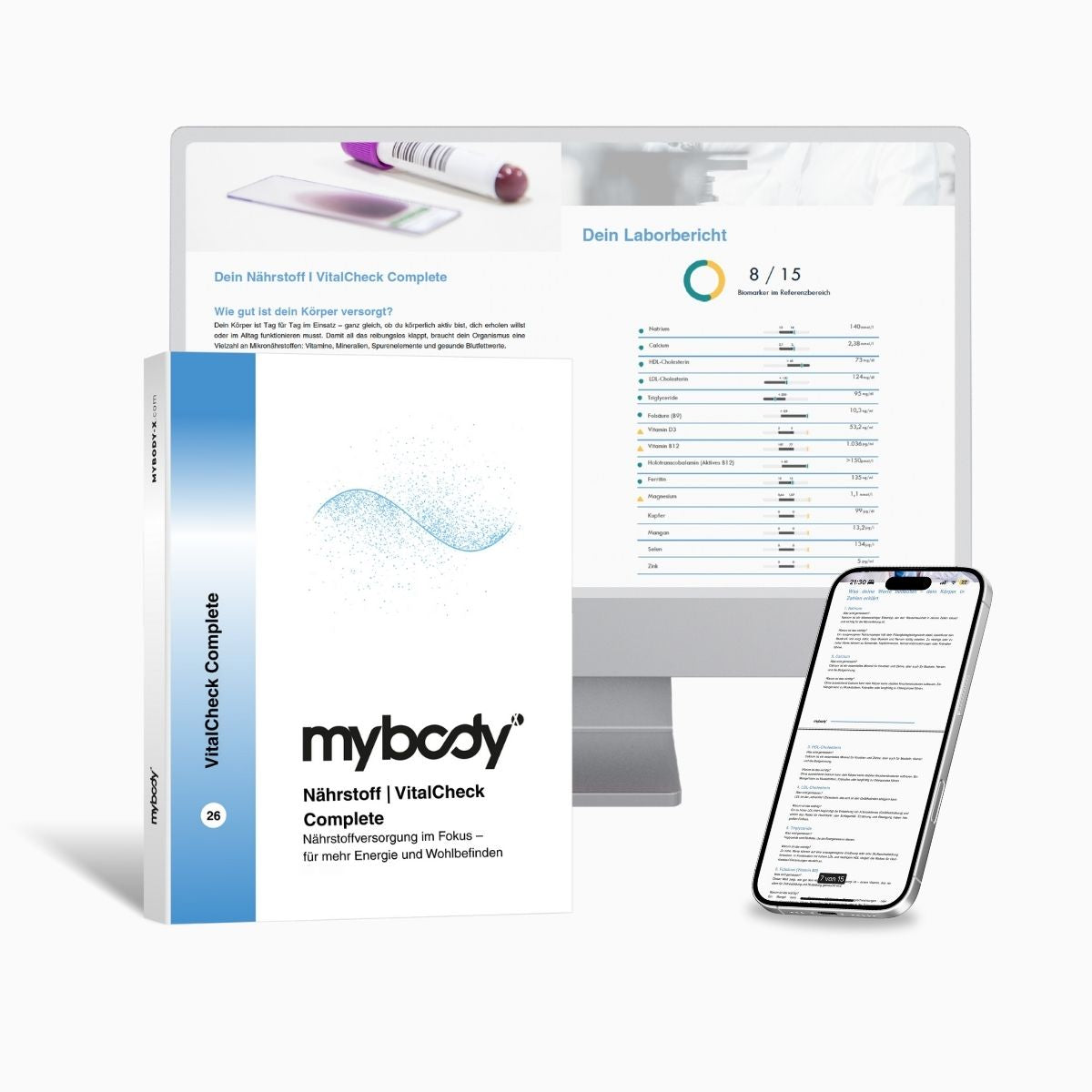
Nutrient | VitalCheck Complete
Measures 15 biomarkers from capillary blood, including five of the critical nutrients mentioned here: vitamin B12 and transcobalamin, 25-OH vitamin D3, calcium, zinc, and selenium—plus ferritin, folate, magnesium, and others. What the test does not do: It contains no iodine measurement, meaning it specifically does not include the second nutrient with its own supplement recommendation. It also does not measure protein, vitamin B2, or omega-3 fatty acids. It does not provide a diagnosis and does not replace a consultation with a doctor.
Price: €169.00 (instead of €199.00) · Sample type: Capillary blood · Processing time: Kit shipping 1–3 business days, laboratory analysis 3–5 business days after sample receipt · Laboratory: ISO-certified laboratory analysis in Germany
About Nährstoff VitalCheck CompleteAll prices and service details are current as of August 5, 2026. Prices and the scope of services may change; the applicable product page always governs.
Pregnancy, breastfeeding, and children
Here, the DGE’s position is considerably more cautious than it is for adults in general, and that caution should be conveyed in full.
For children, adolescents, pregnant women, breastfeeding women, and older adults, the DGE cannot make a clear recommendation for or against a vegan diet because the available data remains limited. For these groups, it refers to a risk of potential, sometimes irreversible consequences if the diet is implemented inadequately—and therefore strongly recommends nutritional counseling from qualified professionals.
Specifically, the DGE names two observed consequences. Among exclusively breastfed infants of vegan mothers, vitamin B12 deficiency with corresponding consequences has been observed as early as the first months of life. In the past, failure to thrive due to energy and protein deficiencies, as well as other nutrient deficiencies, has also been observed.
Pregnancy adds another point: According to the DGE, a vitamin B12 deficiency before pregnancy may represent an independent risk factor for complications such as miscarriage and preeclampsia. Nutrient status should be checked regularly by a doctor during these stages of life.
This is not a call to switch diets or stop during these phases. It is a call to seek professional guidance—before making a change, not when symptoms occur.
What is remarkable is how the DGE justifies its caution. It does not say that a vegan diet is harmful during these stages of life. It says that the evidence is insufficient for a clear statement in either direction. That is a distinction that regularly disappears from public debate—in both directions.
The DGE also names who is suitable as a professional: qualified nutrition professionals, supplemented by targeted medical care. This is more than a passing consultation and less than therapy—it is planning with checkpoints.
What ultimately matters
Anyone looking for a vegan food pyramid is looking for simple guidance. It does not exist in an official form—and that is not a gap this article can fill, but information that belongs in the answer.
What exists is more precise than a graphic: a list of ten potentially critical nutrients, reference values for each, and two nutrients with their own specific guidance—vitamin B12, for which a supplement is essential, and iodine, for which supplementation is recommended in consultation with a doctor.
Your specific next step: If you follow a vegan diet and are not taking a B12 supplement, that is where you start—in consultation with a doctor, continuously, and not just during certain phases. Everything else, from iodine and zinc to selenium, is then a matter of food selection and, where appropriate, testing.
And if you do want a graphic on the kitchen door: use the Giessen pyramid, but take it for what it is—a quantity model from private sources, based on DGE reference values and cited as guidance by two government bodies. It organizes your shopping. The nutrient list organizes what matters in the process.
Frequently asked questions
Does the DGE have a vegan food pyramid?
No. Neither the German Nutrition Society nor the BZfE, BfR, IQWiG, or RKI publishes a vegan food pyramid—their graphic models are based on mixed diets. As a guide, the BZfE and the Verbraucherzentrale refer to the Giessen vegan food pyramid, which comes from the Research Institute for Plant-Based Nutrition and Veganuary and is based on DGE reference values.
Which nutrients are critical on a vegan diet?
Alongside vitamin B12, the DGE lists iodine, protein, long-chain omega-3 fatty acids, vitamin D, vitamin B2, calcium, iron, zinc, and selenium. In its detailed version, it cautiously mentions vitamin A as a possible additional candidate. Vitamin B12 holds a special position because adequate intake cannot be achieved without a supplement.
Do I really need to supplement B12 on a vegan diet?
Yes. According to current knowledge, adequate vitamin B12 intake on a vegan diet is possible only by taking a nutrient supplement—continuously, regularly, and reliably (DGE, FAQ 2025). The BfR recommends taking it after consulting a doctor and specifies a maximum amount of 25 micrograms per daily dose for food supplements (as of 2023).
Do algae, sauerkraut, or shiitake provide plant-based B12?
According to the DGE, these foods may contain vitamin B12 compounds. However, the forms they contain are not available to humans and do not contribute to adequate intake (as of 2018). For iodine intake, by contrast, the DGE explicitly names algae as an option—provided they have a declared iodine content.
Is a vegan diet possible during pregnancy?
Due to the limited available data, the DGE neither issues a recommendation for nor against this for pregnant and breastfeeding women, children, adolescents, and older people. It points to a risk of potential, partly irreversible consequences if implemented inadequately and strongly recommends nutritional counseling from qualified professionals as well as regular medical monitoring of nutritional status.
Intake is not the same as adequate status
Reference values indicate how much should be consumed. Whether it is absorbed is shown by the blood. Five of the critical nutrients mentioned here can be measured—iodine is explicitly not one of them.
View VitalCheck Complete NutriCare INFINITYYou might also be interested in
→ Food pyramid: Structure, application, and analyses
The general pyramid—the model that, unlike the vegan version, is officially recognized.
→ Macronutrients explained simply: What protein, fat, and carbohydrates really do
For the section of the list covering protein and the essential amino acids.
Sources
- German Nutrition Society (DGE): Reassessment of its position on vegan diets, position paper 2024 — dge.de
- German Nutrition Society (DGE): FAQs on vegan diets, as of 2025 — dge.de
- German Nutrition Society (DGE): Reference values for nutrient intake (vitamin B12, iodine, iron, zinc, calcium, vitamin D, selenium, protein) — dge.de
- German Federal Institute for Risk Assessment (BfR): Vitamin B12 in a plant-based diet, as of 2023 — bfr.bund.de
- Federal Centre for Nutrition (BZfE): Eating a vegan and balanced diet, as of 2023 — bzfe.de
- Consumer Advice Centre: Eating and drinking vegan — how to succeed with a purely plant-based diet, as of 2026 — verbraucherzentrale.de
The overall assessment of a vegan diet and the statements regarding the four evaluated dimensions are based on source [1]. The list of potentially critical nutrients, the statements on B12 supplementation and the recommendation for iodine supplements, the information on sauerkraut, algae, and shiitake, and all statements regarding pregnancy, breastfeeding, and children are based on source [2]. All numerical values in the reference-value table, including the distinction between recommended intake and estimated value, are based on source [3]. The information on the production of vitamin B12 by microorganisms and the maximum amount of 25 micrograms per daily dose in dietary supplements are based on source [4]. The classification of the Giessen vegan food pyramid as a guideline is based on source [5], while its structure from bottom to top is based on source [6]. The statement that none of the institutions mentioned publishes a vegan food pyramid is based on a review of their websites on August 5, 2026, and is identified as such. Product information comes from the mybody®x product pages, accessed on August 5, 2026.

mybody®x Editorial & Expert Team
Nutritional science Micronutrients Plant-based nutrition
This article was created and professionally reviewed by the mybody®x Editorial and Expert Team. The team combines expertise in nutrigenetics, microbiome and gut science, blood analysis interpretation, nutritional science, and laboratory diagnostics.
Published on August 5, 2026 · Last updated on August 5, 2026
Medical advice: This article is intended for general information only and does not replace medical advice, diagnosis, or treatment. Dietary supplements should be taken in consultation with a doctor. During pregnancy and breastfeeding, in infancy, childhood, and adolescence, as well as in older age, the DGE strongly recommends that people following a vegan diet be supported by qualified professionals.




Share now:
How many calories a day to lose weight: here's how to find your number
Vitamin D3 Deficiency and the Thyroid: What Is Proven and What Isn’t