

Symptoms of Iron Deficiency: Recognize, Understand, Take Action
Iron deficiency is defined as a condition in which the body does not have enough iron to maintain its functions. Symptoms of iron deficiency range from persistent fatigue and paleness to brittle nails and neurological complaints such as restless legs syndrome. According to StatPearls, these signs can occur with or without anemia, often with varying severity. This means you can have a serious iron deficiency even if your hemoglobin level is still within the normal range. Recognizing and correctly interpreting symptoms early allows you to take targeted action and prevent long-term consequences.
What are the symptoms of iron deficiency?
Iron deficiency can cause a wide range of physical and mental complaints. The most common signs are:
- Persistent fatigue and exhaustion: Iron is essential for transporting oxygen in the blood. When it is lacking, muscles and organs receive less oxygen, resulting in profound fatigue.
- Concentration problems and reduced mental performance: The brain is particularly sensitive to iron deficiency. Memory problems and difficulty concentrating are common early signs.
- Pale skin and mucous membranes: Paleness occurs because less hemoglobin circulates in the blood. It is particularly noticeable on the eyelids and fingernails.
- Hair loss and brittle nails: Hair loss and nail changes are among the first visible signs and may gradually become more pronounced.
- Shortness of breath during exertion: Even light physical activity can cause breathlessness because the body has to compensate for the lack of oxygen.
- Headaches and dizziness: These symptoms occur particularly after getting up or during physical activity.
- Restless legs syndrome: Restless, tingling legs, especially at night, are a frequently overlooked sign. Around 40% of people with restless legs syndrome also have iron deficiency, regardless of their hemoglobin level.
The symptoms become more severe as the deficiency progresses. In the early stages, they are often mild and easily dismissed as stress or lack of sleep. In advanced iron deficiency with anemia, physical and mental performance decline significantly.
Pro tip: Pay particular attention to the combination of fatigue, concentration problems, and hair loss. If all three occur simultaneously, laboratory testing is urgently recommended.

How is iron deficiency diagnosed using laboratory values?
The diagnosis of iron deficiency is based on several laboratory parameters, not just the hemoglobin level. This is a crucial point that many people overlook. Symptoms are nonspecific and are not sufficient for a reliable diagnosis. Laboratory values are indispensable.
Overview of the most important laboratory parameters
| Parameter | Normal range | Significance in iron deficiency |
|---|---|---|
| Ferritin | 30–300 ng/mL (women: 13–150) | Below 30 ng/mL indicates absolute iron deficiency |
| Transferrin saturation | 20–50 % | Below 20% indicates functional deficiency |
| Hemoglobin (Hb) | Women: 12–16 g/dL, men: 13.5–17.5 g/dL | Only reduced in advanced deficiency |
| Serum iron | 60–170 µg/dL | Fluctuates considerably and is of limited significance on its own |
| CRP | Below 5 mg/L | Elevated during inflammation, affects ferritin levels |
The hemoglobin level is not a reliable early indicator. It only falls once iron stores are already severely depleted. Ferritin and transferrin saturation indicate a deficiency earlier. Anyone who would like to learn more about the normal Hb level will find an understandable explanation there.
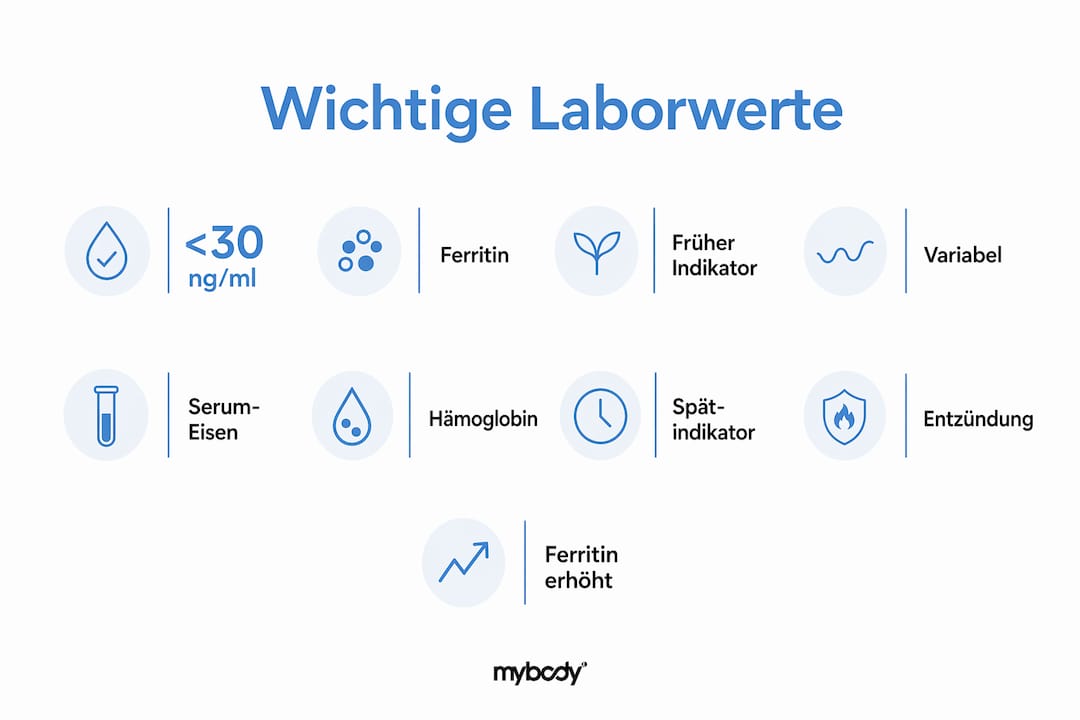
Another critical point: During inflammation, ferritin can be normal or even elevated as an acute-phase protein despite a genuine iron deficiency. In this case, CRP must be taken into account to avoid misdiagnosis. A combined laboratory analysis is therefore the only reliable approach.
Pro tip: Serum iron fluctuates throughout the day and is influenced by meals. Always have blood drawn while fasting and in the morning to obtain reliable values.
What causes and risk factors lead to iron deficiency?
Iron deficiency occurs when the body loses or requires more iron than it absorbs. The causes can be divided into three main groups:
Increased iron loss:
- Heavy menstrual bleeding is the most common cause in women of childbearing age
- Chronic bleeding in the gastrointestinal tract, for example due to stomach ulcers or intestinal polyps
- Operations or injuries involving significant blood loss
Increased iron requirements:
- Pregnancy and breastfeeding significantly increase iron requirements
- Competitive athletes, especially endurance athletes, lose iron through sweat and hemolysis (the destruction of red blood cells caused by impact while running)
- Growth phases in children and adolescents
Reduced iron absorption:
- Vegetarian and vegan diets, as plant-based iron (non-heme iron) is absorbed less efficiently than iron from animal sources
- Intestinal diseases such as celiac disease or Crohn's disease impair absorption
- Chronic inflammatory diseases fundamentally alter iron metabolism
Women with heavy menstruation, pregnant women, vegans, and people with chronic intestinal diseases are particularly at risk. For these groups, early measurement of ferritin and transferrin saturation is recommended, even if the hemoglobin level is still normal.
Iron deficiency vs. copper deficiency: How do the symptoms differ?
Iron deficiency and copper deficiency share some symptoms but differ in important ways. These differences help establish the correct diagnosis and avoid unnecessary supplementation.
Symptom comparison: iron deficiency and copper deficiency
| Symptom | Iron deficiency | Copper deficiency |
|---|---|---|
| Fatigue and exhaustion | Very common | Possible |
| Pale skin | Typical | Rare |
| Hair loss | Common | Possible |
| Brittle nails | Common | Rare |
| Restless legs syndrome | Characteristic | Not typical |
| Neurological deficits | Rare, in cases of severe deficiency | Typical (numbness, gait disturbances) |
| Anemia on the blood count | Microcytic, hypochromic | Normocytic or macrocytic |
| Neutropenia (low white blood cell count) | No | Yes, characteristic |
Copper deficiency causes primarily neurological symptoms such as numbness, gait disturbances, and muscle weakness. The blood count shows a different pattern than in iron deficiency. Anyone who notices symptoms such as tingling in the extremities or coordination problems should have copper tested in the laboratory in addition to iron.
Another difference can be seen in the blood count: iron deficiency causes small, pale red blood cells (microcytic, hypochromic anemia). Copper deficiency, on the other hand, shows normal or enlarged blood cells. This distinction is an important initial indication for the doctor.
What measures help with recognized signs of iron deficiency?
If you recognize symptoms of iron deficiency and a laboratory test confirms the suspicion, there are clear options for action. Treatment always follows one basic principle: eliminate the cause and replace iron.
Step-by-step approach for confirmed iron deficiency
-
Determine the cause: Before you begin supplementation, the cause of the deficiency must be known. Heavy menstruation, intestinal diseases, or chronic bleeding must be treated; otherwise, the deficiency will return.
-
Oral iron supplements: Iron sulfate, iron gluconate, or iron fumarate are the first choice. They are best taken in the morning on an empty stomach, together with vitamin C, which improves absorption. Coffee, tea, and calcium supplements inhibit absorption and should be taken at separate times.
-
Intravenous iron therapy: In cases of severe anemia, absorption disorders, or intolerance to oral supplements, an infusion is the better option. It replenishes the stores more quickly.
-
Adjust your diet: Red meat, liver, legumes, pumpkin seeds, and spinach are good sources of iron. Anyone who wants to know specifically which foods help with iron deficiency can find specific recipe ideas there.
-
Follow-up test: Ferritin should be measured again after 4–8 weeks of supplementation. The stores are sufficiently replenished only once the level remains stably above 50 ng/mL.
Pro tip: Never take iron supplements together with dairy products or antacids. Calcium and magnesium significantly block iron absorption in the intestines.
Anyone who wants to test themselves for iron deficiency before seeing a doctor can use a home test for initial guidance. This does not replace a medical diagnosis, but it provides a good initial overview.
Key findings
Iron deficiency can be reliably identified and effectively corrected through a combination of typical symptoms, targeted laboratory diagnostics, and treatment focused on the underlying cause.
| Point | Details |
|---|---|
| Symptoms are varied | Fatigue, pallor, hair loss, and restless legs can all indicate iron deficiency. |
| Hb level alone is not enough | Ferritin and transferrin saturation indicate iron deficiency earlier and more reliably. |
| Inflammation distorts ferritin levels | When CRP is elevated, ferritin must always be assessed together with other parameters. |
| Clarify the cause before treatment | Supplementation without clarifying the underlying cause often leads to a recurring deficiency after a short time. |
| Iron deficiency vs. copper deficiency | Neurological symptoms and the blood count help clearly distinguish between the two deficiencies. |
What I learned after years of diagnosing iron deficiency
At mybody x, we see test results every day from people who have been living with symptoms for months or years—symptoms they should have had evaluated long ago. The pattern is always similar: fatigue is dismissed as stress, hair loss as a sign of aging, and concentration problems as overload. Yet a simple blood test would have been sufficient.
What concerns me most is that hemoglobin is still the most frequently measured parameter, even though it is simply unsuitable as an early indicator. Anyone who checks only their Hb level misses iron deficiency at a stage when it would still be easy to correct. Ferritin and transferrin saturation are part of the basic diagnostic workup, but they are often measured only at the patient's explicit request.
Another blind spot is restless legs syndrome. Many people affected do not know that restless legs at night can indicate iron deficiency in the brain, even when all other values are unremarkable. This is not a marginal phenomenon. It affects a significant proportion of people with iron deficiency.
My advice: Don't wait until the symptoms become unbearable. A blood test costs little and gives you clarity. Taking responsibility for your health begins by taking your body's signals seriously and backing them up with reliable data.
— mybody x
Your next step: Have your iron status specifically evaluated
Do you recognize yourself in several of the symptoms described? Then now is the right time to gain clarity.

mybody x offers ISO-certified blood tests that reliably measure ferritin, transferrin saturation, and other relevant parameters. Samples are collected conveniently at home, and the analysis provides scientifically sound results with personalized recommendations. With more than 11,300 satisfied customers and a rating of 4.77 stars, mybody x is a reliable partner for anyone who wants to take an active role in managing their health. Start now with the nutrient check from mybody x and find out whether iron deficiency is behind your symptoms.
FAQ
What are the first signs of iron deficiency?
The first signs are persistent fatigue, difficulty concentrating, and pale skin. Hair loss and brittle nails often follow shortly afterward and worsen as the deficiency becomes more severe.
Can I recognize iron deficiency without a blood test?
No. Symptoms are nonspecific and can have many causes. A laboratory test measuring ferritin and transferrin saturation is the only reliable way to diagnose it.
Which laboratory value shows iron deficiency earliest?
Ferritin is the most reliable early indicator. A level below 30 ng/mL indicates absolute iron deficiency, even if the hemoglobin level is still normal.
How do iron deficiency and copper deficiency differ?
Iron deficiency is primarily indicated by fatigue, paleness, and restless legs. Copper deficiency, on the other hand, typically causes neurological symptoms such as numbness and gait disturbances, as well as a different type of anemia in blood tests.
What should I do if my iron level is too low?
First clarify the cause, then begin taking oral iron supplements, preferably in the morning on an empty stomach with vitamin C. In cases of severe anemia or absorption disorders, intravenous iron therapy is the better choice.
Recommendation
- Recognize Nutrient Deficiency Symptoms and Address Them Effectively – mybody®x
- Iron and Vitamin B12 Deficiency Symptoms: Recognize & Take Action – mybody®x
- What Is Iron Deficiency? Symptoms & Detection Made Easy – mybody®x
- Iron Deficiency Self-Test: Interpret Symptoms & Measure Your Levels Correctly – mybody®x



Share now:
I keep gaining more and more weight and don’t know why: The reasons
Boost Your Metabolism for Weight Loss: Your Guide for 2026