
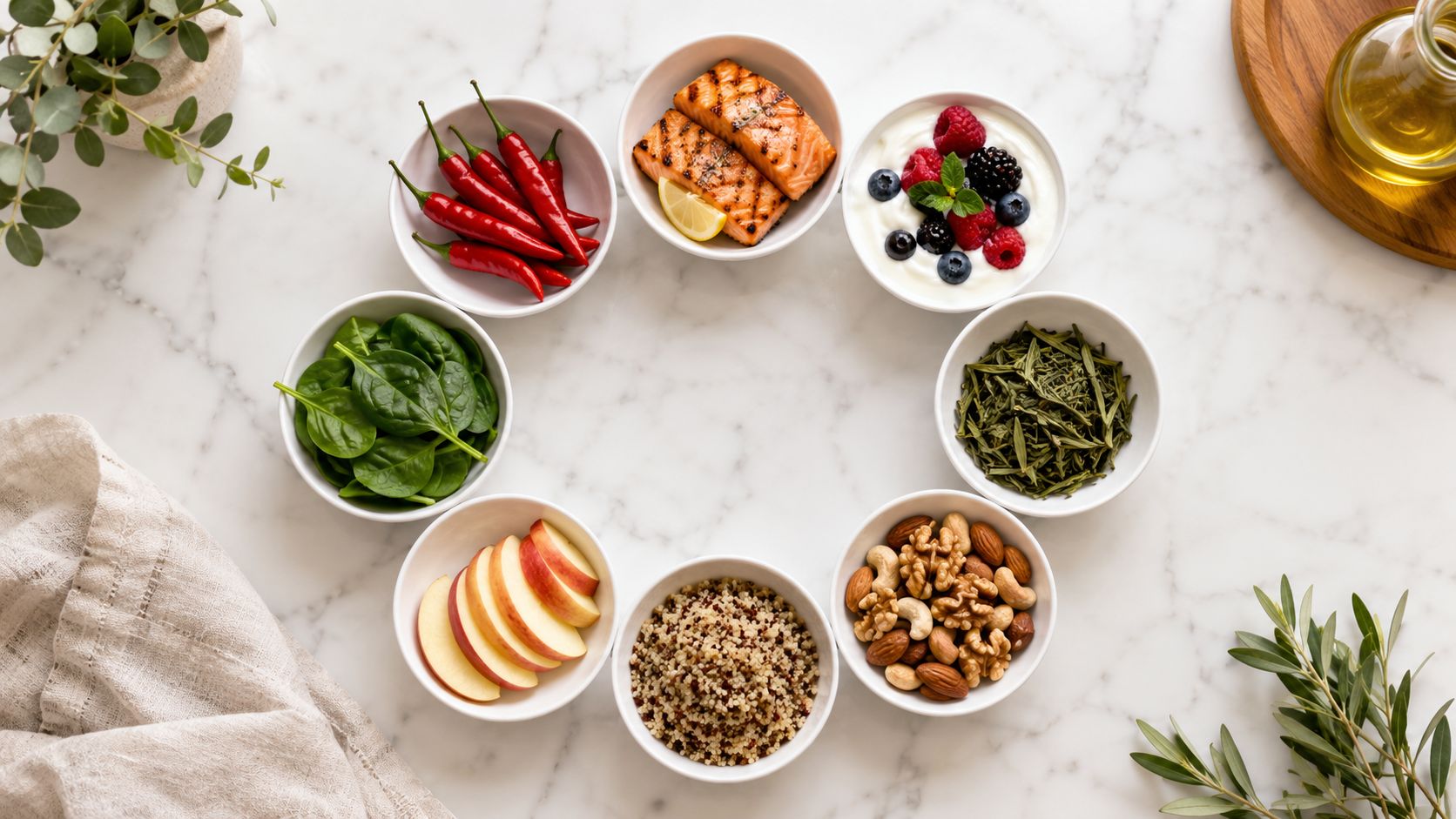
Metabolism-Boosting Foods: Your Turbo Plan for 2026
You have already counted calories, eaten “healthily,” perhaps even followed diets, and yet it still feels as though your body is running in energy-saving mode. That is frustrating, especially when other people seem to just look at a salad and immediately see results. If you recognize yourself in this, the problem is often not a lack of discipline, but the fact that metabolism does not work the same way for everyone.
The good news: You can support your metabolism in a targeted way. Not through radical rules, but with foods that reduce the amount of work your body has to do or trigger greater activity in the right places. That is precisely what the search for effective metabolism-boosting foods is about.
There is something else that matters here. There is no universal solution. Ginger may be noticeable for one person but barely have an effect on the next. Green tea helps many people, but not everyone to the same extent. Protein is a powerful lever, but here too, people respond individually. That is why, alongside a solid understanding of the basics, it is always worth considering genetics and gut health. A personalized assessment, for example through DNA and microbiome analyses from mybody®x, can help turn general recommendations into a strategy that truly suits you.
1. Ginger – The thermogenic root for your metabolism

Ginger is one of those foods that is surprisingly easy to incorporate into everyday life. A few slices in tea, freshly grated into a vegetable stir-fry, or finely chopped into a dressing is often all it takes. Especially if you have trouble getting going in the morning or feel sluggish after eating, ginger can be a good starting point.
German guides mention cinnamon, chili, and ginger as spices that support metabolism. Their effects are described primarily in terms of anti-inflammatory properties and the direct stimulation of fat burning, as explained in Utopia’s article on metabolism-supporting spices.
How to use ginger effectively
Fresh ginger is the easiest option. Cut off a few thin slices and pour hot water over them if you want tea. In warm dishes, ginger goes well with soups, curries, lentil dishes, or stir-fried vegetables.
A practical example: You have oatmeal with yogurt or skyr for breakfast and add some freshly grated ginger. Or you incorporate it into a protein-rich smoothie bowl. This way, you combine several metabolism-boosting foods in one meal without making things complicated.
Fresh ginger is often the most practical choice because you can use it flexibly in tea, stir-fries, or bowls.
Why the effect varies from person to person
Not everyone reacts equally strongly to pungent compounds. Some people quickly notice that ginger agrees with them, while others mainly feel digestive support. This is where personalization becomes interesting. If you want to know whether your body responds more to thermogenic foods, protein, or fiber, a DNA metabolism analysis from mybody®x can help put these differences into perspective.
Tolerance is also important. If you have a sensitive stomach, it's better to take ginger with a meal rather than on an empty stomach. For many people, this is the easiest way to use the root regularly.
2. Green Tea – The Underestimated Power Drink for a Sustainable Metabolism

Green tea is often underestimated because it seems so unremarkable. No trendy product, no magic powder, just a beverage. That is precisely what makes it interesting. It is easy to turn into a habit and fits into almost any daily routine.
Green tea has particularly specific data among foods that stimulate the metabolism. Controlled studies from German-speaking countries show that daily consumption of green tea, which is rich in catechins such as EGCG and polyphenols, can increase fat burning by 70 to 100 calories per day.
What makes green tea so special
Its strength lies in the combination of caffeine and plant compounds. It is also described that green tea or green tea extract can increase the metabolic rate by up to three to four percent. The same context also states that three to four cups per day are recommended for this purpose.
That doesn't mean you have to drink gallons of tea. For many people, it's enough to partially replace their afternoon coffee or start the day with a cup.
How to incorporate green tea into your daily routine
A simple example: You drink a cup of green tea with breakfast in the morning and a second one in the late morning. If you like, you can also cold-brew it and take it to the office. This turns a theoretically healthy food into a routine.
Practical use in everyday life
- In the morning instead of a second coffee: This helps you start the day focused without immediately turning to sugary drinks.
- At lunchtime instead of a soft drink: This also saves sugar and makes the meal lighter.
- As a regular habit at work: Keeping a pot on your desk increases the likelihood that you will actually drink it regularly.
According to assessments from mybody®x and its surrounding experts, green tea is among the foods generally considered to support metabolism. However, how strong the effect is for you personally depends on your individual genetic profile. That is precisely why a personalized perspective is often more valuable than simply trying things out.
3. Protein-rich foods – The cornerstones of an active metabolism
If you could choose just one dietary change, increasing your intake of high-quality protein would often be the most sensible choice. Protein-rich foods are filling, help preserve muscle, and require the body to use more energy during digestion than other macronutrients.
According to the medical assessment by Dr. Julia Fischer, the body burns approximately 20 to 30 percent of the calories consumed from protein during metabolism, compared with 10 to 15 percent for carbohydrates and around four percent for fats. This higher thermic effect is precisely what makes protein such a powerful lever.
Good protein sources in real life
You do not need to follow a bodybuilder-style diet for this. Fish, tofu, lean meat, dairy products, oats, and legumes are considered particularly useful building blocks for an active metabolism. Most practical of all is to plan a protein source with every main meal.
An everyday example: skyr with oats in the morning, lentil salad with vegetables at lunchtime, and roasted vegetables with tofu or fish in the evening. This is not a diet plan, but a structure that keeps you fuller for longer and often significantly reduces cravings.
What many people forget about protein
Protein works not only through the calories burned during digestion. It also helps preserve muscle mass. This is important because muscle mass is closely linked to your everyday energy expenditure. If you also do regular strength training or bodyweight exercises, you enhance this effect.
If you often snack between meals, the solution does not always start with eating less; it often starts with more protein in the previous meal.
How much you personally need depends on your daily routine, training, body composition, and goal. A good starting point is the mybody®x article on daily protein requirements.
The same applies here: not everyone processes macronutrients in the same way. The DNA metabolic analysis from mybody®x can show which nutritional priorities better suit your profile.
4. Fiber – The underrated secret to a faster metabolism
You eat breakfast, and two hours later you’re already hungry again. Often, this isn’t due to a lack of discipline, but to a meal that contains too little fiber.
Fiber is among the foods that influence metabolism not through a brief kick, but through many small mechanisms. It slows the rise in blood sugar after eating, prolongs satiety, and supports digestion that works regularly and calmly. There is another point many people underestimate: certain types of fiber serve as food for your gut bacteria. The metabolic products created when they process this fiber are in turn linked to appetite, blood sugar, and inflammatory processes.
For adults, around 30 grams of fiber per day is often cited as a useful guideline, for example by the German Nutrition Society in its recommendations on fiber. Good sources include oatmeal, legumes, vegetables, berries, nuts, seeds, and whole-grain products.
Why fiber can make such a big difference in everyday life
Fiber works more like a speed regulator than a turbo button. That is precisely what makes it so helpful for many people. When meals are digested more slowly, you are more likely to have steadier energy between meals and less likely to reach for quick snacks.
A simple example: A white bread roll with jam is quick to eat and often quickly “used up” as well. Oatmeal with berries, flaxseed, and plain yogurt usually stays with you longer because it contains more volume, more texture, and more fiber. The difference often doesn’t show up in minutes, but in how your morning unfolds.
The gut responds individually
This is where personalized nutrition becomes particularly interesting. Fiber is not all the same, and not every gut responds in the same way. Some people tolerate beans and lentils without any problems, while others initially experience bloating and do better with oats, cooked carrots, potatoes, or psyllium husks.
The reason is simple: your microbiome is as unique as a fingerprint. Which bacteria are more prevalent in your gut influences, among other things, which foods you digest well and what amount is right for you at a given time. Genetic differences can also play a role, for example in how your metabolism responds to certain dietary patterns. A good introduction to this connection can be found in mybody®x’s article on genes and metabolic connections.
The Gut Flora MICROBIOME Test Complete from mybody®x analyzes overall gut health, including bacterial diversity, leaky gut, inflammation markers, and dysbiosis. This helps you choose fiber not from a general list, but in a way that is better suited to your own body.
If you want to explore the topic further, the mybody®x guide contains more information about fiber, its effects, benefits, and tips.
How to increase fiber without overwhelming your stomach
More is not automatically better. If you increase fiber very suddenly, you will often first notice pressure, bloating, or a feeling of fullness. A slower increase along with enough fluids is more sensible.
- Upgrade breakfast: Add oats, chia seeds, or berries instead of eating sweet pastries on their own.
- Swap side dishes: Choose whole grains, beans, lentils, or potatoes with their skins more often.
- Make vegetables easier to include: An extra serving at lunch or dinner is enough as a first step.
- Increase gradually: First add one fiber-rich component to each meal, then build from there.
If you often react sensitively to fiber, that does not mean it is “not for you.” Usually, it is about choosing the right form, the right amount, and a pace that suits your gut. That is where a diet begins that not only sounds healthy but also works for you.
5. Natural Folate from Green Leafy Vegetables – The Gene-Driven Foundation for Metabolism
This is where personalization becomes particularly tangible. Not every “healthy” vitamin works the same way for everyone, especially when genes are involved in metabolism. That is precisely what makes folate so interesting.
Depending on the gene variant, people with an MTHFR variant may be advised to consume more natural folate from green leafy vegetables, because the metabolism of synthetic folic acid may be impaired. This makes spinach, lamb’s lettuce, arugula, broccoli, or Swiss chard more than just “somehow healthy vegetables”—for some people, they are a genuine foundation for metabolism. mybody®x explains more in the article Your Metabolism in Your Genes.
What this means for you in practice
If you often reach for highly processed products or conventional multivitamin routines, it is worth taking a second look. For some people, natural folate from food is the more suitable choice. A large handful of spinach in an omelet, leafy greens in a smoothie, or broccoli as a side dish are simple ways to put this into practice.
A good everyday example is a lunch consisting of mixed leafy greens, chickpeas, nuts, and a source of protein. This allows you to cover several beneficial nutritional areas at once, including folate, fiber, healthy fats, and protein.
Food first, targeted supplementation
If a deficiency is present or a test indicates a specific need, supplementation may be useful. However, it should be targeted. The Vitamin D3 K2 Komplex | Shield from mybody®x combines high-dose D3 with K2 for optimal calcium utilization, bone health, and immune system support. According to the product description, it is ideal after a DNA or blood test has confirmed a deficiency.
Personalized nutrition does not mean that you need more products. It means you can better distinguish what makes sense for your body and what does not.
This is especially important when it comes to metabolism. Greens are healthy. But why exactly they matter to you often only becomes clear when you look at your individual profile.
6. Chili and Capsaicin – Thermogenic Power for Your Metabolism
You cook a vegetable stir-fry in the evening, add a small pinch of chili, and notice shortly afterward: you feel warm, your nose runs slightly, and your body reacts immediately. This very noticeable warmth explains why chili has received so much attention in discussions about metabolism for years.
The key substance behind this is called capsaicin. It stimulates certain receptors in the body that also respond to heat. This can stimulate heat production. The effect is real, but it is not a fat-burning trick and does not replace a balanced diet. It makes more sense to view chili as one small component that can fit into an overall metabolism-friendly way of eating.
How to use chili in everyday life
Many people do not struggle with chili itself, but with the amount. If you rarely eat spicy food, you can quickly overwhelm your stomach and intestines. So start small, for example with some fresh chili, chili flakes, or a mild variety in soups, curries, roasted vegetables, or tomato sauces.
A good everyday example is a lentil soup with just a small pinch of chili. If you tolerate it well, slightly increase the amount next time. This way, you can test your personal range instead of orienting yourself by other people's spice tolerance.
Chili acts as a stimulus. And as with many stimuli, the right dose is individual.
Why the effects are not the same for everyone
This is where the personalized perspective gets interesting. Some people tolerate spicy foods without any problems and eat them regularly. Others react to even small amounts with heartburn, sweating, or discomfort. This is often due not only to habituation, but also to differences in digestion, mucosal sensitivity, satiety signals, and the gut microbiome.
That is precisely why a simple list of metabolism-boosting foods is only of limited use. A DNA or microbiome test from mybody-x can help you better understand how your body responds to certain food groups and which dietary strategy suits you. In practical terms, when it comes to chili, this means that for one person it is a useful addition in small amounts, while for another it is simply an unnecessary stressor for the digestive tract.
Who chili may not be a good idea for
If you suffer from heartburn, have a sensitive stomach, irritable bowel syndrome, or known symptoms after eating spicy food, caution is advisable. You do not have to force chili into your diet. Metabolism can also be supported in other ways, such as through protein-rich meals, fiber-rich foods, or well-tolerated spices.
So the helpful thought is not: Chili is good for everyone. More accurately: Chili can be beneficial if your body tolerates it well.
This is how a trendy food becomes an informed choice. That is precisely the difference between general nutritional knowledge and a diet that truly suits you.
7. Water and hydration – The underestimated foundation of all metabolic processes

Water is not a conventional food. Nevertheless, it is essential for your metabolism. Without sufficient fluids, digestion, nutrient transport, and many metabolic processes simply work less efficiently. This may sound trivial, but it is constantly underestimated in everyday life.
In German-language recommendations on metabolism, water is explicitly mentioned as the foundation of a sensible diet. The combination of protein-rich foods, healthy fats, and fiber with regular exercise and sufficient sleep is considered an evidence-based approach to sustainably boosting metabolism.
What drinking enough really means in everyday life
Many people only drink when they feel thirsty. By then, you are often already behind. It is more useful to tie drinking to set moments. One glass after getting up, one in the morning, one with each main meal, and one after physical activity. That way, you do not have to think about it constantly.
A good example: Put a bottle on your desk first thing in the morning. When it is visible, you are more likely to drink automatically. Combined with drinking water before or between meals, this also helps many people eat more mindfully.
Water is the foundation, not the trick
Lemon slices, herbs, or unsweetened tea can help if you find plain water difficult to drink. But the real key is consistency. No metabolism-boosting food can fully deliver its benefits if you chronically fall short on fluids.
Integrating water into your day more easily
- Keep it visible: Place the bottle on your desk, kitchen counter, or in the car.
- Pair it with routines: After getting up, before meetings, or after walks.
- Create variety: Water with lemon, mint, or unsweetened tea.
8. MCT Oil and High-Quality Fats – Targeted Fuel for a Fast Metabolism
Many people have learned to avoid fat across the board. That is an oversimplification when it comes to metabolism. What matters is not only the amount, but also the type of fat. Nuts, seeds, avocado, fish, and certain oils provide building blocks that support the body differently from highly processed fats.
Medium-chain fatty acids from coconut oil are described as stimulating the metabolism more strongly than long-chain fatty acids, such as those in butter, because they are metabolized more quickly and flow directly into mitochondrial energy production.
Where high-quality fats really make sense
In everyday life, you do not have to start experimenting with pure MCT oil right away. Nuts and seeds, a high-quality dressing, or fatty fish are good starting points. Nuts and seeds contain unsaturated fatty acids, protein, and fiber, which together can activate the metabolism and help preserve muscle mass, as Lebens-Retter explains in its article on metabolism-boosting foods.
For example, instead of having a fat-free snack, you add some plain yogurt with walnuts and seeds to your day. Or you top a salad with not only vegetables, but also olive oil, seeds, and a source of protein. This is more filling and can help prevent later snack attacks.
Personalization is also important for fat metabolism
Not everyone tolerates the same fat profile equally well. Some people benefit from more fat in their diet, while others feel better with moderate amounts. The mybody®x article What Is Fat Metabolism offers an introduction to the topic.
If you want to experiment with MCT oil, start cautiously and monitor how well you tolerate it. Sensitive digestion in particular can sometimes react strongly. As is often the case with high-quality fats: use sensible amounts, combine them with real meals, and pay attention to your own response.
Metabolism boosters: 8 foods compared
| Measure | Implementation complexity 🔄 | Resources & effort ⚡ | Expected effect ⭐📊 | Ideal use cases 💡 | Key benefits ⭐ |
|---|---|---|---|---|---|
| Ginger – The thermogenic root | Low (fresh/as tea) 🔄 | Low, available year-round ⚡⚡ | ⭐⭐⭐ Thermogenesis ≈+5%; cumulative; promotes digestion | In the morning as tea, in smoothies, or when cooking | Well researched; anti-inflammatory; affordable |
| Green tea – Power drink | Low (brewing/cold brew) 🔄 | Low; quality varies ⚡⚡ | ⭐⭐⭐⭐ Long-lasting 4–6 h; EGCG → COMT inhibition (strong in COMT slow metabolizers) | Daily consumption for consistent activation | Strongly evidence-based; antioxidant; mildly stimulating |
| Protein-rich foods | Medium (meal planning) 🔄🔄 | Medium–high (food costs) ⚡⚡⚡ | ⭐⭐⭐⭐⭐ TEF ↑ up to 30%; satiety; muscle preservation | Weight loss, muscle building, every main meal | Highly effective for metabolism; versatile; sustainable |
| Fiber | Low–medium (gradual transition) 🔄🔄 | Low; found in many foods ⚡⚡ | ⭐⭐⭐ Long-term microbiome activation ≈+40%; stabilizes blood sugar | Microbiome development, glycemic control, prevention | Promotes gut health; cost-effective; preventive |
| Natural folate (leafy greens) | Low (raw/minimally steamed) 🔄 | Low; freshness is important ⚡⚡ | ⭐⭐⭐ Supports one-carbon metabolism & mitochondria; MTHFR-dependent | MTHFR carriers, regeneration, building energy over weeks | Essential for cellular and energy metabolism; safe |
| Chili & capsaicin | Low (seasoning) 🔄 | Low; widely available ⚡⚡ | ⭐⭐⭐⭐ Acute thermogenesis ↑ up to 8%; effect may diminish | Short-term thermogenesis, seasoning meals | Strong thermogenesis; anti-inflammatory; versatile |
| Water & hydration | Very low (drinking routine) 🔄 | Very low; available everywhere ⚡ | ⭐⭐⭐⭐ Immediate effects; dehydration −10–30% metabolism; drinking ↑ thermogenesis ≈30% | Foundation of every strategy; before meals; hydration baseline | Fundamental; safe; synergistic with all measures |
| MCT oil & high-quality fats | Medium (dose carefully, increase slowly) 🔄🔄 | Higher (specialty oil, cost) ⚡⚡⚡ | ⭐⭐⭐⭐ Postprandial ↑ up to 12%; ketones → fast energy; diet-dependent | Keto/low-carb, pre-workout, bulletproof coffee | Fast mitochondrial fuel; filling; promotes ketogenesis |
From Knowledge to Action: Your Personalized Metabolism Plan
You have seen that there are many nutritious foods that can support your metabolism. Protein-rich meals increase the energy expenditure required for digestion. Green tea and chili can stimulate thermogenesis. Fiber supports satiety, digestion, and gut health. Ginger, leafy greens, and high-quality fats complement this picture in different ways.
But the most important point is this: Not every one of these foods affects everyone in the same way. This is exactly where many standard tips fail. You read a list, try everything at once, and become frustrated when the hoped-for effect doesn’t materialize. The problem is often not your willpower, but the lack of fit with your body.
Personalization turns general nutrition tips into a real strategy. When you know how your body processes certain nutrients, you can make smarter decisions. Are you likely to respond well to green tea? Do you need to focus more on protein? Do you particularly benefit from fiber and a stable gut microbiome? Or are there genetic indications that natural folate is more important for you than for others?
This is exactly where a DNA metabolism analysis from mybody®x may be useful. It isn’t a decorative extra, but a tool for planning your diet more purposefully. Instead of blindly following trends, you gain a basis for understanding which levers are likely to be more relevant for you. If digestive problems, bloating, unclear satiety, or fluctuating energy are also present, looking at the microbiome may be helpful as well.
You still don’t need perfectionism to get started. Begin with three simple steps. First: include a good source of protein in every main meal. Second: gradually increase your fiber intake in a practical way. Third: try one or two thermogenic aids, such as green tea, ginger, or a little chili, for two to three weeks. Then honestly observe how you feel. More energy, better satiety, calmer digestion, and fewer cravings are often the first signs that you’re moving in the right direction.
If you want to know more precisely, a personalized approach is the next logical step. MYBODY Lab GmbH offers analyses in the areas of DNA, metabolism, and the microbiome, all aimed at helping you understand your body better. For many people, this is the point at which nutrition stops being a guessing game.
Ultimately, it’s not about “fixing” your metabolism with a single superfood. It’s about understanding your body better and choosing foods that are realistic, well tolerated, and sensible for you in the long term. That’s when good intentions become real habits.
If you no longer want to guess which metabolism-boosting foods are truly right for you, take a look at the analyses from MYBODY Lab GmbH. The combination of DNA, metabolism, and microbiome tests can help you tailor your diet and lifestyle more precisely to your body.


Share now:
Healthy Weight Loss Plan: Your 4-Week Guide for 2026
DNA Test for Nutrition & Metabolism: Eat According to Your Genetics