
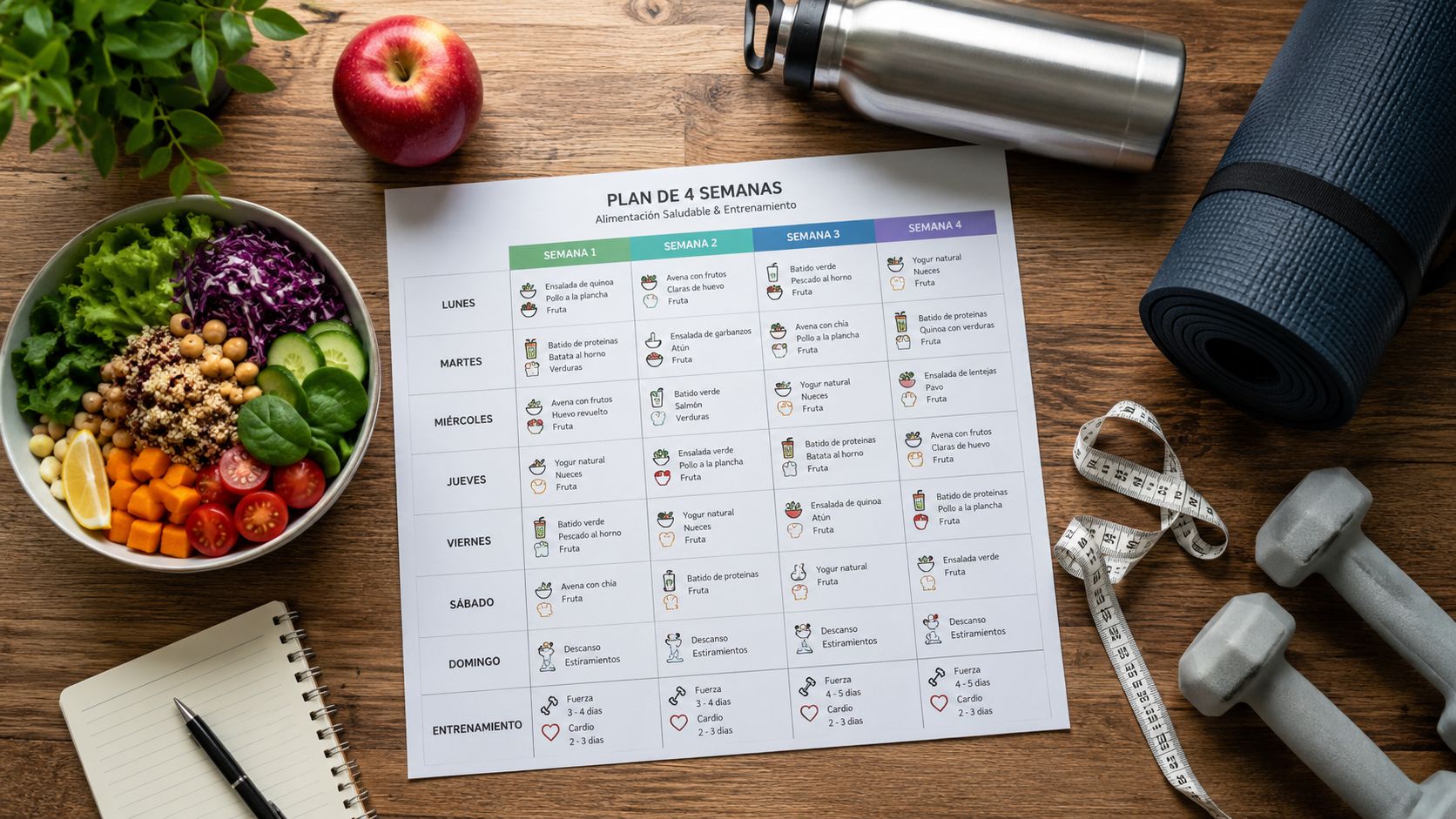
Healthy Weight-Loss Plan: Your 4-Week Guide for 2026
You're probably at exactly this point: You finally want to lose weight, but without the next crash diet, constant hunger, or feeling that you've failed yourself yet again. Maybe you've already counted calories, skipped meals, exercised more, and still saw no results—or only short-lived ones.
The problem is rarely a lack of willpower. It's usually a plan that's too general. A good healthy weight-loss plan needs structure, but also individuality. Your daily routine, eating habits, energy level, and sometimes even your blood test results or hormones all influence whether your plan works.
That's exactly what this is about. No empty motivational talk, no miracle solution. Instead, a clear 4-week approach that combines nutrition, exercise, and the often-overlooked question: Why might weight loss not have worked for you so far the way it should?
Laying the foundation: Setting goals and finding motivation
If you want to lose weight, don't start with prohibitions. Start with honesty. Many people begin with an overly strict plan, stick to it for a few days, and then fall back into old patterns. Not because they lack discipline, but because the plan wasn't practical for everyday life.
In Germany, 53.5% of adults are affected by overweight, underscoring the need for a structured healthy weight-loss plan. RKI data also shows that losing just 5 to 10% of body weight can provide health benefits, as described in the RKI data on overweight and health behavior.

Your goal must be measurable and humane
“I want to lose 10 kilos quickly” isn't a good goal. It puts you under pressure and doesn't help you at all on a stressful Wednesday evening. A better goal is one you can control specifically.
Work with three levels:
- Outcome goal: You want to become lighter, fitter, or more resilient.
- Behavioral goal: You cook for yourself on weekdays, go for regular walks, or plan meals in advance.
- Identity goal: You want to become someone who understands their own body and doesn't constantly work against it.
Practical rule: Don't measure progress only by the number on the scale. Pay attention to satiety, sleep, energy, digestion, how your clothes fit, and your mood, too.
Find your real why
Your why isn't “because it's summer.” That won't hold. Your why has to affect you emotionally. Maybe you don't want to be out of breath when climbing the stairs anymore. Maybe you want to feel more comfortable in your body again. Maybe you're fed up with constantly thinking about food, weight, and guilt.
Write down your why. Keep it short and specific, without clichés. If you need support, this article on body awareness and motivation can help, because motivation without self-understanding usually doesn't last long.
Set clear guardrails for the next 4 weeks
Instead of changing everything at once, set some firm basic rules:
| Area | Practical guardrails |
|---|---|
| Nutrition | Regular, planned meals instead of spontaneous snacking |
| Exercise | Set time slots in your calendar |
| Environment | Shopping list before going to the supermarket |
| Monitoring | Weekly check-in instead of daily self-criticism |
You don't need a perfect start. You need a plan you can still manage on tired days. That's the difference between short-lived euphoria and real change.
Your nutrition roadmap for the first 4 weeks
Your body won't lose weight healthily if you constantly put it on high alert. That's exactly why a moderate deficit is the right approach. A daily calorie deficit of approximately 500 kcal is considered sensible for sustainable weight loss. By contrast, consuming fewer than 1,500 kilocalories per day is considered risky, as described in the article by Endokrinologie Bayern on a nutrition plan for weight loss.

A good nutrition plan is therefore not strict but sustainable. You don't have to go hungry. You have to stop eating chaotically.
Weeks 1 to 4 with a clear focus
Don't use the four weeks to eat perfectly. Use them to build healthy eating habits properly.
-
Week 1: Fluids and vegetables
Drink water regularly and fill a large portion of your main meals with vegetables, salad, or other minimally processed plant foods. -
Week 2: Protein and healthy fats
Every meal needs a clear source of protein. Add consciously chosen fats, such as those from nuts, seeds, avocado, or high-quality oils. -
Week 3: Mindful eating
Sit down, eat without scrolling at the same time, and stop earlier when you feel pleasantly full rather than stuffed. -
Week 4, reducing sugar
Don’t go from zero to one hundred. The tapering method is often smarter. Gradually reduce sweet foods instead of forcefully banning everything.
If you gradually reduce sugar, your taste preferences are more likely to adapt. This lowers the risk of completely reverting after a few difficult days.
What an everyday-friendly day looks like
This is not about following a rigid meal plan. It is about structure.
| Meal | Example |
|---|---|
| Breakfast | Plain yogurt or skyr with oats, nuts, and berries |
| Lunch | A large bowl of vegetables with potatoes or whole-grain rice and a source of protein |
| Dinner | A light, filling meal with vegetables, protein, and few highly processed ingredients |
| As needed | A planned snack instead of constant grazing, such as plain yogurt, fruit, or a small portion of nuts |
If you need ideas for simple meals, you can find a practical weight-loss meal plan in this article.
What often sabotages your plan
The biggest problems are rarely individual foods. They are patterns.
- Unplanned snacking disrupts your sense of hunger and fullness.
- Liquid calories are not very filling and barely register in everyday life.
- Eating heavy meals too late makes it harder for many people to establish a consistent routine.
- Too little protein and fiber almost always leads to intense cravings.
If a deficiency is identified after a blood test, targeted supplementation may be helpful. The Vitamin D3 K2 Complex | Shield combines high-dose D3 with K2 for optimal calcium utilization, bone health, and immune support. According to the product description, it is ideal after a DNA or blood test has confirmed a deficiency and is precisely dosed.
A sensible healthy weight-loss plan does not rely on deprivation. It relies on repeatable decisions.
Integrating exercise intelligently into your everyday life
Most people make a classic mistake when exercising. They treat movement like punishment for eating. That doesn’t work for long. Exercise needs to fit into your everyday life; otherwise, it disappears during the first stressful week.
For a healthy weight-loss plan, experts recommend at least 150 minutes, or preferably 200 to 250 minutes of endurance training per week, which is approximately 3 to 4 sessions per week. You can find this recommendation at diabinfo's information on reducing excess weight in the long term.

Train according to reality, not an idealized image
If you think you have to start training hard five times a week right away, you're already building your next breaking point. A rhythm you can actually stick to makes more sense.
A simple weekly framework could look like this:
- Monday with brisk walking, cycling, or swimming
- Wednesday with another endurance session
- Friday with a third session
- Weekend with longer, relaxed activity or active recovery
If you also enjoy light strength training, great. But don't force yourself into a plan you hate. Consistency beats overmotivation.
Which type of exercise is right for you
Not every form of exercise feels equally good for every body. Anyone experiencing discomfort, a feeling of heaviness in the legs, or certain physical limitations needs suitable exercise rather than standard advice. For those affected, the guide Tips for Exercise with Lipedema may be helpful because it explains exercise choices in the context of sensitive tissue.
Don't chase calories during your workouts. Choose forms of movement that you will still be doing in four weeks and can still tolerate in four months.
Three rules that really help
-
Schedule exercise like an appointment
What isn't on the calendar is usually the first thing to go. -
Make the hurdle small
Put your shoes on and head out as soon as you finish work. Don't stop to think about it first. -
Think in weeks, not individual days
Missing one day ruins nothing. Two weeks without a plan are more likely to.
You don't have to love exercise. But you should find a form of activity that you don't constantly resist internally. That's when movement becomes part of your life instead of the next failed project.
Break through plateaus with personalized data
You stick to the plan. You eat more systematically, exercise regularly, and may even sleep better. And yet your weight has plateaued. The answer is not automatically to eat even less or train even more.
This is where many people fall into blind actionism. More restriction. More cardio. More frustration. That is often the wrong approach. Standard plans are especially likely to fail when they ignore biological differences.

When your body needs data instead of even more discipline
A blood test is essential for uncovering individual obstacles to weight loss. A deficiency in vitamin B12 or iron, or an imbalance in thyroid hormones, can lower your basal metabolic rate and block weight loss despite dieting. This is the assessment described by Apotheken Umschau on the subject of healthy weight loss.
This is something many people underestimate. If you are unaware of a deficiency or hormonal shift, you interpret every plateau as a personal failure. In reality, you simply lack information.
Three typical reasons for a plateau
-
Nutrient deficiencies
Low reserves can be associated with fatigue, reduced resilience, and less motivation. In that case, it is often not only your metabolism that suffers, but also your ability to follow through in everyday life. -
Hormonal imbalances
Thyroid levels in particular play a role. If something is out of balance here, losing weight often feels more difficult, even though you are “actually doing everything right.” -
Intolerances and digestive issues
People who constantly struggle with bloating, discomfort, or unclear reactions to foods often eat in ways that do not suit their bodies. This makes consistent eating unnecessarily difficult.
Why self-tests can be useful
Not everyone needs the full range of tests right away. But if you repeatedly get stuck at the same point, personalized data is often the more logical next step than another internet plan.
At-home self-tests can help make patterns visible. Depending on the situation, the following are particularly relevant:
| Test type | What it can help with |
|---|---|
| Nutrient test | If you are frequently tired or do not feel stable despite eating well |
| Hormone test | If you suspect a hormonal obstacle, such as thyroid issues |
| Intolerance test | If certain foods regularly cause you discomfort |
| DNA metabolic analysis | If you want to know how your body processes certain dietary patterns |
A general plan tells you what often works. Personalized data shows you what is getting in your way.
Those who want to delve deeper will find this metabolic analysis for weight loss a useful explanation of how genetic and metabolic differences can be translated into practice.
A factual option in this area is mybody x Gesundheit. The provider offers at-home self-tests, including DNA, blood, and other health analyses, which can help assess metabolism, nutrient status, intolerances, and hormone levels in a more structured way. For people who want to understand their bodies better, this is often more helpful than the tenth standard plan from the internet.
Stay committed sustainably and secure your achievements for the long term
The first few weeks are important. But they are not the actual goal. What matters is whether your new behavior lasts when everyday life becomes busy again, invitations come up, stress increases, and the initial motivation wears off.
This is exactly where a genuine healthy weight-loss plan differs from a short-term diet phase. Long-term success does not require an extreme program. It requires repetition, adjustment, and support.
Studies show that combining a calorie deficit, regular physical activity, and behavioral therapy support can increase the long-term success rate to over 50%. Without this support, up to 80% of weight-loss attempts fail.
What you should start monitoring regularly
Forget the idea that the scales are all that matter. They show one part of the picture, not the whole picture.
Pay attention to these markers in everyday life:
-
Energy throughout the day
Are you stable, or do you regularly experience fatigue and intense hunger? -
Sleep quality
Poor sleep can throw many plans off track because hunger, stress, and motivation are more closely connected than many people realize. -
Digestion and tolerance
A plan is not good if it works on paper but your stomach is constantly rebelling. -
Practicality
Can you maintain your routine during normal working weeks?
How to prevent a relapse into old patterns
You do not need to make your plan stricter. You need to make it sustainable. That means:
-
Adapt your plan to different stages of life
Holidays, shift work, family life, or professional stress require flexible solutions. -
Keep routines small and consistent
Three solid habits that last are better than ten rules that become annoying after two weeks. -
Get support
Coaching, community, or behavioral therapy strategies are not a sign of weakness; they are often the reason people stay on track.
Sustainability does not come from perfection. It comes when your behavior also works on imperfect days.
The real turning point
The greatest progress happens when you no longer just “want to lose weight,” but learn to read your body. Which meals really satisfy you? When does intense hunger spiral out of control? Which type of exercise feels good for you? Could a deficiency, intolerance, or hormonal issue be holding you back?
Then a diet becomes a system. And that is what lasts.
If you no longer want to guess, but instead want to understand more precisely why your body reacts to nutrition, exercise, and stress the way it does, it may be worth taking a look at the self-tests and health solutions from mybody x Gesundheit. This gradually turns a general plan into an approach that suits you better.



Share now:
Nutrition Basics: Your Guide for 2026
Boost Metabolism with Foods: Your Turbo Plan for 2026