

Nocturnal calf cramps: causes and what the values show
The essentials at a glance
The most common nocturnal calf cramp has no identifiable cause. The guideline of the German Society for Neurology calls it idiopathic and places the trigger in the nerve, not in mineral balance (2023). More than 90 percent of young adults report occasional muscle cramps, while 30 to 55 percent of older people are affected regularly.
The evidence on magnesium is clear and inconvenient: a Cochrane review of eleven studies concludes that it probably does not reduce the frequency or severity of cramps in older adults (2020). This article says so openly and explains what is supported by evidence instead.
First, you will read what happens in the muscle during a cramp. Then come the prevalence figures, three common statements fact-checked, the medications with a documented risk, the values included in basic medical diagnostics, the warning signs, and the evidence-based measures. The limitations come at the end.
What to expect in this article
1. What happens during a nocturnal calf cramp
2. How common nocturnal cramps are
3. Why the cause usually remains unknown
4. Three statements about calf cramps fact-checked
5. Which medications measurably increase the risk
6. Which values are checked for cramps at all
7. When cramps should be evaluated by a doctor
8. What actually helps and how well it is supported by evidence
9. How to determine your electrolyte levels at home
10. Who should have a measurement and who should not
11. Limitations: what a measurement cannot tell you about cramps
12. What matters for nocturnal cramps
Frequently asked questions
Sources
What happens during a nocturnal calf cramp
The guideline of the German Society for Neurology describes a muscle cramp as an acute, painful, involuntary contraction of part or all of a muscle or a defined muscle group, accompanied by palpable hardening (2023).
The crucial word is involuntary. The muscle contracts without a command from conscious awareness. The palpable hardening is why the pain is so sharp and continues to resonate after the cramp.
Key point
According to current understanding, the trigger for a typical nocturnal calf cramp lies in the nerve, not in mineral balance. This explains why minerals perform so poorly as a remedy.
Why at night and why the calf
The guideline states that idiopathic muscle cramps often occur at rest and during the night and predominantly affect the calf and arch muscles of the foot (2023). The calf is therefore not a coincidence, but the typical location.
A plausible reason lies in the position of the foot while lying down. The foot extends, the calf muscles are shortened, and from this position even a small stimulus is enough. This explanation has not been conclusively proven, so it is presented here as an observation rather than a cause.
Not all cramps are the same
The guideline distinguishes between idiopathic and symptomatic cramps. Idiopathic means: without an identifiable cause. Symptomatic means: resulting from something else, such as an electrolyte imbalance, kidney disease, or nerve damage.
This distinction determines everything that follows. With symptomatic cramps, there is something to identify and treat. With idiopathic cramps, there is not, and that is precisely why so much is promised in this area.
How common nighttime cramps are
Anyone who is woken by a cramp at night rarely feels alone in this, and the figures prove them right. The professional society gives a prevalence for adults that surprises many people.
Documented source
“According to a current Cochrane analysis, the effect of magnesium 100–520 mg/day on the frequency or intensity of idiopathic cramps (5 studies) has not been demonstrated”
German Society for Neurology (DGN)
S1 Guideline on Cramps and Muscle Cramps, 2023 edition
This sentence appears here deliberately early. Anyone who found the article because of magnesium should not have to search for the answer at the end.
The figures on prevalence
According to the same guideline, even young adults report occasional muscle cramps at a frequency of over 90 percent. Among older people, 30 to 55 percent suffer from regular muscle cramps, and 30 to 40 percent of them experience them more than three times a week (2023).
Two groups are affected much more frequently. Cramps occur in 35 to 55 percent of pregnant women and in 35 to 85 percent of people receiving dialysis treatment (DGN, 2023). In both cases, there is an explainable underlying situation.
For everyone else, the unsatisfactory interim conclusion is this: cramps are normal, they become more common with age, and their frequency alone says nothing about a disease.
Why the cause usually remains unknown
The guideline classifies idiopathic muscle cramps as neurogenic: they are triggered in the efferent axons, the nerve fibers that transmit commands to the muscle (2023). This means the origin lies one level before the muscle.
That is why replenishing minerals achieves so little. A nerve sending an incorrect signal will not be convinced by a full reserve.
What electrolytes nevertheless have to do with it
They do play a role in symptomatic cramps. The guideline names calcium and magnesium deficiency, severe liver and kidney failure, and peripheral nerve damage as factors that promote the development of cramps (2023). Fluid deficiency and dilution of the sodium level are additional factors.
The difference from the everyday claim is subtle and important. A confirmed deficiency can promote cramps. A cramp does not indicate a deficiency. These two statements look similar but mean the opposite.
Why distinguishing between them is difficult
The guideline points out that in a survey of people with restless legs syndrome, 60 percent also reported cramps, which makes distinguishing between them more difficult (2023). Anyone who has restless legs and cramps at night may be describing two things at once.
For you, this means that the more precisely you can describe what happens at night, the shorter the medical consultation will be. Duration, side, time, and whether the muscle still hurts afterward are four details that no one can reconstruct later.
Why age plays a role
The guideline notes that cramps without prior physical exertion occur in about one-third of the population and increase with age (2023). This matches the jump between the figures: from occasional cramps in more than 90 percent of young adults to regular cramps in 30 to 55 percent of older people.
There is no obvious explanation for this increase. Changes in nerve endings, reduced muscle mass, and simply the greater number of medications added with age are all discussed. None of these pathways has been conclusively established.
The last point is the only one that can be changed. That is why the next chapter is placed there rather than with the minerals.
Three statements about calf cramps fact-checked
The following three statements appear in almost every advice article on the subject. All three are so widespread that they are rarely questioned anymore.
Examined against the evidence
Widespread
“Magnesium helps with nighttime calf cramps.”
Proven
A Cochrane review of eleven studies involving 735 participants concludes that magnesium probably does not reduce the frequency or severity of cramps in older adults (2020). The DGN and the DGE say the same.
Widespread
“A calf cramp shows that I am lacking minerals.”
Proven
According to the DGN guideline, idiopathic cramps occur without an identifiable cause and are triggered neurogenically (2023). Only the converse has been established: A confirmed deficiency can promote cramps.
Widespread
“At least the benefit of magnesium for pregnant women has been proven.”
Proven
For pregnant women, the Cochrane review expresses uncertainty, not effectiveness: It is uncertain whether pregnant women with muscle cramps would benefit from magnesium (2020).
The third point is often confused. Uncertain does not mean effective, nor does it mean ineffective. It means that the available studies do not allow a reliable answer.
Which medications measurably increase the risk
There are figures here, and they come from a study of prescription data. In 2012, Garrison and colleagues published adjusted sequence ratios for three medication groups in the Archives of Internal Medicine.
For diuretics, the value was 1.47; for long-acting beta agonists used in asthma treatment, 2.42; and for statins, 1.16. Within the diuretics, the value for potassium-sparing preparations was highest at 2.12.
What these figures mean
A value of 1.47 does not mean that a medication causes cramps. It means that prescriptions for cramps appear unusually often in the data after this therapy begins. This is an indication of an association, not proof of causation.
The DGN classifies statins with corresponding caution: The risk is slightly elevated, is barely dependent on the dose, and decreases after the first year of treatment (2023). Other triggers named in the guideline are beta blockers, certain calcium antagonists, lithium, contraceptives, and corticosteroids.
Why potassium-sparing diuretics stand out
Within the group of diuretics, the value for potassium-sparing preparations was considerably higher at 2.12 than for thiazide-like diuretics at 1.48 and loop diuretics at 1.20 (Garrison et al., 2012). At first glance, this is surprising because this group in particular retains potassium in the body.
One possible explanation lies in prescribing practices. Potassium-sparing medications are often added when diuresis is already being induced. People who receive them are therefore often at the end of a longer chain, not at the beginning. A sequence ratio cannot resolve this difference.
The simple practical point is this: Anyone taking one of these medications who experiences cramps at night has a concrete reason to discuss it with a doctor. Nothing should be discontinued because of this, but it is worth raising the issue.
Two situations with a clear explanation
In pregnant women, the guideline suspects hormonal changes and shifts in fluid balance as the basis for cramps (2023). In people undergoing dialysis, cramps can even lead to treatment being ended prematurely.
Both groups show that cramps can have an explainable cause. They also show that these explanations are connected to a medical context, not to a dietary supplement.
Chapter at a glance
For medications, the most concrete figures for the entire topic are available. In 2012, Garrison and colleagues found adjusted sequence ratios of 1.47 for diuretics, 2.42 for long-acting beta agonists, and 1.16 for statins. The DGN additionally names beta blockers, calcium antagonists, lithium, contraceptives, and corticosteroids (2023). No medication should be discontinued because of this, but the list belongs in a discussion with a doctor.
Which values are actually tested for cramps
The DGN guideline lists a basic diagnostic workup, and it is the best available indication of which values are clinically relevant for cramps: complete blood count, electrolytes including sodium, potassium, magnesium, and calcium, blood sugar, creatinine, glomerular filtration rate, urea, creatine kinase, liver values, and the thyroid-stimulating hormone TSH (2023).
| Criterion | Medical evaluation | At-home blood test | Stretching exercises before bed |
|---|---|---|---|
| Question answered | Could there be a symptomatic underlying cause of the cramp? | What are my electrolyte levels right now? | Can the nights be practically improved? |
| Values covered | The guideline’s complete basic diagnostic workup, including kidney function and TSH | Sodium, potassium, magnesium, and calcium. Not kidney function, blood sugar, or TSH | No results; nothing is measured |
| Evidence for a benefit | Guideline-based and intended to rule out treatable causes | Provides results, not an effect. A test does not treat a cramp | A randomized study of 80 people showed 1.2 fewer cramps per night, while the Cochrane review rates the overall evidence as very limited |
| Effort | Appointment, waiting time, and possibly additional examinations | Kit delivery: 1–3 business days; laboratory analysis: 3–5 business days | Three minutes every evening, on an ongoing basis |
The second line shows the crucial gap. A self-test covers the four electrolytes, but not kidney function or thyroid levels. It therefore does not replace the basic diagnostic workup; it only examines one part of it.
When cramps warrant a medical consultation
In its patient edition, the MSD Manual lists the following signs as reasons to seek medical advice (2025). They appear here before the solutions chapter because they take priority.
These signs warrant a medical consultation
Cramps in the arms or torso
that is, outside the typical areas of the calf and arch of the foot
Muscle twitching
Visible twitching of individual muscle bundles, including outside cramp episodes
Weakness
Loss of strength that limits daily activities and is unrelated to the cramp
Pain or loss of sensation
Numbness or tingling in the feet and lower legs
Cramps after severe fluid loss
for example, after vomiting, diarrhea, or heavy sweating over several days
This list is not a diagnostic framework. It identifies situations in which a self-test would be the wrong first step. According to the MSD Manual, people with muscle cramps should seek medical advice as soon as possible if sudden weakness, loss of sensation, or other severe symptoms occur (2025).
What actually helps and how well it is supported by evidence
The DGN reaches a sober conclusion: The available data most strongly support the use of stretching exercises as a non-drug treatment (2023). This is not a recommendation marked with an exclamation point, but the best among options supported by weak evidence.
The best-supported measure against nighttime cramps costs three minutes and nothing.
The best-supported measure against nighttime cramps costs three minutes and nothing. The guideline quantifies the effect from a randomized study involving 80 participants: Stretching exercises for the calf and hamstring muscles for three minutes before going to bed reduced nighttime cramps by 1.2 episodes per night.
Why the figure should not be overinterpreted
This is a single study. A 2021 Cochrane review of three studies involving 201 participants rates the overall evidence for non-drug measures as very limited and finds little to no difference in frequency with calf stretching alone over twelve weeks.
The honest summary is therefore: Stretching is the most defensible option, but the evidence is thin. Those who try it risk nothing and need patience.
What helps with an acute cramp
The guideline identifies static stretching of the cramped muscle and tensing its antagonists as the first physiotherapy measure in an acute case (2023). For the calf, this means pulling the toes toward the shin and holding them there.
This is the only measure in this article that works immediately. Everything else is aimed at the next few weeks, not the next thirty seconds.
What we deliberately do not recommend
The guideline lists quinine as a prescription-only option, but also requires patients to be informed about coagulation disorders. In an advice article alongside a self-test, it has no place except as an indication that this is a medical decision.
Nor do we recommend a dosage for magnesium. The DGE specifies 250 milligrams per day as the tolerable upper intake level for readily soluble magnesium salts in dietary supplements, and the DGN points out that diarrhea is dose-dependent. Both points should be mentioned whenever someone puts specific figures forward.
The objection is justified: Many people report that magnesium helps them. That is true, and this experience is not worthless. Nevertheless, something else is decisive. Cramps occur irregularly, and what appears to be an effect may simply be a calmer phase. That is precisely what controlled studies are for, and their result is stated above.
How to determine your electrolyte levels at home
The DGN lists sodium, potassium, magnesium, and calcium as the electrolytes included in basic diagnostic testing for cramps (2023). A test from mybody®x (MYBODY Lab GmbH) measures exactly these four values from capillary blood, along with eleven other elements.
One point belongs here rather than at the end: A test does not treat a cramp. It answers one of several questions that would be asked in any case during an evaluation.
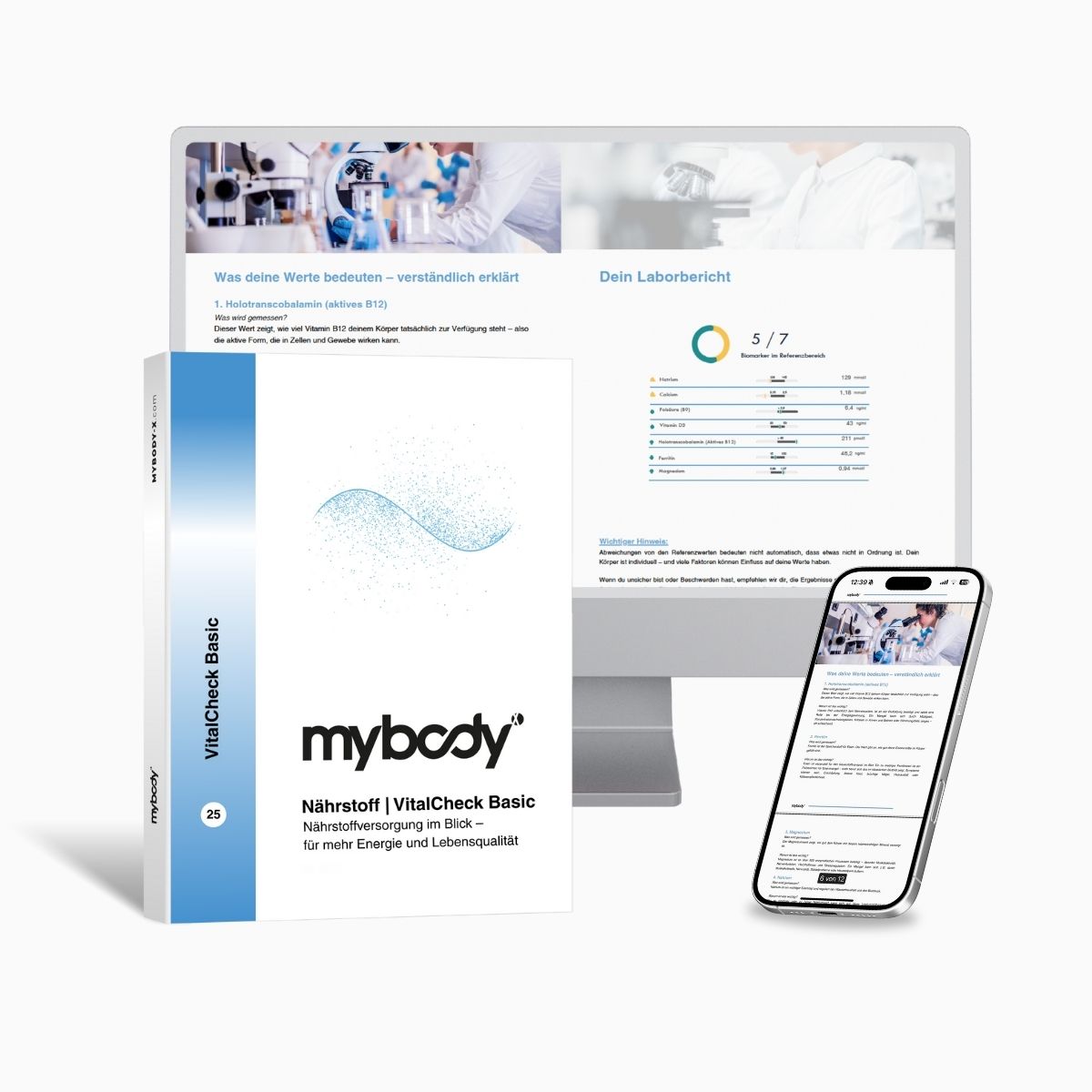
Capillary blood test
BalanceCheck | Electrolytes & Minerals Test
15 elements from a blood sample, including the four electrolytes in the basic diagnostic workup: sodium, potassium, magnesium, and calcium, plus phosphorus, six trace elements, and four heavy metals. What the test cannot do: kidney function tests, blood glucose, and TSH are not included, so it does not replace the basic medical workup. It does not treat cramps or provide a diagnosis.
Laboratory analysis 3–5 working days after sample receipt
Product page information, accessed 10 August 2026
For the results to be meaningful, three cost-free things matter. The following overview summarizes them.
Two-week cramp log
Date, time, side, duration. Four details per night, nothing more.
Place your medication list alongside it
Diuretics, statins, asthma inhalers, beta blockers, contraceptives. Include the start date for each.
Add stretching as a test
Three minutes before going to bed, for four weeks, recorded in the log.
Bring your log to the consultation
Bring your log, medication list, and results together. This noticeably shortens the medical history.
Who a measurement makes sense for—and who it does not
Makes sense for you if …
you regularly experience cramps, have been medically evaluated, and want to monitor your electrolytes over time.
you sweat heavily, do a lot of sports, or work in the heat and want to know where your levels stand.
you want to view the four electrolytes together with trace elements rather than individually, scattered over several years.
Probably not if …
you notice one of the warning signs from Chapter 7. In that case, arranging an appointment is the right order of priority—not taking the test.
you expect the result to provide treatment. No value treats a cramp, and the evidence for magnesium is clear.
you need the full basic diagnostic workup. Kidney function tests, blood glucose, and TSH are not included in this test.
Limits: what a measurement cannot tell you about cramps
The most common case remains unexplained. By definition, an idiopathic cramp has no identifiable cause, and no laboratory value changes that. Unremarkable results are the norm with this symptom pattern, not a disappointment.
A test also covers only part of the basic diagnostic workup. In addition to the four electrolytes, the German Society for Neurology lists a complete blood count, blood glucose, creatinine, glomerular filtration rate, urea, creatine kinase, liver values, and TSH (2023). Anyone who needs a complete evaluation needs to see a medical practice.
The evidence for treatment also remains limited. Regarding magnesium, Cochrane, the German Nutrition Society, and the German Society for Neurology agree that its effectiveness for idiopathic cramps has not been established. For stretching exercises, there is one positive study, countered by a skeptical review.
Finally, a limitation concerning our own scope. An electrolyte level does not explain why a nerve sends an incorrect signal at night. It indicates whether one of the treatable contributing factors is present. That is less than many people expect, and more than a guess.
There is also a limitation that is rarely mentioned. BalanceCheck measures magnesium in the blood, and as described in the article on normal magnesium levels, only one to two percent of the total amount is found there. A normal magnesium level therefore does not rule out insufficient magnesium in the tissues. This applies to every blood test, regardless of the provider.
This list may read like an argument against testing. It is not. It is an argument against expecting a number to explain an unpleasant night. What the test provides is an exclusion, and in a condition without an identifiable cause, exclusions are often the only progress there is.
What matters for nighttime cramps
If you take away just one action from this article, make it this: For four weeks, stretch your calf and the back of your thigh for three minutes every evening, and mark each night whether you had a cramp.
The reason is unremarkable. Of all the measures in this text, this is the only one backed by a positive randomized study, and it costs nothing. If the tally remains unchanged, you have ruled out one possibility. That, too, is a result.
It began with the question of the cause. The most honest answer is: Most of the time, there is no cause that can be found. What does exist are a few contributing factors that can be checked, and one exercise that takes three minutes.
Frequently asked questions
What causes nighttime calf cramps?
In the most common cases, no identifiable cause can be found. The guideline of the German Society for Neurology describes idiopathic muscle cramps as occurring acutely and without an identifiable cause, and locates the trigger in the nerve fibers (2023). Symptomatic cramps may be promoted by calcium or magnesium deficiency, dehydration, severe liver or kidney failure, and nerve damage.
Does magnesium help with nighttime calf cramps?
Based on the available evidence, no. A Cochrane review of eleven studies involving 735 participants concludes that magnesium probably does not reduce the frequency or severity of cramps in older adults (2020). For pregnant women, the same review states that the evidence is uncertain rather than demonstrating effectiveness. The DGN notes that an effect at doses of 100 to 520 milligrams per day has not been established (2023).
When should I seek medical advice for calf cramps?
The MSD Manual lists cramps in the arms or torso, muscle twitching, weakness, pain or loss of sensation, and cramps after severe fluid loss as warning signs (2025). In the event of sudden weakness, loss of sensation, or other severe symptoms, medical advice should be sought as quickly as possible. A self-test is the wrong order of steps here.
Which blood values are tested for muscle cramps?
The DGN guideline lists a complete blood count, the electrolytes sodium, potassium, magnesium, and calcium, blood glucose, creatinine, glomerular filtration rate, urea, creatine kinase, liver values, and TSH as the basic diagnostic workup (2023). If there is a specific suspicion, additional values are tested, including thyroid hormones, phosphate, vitamin D, parathyroid hormone, ferritin, and zinc.
What helps with an acute cramp?
The DGN lists static stretching of the cramped muscle and tensing the opposing muscles as the first measure in an acute case (2023). For a calf cramp, this means pulling the toes toward the shin and holding the position. For prevention, the available data most strongly support stretching exercises before going to bed, although the evidence is limited.
Next step
Four values that are routinely checked for cramps
Sodium, potassium, magnesium, and calcium are included in the basic diagnostic workup in the DGN guideline. The BalanceCheck measures these along with eleven other elements from a blood sample. It does not replace medical evaluation and does not treat cramps.
Go to BalanceCheck Electrolytes at a GlanceRead more
You might also be interested in
When the loss of strength is the main issue rather than the cramp.
The overview of all electrolytes, if you’re thinking beyond the calf.
Sources
- German Society of Neurology (DGN): S1 Guideline on Crampi and Muscle Cramps, AWMF Registry No. 030/037 (as of 2023) – register.awmf.org
- Garrison SR, Korownyk CS, Kolber MR et al.: Magnesium for Muscle Cramps. Cochrane Database of Systematic Reviews, CD009402 (2020) – cochrane.org
- MSD Manual, Patient Edition: Muscle Cramps, Mark Freedman (as of 2025) – msdmanuals.com
- German Nutrition Society (DGE): Selected Questions and Answers on Magnesium (as of 2022) – dge.de
The verbatim quote on the evidence for magnesium, the definition of muscle cramps, all frequency figures, the classification of statins, the basic diagnostic assessment, and the statement on stretching exercises come from source [1]. The findings of the Cochrane review on magnesium, including the statement concerning pregnant women, come from [2]; the warning signs and recommendation to seek medical evaluation come from [3]; and the confirmation of the evidence for magnesium by the professional society and the tolerable upper intake level come from [4]. The sequence ratios for diuretics, beta agonists, and statins come from Garrison SR et al., Archives of Internal Medicine 172(2), 2012; the classification of non-pharmacological measures comes from Hawke F et al., Cochrane Database of Systematic Reviews CD008496, 2021. Both are attributed in the text with the authors, journal, and year. Information on price, biomarkers, sample type, and laboratory comes from the mybody®x product page, accessed on 10.08.2026; processing times follow the central specification for blood tests. All sources were accessed and reviewed on 10.08.2026.

mybody®x Editorial & Expert Team
Laboratory Diagnostics Nutritional Science Blood Analysis Interpretation Nutrigenetics
This article was created by the mybody®x editorial and expert team. The team combines laboratory diagnostics, nutritional science, and the interpretation of blood analyses. Everyone who contributes to it is listed on the authors page.
Published on 10.08.2026 · Last updated on 10.08.2026
The content is intended for general information and does not replace medical advice, diagnosis, or treatment. Reference ranges depend on the laboratory, method, and age—always follow the information on your test report.




Share now:
Create a weight-loss meal plan: how to structure it
Electrolytes or water after exercising: what really matters