
Electrolytes or water after exercise: what really matters
The most important points at a glance
For exercise lasting under an hour, the answer is clear: water is sufficient. The sports nutrition working group of the German Nutrition Society states that, when starting sufficiently hydrated, endurance exercise lasting up to 60 minutes does not yet require fluid intake during exercise (2019). Sodium and carbohydrates are recommended only from around an hour and a half onward.
In the EU, exactly two claims are authorized for carbohydrate-electrolyte solutions, and both only under certain conditions: 80 to 350 kilocalories per liter from carbohydrates, 460 to 1,150 milligrams of sodium, and an osmolality of 200 to 330 mOsm per kilogram. Calorie-free powders do not meet these requirements.
You will first read about the thresholds based on exercise duration. This is followed by the figures for drink composition, a comparison of the three options, what the EU actually permits, the risk of drinking too much, and the question of who might benefit from looking at their own values.
What to expect in this article
1. Three thresholds that determine everything
2. What applies to recreational exercise lasting under an hour
3. What matters after exercise
4. Sodium in figures: sweat, drinks, regulations
5. How to recognize a sensible sports drink
6. Water, spritzer, or electrolyte powder compared
7. What the EU actually permits for electrolyte drinks
8. Why drinking too much is the greater risk
9. How much you should actually drink in everyday life
10. Who might benefit from looking at their own values
11. Limitations: what this article does not answer
12. What matters after exercise
Frequently asked questions
Sources
Three thresholds that determine everything
The question “electrolytes or water” has no universal answer, but it does have an answer that depends on exercise duration. The DGE sports nutrition working group identifies three thresholds, and all recreational exercise falls between them.
According to this position statement, no fluid intake is necessary for less than 30 to 40 minutes, and minor deficits during exercise are tolerable. After 60 minutes, drinking becomes advisable. Only beyond an hour and a half do carbohydrates and sodium become relevant.
Key point
For most people, the question does not arise at all. Anyone who runs for an hour or goes to the gym is below every threshold at which electrolytes are discussed professionally.
What applies to recreational exercise lasting under an hour
The key sentence appears in the position statement of the DGE working group and is worded more precisely than most summaries suggest.
Documented source
“If you start physical activity sufficiently hydrated, endurance exercise lasting up to 60 minutes does not yet require fluid intake during exercise.”
Sports Nutrition Working Group of the German Nutrition Society (DGE)
Fluid Management in Sport, Position Paper, 2019
The condition comes first: start sufficiently hydrated. Anyone who has barely drunk anything all day and then trains for an hour starts with a deficit that was not caused by the exertion.
The second sentence in the same position paper sets the threshold even lower. Accordingly, no fluid intake is generally necessary for exertion lasting less than 30 to 40 minutes. Between that mark and one hour lies the range in which drinking is possible but not necessary.
That covers most recreational sports. A 45-minute run, an hour at the gym, an evening bike ride: in none of these cases does the position paper recommend consuming electrolytes during exercise. Instead, it states that consuming additional minerals or vitamins during exercise is not necessary.
And if it takes longer
For exertion lasting more than 60 minutes, drinking during exercise is recommended according to the same position paper. During longer endurance sessions lasting more than 90 minutes and in team sports, the drink should provide carbohydrates as well as water—30 to 60 grams per hour or 60 to 80 grams per liter.
Sodium is explicitly recommended only when the sweat rate is very high and the duration of exertion exceeds one and a half to two hours. So there are two conditions, not one.
Why there is no fixed fluid intake
The position paper notes that blanket recommendations for fluid intake during sports make little sense because fluid losses vary considerably both between individuals and within the same individual. The sweat rate ranges from 0.3 to 2.5 liters per hour.
The threshold makes it concrete: once fluid loss reaches 2 to 4 percent of body weight, impairments in strength and endurance performance can be expected. At 70 kilograms, that is 1.4 to 2.8 kilograms.
What matters after exertion
This is where the article’s real reassurance lies. If body weight has decreased by less than five percent, according to the DGE position paper, consuming normal meals and snacks combined with sufficient water intake is enough to restore fluid and electrolyte balance.
Five percent of 70 kilograms is three and a half kilograms in one session. Anyone who reaches that mark has completed a competition, not a casual after-work workout.
When time is of the essence
For rapid and complete rehydration, the position paper gives a rule of thumb: around 1.5 liters of fluid per kilogram of weight lost. The amount above the actual loss is due to some of it being excreted again immediately.
This is relevant only if another bout of exertion is scheduled within the next 24 hours. If you finish in the evening and have the next day off, you do not need to do this calculation.
The scale tells you more than any drinking rule
The two figures in the DGE position—five percent and one and a half liters per kilogram—use the same reference value: body weight before and after exertion. This makes the scale the only measuring device this article needs.
The procedure is unremarkable. Weigh yourself before training, weigh yourself again afterward in dry clothing, and note the difference. Any fluid consumed during the session is added to the difference because it has already partially offset the loss.
The resulting value is your personal sweat rate for that exertion, at that temperature, on that day. That is precisely why the DGE position considers blanket recommendations for fluid intake during exercise to be of limited value: losses vary between people and in the same person, and the range of 0.3 to 2.5 liters per hour is too broad for an average to apply to anyone.
Doing the calculation twice—once on a cool day and once on a hot day—makes the difference clearer than any table. This is the most reliable information available without laboratory testing.
Sodium in figures: sweat, drink, regulation
Three figures describe the same substance in the same unit and come from three different contexts. Read side by side, they provide a useful picture.
Sodium per liter
900 mg
A liter of sweat contains an average of sodium, individually ranging from 175 to 1,512 mg
400–1.100
mg of sodium per liter recommended by the DGE position for a sports drink during prolonged exertion
460–1.150
mg of sodium per liter required by the EU regulation for a drink to carry the authorized claims
Source: DGE Sports Nutrition Working Group, Fluid Management in Sports (2019); Regulation (EU) No. 432/2012 of May 16, 2012, Annex
Why the three figures are so close together
This is not a coincidence. A drink intended to replace sweat losses is based on its composition. The DGE range and the regulation's corridor overlap almost completely, and the average sodium content of sweat lies right in the middle.
In practical terms, a drink containing significantly less than 400 milligrams of sodium per liter does not replace any significant share of the loss. It is then simply flavored water, which is fine as long as it is not marketed as an electrolyte replacement.
How to recognize a suitable sports drink
The DGE position names three figures. Accordingly, optimal water absorption is achieved with slightly hypotonic or isotonic drinks containing 4 to 8 percent carbohydrates and 400 to 1,100 milligrams of sodium per liter. Osmolality should be below 300 mmol per kilogram.
For additional electrolytes, there are upper limits rather than recommendations. If additional electrolytes have been added to the beverage, concentrations should not exceed 200 to 250 milligrams per liter for potassium and calcium and 75 to 125 milligrams per liter for magnesium.
The alternative that costs nothing
The same position statement mentions a mixture that never appears in advertising: Fruit juice spritzers made from one part fruit juice and two parts high-sodium, low-carbonation mineral water are well suited as rehydration drinks.
Two details in it are regularly overlooked. The ratio is one to two, not half and half, and the mineral water should be high in sodium. A ready-made spritzer bought with low-sodium water meets neither requirement.
Where these figures appear on a package
The carbohydrate concentration can be read from the nutrition table, where it is listed as grams of carbohydrates per 100 milliliters. Four to eight percent means 4 to 8 grams per 100 milliliters, or 40 to 80 grams per liter. This range corresponds to the 60 to 80 grams per liter that the DGE position statement specifies for exercise lasting more than 90 minutes.
Sodium is the second value, and it is the more troublesome one. Many nutrition tables list salt instead of sodium. If you find salt in grams and need sodium in milligrams, use a conversion factor of 400: One gram of salt per liter corresponds to approximately 400 milligrams of sodium per liter. For the 400 to 1,100 milligrams cited by the DGE, a beverage therefore needs approximately one to just under three grams of salt per liter.
Osmolality is stated on hardly any packaging. It cannot be checked from the outside, and this article does not claim otherwise. The first two figures are sufficient to roughly classify a product.
Water, spritzer, or electrolyte powder in comparison
After exercise, three options are available. The table compares them according to the same four criteria.
| Criterion | Water | Apple spritzer, one part juice to two parts water | Calorie-free electrolyte powder |
|---|---|---|---|
| Sufficient for under an hour | Yes. Up to 60 minutes, no intake at all is required during exercise | Yes, but without any additional proven benefit compared with water | Yes, likewise without any proven added benefit in this area |
| Provides carbohydrates | No | Yes, from the fruit juice content | No, not by definition |
| May bear the authorized EU claims | No, the conditions of the regulation are not met | No, it is not an authorized product within the meaning of the regulation | No. Without 80 to 350 kcal per liter from carbohydrates, a basic requirement is missing |
| Mentioned in the DGE position statement | Yes, together with normal meals and less than five percent weight loss | Yes, explicitly as a suitable rehydration drink | No. Additional minerals are not required during exertion |
The third line is the most surprising finding. The very product that advertises its electrolytes meets the conditions for the authorized claims the least.
What the EU actually allows for electrolyte drinks
Regulation (EU) No 432/2012 establishes which health claims may be made about foods. For carbohydrate-electrolyte solutions, the annex contains exactly two entries.
The first states that carbohydrate-electrolyte solutions contribute to maintaining endurance performance during prolonged endurance exercise. The second states that they improve water absorption during physical activity. That is all it says.
The conditions in the wording
Both claims are subject to conditions. According to the annex, carbohydrate-electrolyte solutions must contain 80 to 350 kilocalories per liter from carbohydrates, and at least 75 percent of the energy must come from carbohydrates with a pronounced blood-glucose-raising effect.
There are also two further requirements: between 20 and 50 millimoles of sodium per liter, that is, 460 to 1,150 milligrams, and an osmolality of 200 to 330 mOsm per kilogram of water.
What follows from this
By definition, a calorie-free electrolyte powder provides none of the 80 to 350 kilocalories per liter from carbohydrates. It therefore does not meet the first condition and may not carry the two authorized claims.
Claims such as “accelerates recovery,” “prevents muscle cramps,” “replenishes an electrolyte deficiency,” or “prevents dehydration” are not authorized and therefore cannot be made. Anyone who reads such sentences on packaging is not reading a verified claim.
What the regulation explicitly does not say
A distinction is needed here that is often overlooked in the discussion. The fact that a product does not meet the conditions for an authorized claim says nothing about its effects. It is a statement about what may appear on the packaging.
The regulation assesses advertising claims, not drinks. It does not declare any calorie-free powder harmful or any powder useless. It draws a line beyond which a manufacturer may print a particular sentence, and that line is 80 kilocalories per liter from carbohydrates and 460 milligrams of sodium per liter.
The same applies in the other direction. A drink that meets the conditions is not automatically suitable for your own level of exertion. The two authorized claims concern prolonged endurance exercise, not half an hour after work.
Why drinking too much is the greater risk
The DGE position statement describes the mechanism: Excessive intake of mineral-poor beverages such as tap water or low-sodium mineral water can cause hyponatremia when accompanied by substantial sweat losses—that is, a plasma sodium concentration below 135 mmol per liter.
During prolonged exertion, drinking too much is more dangerous than drinking too little.
During prolonged exertion, drinking too much is more dangerous than drinking too little. The position statement lists possible consequences including nausea, vomiting, headaches, impaired consciousness, and muscle cramps, progressing to respiratory arrest, pulmonary and cerebral edema, and coma. In the worst case, exercise-associated hyponatremia can be fatal.
The simple countermeasure
To prevent this, people are advised not to drink beyond their thirst. The position statement recommends ideally drinking no more than 80 percent of the measured fluid loss during prolonged exertion.
This turns the common rule on its head. Anyone who decides to drink a set cupful every twenty minutes is following a plan rather than a signal. Thirst knows your sweat rate; a plan does not.
Anyone who notices nausea, headaches, or confusion after prolonged exertion should stop drinking and seek medical help. Hyponatremia is a medical emergency, not something to treat yourself.
How much you should actually drink in everyday life
Outside the context of sports, there is a simple guideline. The Institute for Quality and Efficiency in Health Care states that, in Germany, drinking around 1.5 liters per day is a good guideline for adults (2023).
The DGE arrives at similar figures by a different route. For people aged 25 to under 51, it gives a guideline of 1,410 milliliters from beverages and around 2,600 milliliters of total water intake per day, along with the rule of thumb of 35 milliliters per kilogram of body weight. These figures are based on a derivation from 2000.
When more is advisable
IQWiG lists situations involving increased needs, including strenuous physical activity at work or during leisure time and high outdoor temperatures. The DGE additionally mentions fever, vomiting, diarrhea, and high salt intake from food.
Regarding electrolyte drinks, IQWiG sets out a narrowly defined condition: After prolonged heavy sweating, isotonic drinks with electrolytes may be useful; likewise, salty broth may be appropriate in cases of fever or diarrhea. The condition is prolonged heavy sweating—not an after-work run.
Why 1.5 liters and 2.6 liters are not contradictory
The two figures refer to two different things. The DGE’s 1,410 milliliters refers to beverages, while the roughly 2,600 milliliters refers to total water intake. The difference comes from solid foods and from water produced by metabolism itself.
In practical terms, eating soup, fruit, and vegetables covers part of your intake without having to open a bottle. The guideline of around 1.5 liters per day cited by IQWiG refers to the same beverage portion, not the total amount.
These values are reference ranges for adults without unusual physical strain. They are neither an upper limit nor a target to be worked toward. Anyone who drinks more on hot days or after training follows the same principle, just with a higher baseline.
Who may benefit from checking their own values
A blood test does not answer the question addressed in this article. It does not show whether water or an electrolyte drink was the better choice, and it does not measure sweat loss. What it shows is the electrolyte status at the time of sampling, measured together rather than separately.
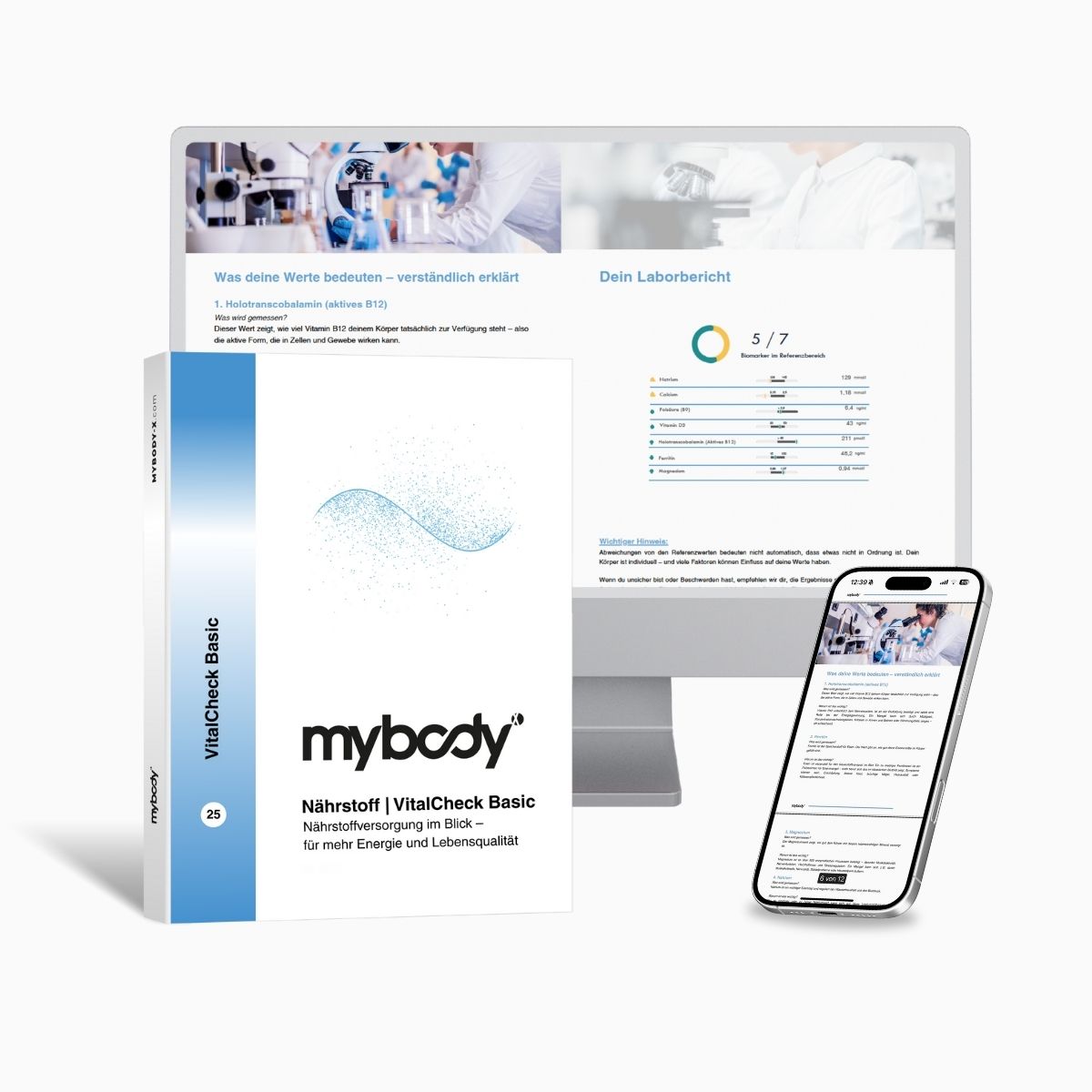
mybody®x works with a certified medical laboratory in Germany, performs its analyses in compliance with the GDPR, and has been active since 2016, in the consumer market since 2022. The test below is the version for electrolytes and minerals.
Capillary blood test
BalanceCheck | Electrolytes & minerals test
15 elements from one blood sample: sodium, potassium, calcium, magnesium, and phosphorus, plus six trace elements and four heavy metals. What the test does not do: it does not answer whether you need water or an electrolyte drink after training, and it does not provide a diagnosis. For healthy recreational athletes, the sources reviewed identify no indication for routine electrolyte testing.
Laboratory analysis 3–5 business days after sample receipt
Information from the product page, accessed 11 August 2026
The following two columns are intentionally asymmetrical. The right one is longer because it applies to more readers of this article.
Makes sense for you if …
you regularly train for more than two hours or do physical work in hot conditions and want to see your values together at one point.
you are preparing for a medical evaluation and would like to bring a baseline value.
you want to see your electrolytes together with trace elements rather than separately over the years.
Probably not if …
you do recreational sports for under an hour. None of the sources reviewed identifies an indication for testing in this case.
you want to know how much you have sweated out. No blood value shows that; the scales do.
you want to make a decision about a dietary supplement based on it. You need medical guidance for that.
Limitations: what this article does not answer
There is no direct comparison of electrolyte drinks and water for recreational exercise lasting less than an hour in the sources reviewed. No statement describes electrolyte drinks as ineffective in this context. Only the indirect chain is supported: no intake is required for less than 60 minutes, and additional minerals during exercise are not necessary.
We found nothing about coconut water in any of the four sources, either for or against it. It therefore appears in this article neither as an alternative nor as a warning.
The figures also have a history. The DGE reference values for water intake are based on a derivation from 2000. They are the currently published values, but they are not new, and that should be said.
Finally, one limitation on our part. None of the four sources contains a recommendation to routinely measure blood electrolytes in healthy recreational athletes. This article therefore contains no recommendation to get tested, but rather a hydration rule.
Chapter at a glance
For exercise lasting less than an hour, water is sufficient, and for exercise lasting less than 30 to 40 minutes, no intake at all is required during exercise. Sodium is recommended only after one and a half to two hours and when the sweat rate is high. After exercise, normal meals and water are sufficient when weight loss is less than five percent. In the EU, exactly two claims are authorized for carbohydrate-electrolyte solutions, and calorie-free powders do not meet their conditions.
What matters after exercise
If you take away just one action from this article, let it be this: next time you see an electrolyte product on the shelf, turn the package around and look for two numbers. Kilocalories per liter from carbohydrates and milligrams of sodium per liter.
The reason is unremarkable. If the first value is below 80 and the second below 460, the product does not meet the conditions of the regulation under which the two authorized claims apply at all. This is not an opinion, but a calculation based on two numbers from the back of the package.
It began with the question of electrolytes or water. The most honest answer is: for most people on most days, water, followed by dinner. That is less than the wall of products on the shelf promises, and more than a serving of powder can deliver.
Frequently asked questions
Do I need electrolytes after exercising, or is water enough?
For exercise lasting less than an hour, water is sufficient. The DGE Sports Nutrition Working Group states that, when starting adequately hydrated, endurance exercise lasting up to 60 minutes does not require fluid intake during exercise, and that additional minerals or vitamins during exercise are not necessary (2019). Sodium is recommended only after about one and a half to two hours and when the sweat rate is high.
What must a sports drink contain?
The DGE position paper specifies 4 to 8 percent carbohydrates, 400 to 1,100 milligrams of sodium per liter, and an osmolality below 300 mmol per kilogram (2019). EU Regulation 432/2012 requires, for the permitted claims, 80 to 350 kilocalories per liter from carbohydrates, at least 75 percent of the energy from high-glycemic carbohydrates, 460 to 1,150 milligrams of sodium per liter, and an osmolality of 200 to 330 mOsm per kilogram.
Is apple spritzer a good drink after exercise?
The DGE position paper expressly identifies fruit juice spritzers as suitable rehydration drinks, mixed from one part fruit juice and two parts sodium-rich, low-carbonation mineral water (2019). Both details matter: the one-to-two ratio and the sodium-rich water. A ready-made spritzer purchased with low-sodium mineral water does not meet these conditions.
What may an electrolyte drink claim about itself in the EU?
Exactly two things, and only under certain conditions. Under Regulation (EU) No. 432/2012, it is permitted to claim that carbohydrate-electrolyte solutions contribute to the maintenance of endurance performance during prolonged endurance exercise and that they improve water absorption during physical exercise. Claims concerning recovery, muscle cramps, or correcting a deficiency are not permitted.
Can you drink too much during exercise?
Yes. The DGE position paper states that consuming too much mineral-poor fluid while losing large amounts of sweat can lead to hyponatremia, meaning a plasma sodium concentration below 135 mmol per liter. Reported consequences range from nausea and headaches to cerebral edema and coma. It recommends not drinking beyond thirst and consuming no more than 80 percent of the measured sweat loss during prolonged exertion.
Next step
Two numbers on the back
Kilocalories per liter from carbohydrates and milligrams of sodium per liter. That is all you need to classify a product. Anyone who trains for more than two hours or works in the heat and wants to see their values together can find them in the BalanceCheck.
To the BalanceCheck When to take electrolytesRead more
You might also be interested in
The intake side of the topic, if you are more interested in timing than comparison.
What matters after exertion, beyond fluids and salt.
Sources
- Mosler S, Braun H, Carlsohn A et al. (DGE Sports Nutrition Working Group): Fluid management in sports. Ernährungs Umschau, 2019 – dge.de
- European Commission: Regulation (EU) No 432/2012 of 16 May 2012, Annex, entries on carbohydrate-electrolyte solutions. Official Journal L 136 of 05/25/2012 – eur-lex.europa.eu
- Institute for Quality and Efficiency in Health Care (IQWiG): Fluid deficiency (dehydration), as of 2023 – gesundheitsinformation.de
- German Nutrition Society (DGE): Reference values for water (derivation 2000) – dge.de
The verbatim quotation on fluid intake up to 60 minutes, all exertion thresholds, the information on beverage composition, sodium in sweat, fruit juice spritzers, rehydration, and hyponatremia are from source [1]. The approved claims and their conditions, verbatim, are from [2]. The guideline of 1.5 liters per day, situations involving increased requirements, and the condition for isotonic beverages are from [3]; the guideline values for water intake and the rule of thumb of 35 milliliters per kilogram are from [4]. Information on price, biomarkers, sample type, and laboratory comes from the mybody®x product page, accessed on 08/11/2026; processing times follow the central specification for blood tests. All sources were accessed and reviewed on 08/11/2026.

mybody®x Editorial & Expert Team
Laboratory diagnostics Nutritional science Blood analysis interpretation Nutrigenetics
This article was created by the mybody®x editorial and expert team. The team combines laboratory diagnostics, nutritional science, and the interpretation of blood analyses. Those who contribute to it are listed on the authors page.
Published on 08/11/2026 · Last updated on 08/11/2026
The content is intended for general information and does not replace medical advice, diagnosis, or treatment. Reference ranges depend on the laboratory, method, and age; the information on your test report is always authoritative.

Share now:
Nighttime calf cramps: Causes and what the values indicate
Pharmacies offer self-tests, not DNA analyses.