

Magnesium in serum and whole blood: two different messages
The essentials at a glance
One thing about magnesium is clearly documented: The serum value reflects the amount in the body poorly. The medical literature states this with unusual clarity.
This is often turned into a second statement, namely that a measurement in whole blood provides a more meaningful result. This second statement does not appear in the sources reviewed, and this article says so openly.
You will read the quoted source verbatim, three documented facts about distribution in the body, three common statements examined in a fact-check, a comparison of both measurement methods, and a note on how the medical literature actually deals with the problem.
What to expect in this article
1. Two ways to measure the same substance
2. The documented source
3. Where magnesium is found in the body
4. Three figures on distribution
5. What a serum value can tell us
6. Three sentences in the fact-check
7. The core point in one sentence
8. What the sources say about whole blood
9. Comparing the two measurement methods
10. How the medical literature deals with the problem
11. For whom a magnesium value is useful
12. What a capillary blood test can show here
13. Limitations: what both methods leave unanswered
14. What matters for this value
Frequently asked questions
Sources
Two ways to measure the same substance
Few laboratory values are mentioned with a caveat as often as magnesium. Anyone looking into the subject quickly encounters the statement that the usual value says little.
The usual value is serum magnesium, measured from the liquid portion of the blood without cells. As an alternative, measurement in whole blood is mentioned, meaning that it includes the blood cells.
The reasoning behind it is plausible: If magnesium is located predominantly in the cells, then a measurement that includes the cells should show more.
This article examines both halves of this line of thought separately. The first half is well documented. The second does not appear in the sources reviewed, and that is precisely where we do not repeat what is widely read.
The documented source
The sentence that carries the point appears in the overview of a professional reference work and is remarkably unambiguous.
Documented source
“The serum magnesium concentration is not closely related to either total body magnesium content or intracellular magnesium concentration.”
MSD Manual, Professional Edition
Overview of magnesium concentration disorders, Lewis JL III, as of June 2025
Two reference quantities are ruled out in this sentence: the total amount in the body and the concentration in the cells.
The same source makes this even clearer elsewhere. It states that the serum magnesium concentration may be normal even when the concentration of free magnesium is measured, although the reserves of intracellular or bone-stored magnesium are reduced (as of June 2025).
This is not a cautious formulation, but a clear statement about the limits of a value. And it comes from the same source that uses this value for diagnostic purposes.
Where magnesium is found in the body
The explanation for this limit lies in the distribution, which is described in both sources.
IQWiG states that most magnesium in the body is found in tendons, teeth, and bones; about two-thirds is bound in the bones alone, and only 1 to 2 percent of all magnesium is found in the blood (as of March 20, 2025).
The MSD Manual uses different units and presents a related picture. A 70-kilogram adult contains approximately 1,000 mmol of magnesium, about 50 percent of which is incorporated into bone and is not readily available for exchange with other compartments, while extracellular fluid contains approximately 1 percent of total-body magnesium (as of June 2025).
The two sources draw the boundaries between compartments differently, which is why both figures are shown here rather than an averaged number. They agree on the crucial point: the share captured by a serum value is around one percent of the total stores.
Three statements about distribution
Three statements from the sources reviewed. They provide context and do not constitute a diagnosis.
Documented information
1–2 %
of all magnesium is found in the blood; about two-thirds is bound in the bones alone (IQWiG, as of March 20, 2025)
approx. 50%
of total-body magnesium is incorporated into bone and is not readily available for exchange with other compartments (MSD Manual, professional edition, as of June 2025)
0,70–1,05
mmol/L is the stated reference range for adults aged 18 and over; this corresponds to 1.7–2.6 mg/dL (IQWiG, as of March 20, 2025)
The third figure shows how narrow the range is. The difference between the lower and upper limits is roughly half the lower value, and this narrow range describes a share of one to two percent of the total stores.
And as with every laboratory value, the decisive factor is the reference range given on your own report, because reference values may vary from one laboratory to another (IQWiG, as of April 2, 2025).
What a serum value can tell you
So that this article does not overstate the case in the other direction: the serum value is not worthless.
The MSD Manual defines a clinically relevant threshold: hypomagnesemia occurs at serum magnesium concentrations below 1.8 mg/dL or 0.70 mmol/L, while a severe form involves concentrations below 1.25 mg/dL or 0.50 mmol/L (as of June 2025).
These thresholds are defined, assigned numerical values, and used medically. A serum value therefore answers one question very precisely: whether the concentration in the blood is below a defined limit.
What it does not answer is the question of total stores. That is the difference between a precise value and a comprehensive value, and with magnesium these two properties diverge.
Three statements in the fact check
These three statements come up as soon as a magnesium level is discussed.
Checked against the available evidence
Widespread
“My magnesium level is normal, so everything is fine.”
Established
The MSD Manual states that serum magnesium concentration may be normal even though reserves of intracellular or bone-stored magnesium are reduced (as of June 2025).
Widespread
“Whole-blood measurement is the better test.”
Established
The sources reviewed for this article say nothing about this. Neither IQWiG (as of March 20, 2025) nor the MSD Manual (as of June 2025) mentions a whole-blood measurement, a reference range for it, or any statement about its significance.
Widespread
“The serum value is therefore useless.”
Established
The same source defines hypomagnesemia using the serum value as concentrations below 0.70 mmol/L, and the severe form as below 0.50 mmol/L (MSD Manual, as of June 2025). For this question, it is the decisive value.
The core in one sentence
This is where the subject can be brought together.
The fact that one value leaves a question unanswered does not mean that another value answers it.
This exact gap is regularly skipped over when it comes to magnesium. The documented weakness of one value is turned into the undocumented strength of another.
This is a logical step that none of the reviewed sources takes, and this article does not take it either.
What the sources say about whole blood
This is where a sentence belongs that is rarely found in an advice article—and it partly contradicts this article’s headline.
The sources reviewed for this article say nothing about whole-blood measurement. Neither IQWiG in its article on the laboratory value magnesium (as of March 20, 2025) nor the MSD Manual in its overview and chapter on hypomagnesemia (as of June 2025) mentions it.
What is established: The serum value is not closely related to total stores or to the concentration in cells (MSD Manual, as of June 2025). What does not follow from this: that another measurement method establishes this relationship.
We present both versions openly instead of adopting one of them. One version says that serum and whole blood provide two different pieces of information. The other says that the reviewed sources address only the first of the two. If this changes, this article will receive a new date and a new paragraph at this point.
The two measurement methods compared
The table compares what the reviewed sources state about each of the two methods. It provides context and does not constitute a diagnosis.
| Measurement method | What is measured | What the sources say about it | What remains unresolved |
|---|---|---|---|
| Serum magnesium | The concentration in the liquid portion of the blood, without cells | Reference range 0.70–1.05 mmol/L (IQWiG, as of 03/20/2025); hypomagnesemia below 0.70 mmol/L (MSD Manual, as of June 2025) | The stores—the value is not closely related to total-body magnesium |
| Whole-blood magnesium | The concentration in the blood, including the blood cells | Not mentioned in the sources reviewed: no reference range and no statement about its significance | Everything—without a statement from the sources, neither a recommendation nor an exclusion is possible here |
| Clinical suspicion | Not a measurement value, but a medical assessment based on several values | In cases of unexplained hypocalcemia or refractory hypokalemia, magnesium deficiency should be suspected even if the serum concentration is normal (MSD Manual, as of June 2025) | The number—this approach does not provide a separate measurement value |
| Do not measure at all | Nothing | A single laboratory value is always only one component of an overall diagnosis (IQWiG, as of 02/04/2025)—without a value, that component is entirely missing | The question of the concentration in the blood, for which the serum value is decisive as well |
The third line is the most surprising. The medical literature does not solve the problem through a better measurement method, but through other values from the same test result.
How the medical literature addresses the problem
This point deserves its own chapter because it contains the actual answer to the original question.
The MSD Manual states: Magnesium deficiency should be suspected in patients with unexplained hypocalcemia or refractory hypokalemia, even if the serum magnesium concentration is normal (as of June 2025).
In other words, suspicion does not arise from the magnesium value, but from the behavior of other values. A calcium value that is low for no apparent reason, or a potassium value that does not behave as expected, raises the question of magnesium.
In practice, this means the serum value’s limitation is not overcome by another measurement, but by considering several values together. This is less spectacular than a new method and is supported by the sources.
This has a practical implication for interpreting results: A magnesium value becomes more informative when calcium and other values from the same sample are shown alongside it. Assessing how these values interact is a medical task.
Who may benefit from a magnesium test
The comparison concerns whether a documented magnesium value will help you.
Useful for you if …
You want to see magnesium together with calcium and other values from the same sample.
You want to bring dated results to a discussion at your doctor’s office.
You have been taking something for a long time and have never had a baseline value measured.
You know that this value answers a limited question and you are asking precisely that question.
Probably not if …
You expect a statement about your total magnesium stores. The serum value does not provide that.
You are looking for a whole-blood measurement. It is not included in our tests.
You are already undergoing evaluation. In that case, the practice that started it will guide you.
You expect a diagnosis. That is provided by a medical practice, not a self-test.
What a capillary blood test can show here
A capillary blood self-test does not provide a diagnosis and does not replace medical evaluation. What it can do is present several values from the same sample side by side, and for magnesium, that is precisely the demonstrable benefit.
VitalCheck by mybody®x (MYBODY Lab GmbH) measures magnesium together with calcium, phosphate, and albumin. A whole-blood measurement is not included, and this article does not claim anywhere that it would show more.
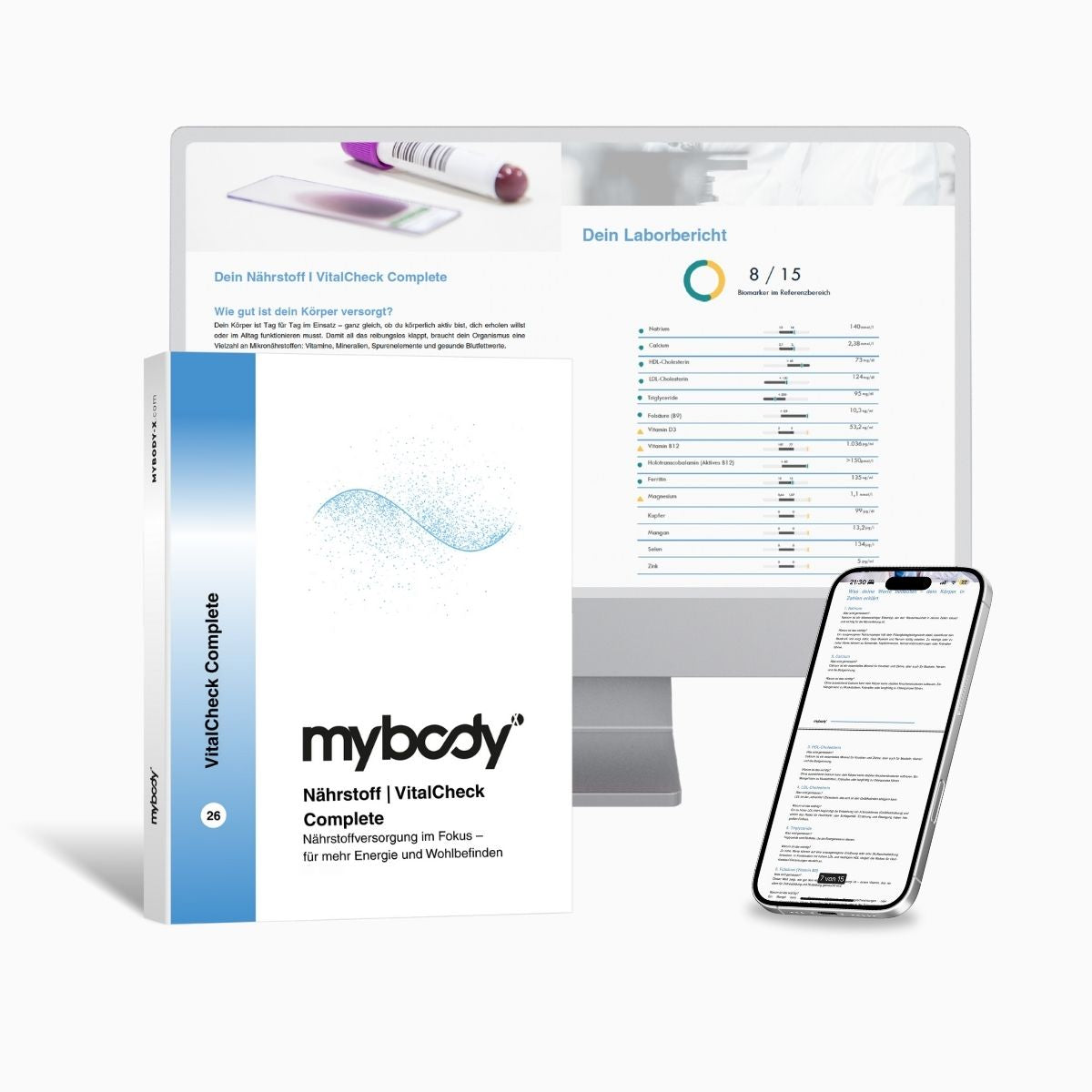
Capillary blood test
VitalCheck | Complete Nutrient & Mineral Test
Measures 18 values from the same sample, including magnesium, calcium, phosphate, albumin, 25-OH vitamin D3, ferritin, iron, transferrin, vitamin B12, folic acid, selenium, zinc, CRP, long-term blood sugar, and total cholesterol, HDL, LDL, and triglycerides. What the test does not provide: no whole-blood measurement, no information about total body stores, no diagnosis, and no substitute for a medical examination.
Laboratory results 3–5 business days after sample receipt
Product page information, accessed August 17, 2026
Chapter at a glance
A capillary blood test provides the serum value alongside calcium, phosphate, and albumin from the same sample. It does not provide a whole-blood measurement or information about total body stores, and interpreting how these values interact belongs in a medical practice.
Limitations: what both approaches leave open
The first limitation is the baseline level. The serum magnesium concentration is not closely correlated with total body magnesium content or intracellular concentration (MSD Manual, as of June 2025). A normal value does not rule out reduced reserves.
The second limitation is the alternative. The reviewed sources say nothing about whole-blood measurement, and this article therefore makes no evaluative statement about it either. This is an open question, not an answered one.
The third limitation is context. The pathway described in the medical literature involves other values, such as unexplained hypocalcemia or refractory hypokalemia (MSD Manual, as of June 2025). This assessment is a medical task.
The fourth limitation is diagnosis. A single laboratory value usually cannot be used to infer a disease; only in conjunction with other values, symptoms, and examinations does a clear picture emerge (IQWiG, as of March 20, 2025).
What matters about this value
If you take away just one thing from this article, let it be this: The weakness of the serum value is documented; the strength of the alternative is not established in the sources reviewed.
The distribution is documented: Only 1 to 2 percent of total magnesium is found in the blood (IQWiG, as of March 20, 2025), and the serum concentration is not closely related to total stores (MSD Manual, as of June 2025). It is also documented what the serum value remains decisive for—namely, assessing hypomagnesemia below defined thresholds.
Everything concerning whole-blood measurement remains unresolved. What the medical literature offers here is not a different value, but a look at other values alongside it. This can be prepared using a lab report, and interpretation should then take place in a medical practice.
Frequently asked questions
Does a normal magnesium value rule out a deficiency?
The cited sources do not establish this with certainty. The MSD Manual states that the serum magnesium concentration may be normal even though reserves of intracellular or bone-stored magnesium are reduced (as of June 2025). The same source notes that the serum concentration is not closely related to total body magnesium stores.
Is whole-blood measurement better than the serum value?
The sources reviewed for this article contain no information on this. Neither IQWiG, in its article on the magnesium lab value (as of March 20, 2025), nor the MSD Manual (as of June 2025) mentions whole-blood measurement, a reference range for it, or any statement about its significance. We therefore make neither a recommendation for nor against it.
How much magnesium is actually in the blood?
IQWiG states that only 1 to 2 percent of total magnesium is found in the blood and that about two-thirds is bound in the bones alone (as of March 20, 2025). The MSD Manual cites approximately 1 percent of total body magnesium in extracellular fluid and approximately 50 percent in bone (as of June 2025).
When is it considered hypomagnesemia?
The MSD Manual cites serum magnesium concentrations below 1.8 mg/dL or below 0.70 mmol/L, and below 1.25 mg/dL or 0.50 mmol/L for the severe form (as of June 2025). The reference range on your own report is always decisive, and interpretation belongs in a medical practice.
How can a medical practice suspect a deficiency despite a normal value?
The MSD Manual describes a different approach based on other values: In patients with unexplained hypocalcemia or refractory hypokalemia, magnesium deficiency should be suspected even when the serum magnesium concentration is normal (as of June 2025). There, the suspicion arises from the interplay of several values, not from a different measurement method.
Next step
Read about magnesium in context
VitalCheck measures 18 values from capillary blood, including magnesium, calcium, phosphate, and albumin from the same sample. It does not provide whole-blood measurement, information about total stores, or a diagnosis, and does not replace medical evaluation.
To VitalCheckRead more
You might also be interested in
Why a tightly regulated value answers a different question than expected.
How an imbalanced electrolyte balance can make itself known.
Sources
- MSD Manual, Professional Edition: Overview of Magnesium Concentration Disorders, Lewis JL III (as of June 2025) – msdmanuals.com
- MSD Manual, Professional Edition: Hypomagnesemia, Lewis JL III (as of June 2025) – msdmanuals.com
- Institute for Quality and Efficiency in Health Care (IQWiG): Magnesium, as of March 20, 2025 – gesundheitsinformation.de
- IQWiG: Understanding laboratory values correctly, as of April 2, 2025 – gesundheitsinformation.de
The verbatim quotation concerning the relationship between serum concentration, total body magnesium, and intracellular concentration, as well as the figures of 1000 mmol, approximately 50 percent in bone, and approximately 1 percent in extracellular fluid, come from source [1]. The statement about normal serum values despite reduced reserves, the thresholds for hypomagnesemia and its severe form, and the note on unexplained hypocalcemia and refractory hypokalemia come from [2]. The figures of 1 to 2 percent in the blood, two-thirds in the bones, the reference range for adults aged 18 and over, and the statement about the significance of a single laboratory value come from [3]. The explanation of the reference range and the statement that it is one component of an overall diagnosis come from [4]. The fact that none of these sources says anything about whole-blood measurement is a finding concerning the sources reviewed and not a statement about the procedure. Information on price, values, sample type, and laboratory comes from the mybody®x product page, accessed on August 17, 2026; processing times follow the central specification for blood tests. All sources were accessed and reviewed on August 17, 2026.

mybody®x Editorial & Expert Team
Laboratory diagnostics Blood analysis interpretation Nutritional science Nutrigenetics
This article was created by the mybody®x editorial and expert team. The team combines laboratory diagnostics, nutritional science, and the interpretation of blood analyses. Anyone who contributed to it is listed on the authors' page.
Published on August 17, 2026 · Last updated on August 17, 2026
The content is intended for general information and does not replace medical advice, diagnosis, or treatment. Reference ranges depend on the laboratory, method, and age—the information on your report is always authoritative.




Share now:
Measure first, then supplement: why it makes sense
Vitamin D3 and K2: what has been proven about the combination