

Vitamin D3 and K2: what is substantiated about the combination
The essentials at a glance
The two letters appear together on many packages. They do not appear together in the reviewed professional sources.
A great deal has been documented about vitamin K on its own, and the findings are noteworthy: According to the MSD Manual, deficiency is rare in healthy adults, and there is no routine blood test for vitamin K.
You will read three documented points, four comparison questions, the cited source verbatim, three common statements in a fact check, and one interaction that anyone taking anticoagulants should know about.
What to expect in this article
1. Why the two letters appear together
2. Three points about vitamin K
3. What vitamin K does in the body
4. Four questions comparing the combination
5. How K1 and K2 differ
6. The documented source
7. Why there is no routine test for vitamin K
8. The core point in one sentence
9. The point you really need to know
10. Three sentences in the fact check
11. What remains of the combination in the sources
12. Who can benefit from a vitamin D test
13. What a capillary blood test can show here
14. Limitations: what this article leaves open
15. What matters about this topic
Frequently asked questions
Sources
Why the two letters appear together
D3 and K2 have become established as a pair in common usage. Anyone looking for one finds the other alongside it.
The reasoning sounds plausible and is rarely substantiated. It goes roughly like this: one brings calcium into the body, the other takes it to the right place, and therefore the two belong together.
This article examines what the reviewed professional sources have to say about it. It does not recommend or discourage any supplement and does not specify a dosage.
The result is twofold. The sources contain considerable information about vitamin K on its own, some of which is surprising. They contain nothing about the combination.
Three points about vitamin K
Three points from the reviewed sources. They provide context and do not constitute a diagnosis.
Documented information
4
Vitamin K regulates the following clotting factors in the liver: II (prothrombin), VII, IX, and X (MSD Manual, professional edition, as of August 2024).
hardly ever
Vitamin K deficiency rarely occurs in healthy adults because the vitamin is abundant in green vegetables (MSD Manual, as of August 2024).
0
The source refers to routine blood tests for vitamin K levels: assessment is based on prothrombin time or the INR (MSD Manual, as of August 2024).
The third point is the most consequential for this topic. Anyone who wants to know their vitamin K status will not find a corresponding value on a routine nutrient panel.
As with every laboratory value, the decisive factor is the reference range stated on your own report, because reference values may vary from one laboratory to another (IQWiG, as of April 2, 2025).
What vitamin K does in the body
The name is misleading because it sounds like a nutrient for bones. The main function identified in the sources is different.
The MSD Manual states: Vitamin K controls the formation of clotting factors II (prothrombin), VII, IX, and X in the liver (as of August 2024).
The same source identifies food as its origin: Sources include green leafy vegetables, especially cabbage, spinach, and salad greens, as well as soybeans and vegetable oils (as of August 2024).
This already corrects the first expectation. The documented core function of this vitamin lies in blood clotting, and that is precisely what later leads to the interaction discussed in Chapter 9.
Four questions about the combination in comparison
The table presents four questions and assigns to them what the reviewed sources say. It provides context and does not make a diagnosis.
| Question | What the sources say about it | Can it be measured? | What remains open |
|---|---|---|---|
| What is the status of my vitamin D? | 25(OH)D is the most important form in the bloodstream and reflects the body's stores (MSD Manual, as of April 2025). | Yes, as 25-OH vitamin D on a standard laboratory report. | Interpretation—low blood values alone do not yet indicate a deficiency (IQWiG, as of November 15, 2023). |
| What is the status of my vitamin K? | Deficiency is rare in healthy adults; it is assessed using prothrombin time and INR (MSD Manual, as of August 2024). | Not as a separate level on a nutrient test result. | Personal status—without a measurement, it remains an assumption. |
| Does combining the two provide any benefit? | The reviewed sources contain no statement about this combination. | No—there is no value that represents a combination. | Everything—without a statement from the sources, neither a recommendation nor an exclusion is possible here. |
| Is there anything to consider? | Coumarin anticoagulants inhibit the synthesis of vitamin K-dependent clotting proteins (MSD Manual, as of August 2024). | Yes—via the INR, which is routinely monitored in clinical practice anyway. | Nothing you should decide yourself—that belongs in the care of the treating practice. |
The third line is the one that appears on the packaging, and the only one about which the sources are silent.
What distinguishes K1 and K2
The number after the K is not a marketing invention but refers to two different origins.
The MSD Manual states: Vitamin K1 (phylloquinone) is the vitamin K found in food. It continues: Vitamin K2 refers to a series of compounds (menaquinones) synthesized by intestinal bacteria (as of August 2024).
So the difference lies in their origin. One comes via food, while the other is produced in the intestine.
This distinction explains why K2 is so often mentioned specifically in informational texts. However, it does not explain what should follow from the difference in terms of taking it, and the cited source says nothing about that.
The documented source
The sentence that puts the subject into context appears in the chapter on vitamin K deficiency and is unremarkable.
Documented source
“Vitamin K deficiency is rare in healthy adults because the vitamin is abundant in green vegetables.”
MSD Manual, Professional Edition
Vitamin K Deficiency, Johnson LE, last updated August 2024
This statement answers the question of the starting point. If a condition is rare in healthy adults, then for most people, the question of correcting it is not urgent.
At the same time, it is not a judgment about individual cases. Rarely does not mean never, and the source mentions elsewhere situations in which a deficiency occurs. These are identified in medical practice.
What the statement means for this article: It shifts the burden of proof. It is not restraint that requires justification, but the assumption that something is missing.
Why there is no routine test for vitamin K
This gap becomes immediately apparent when reviewing a nutrient test result.
Vitamin D is listed there, vitamin B12 is listed there, folate is listed there. Vitamin K is not listed there, and that is not an oversight.
The MSD Manual describes the diagnostic approach through coagulation: prolonged prothrombin time or elevated INR that decreases after administration of phytonadione (as of August 2024). What is assessed, therefore, is the effect, not the level.
This is the same idea as with molybdenum, where the documented diagnosis was also based on other values. A vitamin can be properly assessed when it leaves a measurable effect, and with vitamin K, that effect is coagulation.
This has an inconvenient consequence in practice. Anyone who wants to know whether taking it has changed anything for them has no value that would show this. With vitamin D, that is possible: there is a baseline value, a later value, and a comparison between them.
Prothrombin time and INR are not a substitute for it. They are coagulation values, they are monitored by doctors during certain treatments, and they answer a medical question—not a question about nutritional status.
The core idea in one sentence
At this point, the subject can be summed up.
Of the two letters, only one is measurable. The other is discussed without anyone ever having seen it.
This is not an argument against vitamin K. It is a description of the situation: one value can be discussed with a number; the other cannot.
And it explains why the combination is so resilient as a pair. A claim that cannot be measured cannot be disproved either.
The point you really need to know
There is one specific, documented fact on this subject, and it concerns not the benefit but an interaction.
The MSD Manual states: Coumarin anticoagulants interfere with the synthesis of vitamin K in the intestinal tract and inhibit the synthesis of vitamin K-dependent coagulation proteins (as of August 2024).
Coumarin anticoagulants are a group of anticoagulant medications. Anyone taking such medication has a direct connection with vitamin K, and this connection is medically monitored.
For this article, that leads to exactly one statement, and it is not a recommendation but a note: If you take anticoagulant medication, any consideration of vitamin K should be discussed with the practice treating you. This article specifies neither an amount nor an instruction for action.
Three statements fact-checked
These three statements come up as soon as the combination is mentioned.
Checked against the evidence
Widespread
“D3 always belongs together with K2.”
Supported by evidence
No statement about this combination appears in either the MSD chapter on vitamin K deficiency (as of August 2024), the chapter on vitamin D deficiency (as of April 2025), or the IQWiG materials (as of November 15, 2023).
Widespread
“Most people are deficient in vitamin K.”
Supported by evidence
The MSD Manual states: Vitamin K deficiency is rare in healthy adults because the vitamin is abundant in green vegetables (as of August 2024).
Widespread
“I can have my K2 status tested.”
Supported by evidence
The cited source does not identify a vitamin K level as a diagnostic measure, but rather a prolonged prothrombin time or elevated INR that decreases after phytonadione (as of August 2024).
What remains of the combination in the sources
This is where a summary belongs, and it is shorter than expected.
What is supported by evidence is what vitamin K regulates in the liver, where it comes from, how K1 differs from K2, that deficiency is rare in healthy adults, how it is assessed, and that coumarin anticoagulants interact with it.
The combination itself is not supported by evidence. None of the sources reviewed describes a benefit from taking both substances together, and none specifies a condition or amount for doing so.
We write this because the opposite would be more convenient. An article confirming the combination would be easier to connect to a product. The evidence does not support it, so we do not write it.
Who may benefit from a vitamin D level measurement
The comparison refers to the one of the two values for which a measurement is available.
Useful for you if …
If you are considering taking something and do not know your baseline level.
If you have been taking a combination supplement for some time and have never had your levels measured.
If you want to bring a dated number to a consultation at the practice.
If you want to see the vitamin D level alongside calcium and albumin from one sample.
Probably not, if …
You are looking for a vitamin K level. It is not included in a nutrient test report.
You expect a recommendation for a combination. This article does not provide one.
You take anticoagulant medication. In that case, the treating practice takes the lead.
You expect a diagnosis. That is provided by a medical practice, not a self-test.
What a capillary blood test can show here
A capillary blood self-test does not make a diagnosis and does not answer any question about a combination. What it can do is provide one of the two numbers that exist.
VitalCheck by mybody®x (MYBODY Lab GmbH) measures 25-OH vitamin D3 among its 18 values, along with calcium, albumin, magnesium, and phosphate. Vitamin K is not among them, and according to the sources cited in this article, there is no established level for it either.
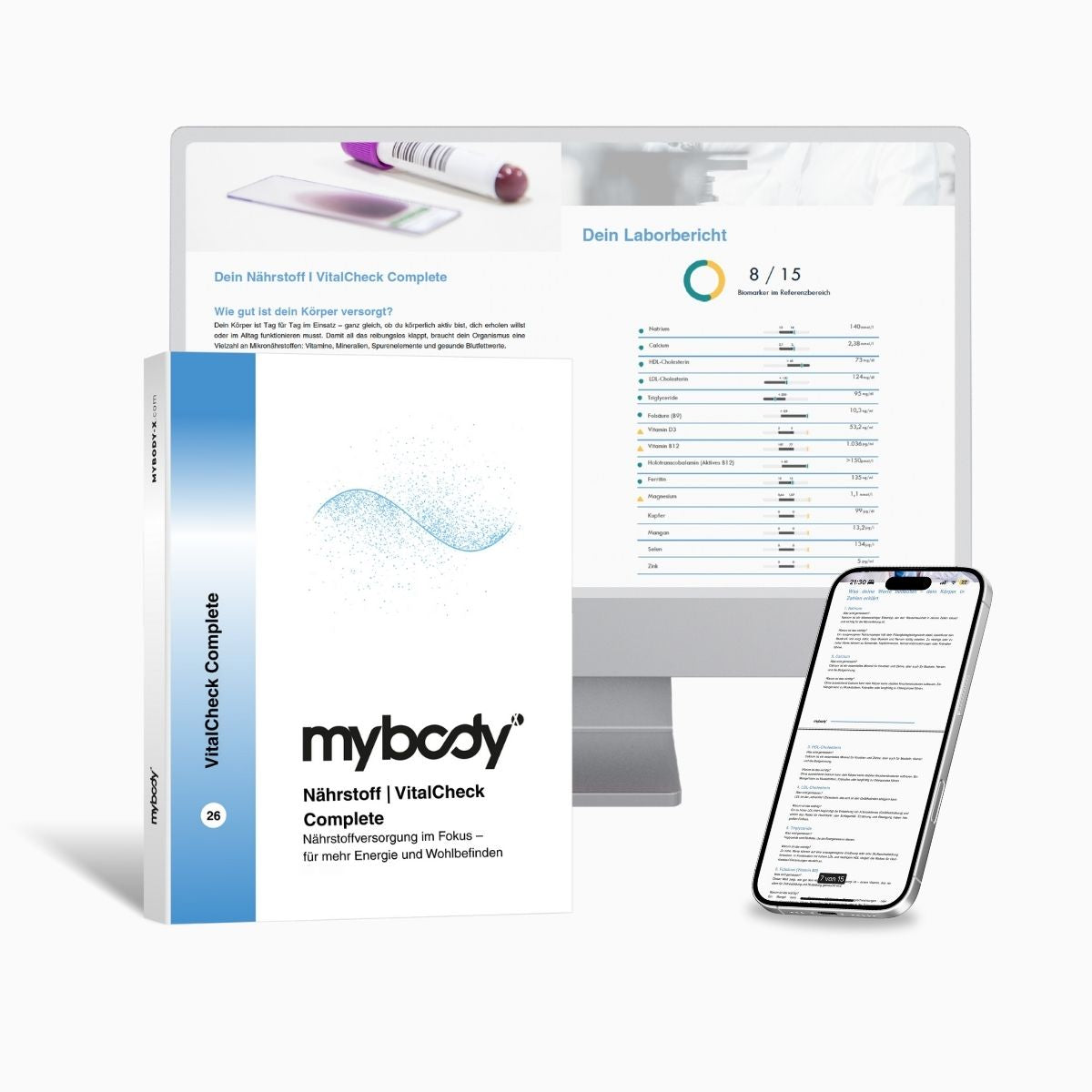
Capillary blood test
VitalCheck | Complete Nutrient & Mineral Test
Measures 18 values from the same sample, including 25-OH vitamin D3, calcium, magnesium, phosphate, albumin, ferritin, iron, transferrin, vitamin B12, folate, selenium, zinc, CRP, long-term blood sugar, and the cholesterol profile. What the test does not provide: Vitamin K is not included; it does not assess a combination of nutrients, recommend a supplement, state an amount, make a diagnosis, or replace a medical examination.
Laboratory analysis 3–5 business days after receipt of the sample
Product page information, retrieved 18 August 2026
Chapter at a glance
A capillary blood test provides the vitamin D level with the date, along with calcium, albumin, and magnesium from the same sample. Vitamin K is not included because the cited sources do not identify an established level for it. Interpretation belongs in a medical practice.
Limitations: what this article leaves open
The first limitation is the selection of sources. The MSD chapters on vitamin K deficiency and vitamin D deficiency, along with two IQWiG articles, were reviewed. The fact that they say nothing about the combination is a finding about these sources, not proof that nothing exists anywhere.
The second limitation concerns individual cases. Rare does not mean never. The fact that vitamin K deficiency rarely occurs in healthy adults (MSD Manual, as of August 2024) says nothing about a particular person with a particular medical history.
The third limitation is measurability. The reviewed sources contain no vitamin K level as a diagnostic measure. Anyone who wants to know their status will find no value for this.
The fourth boundary is diagnosis. All the classifications in this article provide context and do not constitute a diagnosis. A diagnosis is made in a medical practice based on several components, and no self-test can anticipate it.
What matters about this topic
If you take away just one thing from this article, let it be this: Of the two letters, one can be measured and the other cannot.
There is a value for vitamin D, along with reference ranges and caveats that can be specified. For vitamin K, there is a described function in blood clotting, the finding that deficiency is uncommon in healthy adults, and no routine level measurement (MSD Manual, as of August 2024).
The sources reviewed say nothing about the combination, and this article therefore makes no evaluative statement about it either. What it does say is the guidance for the one situation in which the issue becomes concrete: Anyone taking anticoagulant medications should discuss any consideration of vitamin K with the practice treating them.
Frequently asked questions
Do D3 and K2 go together?
The sources reviewed for this article contain no statement about this combination. Neither the MSD chapter on vitamin K deficiency (as of August 2024), the chapter on vitamin D deficiency (as of April 2025), nor the IQWiG article on vitamin D deficiency (as of November 15, 2023) describes any benefit from it. We therefore make neither a recommendation for nor against it.
What is the difference between K1 and K2?
The origin. The MSD Manual states that vitamin K1 (phylloquinone) is the vitamin K found in food, while vitamin K2 refers to a group of compounds (menaquinones) synthesized by intestinal bacteria (as of August 2024).
Can I have my vitamin K level measured?
Not as a level reported on a nutrient test. The MSD Manual identifies a prolonged prothrombin time or an elevated INR that decreases after phytonadione as diagnostic indicators (as of August 2024). What is assessed, therefore, is the effect on coagulation, not the amount in the blood.
How common is vitamin K deficiency?
The MSD Manual states: Vitamin K deficiency is uncommon in healthy adults because the vitamin is abundant in green vegetables (as of August 2024). The same source lists green leafy vegetables, especially cabbage, spinach, and salad greens, as well as soybeans and vegetable oils.
What applies to anticoagulant medications?
There is a direct connection here. The MSD Manual states that coumarin anticoagulants interfere with the synthesis of vitamin K in the intestinal tract and inhibit the synthesis of vitamin K–dependent coagulation proteins (as of August 2024). If you take such medications, any consideration of vitamin K belongs in a conversation with the practice treating you. This article gives neither an amount nor instructions for action.
Next step
Know the measurable value
VitalCheck measures 18 values from capillary blood, including 25-OH vitamin D3, calcium, and albumin from the same sample. Vitamin K is not included. The test does not recommend a supplement, specify a dosage, make a diagnosis, or replace medical evaluation.
Go to VitalCheckRead more
You might also be interested in
Why the season is only one of several factors.
What the evidence says about the order and what it leaves open.
Sources
- MSD Manual, Professional Edition: Vitamin K deficiency, Johnson LE (last updated August 2024) – msdmanuals.com
- MSD Manual, Professional Edition: Vitamin D deficiency and dependency, Johnson LE (fully reviewed August 2024, last updated April 2025) – msdmanuals.com
- Institute for Quality and Efficiency in Health Care (IQWiG): Vitamin D deficiency, as of November 15, 2023 – gesundheitsinformation.de
- IQWiG: Understanding laboratory values correctly, as of April 2, 2025 – gesundheitsinformation.de
The verbatim quotation regarding the frequency of vitamin K deficiency; the statements about coagulation factors II, VII, IX, and X; dietary sources; the distinction between K1 and K2; diagnosis using prothrombin time and INR; and the interaction with coumarin anticoagulants are taken from source [1]. The description of 25(OH)D as the most important form in the bloodstream is taken from [2]. The sentence about low vitamin D blood levels is taken from [3]. The explanation of the reference range is taken from [4]. The fact that none of these sources says anything about the combination of vitamin D3 and K2 is a statement about the sources reviewed and not a statement about the combination itself. Information on price, values, sample type, and laboratory comes from the mybody®x product page, accessed on August 18, 2026; processing times follow the central specification for blood tests. All sources were accessed and reviewed on August 18, 2026.

mybody®x Editorial & Specialist Team
Laboratory diagnostics Blood analysis interpretation Nutritional science Nutrigenetics
This article was created by mybody®x’s editorial and specialist team. The team combines laboratory diagnostics, nutritional science, and the interpretation of blood analyses. The people who contribute to it are listed on the authors page.
Published on August 18, 2026 · Last updated on August 18, 2026
The content is intended for general information and does not replace medical advice, diagnosis, or treatment. Reference ranges depend on the laboratory, method, and age; the information on your test report is always authoritative.




Share now:
Magnesium in Serum and Whole Blood: Two Statements
How often to test blood values: what can be inferred