
Have your hormone status checked: Your path to health in 2026
You get enough sleep and are still tired. Your menstrual cycle feels unpredictable. Your mood changes more quickly than usual, or you wonder why your body suddenly reacts differently than it used to. Many people first notice only that something no longer feels quite right.
This is precisely the point at which it makes sense to have your hormone status checked. Not because a single value provides every answer, but because a well-chosen test can help put symptoms into context, identify patterns, and clarify the next steps. The key is always asking the right question: What should the test clarify, and in what context?
Do you not feel like yourself
If you have felt “not like yourself” for weeks or months, that is not something you simply have to push aside. Hormonal changes can show up in very different ways. Some people first notice exhaustion, while others experience sleep problems, skin changes, loss of libido, or shifts in their menstrual cycle.
People often hastily attribute this solely to stress. Stress does often play a role. But it does not automatically explain everything. That is precisely why it is worth taking a structured look at your symptoms, triggers, and possible laboratory values.
You do not need a perfect hypothesis before taking action. You need a sensible starting point.
If you want to better understand the first signs, this article on symptoms of hormonal imbalance provides a good overview. The most important point is this: A hormone test is helpful when it matches your symptoms, your menstrual cycle, your age, and your goal. Simply collecting numbers rarely gets you further.
Many people affected by these issues mainly want one thing: clarity. That does not come from testing at random, but from having a plan. That is why we first look at which hormones may actually be relevant.
Which hormones are relevant to you
Hormone status is not a single laboratory value. It describes an interplay of various messengers that can influence energy, metabolism, the menstrual cycle, sleep, mood, and resilience.

Sex hormones in relation to the menstrual cycle, libido, and times of transition
When it comes to many questions surrounding hormonal well-being, estrogen, progesterone, and testosterone are at the forefront. Among other things, these hormones influence the menstrual cycle, fertility, skin, sexual desire, and how you feel in your body overall. For this reason alone, it makes little sense to look at just one isolated value.
Medical evaluation is particularly important for younger women with typical symptoms. In women under 40 with symptoms such as hot flashes, FSH levels must be measured to rule out premature menopause. This affects approximately one in every hundred women. In such cases of illness, statutory health insurance providers cover the costs, as described by Apotheken Umschau in its article on hormone testing during menopause.
This is a good point at which to correct a common misconception: Midlife symptoms do not automatically mean that as many hormones as possible should be measured.
Do not overlook the thyroid and stress
Fatigue, lack of motivation, or inner restlessness are often immediately interpreted as a “hormone problem,” even though they can involve very different systems. TSH, fT3, and fT4 relate to the thyroid and therefore to energy metabolism. Cortisol plays a role in stress, recovery, and the daily rhythm.
Therefore, anyone who wants to have their hormone levels checked should not think only about menopause or the menstrual cycle. Stress patterns and metabolic regulation are often part of the picture as well. In practice, a broader understanding is usually more useful than focusing on a single suspected value.
Important context: During perimenopause and postmenopause, determining hormone levels in the early phase is often not useful. The current S3 guideline recommends it only in certain situations, such as for women between 40 and 45 with hot flashes and cycle changes or for women under 40 with signs of impaired ovarian function. The German Menopause Society emphasizes individualized counseling rather than simply collecting numbers, as summarized by Frauenärzte im Netz in its summary of the DMG recommendation.
When a test is useful
A hormone test is particularly helpful when you have a specific question. For example:
- When cycle changes occur, a targeted look at sex hormones may be useful.
- In cases of exhaustion and low energy, it is also worth considering the thyroid and stress axis.
- If early menopause is suspected, medical evaluation should clearly come first.
- In cases of vague uncertainty, a symptom-oriented approach is often more helpful than an indiscriminate comprehensive panel.
The key is not to measure as much as possible. The key is to measure the right things.
The right preparation for reliable results
A hormone test is only as good as the sample that reaches the laboratory. If you are careless about timing or preparation, you are more likely to get results that are difficult to interpret.

What to consider before collecting the sample
From a practical perspective, sample collection follows one simple basic rule: test in the morning, while fasting, and without intense physical exertion. Exercise and acute stress can distort values. If you still have a menstrual cycle, collecting the sample on days 3 to 5 is often useful when assessing certain sex hormones.
This is not excessive caution but careful preparation. Hormone levels fluctuate throughout the day and are sensitive to external influences. The more standardized your testing conditions are, the easier it is to evaluate the result.
A practical do-and-don't list
- Test in the morning: Many hormones follow a daily rhythm. A morning sample is easier to compare.
- Stay fasting: Eating or drinking sugary beverages beforehand can affect the reliability of the results.
- Avoid strenuous exercise beforehand: Intense exertion primarily changes stress-related values.
- Pay attention to the cycle day: If you menstruate, timing plays a major role when testing sex hormones.
- Read the instructions carefully: Especially with dried blood spot samples, careful collection determines the quality.
Practical rule: If you are unsure, do not test “at some point in between.” Plan the appointment deliberately so you do not have to question the result later.
Why standardization is so important
Many people expect a hormone test to provide a clear-cut answer. Reality is more nuanced. Laboratory values only provide a useful picture when timing, symptoms, and living circumstances are taken into account.
This applies both at the doctor's office and at home. Clear instructions, the right time to test, and calm sample collection often make the difference between useful guidance and unnecessary confusion.
Doctor's office or at-home self-test
You finally want to know whether a hormonal issue is behind your exhaustion, cycle changes, or mood swings. You often face one practical question: Should you go to the doctor's office first or test at home first? Both approaches make sense. What matters is what you need right now: quick guidance or medical evaluation with diagnosis and treatment.

When a doctor's office is the better choice
A doctor’s office is the right next step when symptoms are severe or when there is a specific concern. Examples include unusual bleeding, significant menstrual irregularities, suspected thyroid disease, PCOS, testosterone deficiency, or early menopause. In a medical practice, the process does not end with the laboratory result. Doctors can also investigate physical causes, arrange further diagnostics, and provide treatment directly if necessary.
There is also a real difference when it comes to costs. Without a medical indication, hormone analyses are often billed privately. If there is a well-founded suspicion, health insurance is more likely to cover the evaluation, depending on the circumstances. That is exactly why it is worth clarifying honestly in advance whether you only want an initial overview or whether you already have symptoms that should be medically evaluated.
What an at-home self-test can do well
An at-home test is particularly useful when you want an initial, structured data point without arranging an appointment. For many people, it is an easier starting point. Discreet, flexible, and at your own pace. An option such as the at-home hormone self-test can help you avoid waiting several more weeks before getting started.
Skepticism toward at-home tests is justified. I would never rely on just any rapid test simply because it is convenient. What matters is whether the sample is analyzed in a certified laboratory, whether the instructions are clear, and whether the limitations are clearly stated. A good self-test does not replace a medical diagnosis. However, it can give you a reliable basis for better understanding your symptoms and having a more focused conversation with a doctor.
The German Society for Endocrinology specifically highlights this point and urges caution regarding commercial hormone self-tests. You can find the relevant assessment in the DGE statement on hormone self-tests. In practice, this means that the quality depends not solely on the test format, but on the entire process, from sample collection to laboratory analysis.
Direct comparison in everyday life
| Approach | Strengths | Limitations |
|---|---|---|
| doctor’s office | medical interpretation, further diagnostics, treatment can follow directly | appointment requirements, often only when there is a clear indication |
| At-home self-test | flexible, discreet, a good initial overview, more control over where to start | not a diagnosis; results must be interpreted appropriately; provider quality is crucial |
Those who want to understand health more broadly often look beyond hormones. The Longevity | ALL IN ONE DNA Test from mybody®x analyzes genetic risk factors related to aging, inflammation, nutrient utilization, and metabolism. This may be interesting as a supplement, but it does not replace symptom-based hormone diagnostics.
Your mybody®x Hormone Test Step by Step
If you decide to take an at-home test, the process should be simple, transparent, and properly documented. That is exactly what matters when you want to have your hormone status assessed without visiting a doctor’s office.

How the Process Works
The mybody®x hormone status test process consists of four clear steps:
-
Order the Test Kit
You order the kit online and receive everything you need to collect the sample. -
Collect the Sample
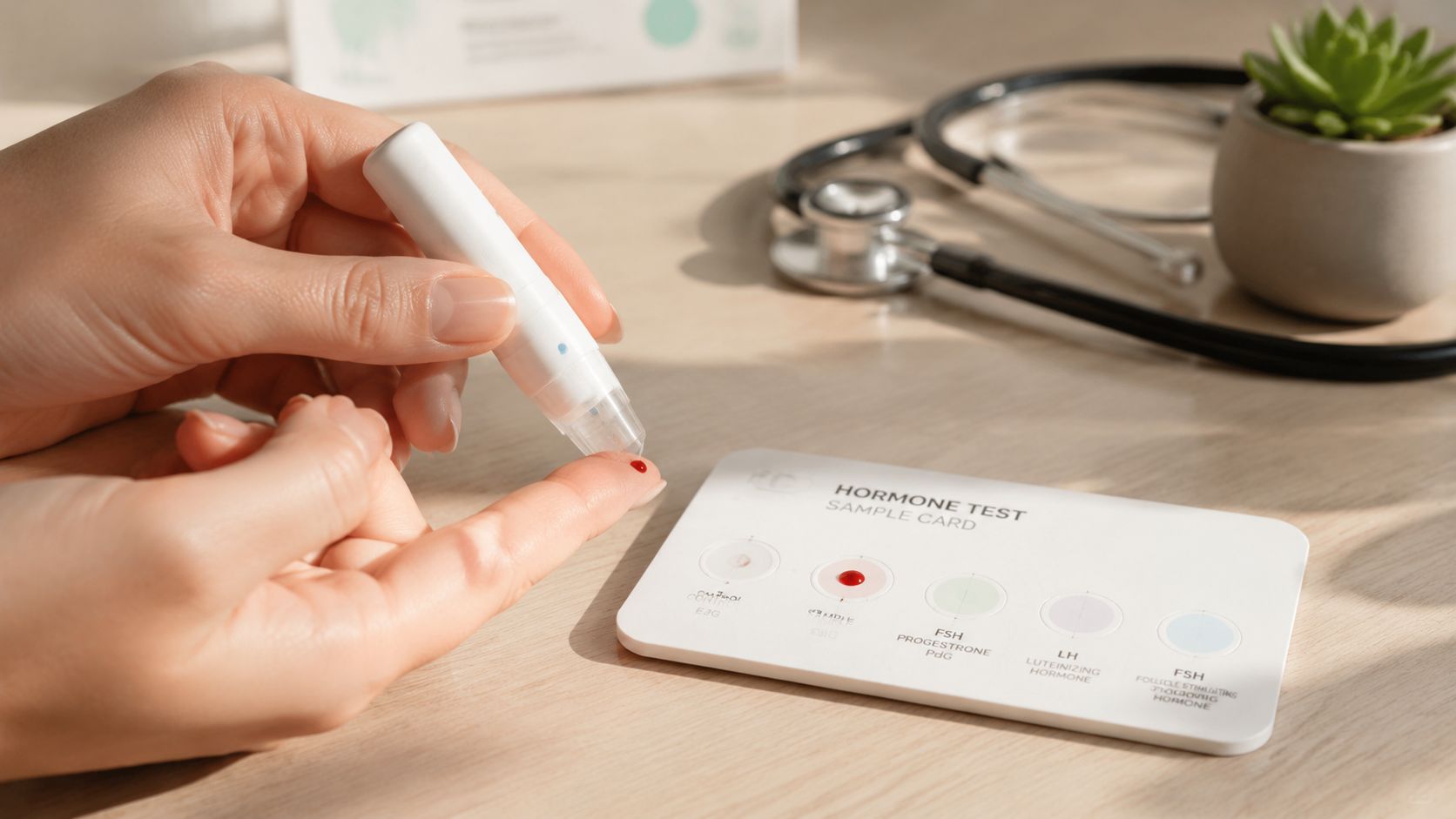
The sample is collected with a small prick in the fingertip. The blood is applied as a dried blood spot sample. -
Send in the Sample
The sample is then sent to a certified laboratory. -
Receive Digital Results
Afterward, you receive your results along with clear recommendations in the online portal.
The advantage of this process is not just convenience. It also removes the typical hurdle of having to arrange an appointment before you even have an initial data point.
What Many People Want to Know in Advance
Two questions come up almost every time. The first is: Are the results as reliable as those from a doctor? The answer is clear: the same laboratory standards apply when appropriately certified laboratories are used. The second question is often even more important: What should I do if my values are abnormal? You then receive individual recommendations on nutrition, stress management, or consulting a healthcare professional.
A good at-home test does not end with a PDF full of numbers. It should help you translate the results into your everyday life.
How Long You Have to Wait for the Results
The processing time depends on the scope of the test. Results are usually available after 4 to 8 business days; more comprehensive analyses such as the Hormone & VitalCheck may take up to 10 to 15 business days. The results are then available digitally in the portal.
This is practical because you are not simply left waiting; you can expect a clear process. Especially with topics such as energy, your cycle, or resilience, this predictability often helps more than many people realize.
Understanding Results and Taking the Next Steps
You open your results in the portal and see several values outside the reference range. This is often the point where uncertainty turns into actionism. Neither is particularly helpful. A calm assessment is more useful.
A hormone test result is not a grade, but a snapshot taken under specific conditions. What matters is not only whether a value stands out, but whether it fits with your symptoms, your cycle, your sleep, or a stressful phase. If you want to understand the basics more clearly, the article What Is a Hormone Analysis can help.
How to Make Sense of Your Results
I recommend first looking at three things side by side: the laboratory value itself, your symptoms at the time the sample was collected, and whether you are seeking initial guidance or whether there is already a specific medical suspicion.
Only this combination makes the result useful.
A single value can be abnormal without requiring immediate treatment. Conversely, symptoms can be pronounced even when values deviate only slightly. That is precisely why a self-test is valuable when it not only shows you numbers but also provides an understandable interpretation. Its advantage over the traditional route through a doctor is often speed and clarity. The advantage of a medical practice lies in direct diagnostics when symptoms are severe or further examinations are needed.
Which next steps may be appropriate
The best outcome of a test is not a quick self-diagnosis, but a clear decision. Depending on the result, different steps may be appropriate:
- Review your daily routine: Sleep, stress, training load, eating patterns, and the course of your cycle often influence interpretation more than many people expect.
- Monitor the progression: Some values are of limited significance as a single measurement. A second measurement can provide considerably more clarity.
- See a doctor with a specific concern: Concrete values and questions often make the conversation more precise. This saves time and prevents vague symptoms from being dismissed out of hand.
- Seek immediate medical evaluation: In the event of severe bleeding disorders, sudden significant changes in your cycle, severe symptoms, or other warning signs, a home test is not sufficient.
Abnormal values are no reason to panic. They are a reason to take a closer look.
This is where the practical difference between a good home test and a result that disappears into a drawer becomes clear. If your test is evaluated in a certified laboratory and the results are presented in an understandable way, you get a reliable initial data point. You don’t have to wait for someone else to formulate the first question for you. You can move forward prepared, either by making adjustments in your daily life or by seeking targeted medical clarification.
A self-test does not replace a diagnosis. Nor does it replace an examination if symptoms persist or worsen. However, it can help you recognize earlier that something should be investigated. For many people, that is the real benefit: a better overview, more control over the next step, and less guesswork.
If you want to understand your body better and not just collect laboratory values but interpret them meaningfully, you’ll find suitable at-home health self-tests at mybody x Gesundheit, including the hormone status test with a digital results overview and easy-to-understand recommendations.



Share now:
Find the best at-home tests for weight loss and more energy!
Stomach Pain Diet: What Really Helps in 2026