

Hormones and skin appearance: what is connected and what is not
The essentials at a glance
“Hormonal acne” is a term from the internet, not a diagnosis from medical practice. That hormones influence the skin is undisputed. What is disputed is what follows from this and how much a test contributes.
This article explains, with evidence, what happens in the skin, which hormones play a role, why the chin is so often affected, and why the facial-zone theory is nevertheless of little use.
What you will not find here: a treatment. Acne is a skin disease, and what helps against it should be decided by a medical or dermatological practice, not a guide.
What to expect in this article
1. Why “hormonal acne” is not a diagnosis
2. What actually happens in the skin
3. Which hormones play a role
4. Pimples on the chin: what the pattern indicates
5. How useful is face mapping?
6. Three approaches compared
7. When test results are helpful
8. What you will take away from this article
Frequently asked questions
Sources
Why “hormonal acne” is not a diagnosis
The term does not appear in any diagnostic classification. It emerged online to describe an observation made by many adults: The skin is not like it was during puberty; instead, it reacts in flare-ups, often on the chin and jawline, often in sync with the menstrual cycle.
The observation is accurate. The term is still misleading because it names a cause before it has been verified. It suggests that there is acne with a hormonal cause and acne without one, and that the former can be resolved through hormones. It is not that simple, and that has to do with how acne develops.
Two things are more important than the term itself when it comes to this topic. First: Acne is a skin disease, and medical advice or treatment is advisable for more severe forms (IQWiG, 2025). Second: What you can contribute yourself is observation, not treatment. When do the flare-ups occur, how long do they last, and what happened beforehand?
This article therefore provides context rather than recommendations. It explains which connection is supported by evidence, what that means for your pattern, and where a measurement can contribute at all. What happens afterward belongs in a medical practice.
What changes in adulthood
In puberty, the mechanism is clear, and the source names it as such. In adults, the situation is different: Androgen production is no longer ramping up, yet the skin still reacts. This leads to the common question of whether something is wrong.
Usually, something else does not match the expectation. Skin responds to shifts in hormone levels throughout life, and such shifts occur at every stage of life: during the menstrual cycle, after stopping hormonal contraception, during pregnancy, and during the transition that begins around the mid-forties. The fact that the skin responds as well is not the exception.
The practical difference from puberty is the distribution. In adolescents, it often affects the T-zone; in adults, the lower half of the face is more commonly affected. This, too, is anatomy, not an indication of the cause, but it explains why many people feel that it is “something different” from before.
And one point that is often overlooked: The skin reacts slowly. What you see today developed with a delay of several weeks. Therefore, anyone assessing a change must think in weeks, not days. This applies to worsening just as much as improvement, and it is the main reason why self-experiments are so often evaluated incorrectly.
What actually happens in the skin
The process begins in the sebaceous gland. It produces sebum, which reaches the skin’s surface through the pore opening. The Institute for Quality and Efficiency in Health Care describes the problem as follows: “However, if a layer of dead skin forms at the opening of a sebaceous gland, the sebum cannot drain” (IQWiG, 2025). What follows is a blocked opening, irritation, and the resulting visible inflammation.
The hormonal component begins precisely there, namely with the amount of sebum. And this is the point obscured by the term “hormonal acne”:
Documented source
“Androgens are male sex hormones, although they are also produced in greater amounts by the female body during puberty.”
Institute for Quality and Efficiency in Health Care (IQWiG)
Acne, as of November 12, 2025
There is also the explanation of the mechanism: In adolescents, acne develops mainly because the body produces more androgens during puberty (IQWiG, 2025). Androgens stimulate sebum production. More sebum combined with a keratinized pore opening produces exactly the picture seen in the mirror.
Key message
Hormones control the amount of sebum, not keratinization. That is why they explain only part of the picture, never all of it.
Two figures help put the topic into perspective: Acne is the most common skin disease among adolescents, and around 15 to 30 out of every 100 adolescents have more severe acne for which medical advice or treatment may be appropriate (IQWiG, 2025). That is the range in which making an appointment is the right response—not reaching for the next serum.
Which hormones play a role
When hormones and skin are discussed, four factors are meant, and they are interconnected. Understanding this also explains why a single number is rarely enough.
Androgens, especially testosterone. They stimulate sebum production. The female body also produces them, in smaller amounts, and their proportion shifts throughout the cycle and across life stages.
SHBG, the transport protein. It binds some of the sex hormones in the blood. Bound hormones are inactive. That is why the total value alone says little: Two people with the same testosterone level can have very different amounts freely available, depending on how high their SHBG level is.
Estrogen and progesterone. Their ratio shifts throughout the cycle, as does their ratio to the androgens. This is why many people observe a recurring pattern rather than a consistent state.
Prolactin and the thyroid. Both come up in this context because they influence other hormonal axes. They are rarely the explanation, yet they should be part of an evaluation because they can be measured and because they come with other symptoms that would otherwise be treated separately.
What you should remember is this: There is no single skin value. There is a relationship, and relationships cannot be read from one number.
Why the timing of a measurement matters
When hormone levels are measured, the day the sample is taken is part of the result. Estradiol, progesterone, FSH, and LH fluctuate considerably over the cycle. A value without the cycle day is therefore difficult to interpret, and comparing two measurements from different cycle phases produces not a trend line but a false impression.
Testosterone has a second fluctuation: the course of the day. Its level is highest in the morning and declines throughout the day. A measurement in the afternoon therefore says something different from one taken early in the morning, even if the same number is shown.
For you, this means two things. First: note the day of your cycle and the time when you take the measurement, before you see the result. Second: compare only values obtained under the same conditions. The article Fasting Before a Blood Test explains what this means in detail.
Pimples on the chin: what the pattern indicates
The chin and jawline are the areas most commonly mentioned in adults. The reason is unremarkable: the density of sebaceous glands is high there, so the area reacts noticeably when sebum production increases.
The Location Says Less Than the Timing.
This sentence is the practical core of the chapter. The fact that it appears on the chin narrows almost nothing down. The fact that it regularly appears during the same phase of the cycle narrows things down considerably. One is anatomy; the other is a meaningful pattern.
That is why the most useful preparation is a simple record covering two or three cycles: date, cycle day, where, and how severe. Four columns on a sheet of paper are enough. Anyone who brings this to a medical practice provides information that cannot be reconstructed from memory.
When Other Signs Appear
There is one constellation in which the skin is only part of the picture. If your cycle also becomes irregular or stops, if increased body hair appears, or if the hair on your head becomes thinner, these observations should be mentioned together and medically evaluated.
This is explicitly not a self-diagnosis and is not intended to trigger one. It indicates that these signs together mean more than they do individually, and that in this combination they belong in a gynecological or primary care practice, not in another round of skincare.
The same applies if your skin becomes noticeably worse in a short time, if painful nodules appear, or if scars remain: that is the time to see a dermatology practice. Scarring conditions are difficult to correct afterward, and that is the strongest reason not to wait.
The Record a Consultation Really Requires
Four columns are enough: date, cycle day, affected area, severity from one to three. If you keep this record for two or three cycles, you can see for yourself at the end whether a pattern exists and no longer have to guess.
Two additional columns make it much more valuable. The first is a list of what you apply to your skin, with the start date. The second is medications and supplements, also with their start dates, explicitly including those you consider harmless. These are details that would otherwise have to be reconstructed from memory during a consultation, making them inaccurate.
What you can skip is taking daily photos for self-assessment. Lighting, the camera, and the time of day change the image more than the skin does, and comparing photos every day mainly intensifies your preoccupation with the issue. One photo every two weeks, always in the same place and at the same time, tells you more and causes less stress.
What Face Mapping Is Good For
Face mapping assigns specific organs to facial zones: the chin to hormonal balance, the forehead to digestion, and the cheeks to the lungs. The idea is old, easy to grasp, and not reliable as a diagnostic method.
The reason is the same as above: Where sebaceous glands are densely concentrated, more appears, regardless of the cause. The zone assignments therefore confuse anatomy with evidence. We do not have a reliable source for a connection between a facial zone and a specific organ.
Exactly one thing remains useful about it, and that has nothing to do with the zones: looking and taking notes in the first place. Anyone who records when something occurs is collecting information. Anyone who uses that to infer something about an organ is stepping beyond the evidence. The article Face Mapping describes how the zone theory is structured in detail.
The same caution applies to the question of diet. Many claims circulate about individual foods and their effects on the appearance of the skin. We do not have a documented source that would support a general recommendation. What you can observe is your own pattern over several weeks; what you infer from it should be discussed with a medical practice.
How to recognize a reliable statement
There is a lot circulating on this topic, and distinguishing between claims is difficult when you are in the middle of it. Three questions help, and they require no specialist knowledge.
First: Is a source cited, and can it be accessed? A statement without a reference is an opinion, even when delivered by someone in a white coat. Second: Is a distinction made between observation and explanation? “It got better for me after the change” is an observation. “The change cures acne” is a claim, and there is a long way between the two.
Third: Does it say what the approach cannot accomplish? Anyone who lists only the advantages is selling. Anyone who names the limitations is explaining. In practice, this third question is the most reliable differentiator, and it applies to advice just as much as to products—including this offering explicitly.
Three approaches compared
Anyone who wants to do something about this topic has three options. The table places them side by side according to the same criteria, with a column showing what each option does not accomplish.
| Criterion | Record patterns | Dermatology practice | Know your own values |
|---|---|---|---|
| What it addresses | Whether it follows a temporal pattern | The skin itself, based on visual assessment and experience | Whether something measurable is out of balance in the background |
| What it can do | Turns a feeling into an observation you can show | Assessment and, if necessary, treatment | Replaces guesswork with numbers for the conversation |
| Effort | Four columns on one sheet, two to three cycles | One appointment, potentially with a waiting period | Measure once, repeat later if needed |
| What it does not do | does not change the skin, it only provides the basis | does not relieve you of the observation that makes the appointment useful | no diagnosis, no treatment, no substitute for an appointment |
What is striking is what is missing from the table: a skincare routine and a dietary recommendation. That is intentional. There is no evidence-based source here to support a general statement about either, and blanket recommendations are the wrong approach for a skin condition. Someone who has seen your skin can tell you what suits it.
The honest reading: column two is the actual answer, column one makes it better, and column three is an add-on for when further signs appear. Anyone who reverses the order and starts with testing collects numbers without a question.
The three shifts mentioned most often
Anyone who notices a change in their skin during adulthood will, in most cases, find one of three points in time in their own history. Knowing them helps because they direct attention to the calendar rather than to the shelf in the bathroom.
The first is stopping hormonal contraception. The body readjusts afterward, and this adjustment takes time. What happens in the months that follow is therefore difficult to distinguish from other influences, yet it is regularly attributed to a new product that happened to be introduced at the same time.
The second is the period from around the mid-forties onward, when the balance of sex hormones gradually shifts. The third is any phase with significantly disrupted sleep or persistent stress, because the adrenal axis also plays a role here.
None of the three is a diagnosis, and none of them leads to treatment. They provide context, and context is exactly what is otherwise missing in a ten-minute appointment.
When test results can help
There is one situation in which the results can genuinely add something: when, alongside skin symptoms, there are other signs that point to a hormonal axis. Persistent fatigue, changes in the menstrual cycle, hair loss, or unexplained weight changes. The question is then no longer “why these pimples?” but “what is going on in the background?”
At mybody®x (MYBODY Lab GmbH), the Women's Wellness Check covers this area. It measures SHBG and prolactin, the complete thyroid profile, as well as ferritin, vitamin B12, and vitamin D3, evaluated in Germany under ISO certification. What it explicitly does not measure is stated on the product page itself: no cycle hormones.
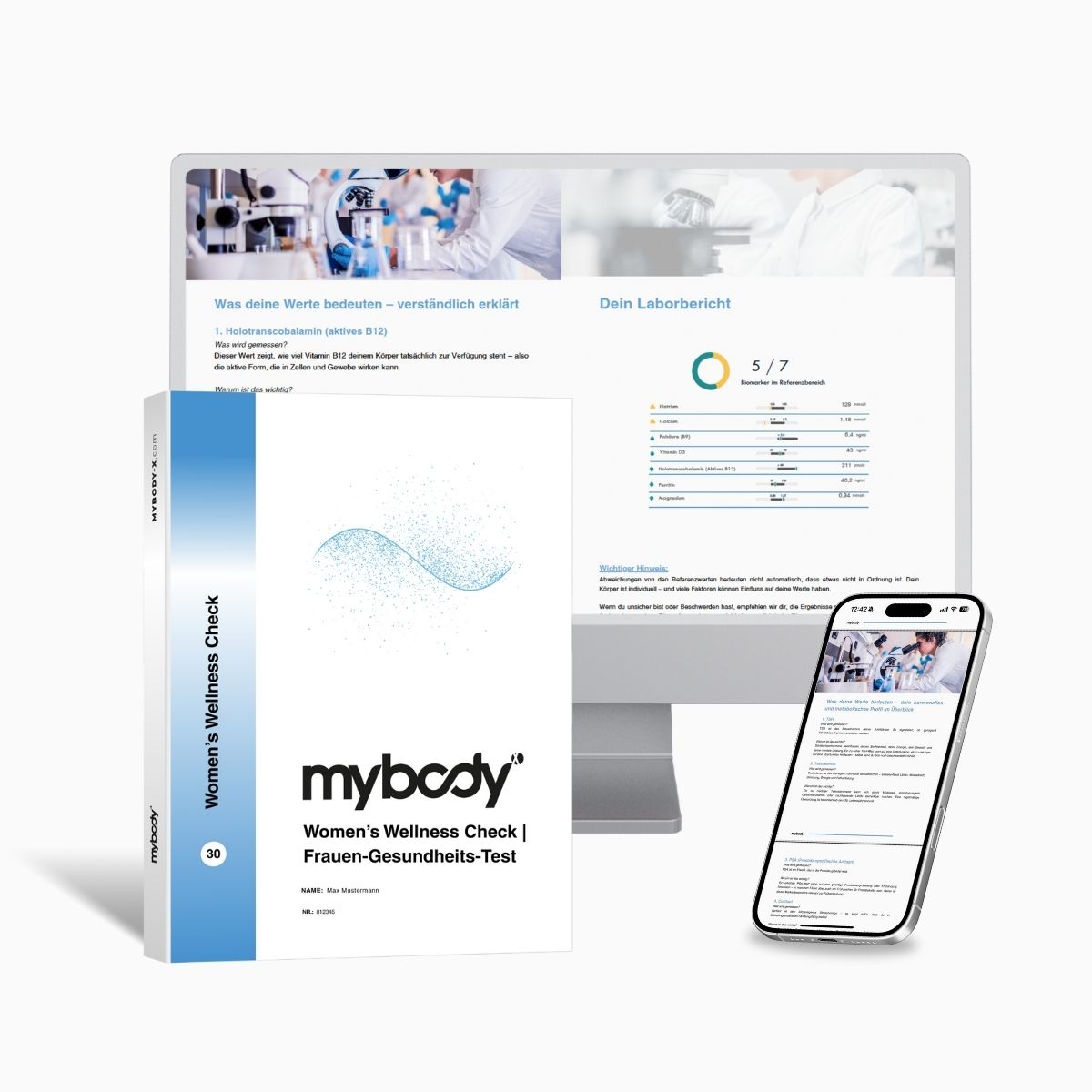
Blood test with 18 values
Women’s Wellness Check | Women's Health Test
18 values from a blood sample: thyroid profile with TSH, fT3, and fT4, plus ferritin, vitamin B12, vitamin D3, cortisol, prolactin, and SHBG. What the test does not do: it does not measure menstrual cycle hormones, provide a diagnosis, or replace a dermatological examination.
Laboratory analysis 3–5 business days after sample receipt
Information from the product page, accessed 26/08/2026
If your question concerns menstrual cycle hormones, the Menopause Check is the more suitable test; it measures estradiol, progesterone, and FSH. The Biomarker Lexicon with 67 explained blood values explains what each value means. This comparison honestly answers both sides of whether testing is worthwhile for you:
Makes sense for you if …
there are other signs besides skin issues, such as persistent fatigue, hair loss, or menstrual cycle changes.
you are preparing for an appointment and want to bring SHBG, prolactin, and thyroid results with you.
you want to know whether a nutrient deficiency may be behind it before making further changes to your skincare routine.
Probably not if …
you are hoping for better skin as a result. A measurement does not change the appearance of your skin.
your skin is the only sign. Then your first appointment should be with a dermatology practice.
painful lumps appear or scars remain. You should not wait for lab results in this case.
Next step
If you first want to see where you stand
The Women’s Wellness Check measures 18 values from a blood sample, including SHBG, prolactin, and a complete thyroid profile. The Biomarker Lexicon explains what each value means.
Go to the Women’s Wellness Check Go to the Biomarker LexiconWhat a test result does not answer
A laboratory result shows where a value stood on one day. It does not show whether that value is the cause of your skin changes. This gap is particularly large with hormones because many values are normal within a broad range and because their effects in tissue depend on factors that do not appear in the blood at all.
In practical terms, an unremarkable result does not rule out a hormonal component, and an abnormal result does not prove one. This may sound like little, but it is still useful because it determines the direction of the next conversation and rules out paths that might otherwise cost months.
That is why this chapter also does not recommend simply getting tested. A test without a question behind it produces numbers, not clarity. Anyone who has twenty values tested without knowing what they are looking for will, statistically speaking, almost certainly get one or two abnormalities—and therefore new uncertainty instead of less.
What you can take away from this article
If you remember one thing, remember the order: first the timing, then the location, then the test results. A pattern over two to three cycles says more than any facial zone, and it is the preparation that makes an appointment truly useful.
And keep in mind what is deliberately not included here: a treatment, a skincare routine, or a dietary recommendation. Acne is a skin disease, and for more severe forms, medical advice or treatment is advisable (IQWiG, 2025). Anything else would be guesswork.
It began with a word from the internet. What remains is a proven mechanism, a useful record, and the insight that the location on the face says less than the calendar. If you want to know what your body is currently responding to: The consultation costs nothing, and it will not sell you anything.
Frequently asked questions
Is “hormonal acne” a diagnosis?
No, the term does not appear in any diagnostic classification. What is supported is the mechanism behind it: Androgens stimulate sebum production, and in adolescents acne mainly develops because the body produces more androgens during puberty (IQWiG, 2025). This explains part of the picture, not all of it.
Why do I get pimples on my chin?
Sebaceous gland density is high on the chin and along the jawline, so more appears there regardless of the cause. More informative than the location is the timing: a pattern that regularly occurs during the same phase of the cycle narrows the question much more clearly.
Does face mapping work?
We have no reliable source establishing a connection between a facial zone and a specific organ. The zone mapping confuses anatomy with evidence: where there are many sebaceous glands, more is visible. The only useful part is that it prompts you to note when something occurs.
Which blood values are relevant for skin problems?
In connection with hormones and the skin, androgens, SHBG as a transport protein, estrogen and progesterone, as well as prolactin and the thyroid, are mentioned most often. A single number is rarely sufficient because the relationships between values matter. Your medical practice will decide which values are useful in your case.
When should I see a doctor about this?
Around 15 to 30 out of 100 adolescents have more severe acne, for which medical advice or treatment may be appropriate (IQWiG, 2025). The same applies in principle to adults. You should not wait if you have painful nodules, scarring, or if menstrual cycle changes, increased body hair, or hair loss also occur.
Read more
You might also be interested in this
A second topic in which the menstrual cycle creates a pattern.
So that you can understand SHBG, TSH, and the other abbreviations.
Sources
- Institute for Quality and Efficiency in Health Care (IQWiG): Acne (as of November 12, 2025) – gesundheitsinformation.de
The verbatim quote about androgens, the description of the keratinized opening of the sebaceous gland, the statement about its development during puberty, and the information that acne is the most common skin disease among adolescents and that around 15 to 30 out of 100 adolescents have more severe acne come from [1]. This article deliberately makes no statements about face mapping, skincare routines, or the influence of individual foods on the appearance of the skin, because there is no substantiated source for them. Information about the price, sample type, scope of services, and laboratory comes from the mybody®x product page, accessed on August 26, 2026; processing times follow the central specification for each test type. The source was accessed and reviewed on August 26, 2026.

mybody®x editorial & specialist team
Blood analysis interpretation Nutritional science Laboratory diagnostics
This article was created by the mybody®x editorial and specialist team. The team combines expertise in interpreting blood analyses, nutritional science, and laboratory diagnostics. Those who contribute to it are listed on the authors page.
Published on August 26, 2026 · Last updated on August 26, 2026
The content is intended for general information and does not replace medical advice, diagnosis, or treatment. Reference ranges depend on the laboratory, method, and age—your test report always takes precedence.



Share now:
Fasting for a blood test: what is and isn’t allowed
Kefir and the gut microbiome: what it contains and what has been proven