
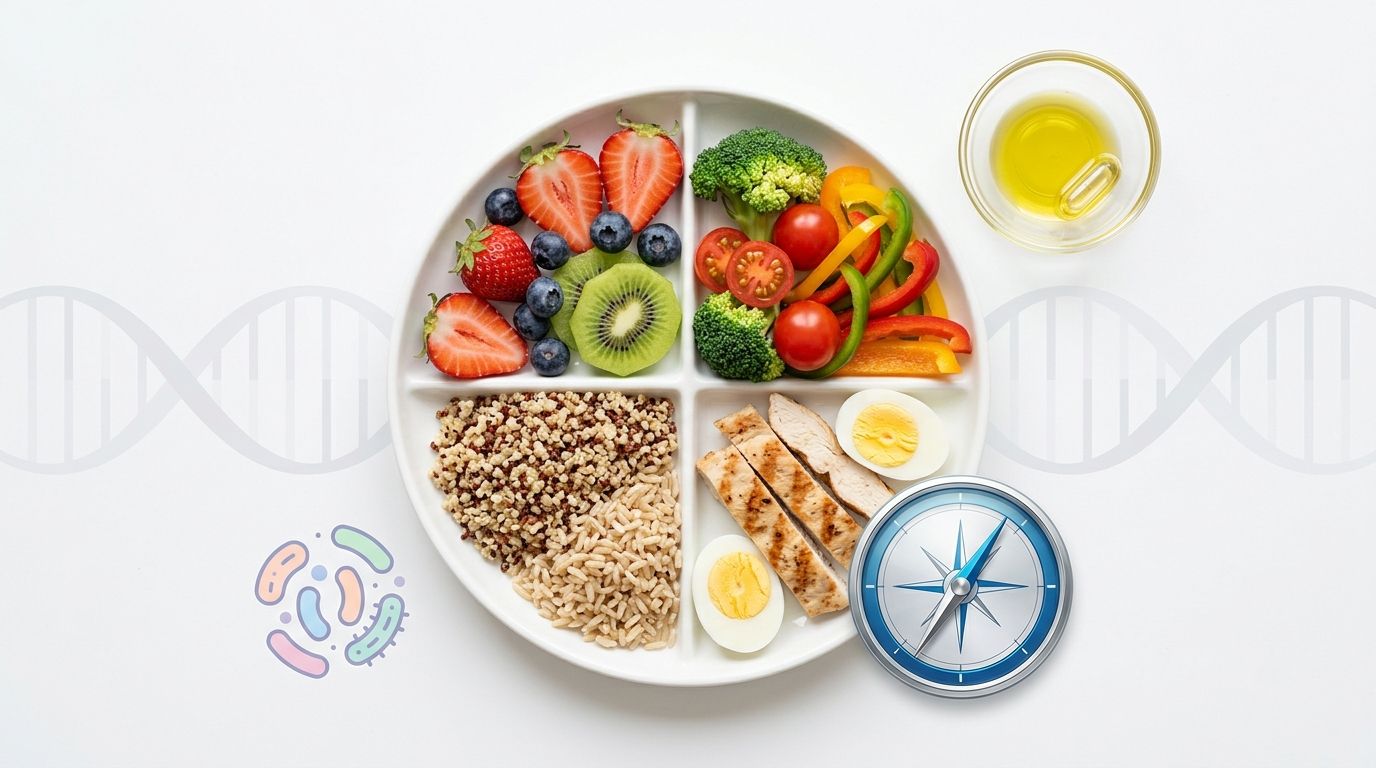
Nutrition basics: Your guide for 2026
You want to eat better. So you read articles, save recipes, and perhaps try less sugar, more protein, less bread, or more vegetables. And yet this feeling often remains: Why doesn’t it work as clearly for me as it does for others?
That is exactly where the topic of nutrition basics begins. Not with another list of prohibitions, but with an honest understanding of what your body actually needs, why broad rules often miss the mark, and how to turn general recommendations into something personal.
Many people are not undisciplined. They are simply working with the wrong assumptions. If you experience fatigue, digestive issues, cravings, or entrenched habits, you often do not need more willpower, but greater clarity.
Why you often feel your way through the fog when it comes to nutrition advice
On Monday, you hear that carbohydrates make you fat. On Wednesday, fat is supposedly the real problem. Over the weekend, you read that fruit contains too much sugar, while someone else swears they have only had energy since they started drinking smoothies. No wonder nutrition feels like a maze to so many people.
The problem is rarely that you are not trying hard enough. The problem is that much advice sounds as though a single plan could work for every body. It can’t.
Why conflicting advice is so frustrating
Perhaps you have experienced exactly this: A friend loses weight with intermittent fasting, a colleague feels better eating low-carb, while you only become irritable or tired—or develop digestive problems. The obvious conclusion is that you must be doing something wrong.
Usually, the opposite is true. You simply respond differently.
Your daily routine, digestion, sleep, preferences, and biological starting point all influence how well a particular way of eating suits you. What feels relieving for one person can mean too little energy, too little satiety, or too few nutrients for another.
You don’t need a perfect diet. You need a system that fits your body and your life.
Broad rules overlook what matters most
Many classic nutrition guides are helpful as an introduction. They provide structure. But they often do not answer the question that matters in everyday life: Why don’t I actually feel better despite “healthy eating”?
There is also a practical point that is discussed far too rarely. Healthy eating is not just about knowledge; it also has to be workable in everyday life. Deutschlandfunk’s article on food poverty in Germany explains that around three million people are affected and that theoretical knowledge about healthy eating does not automatically mean being able to afford it.
That takes the pressure off. Nutrition often does not fail because of a lack of insight, but because of a mix of daily routines, habits, discomfort, and a lack of personalization.
The more sensible starting point
If you finally want to understand nutrition, do not start with extremes. Start with questions like these:
- How do you respond after meals? Do you feel alert, full, and stable, or rather sluggish and bloated?
- What really keeps you going throughout the day? A meal that looks healthy on paper is not automatically practical or right for you.
- Where are you missing data? Without considering nutrients, digestion, or individual differences, much remains guesswork.
That is where the basics of nutrition become interesting. Not as a rigid set of rules, but as a tool for learning to understand your own body better.
The foundation of your diet: macronutrients and micronutrients
Your body works a bit like a car. It needs fuel for anything to move at all. And it needs the small, often overlooked components for the engine to run smoothly. In nutrition, these are macronutrients and micronutrients.

Macronutrients provide energy and structure
You need macronutrients in larger amounts. They provide energy and building material.
| Nutrient | Put simply | Typical role in the body |
|---|---|---|
| Proteins | Building blocks | Muscles, enzymes, tissue |
| Fats | Storage and protection | Hormone production, cell membranes, energy reserves |
| Carbohydrates | quickly available energy | Daily life, physical activity, brain function |
Proteins help you with more than just building muscle. They are also involved in many repair and remodeling processes. Fats are not “bad”; they are vital. And carbohydrates are not automatically a problem. What matters more is what type, how much, and how well they fit into your daily routine.
If you want to take a deeper look at how these building blocks are distributed, the article on macronutrients and their role in health is a sensible next step.
Micronutrients are small, but not insignificant
Micronutrients provide little or no energy. Nevertheless, essential processes do not run smoothly without them. They include vitamins, minerals, and trace elements.
They support, among other things:
- energy metabolism, so that food can be utilized properly in the first place
- The nervous system, which relies heavily on a stable supply
- The immune system and regeneration, meaning everything related to defense and recovery
- Bones, muscles, and cell function, which depend on the right cofactors
A deficiency often presents with nonspecific symptoms. Fatigue, concentration problems, susceptibility to infections, or vague dips in performance can quickly seem like “stress,” even though nutritional deficiencies may also be involved.
This is particularly relevant because, according to the UGB article on the nutrition survey in Germany, more than 80% of Germans—both women and men—fail to reach the recommended intake of folate, and similarly high rates of over 80% also fall below the reference values for vitamin D.
Practical rule: If you focus only on calories or macros, you often overlook the key levers that influence energy, mood, and resilience.
Why “eating healthy” is not automatically enough
Many people eat more consciously today than they did in the past and still have nutritional gaps. This is because “healthy” is often understood rather broadly in everyday life. A salad is not automatically nutritious enough. A protein shake does not replace an overall balanced diet. And even a solid basic diet says nothing about what you personally may be lacking.
That is precisely why a nutrient test can be more useful than mere guesswork. If a deficiency is actually detected in a blood test, appropriate measures can be selected more specifically. One example is Vitamin D3 K2 Complex | Shield. According to the product description, it combines high-dose D3 with K2 to support calcium utilization, bone health, and the immune system, and is intended for use after DNA or blood testing confirms a deficiency.
The key point remains: The fundamentals of nutrition are not dry theory. They explain why some people still cannot feel fully energized despite “eating properly.”
Understanding Your Engine: Energy Needs and Digestion
Many people reduce nutrition to the question: How much do I eat? But your body doesn’t work like a calculator. It functions more like an engine that not only needs fuel but must also be able to process it.

Energy needs are about more than counting calories
Even when you’re sitting on the sofa, your body uses energy. Your heart, brain, breathing, temperature regulation, and repair processes all keep running. On top of that, there’s everything involved in moving, thinking, digesting, and managing everyday demands.
That is why the same meal can affect two people in completely different ways. One person stays full and focused for a long time. The other gets a brief burst of energy and then crashes.
Anyone who wants to better understand this topic will find a useful practical exploration in the article on basal metabolic rate and its importance for weight loss.
Digestion helps determine what reaches your body
You do not simply eat nutrients. Your body must first break them down, absorb them, transport them, and use them. This process begins in the mouth, continues through the stomach and intestines, and does not end when the nutrients enter the bloodstream. Only when your body can use these substances effectively does food become actual nourishment.
That is why generic meal plans often have only limited benefits. Two people can eat the same breakfast and feel completely different afterward.
A few typical stumbling blocks include:
- eating too quickly, which can affect satiety and tolerance
- very one-sided meals that provide calories but little balance
- Digestive stress, for example when certain foods are poorly tolerated on an individual basis
The microbiome is the often-overlooked player
Countless microorganisms live in the gut and are involved in how well you process food and how your body responds to it. The microbiome is not a side issue. It influences how your abdomen feels and whether general recommendations are actually practical for you.
If you often experience bloating, a feeling of pressure, or fatigue after eating, that does not automatically mean you are eating “badly.” It may also mean that your digestion should be examined more closely.
A plan is only as good as the digestion that puts it into practice.
The map of dietary patterns from mixed diet to vegan
Anyone who explores nutrition quickly encounters labels and camps. Mixed diet, vegetarian, vegan, low-carb, high-protein, Mediterranean, clean eating. Many debates act as though you have to choose the one right direction. In practice, these models are more like different routes on a map.
The standard route is not automatically your route
The DGE’s Optimized Mixed Diet is an evidence-based reference. According to the BMLEH document on the nutrition strategy, it recommends at least 30 g of fiber daily, a level currently reached by only 15% of the population in Germany.
This is a good indication of where everyday life often falls short. Not in exotic superfoods, but in basics such as choosing fiber-rich foods, maintaining regularity, and building a sensible foundation of foods.
What the common dietary approaches each represent
Instead of judging right away, it is worth taking a sober look:
- An omnivorous diet is often suitable as a flexible everyday approach because it does not fundamentally exclude any food group.
- Vegetarian can work well for many people when protein and micronutrients are considered deliberately.
- Vegan is ethically and environmentally appealing to many, but requires more attention to critical nutrients.
- Low carb is often used by people who want to manage their appetite or meal structure better.
- A plant-forward diet is a pragmatic middle ground for many people because it is not dogmatic.
None of these approaches is automatically superior. What matters is whether you can follow it long-term, with attention to nutrients, and in everyday life.
A model is not a judgment of your body
People often fall into an unnecessary either-or mindset. Either completely vegan, or strictly low-carb, or “eat normally.” That is rarely how long-term nutrition works.
Questions like these are more helpful:
- Does it suit your digestion and energy levels?
- Does it reliably meet your nutrient needs?
- Can you follow it in real life, not just for two motivated weeks?
That is why genuine nutrition basics involve more than just food groups; they also require context. A way of eating is a tool, not a creed.
Why standard diets often fail: myths and beginner mistakes
Most diets do not fail because people know too little. They fail because they are too simplistic. They rely on prohibitions, simplistic villains, and the hope that someone else’s plan will somehow suit your own body.

The most common beginner mistake
Many people copy exactly what has worked for others. That seems logical. When something has visibly produced results, you want to replicate it. But your body does not respond to social media results; it responds to your own biology, digestion, and real-life circumstances.
Some typical misconceptions keep coming up:
- Carbohydrates are fundamentally bad. For some people, it is more accurate to say that the type, amount, and timing matter.
- Fat automatically makes you fat. In reality, it depends greatly on the overall context and quality of your diet.
- The stricter, the better. Extreme rules often lead to cravings, frustration, or nutrient deficiencies.
- Healthy means equally well tolerated by everyone. That is often simply not true.
Why your gut interferes with standard plans
One point that general guides often overlook is particularly important. According to the BMLEH Nutrition Report 2025 on individual variability in the gut microbiome, general nutrition guides often ignore individual variability in the microbiome. This may be one reason why standard recommendations do not bring noticeable improvement for issues such as bloating or fatigue.
This explains a common everyday frustration. You eat more vegetables, whole grains, or legumes because they are generally considered beneficial, yet you still do not feel well. That does not automatically mean the food is “bad.” Perhaps the quantity, combination, or your current digestive state is not right for you.
Those who only copy rules overlook signals. Those who take signals seriously can adapt their nutrition much more precisely.
What works better instead
Instead of thinking in myths, a more objective approach helps:
| Less helpful | More sensible |
|---|---|
| rigid prohibitions | recognize patterns |
| copy other people’s success plans | observe your own reactions |
| force yourself to eat “healthy” foods | check tolerance and everyday practicality |
| assess weight alone | also consider energy, digestion, and satiety |
This takes the drama out of nutrition. And that is exactly why it is often more successful.
The compass for your body: Personalize your nutrition
You make an effort, eat more mindfully, and may even try a plan from the internet. Yet you still feel that your body follows different instructions than everyone else’s. This is exactly where personalized nutrition begins. It replaces guesswork with insights that truly suit you.

Genetics explains one part. Your everyday life explains the rest.
Your DNA acts like a technical preset. It can influence how your body processes nutrients, how easily you perceive hunger, or how your metabolism responds to certain patterns. According to Cerascreen’s account of metabolic analysis and genetic differences, differences in weight between people are influenced to a considerable extent by genetics.
This helps put things into perspective. If you find a particular eating method more difficult than others do, that does not automatically mean a lack of discipline. At the same time, genetics is not a fixed prediction. Sleep, stress, exercise, digestion, and nutrient status all play a role every day. So your body is neither completely free of predispositions nor helplessly at their mercy.
It is also important to recognize the limitations of such tests. The Quarks article on personalized gene-based diets explains that there is currently no sound scientific basis for rigidly classifying people into simple carbohydrate, fat, or protein types. That is precisely why personalization is more than a single genetic test. It only becomes useful when several pieces of the puzzle come together.
What personalization really means
Personalized nutrition does not mean that a test will produce a perfect meal plan for you and solve everything. It works more like a compass. It does not take the journey for you, but it shows you the direction more reliably.
Three data sources are particularly useful for this:
-
DNA analysis
It shows predispositions, for example in metabolic pathways or in how the body processes certain nutrients. -
Blood values
They help check for possible deficiencies or imbalances instead of merely assuming that fatigue, concentration problems, or exhaustion are the cause. -
Microbiome analysis
It may be useful if digestion, bloating, bowel movements, or tolerance remain inconsistent despite following good basic guidelines.
You can find an accessible explanation in the article about personalized nutrition and the role of analyses.
Who can benefit most from this perspective
Not everyone immediately needs laboratory results or several tests. But for some questions, the difference between general advice and genuine personalization becomes noticeable.
This is especially true if you have recurring symptoms, react strongly to certain meals, or have been doing many things right for months without making progress. Suspected nutrient deficiencies, hormonal fluctuations, or poor tolerance also fall into this category. In such cases, a data-based approach is often more useful than the next restrictive diet plan.
Providers such as mybody x Gesundheit bundle these at-home self-tests for areas such as metabolism, nutrient status, intolerances, and hormone status. In the context of nutrition, nutrient tests, at-home self-tests, hormone tests, and, where relevant, analyses of metabolism and the gut are particularly useful.
Personalized eating means understanding your body’s signals better and making decisions based not only on trends, but also on your own operating manual.
Your practical starting point Simple steps for every day
Monday morning, little time, a quick breakfast. Two hours later, you’re tired, irritable, or craving something sweet again. Many people know this exact moment and wonder why simple nutrition tips still don’t work in everyday life. The reason is often not a lack of discipline, but a lack of feedback from your own body.
That’s why the best way to start is simple. Observe first instead of immediately imposing another rule on your life. Step by step, general nutrition knowledge becomes a personal guide that fits your everyday life, digestion, and energy levels.
Three steps that help right away
-
Keep an honest body log
For a few days, write down not only what you eat, but also what happens afterward. How full do you feel? Does your concentration remain stable? Do you feel light, bloated, calm, or restless? This log works like a mirror. It reveals connections that would otherwise get lost in the stress of everyday life. -
Build meals that give your body a longer-lasting sense of calm
A good plate often consists of three components: protein for satiety and muscle, fiber for digestion and blood sugar, and suitable fats for flavor and lasting energy. This is easier to implement than complicated dietary rules. Yogurt with nuts and berries, a lentil salad, or potatoes with vegetables and egg are practical everyday examples. -
Use data when your body reacts inconsistently despite having good basics
If fatigue, digestive problems, major fluctuations in hunger, or poor tolerance persist, general advice may no longer be enough. Blood tests, hormone analyses, or other suitable self-tests can then help clarify open questions more precisely. This is where true personalization begins. You guess less and gain a better understanding of which adjustments your body really needs.
The order matters. Observe first, then simplify, and only investigate specific issues if needed. Many people don’t fail because they lack knowledge, but because they start too many changes at once. In the end, it’s unclear what actually helped.
A good nutritional foundation doesn’t have to be perfect. It has to become understandable for you.
If you want to structure your diet based on real bodily signals and potential test data, mybody x Gesundheit can be a useful place to start. There you’ll find at-home self-tests, for example for nutrient status, intolerances, and hormone levels, which can turn uncertainty into concrete next steps.


Share now:
Stomach Pain Diet: What Really Helps in 2026
Healthy Weight Loss Plan: Your 4-Week Guide for 2026