

Genetically Analyze Your Lipid Metabolism: Your Guide for 2026
Genetic analysis of lipid metabolism is a method for identifying individual gene variants that influence how your body absorbs, processes, and breaks down fats. Two fundamentally different approaches are distinguished: medical diagnostics for hereditary lipid metabolism disorders such as familial hypercholesterolemia, and nutrigenetics, which evaluates genetic markers to provide personalized nutrition recommendations. Both approaches now use saliva tests or blood samples, which are analyzed in certified laboratories using methods such as next-generation sequencing. The result is not a verdict on your health but a tool that shows you where your body needs individual support.
Which genetic factors influence lipid metabolism?
Lipid metabolism is controlled by several genes whose variants have measurable effects on cholesterol, triglycerides, and cardiovascular risk. The best-known genes in medical diagnostics are LDLR, APOB, and PCSK9. Mutations in these genes are the most common causes of familial hypercholesterolemia, an inherited lipid metabolism disorder that, if left untreated, significantly increases the risk of heart attack.
In addition to these clinically relevant genes, there is a second category: nutrigenetic markers. These are so-called SNPs, or single-letter changes in the genome, that do not cause disease but influence how well you metabolize certain fats, how your body responds to saturated fatty acids, or how efficiently you absorb fat-soluble vitamins. Commercial tests often examine more than 80 gene variants and use them to provide personalized guidance on macronutrient metabolism.

One often overlooked factor is copy number variants, or CNVs for short. These are larger sections of the genome that may be present in duplicate or entirely missing. An international survey shows that CNV testing is not routinely performed in about one-third of laboratories. This compromises diagnostic quality, particularly when investigating hereditary disorders.
Particularly noteworthy is Lp(a), a blood lipid level that is determined almost exclusively by genetics. Guidelines recommend measuring Lp(a) at least once during adulthood because it strongly influences cardiovascular risk independently of lifestyle. So anyone who wants to have their lipid metabolism genetically analyzed should not forget this value.
Genetic markers at a glance:
- LDLR, APOB, PCSK9: Clinically relevant genes in familial hypercholesterolemia; medical diagnostics required
- SNPs: Individual gene variants that describe tendencies in lipid processing; the basis of nutrigenetics
- CNVs: Larger genetic changes that are still missing from many commercial tests
- Lp(a): Genetically dominant risk factor; should be measured once in a laboratory
Pro tip: Ask the test provider explicitly whether CNVs are also analyzed. Anyone who tests only SNPs receives an incomplete picture, especially when a hereditary disorder is suspected.
How does a genetic lipid metabolism analysis work?
The process varies depending on the goal. For nutrigenetic tests, a saliva test at home is usually sufficient. You collect a sample with a cotton swab, send it to a laboratory, and receive a digital report after a few days. For medical diagnostics when familial hypercholesterolemia is suspected, however, a blood sample is necessary, and the analysis is carried out by specialized human geneticists.
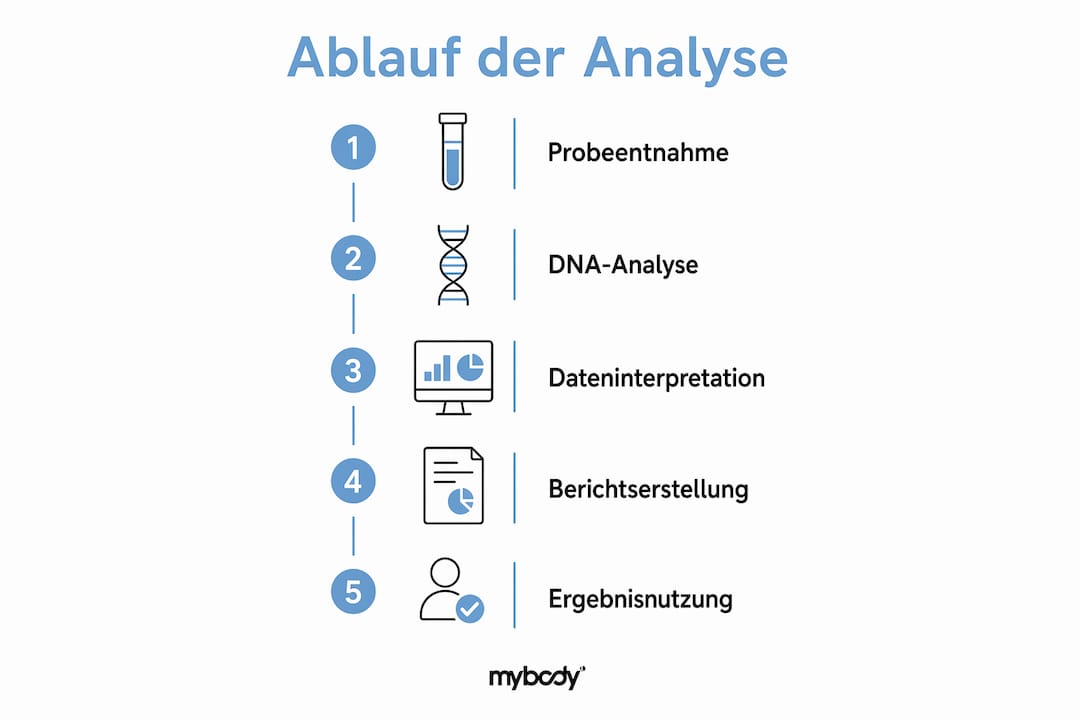
This is how a nutrigenetic test typically works:
- Order the test kit: Choose a provider with an ISO-certified laboratory and a clearly defined testing scope.
- Collect the sample: Saliva sample collected at home; instructions are included and the process takes only a few minutes.
- Send in the sample: Pseudonymized shipping materials protect your data on its way to the laboratory.
- Laboratory analysis: The laboratory uses next-generation sequencing for index cases. More than 80 percent of specialized centers use NGS as the standard for initial diagnoses. Sanger sequencing is often used for family members of known cases.
- Receive the report: The report lists your genetic variants, explains their significance, and provides specific dietary and lifestyle recommendations.
What the report contains depends heavily on the provider. Good reports clearly distinguish between a genetic tendency and a current disease finding. They explain, for example, whether you have an increased tendency to respond to saturated fatty acids with an increase in LDL, without making medical promises of a cure.
| Test type | Method | Sample | Goal |
|---|---|---|---|
| Nutrigenetics | SNP analysis, NGS | Saliva | Personalized nutrition |
| Medical diagnostics | NGS, Sanger sequencing, CNV analysis | Blood | Diagnostic evaluation |
| Lp(a) measurement | Laboratory blood test | Blood | Cardiovascular risk |
Pro tip: Choose a provider that complies with the GDPR and destroys samples after analysis. Your genetic data remain valid for life. Data protection is not a bonus here; it is mandatory.
How do you use the results for nutrition and health?
The results of a genetic fat metabolism analysis only become useful when you combine them with specific behavioral changes. This may sound obvious, but it is often underestimated. Randomized studies show that genotype-based dietary recommendations improve metabolic markers such as HbA1c and triglycerides, while the direct effect on body weight remains inconsistent.
In concrete terms: If your report shows that you carry a variant in the APOE gene associated with poorer processing of saturated fats, that is not a verdict. It is an indication that you may benefit more from a Mediterranean diet rich in monounsaturated fatty acids than from a low-carb diet high in animal fats. This difference may not show up on the scales, but it can be reflected in your blood lipid levels after a few months.
For medically relevant findings, such as when genes like LDLR or PCSK9 are affected, different rules apply. Here, guidelines recommend genetic testing primarily to identify high-risk groups and for family screening. Treatment then involves not only diet but often medications such as statins or PCSK9 inhibitors, always in consultation with a doctor.
What genetic results mean in practice:
- Macronutrient utilization: Some gene variants indicate whether you use carbohydrates or fats more efficiently as an energy source. This affects which type of diet works better for you in the long term.
- Omega-3 requirements: Variants in the FADS1 gene influence how effectively you convert plant-based omega-3 fatty acids into the active forms EPA and DHA. People who carry a less efficient variant benefit more from direct fish oil sources.
- Vitamin absorption: The absorption of fat-soluble vitamins such as D and E also depends on genetic factors, which a good test takes into account.
- Weight management: Genetic tendencies toward overweight can be addressed more specifically through DNA-based nutrition than through generic diets.
“Personalized nutrition based on gene variants must be considered in combination with lifestyle factors, as not everyone responds equally to genetic dietary recommendations.” (Source)
So anyone who wants to understand their lipid metabolism through nutrigenetics does not get a one-size-fits-all solution. They get a map showing which routes are probably shorter for their body.
What mistakes occur in genetic lipid metabolism analyses?
The most common mistake is having excessively high expectations. Many people buy a genetic test hoping to finally find the key to losing weight. Genetic tests alone do not lead to significant weight loss. Success is more likely to show up in improved metabolic parameters and long-term behavioral changes, not on the scale after four weeks.
Another mistake is confusing genetic predisposition with current metabolic status. Your genes describe what you tend toward. Whether you actually have elevated triglycerides depends on diet, exercise, sleep, and stress. Genetic variations describe tendencies; actual metabolic status is strongly influenced by lifestyle. A genetic test therefore does not replace current laboratory values.
Common pitfalls at a glance:
- Missing CNV analysis: Anyone who tests only for SNPs may overlook relevant genetic changes, especially when there is a family history.
- No medical consultation for abnormal findings: Anyone carrying a pathogenic variant in genes such as LDLR or PCSK9 needs medical guidance, not a diet plan from the internet.
- One-time assessment: Genetic data are stable, but the body changes. Regular laboratory monitoring of LDL-C, HDL-C, triglycerides, and Lp(a) remains necessary.
- Privacy overlooked: Not all providers destroy samples after analysis. This is a risk many people underestimate.
Pro tip: Always compare your results with current blood test values. Thorough diagnostics when genetic lipid metabolism disorders are suspected include not only genetic analysis but also LDL-C, HDL-C, triglycerides, and Lp(a). Only the complete picture allows for sound decisions.
Key insights
Analyzing fat metabolism genetically provides valuable insights into individual risks and dietary tendencies, but it only delivers benefits when combined with laboratory values and consistent lifestyle changes.
| Topic | Details |
|---|---|
| Two types of analysis | Medical diagnostics for hereditary disorders and nutrigenetics for dietary recommendations pursue different goals. |
| Consider CNV testing | About one-third of laboratories do not test for CNVs, which compromises diagnostic quality in hereditary lipid metabolism disorders. |
| Don't forget Lp(a) | Lp(a) is determined almost exclusively by genetics and should be measured at least once in adulthood. |
| Metabolic markers instead of weight | Genetically guided nutrition improves triglycerides and HbA1c more reliably than it directly affects body weight. |
| Involve a doctor | Medical supervision is essential for pathogenic variants in LDLR, APOB, or PCSK9; no nutrition plan can replace it. |
What I have learned after years of working with genetic analyses
I have supported many people who came to us with a genetic test in hand, convinced that they would finally know everything. Often, the opposite was true. The test had shown them that they carried a variant associated with an increased risk of high LDL levels. But their current blood values were completely normal because they ate well and exercised regularly. This unsettled them, even though it was actually good news.
Genetic information is not destiny. It is an early warning system. Knowing that your body reacts more sensitively to saturated fats allows you to take targeted action before your levels get out of control. That is the true value of these analyses: not diagnosis, but prevention.
What I believe is truly underestimated is the combination of genetic testing and microbiome analysis. Your gut influences how fatty acids are absorbed, and this can sometimes significantly outweigh genetic tendencies. Anyone who looks only at the genes sees only half the picture. Knowing both can take personalized nutrition to an entirely different level.
My honest advice: Start with a test that clearly distinguishes between nutrigenetics and medical diagnostics. Get advice instead of being fobbed off with just a PDF. Then check the results after six months with a blood test. Only then will you see whether your body responds to the recommendations.
— mybody x
Your genetic profile for fat metabolism with mybody x
mybody x offers ISO-certified DNA metabolism tests that you can conveniently perform at home. All that is needed is a saliva sample. The laboratory analyzes your genetic variants and provides a report with specific dietary recommendations, guidance on macronutrient metabolism, and lifestyle strategies tailored to your genetic profile.

More than 11,300 satisfied customers with an average rating of 4.77 stars attest to the quality of the analyses. All samples are destroyed after analysis, while your data remains pseudonymized and protected in compliance with the GDPR. Shipping is free from 49 euros, and the money-back guarantee applies if no result is obtained. Start now with your DNA metabolism test and understand what your body really needs.
FAQ
What does it mean to analyze fat metabolism genetically?
A genetic fat metabolism analysis examines gene variants such as SNPs in genes like LDLR, APOB, or PCSK9 that influence how your body processes fats. Depending on the objective, it is used either for medical diagnosis of inherited disorders or for personalized nutritional counseling through nutrigenetics.
Which genes are particularly relevant to fat metabolism?
LDLR, APOB, and PCSK9 are the most clinically important genes in familial hypercholesterolemia. For nutrigenetic purposes, APOE, FADS1, and other SNPs are also relevant, as they describe predispositions in fat metabolism and vitamin absorption.
Can a genetic test help with weight loss?
A genetic test does not directly cause weight loss. Randomized studies show that genetically guided nutrition improves metabolic markers such as triglycerides and HbA1c, but its effect on body weight remains inconsistent. The benefit lies in long-term behavioral changes, not short-term results on the scale.
Do I need a doctor for a genetic fat metabolism analysis?
A doctor is not strictly necessary for nutrigenetic tests for dietary purposes. However, medical supervision is essential if an inherited lipid metabolism disorder is suspected or if pathogenic variants are found in LDLR, APOB, or PCSK9, as treatment decisions must be made.
How reliable are commercial DNA tests for fat metabolism?
Commercial tests from ISO-certified laboratories provide reliable results on genetic predispositions. However, their significance is limited if CNVs are not also analyzed. They also describe predispositions, not a current disease status. Current laboratory values such as LDL-C, HDL-C, and Lp(a) therefore remain essential.



Share now:
Beat Winter Fatigue: Causes & Tips 2026
Sudden weight gain in women