
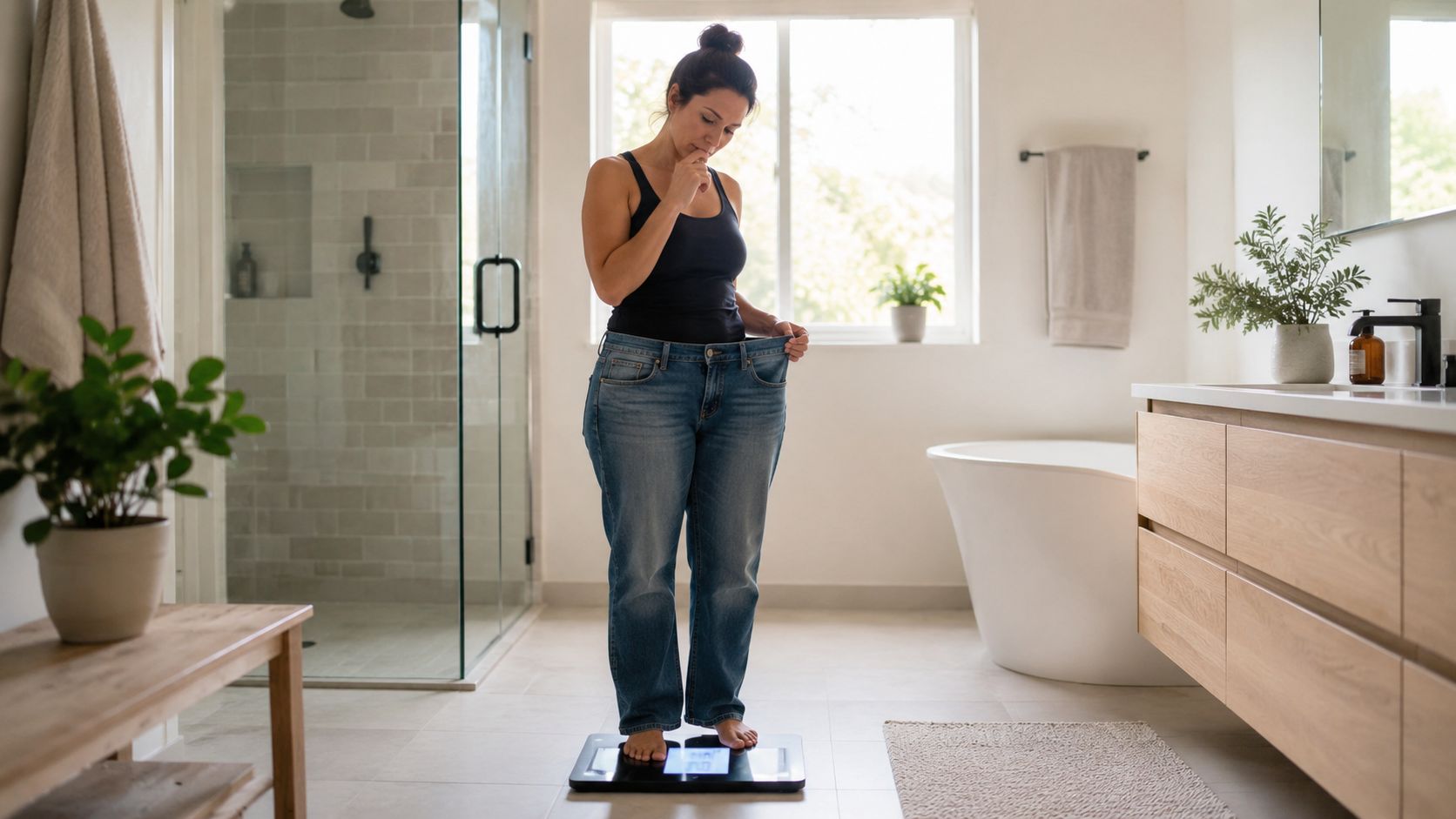
Sudden weight gain in women—symptoms and advice
When your weight suddenly goes up, it often feels unfair. You feel as though you are not eating differently, and you may even be making a conscious effort to stay active, yet your trousers feel tight, your abdomen seems fuller, or the scale shows several extra kilos. Then a thought quickly creeps in: “What am I doing wrong?”
This is exactly the point at which it is worth pausing for a moment. Sudden weight gain in women is not automatically a sign of “eating too much.” It can be related to water retention, hormones, the thyroid, stress, medication, or other physical changes. The important thing is not to guess, but to interpret the signals appropriately.
The number on the scale is rising and you do not know why?
It often begins inconspicuously. The jeans feel tighter. Rings fit less well. The number on the scale is unsettling. And although you mentally review the past few days, you cannot find a clear explanation.

Many women then instinctively respond by eating less immediately. This is understandable, but not always wise. Your body may not be sending a “You have eaten too much” signal, but rather a “Please take a closer look” signal.
In Germany, this issue is widespread. According to the DEGS1 study by the Robert Koch Institute cited in the article, 53.0% of women are overweight, and a waist circumference of 88 cm or more is considered to indicate an increased health risk, as described in the Zanadio article on sudden weight gain. This does not mean that every sudden change is dangerous. It does mean, however, that it deserves attention.
What is probably making you feel uncertain right now
Several questions often arise at the same time:
- Is this just a normal fluctuation? Weight changes in everyday life. Not every change is necessarily a problem.
- Are these fat deposits or water retention? This difference often determines how urgently you should act.
- Do hormones play a role? This is very common, especially among women.
- Do I need to see a doctor immediately? Sometimes yes, but often you can first monitor the situation systematically and collect data.
Important thought: The scale only shows that something has changed. It does not tell you why.
A better way to deal with uncertainty
Instead of putting yourself under pressure, it helps to take an objective look at three points:
| Question | Why it matters |
|---|---|
| How quickly did the gain occur? | Rapid changes are more likely to indicate water retention or hormonal effects than pure fat gain. |
| Where do you notice them? | The abdomen, legs, fingers, face, or the whole body can provide different clues. |
| What other symptoms occur? | Fatigue, swelling, menstrual-cycle changes, shortness of breath, or a lack of energy can help guide your search for the cause. |
If you answer these questions carefully, you will already have more clarity than many people after weeks of worrying.
Is it fat or just water? The important difference
The first major misconception when it comes to sudden weight gain is this: Not everything the scale shows is fat. It sounds simple, but it makes a huge difference in everyday life.

Fat gain usually develops gradually. Fluid retention, on the other hand, can become noticeable much more quickly. The hands, feet, lower legs, or abdomen may suddenly appear fuller, even though your eating habits have barely changed.
The distinction is so important because fluid retention can sometimes be harmless and temporary, but in other cases it should be medically evaluated. The German Heart Foundation points out that weight gain caused by fluid retention can be a symptom of heart failure, making the difference between edema and fat gain particularly important, especially with sudden changes of 3 to 5 kg. This is clearly addressed in the Heart Foundation’s response on weight gain.
How fat and water often feel different
Fat behaves more like a slowly filled storage depot. Water behaves more like a sponge in the tissue.
Typical signs of fat gain
- Slow progression over weeks or months
- Clothes fit more tightly, without significant swelling of the hands or legs
- Body shape changes gradually, often around the abdomen, hips, or thighs
Typical signs of fluid retention
- Rapid progression over a short period
- Heavy legs or swollen fingers
- Sock marks or shoes that feel tighter
- A feeling of tightness in the tissue, sometimes especially in the evening
A simple self-check
You can carefully perform a small pitting test. Gently press one finger on the area over your shinbone or ankle for a few seconds. If a small indentation remains briefly, this may indicate fluid retention.
This does not replace a diagnosis. It only helps you sharpen your observations.
If your weight rises rapidly while your legs, feet, or fingers also swell, you should not automatically assume that you have consumed “too many calories.”
When water retention may be harmless and when it may not be
There are everyday situations in which water retention occurs. Many women experience this around their menstrual cycle, after eating very salty food, on long days spent sitting, or in hot weather. In such cases, the change is often temporary.
It is different when additional warning signs appear. These may include, for example:
- shortness of breath
- noticeable swelling
- increasing waist circumference without an obvious explanation
- severe fatigue or a drop in performance
Then it is no longer just about appearance or frustration with the scales, but about whether the heart, hormones, or metabolism may be involved.
Your changing hormones as the most common cause
For many women, the explanation is not in the refrigerator but in the hormonal system. Hormones act like a finely tuned control system. When individual messengers fluctuate, it affects not only the menstrual cycle but often also appetite, fluid balance, fat distribution, and energy expenditure.
This becomes particularly noticeable from midlife onward. According to the Apotheken Umschau article, people from around 40 years of age may gain an average of about 1 kg per year without changing their eating habits or activity levels. Menopause typically occurs between 45 and 53 years of age, and according to the expert source, women gain an average of about 2.5 kg during this phase. The reason is that declining estrogen levels reduce the basal metabolic rate. The Apotheken Umschau describes this in its article on age-related weight gain.
Perimenopause and menopause
Many women do not experience sudden weight gain as steadily “getting fatter,” but rather as a shift in their body shape. The abdomen becomes softer or more pronounced, even though the legs and arms look almost unchanged. This can seem unsettling, but it is biologically understandable.
When estrogen levels fall, fat distribution often changes. At the same time, muscle mass decreases with age. Muscles use energy in everyday life. That is why having less muscle mass often also means that the body runs more economically.
Why this is so confusing
You may be doing “everything as usual” and still gaining weight. That is precisely the point. Your body today no longer processes the same routine in exactly the same way as it did a few years ago.
A simple analogy helps: In the past, your metabolism may have worked like a stove on a medium flame. With hormonal changes, it becomes more like a smaller flame. If you continue “adding” the same amount, it is easier for something to be left over.
Many women interpret hormone-related changes as a personal failure. Medically, that is often the wrong explanation.
PCOS in younger women
A hormonal disorder can also be behind weight gain in younger women. A well-known example is PCOS. Typical signs often include irregular cycles, skin changes, or the feeling that the weight is particularly stubborn.
Not every woman with menstrual cycle problems has PCOS. But if weight gain is accompanied by irregular cycles, increased body hair, or acne, it is worth taking a closer look at the hormones.
Why a hormone test may be useful
When it comes to hormonal issues, many women get caught in an endless loop of speculation. That is why it can be very helpful to work with actual measurements. An overview of typical connections and laboratory values can be found in Determining hormone status.
A hormone test for women can provide indications of whether estrogen, progesterone, or other hormonal pathways are out of balance. This is especially helpful if you notice not only weight gain but also:
- Changes in the menstrual cycle
- Sleep problems
- Mood swings
- Water retention
- Unusual increase in abdominal size
If you are also unsure because of a missed or changed menstrual cycle, a neutral informational article such as Answers to your questions can help you put initial questions about test results and next steps into context.
The role of the thyroid and metabolism
The thyroid is small but has a major influence. You can think of it as a regulator for energy consumption. When this regulator turns down, many processes in the body slow down. This is exactly when many women report unexplained weight gain, even though they feel they are not eating more.

Signs that may point to an underactive thyroid
An underactive thyroid does not shut the body down. Rather, it puts it into energy-saving mode. It often feels like this:
- You are tired, even though you get enough sleep.
- You get cold easily when others find the temperature normal.
- Your skin is becoming drier, and your hair may appear duller.
- You are gaining weight, even though you cannot see an obvious reason.
This combination is common enough that it should not be ignored.
Which values are important
If you want to check your thyroid, you will usually come across three terms: TSH, fT3, and fT4. Put simply, TSH indicates how strongly the body stimulates the thyroid. fT3 and fT4 provide information about the thyroid hormones themselves that are available.
For an initial overview, an at-home test may be useful, especially if you want to collect your symptoms and approach a medical consultation in a structured way. The article on the TSH Hormone Test offers an easy-to-understand introduction.
Metabolism is not just about calories
Many people use “metabolism” as a blanket term for everything related to weight. But it means much more than that. It includes energy production, temperature regulation, performance, and the speed of many bodily functions.
If a nutrient deficiency is also detected in blood tests, it can be confirmed and supplemented in a targeted way. The Vitamin D3 K2 Complex | Shield from mybody®x combines high-dose D3 with K2 for optimal calcium utilization, bone health & immune system support. According to the product information, it is ideal after a DNA or blood test confirms a deficiency.
A thyroid evaluation is particularly worthwhile if weight gain occurs together with fatigue, feeling cold, and lack of energy.
Other possible triggers, from stress to medication
Not every instance of sudden weight gain can be reduced to a single cause. Often, several factors interact. A little more stress. Slightly worse sleep. Perhaps a new medication. Maybe a hormonal change in the background as well. The result on the scales can then seem to appear “out of nowhere,” even though the body has been sending signals for some time.
German medical sources point out that rapid weight gain may indicate an underactive thyroid, hormonal disorders such as PCOS, or Cushing’s syndrome. If symptoms such as swelling, shortness of breath, or lack of energy occur, medical evaluation is recommended because the underlying cause may not primarily be fat, but also fluid retention or disrupted hormonal regulation. This is described in the Lipoedem Zentrum München guide to weight gain.
Stress affects the body more than many people think
Chronic stress is not just a mental issue. It affects sleep, appetite, daily routines, and often eating habits as well. Some women eat more when stressed. Others do not eat much more but unconsciously move less and sleep worse. Both can throw the body out of balance.
If you suspect that your stress system is constantly running on high alert, it may be useful to learn more about cortisol. An overview is provided in the article Measuring Cortisol at Home.
Medications as an often-overlooked factor
A very practical but often overlooked step is reviewing your medications. Weight gain can occur as a side effect, for example with certain:
- corticosteroid medications
- antidepressants
- hormonal medications
- other long-term treatments
The important thing here is: never stop taking medication on your own. However, comparing the timing of the weight gain with the start of treatment is a sensible step.
Rare but important
There are also more serious causes that are less common but should not be overlooked. These include hormone regulation disorders such as Cushing’s syndrome or conditions in which the body retains water.
Pay particular attention to the combination of weight gain and symptoms such as:
| Observation | Why it should be taken seriously |
|---|---|
| Swollen legs or fingers | May indicate fluid rather than fat |
| shortness of breath | Should always be assessed by a doctor |
| Marked lack of energy | Does not fit a simple day-to-day fluctuation |
| Rapidly increasing abdominal circumference | Requires clear medical evaluation |
This is not about causing fear. It is about not explaining away the obvious.
Your action plan from self-check to targeted diagnosis
If you notice sudden weight gain, you do not need a perfect plan. You need a clear next step. The most helpful approach combines observation, appropriate tests, and knowing when medical help is needed.

Observe first, then assess
Keep a brief record for a while. No complicated diary is needed. A few clear notes are enough.
For example, note:
- Weight and how your abdomen feels on several days
- Cycle phase, if relevant
- Swelling in the fingers, legs, or face
- Sleep, stress, and energy
- new medications or changes to existing medications
This helps you identify patterns. Perhaps your weight always increases around your cycle. Perhaps it happens during particularly stressful weeks. Perhaps it occurs alongside fatigue and feeling cold.
Then collect targeted data
If there are indications of hormonal, thyroid, or nutrient-related issues, at-home health self-tests can be a practical first step. They do not replace medical diagnosis in every case, but they can be very helpful for taking targeted action instead of operating in the dark.
Depending on the symptoms, the following may be useful:
- Hormone test for cycle changes, suspected perimenopause, PCOS, or unexplained abdominal weight gain
- Thyroid test for fatigue, feeling cold, dry skin, and unexplained weight gain
- Nutrient test in cases of exhaustion, an unbalanced diet, or the feeling that “your body just isn’t functioning properly”
Anyone who wants to systematically assess these levels from home can find various self-tests for blood, hormone, and nutrient analyses at mybody x Gesundheit.
If a B-vitamin deficiency is identified, you can supplement it specifically. According to the product information, mybody®x’s Vitamin B Complex | Energize provides all 8 B vitamins in optimal doses for energy, the nervous system & metabolism and is particularly recommended in cases of a confirmed B-vitamin deficiency in a blood or DNA test.
Practical rule: A test is most useful when it answers a specific question. Not “I’ll test everything,” but “Do my symptoms point more toward hormones, the thyroid, or nutrients?”
Do not ignore these red flags
Some situations should not simply be put on next week’s to-do list. Seek medical help promptly if, in addition to the weight gain, you notice the following:
- shortness of breath
- noticeable swelling
- severe exhaustion
- an unusually rapid change without an apparent cause
Then it is about finding the cause, not self-optimization.
Conclusion Take control of your health
A sudden weight gain in women is not a moral judgment about your lifestyle. It is a signal. Sometimes water is behind it. Sometimes hormones. Sometimes the thyroid. And sometimes several factors interact.
The reassuring news is that you do not have to remain stuck guessing. Once you learn to distinguish between fat gain, water retention, hormonal changes, and metabolic problems, diffuse frustration becomes a clearer picture. That alone takes the pressure off.
The most important thing is this change in perspective: The scale is not your opponent. It is merely an indicator. The real question is, what is your body trying to tell you.
When you start observing symptoms, noting connections, and, when needed, collecting data with appropriate tests, you are not being overly cautious. You are acting responsibly. In this case, knowledge creates not only clarity but often genuine relief.
The first sensible step is rarely a radical diet. Usually, it’s a closer look.
If you want to understand your body better, mybody x Gesundheit offers self-tests for hormones, thyroid function, and nutrients that can help you put symptoms into perspective based on data and take the next step well prepared.



Share now:
Analyze Fat Metabolism Genetically: Your Guide to 2026
What boosts the metabolism? 10 effective tips & test