
Discover the DNA Test for Weight Loss: Gene-Based Nutrition That Works
Have you tried countless diets, meticulously counted calories, and still seen no results? You are not alone in feeling this way. A DNA test for weight loss offers a new, scientifically grounded approach. It shows you how your body really processes nutrients and why standard plans may simply not work for you.
Why conventional diets often fail
The frustration is enormous: You follow a nutrition plan that works wonders for others, yet barely anything changes on the scale for you. The reason is often not a lack of discipline, but your unique biological predisposition.
Imagine your body as a highly complex engine. Some engines run best on premium gasoline (perhaps a high-fat diet), while others work more efficiently with diesel (more carbohydrate-based). A standard diet is like giving every car the same fuel—this works for some, but causes problems for many.
Your individual metabolism as the key
The decisive factor is your individual metabolism. Your genes determine whether your body can convert fats, carbohydrates, or proteins into energy particularly well or rather poorly. If your nutrition plan does not match your genetic “blueprint,” you are fighting against your own biology.
That explains why some people seem to be able to eat anything without gaining weight, while others immediately feel the consequences of every little extra. This is a widespread problem:
In Germany, around 53 percent of adults are overweight. Many follow strict diet guidelines and still gain weight, making the search for personalized solutions increasingly important. Learn more about these connections in an analysis by Spiegel.
A DNA test for weight loss is like looking at the manual for your personal engine. It provides you with crucial information about which “fuel” is optimal for you.
The following table highlights the fundamental differences between traditional methods and an approach based on your genetics.
Typical Diet Approaches Compared with the Gene Diet
This table shows the fundamental differences between standardized diet methods and a personalized approach based on DNA analysis.
| Feature | Conventional Diets | Personalized Gene Diet |
|---|---|---|
| Basis | General rules (e.g., "fewer calories", "low carb") | Individual genetic predisposition |
| Approach | "One-size-fits-all" | Personalized plan for your body |
| Effectiveness | Often short-term, with a high risk of the yo-yo effect | Greater chance of sustainable success |
| Motivation | Often shaped by prohibitions and deprivation | Based on understanding and optimization |
| Focus | What you shouldn’t eat | What your body really needs |
You can clearly see it: Instead of blanket rules, the gene-based diet relies on tailored recommendations that truly suit your body.
The way out of the yo-yo effect
The familiar yo-yo effect is often the direct result of an unsuitable diet. If you force your body into an eating pattern that doesn’t suit it, it responds with stress. After the diet, it then tries to build up even more reserves for the next “famine.”
A personalized diet based on your DNA can help you break this cycle. Instead of relying on blanket prohibitions, you learn which foods truly support your metabolism. This leads not only to more sustainable results, but also to a better relationship with your body without constant hunger. You can dive deeper into the benefits by reading more about personalized nutrition in our guide.
A gene-based approach changes the perspective:
- Knowledge instead of guesswork: You understand why your body reacts to certain nutrients the way it does.
- Efficiency instead of struggle: You work with your body instead of fighting against it.
- Sustainability instead of frustration: You develop an eating pattern that you can maintain in the long term without putting yourself through unnecessary hardship.
Ultimately, it’s about recognizing that your willpower wasn’t the problem—the strategy was. A DNA test provides the missing puzzle piece on your journey to a comfortable weight.
How your genes control your metabolism
Are you wondering how a simple saliva sample can reveal which foods can help you specifically with weight loss? The answer lies in the fascinating science of nutrigenetics—the interplay between your diet and your genes. To understand this, we need to take a quick look at how your body actually works.
Imagine your DNA as a huge, personal cookbook. This book contains countless recipes—the genes—that determine how your body is built and functions. Basically, everyone has the same cookbook, but there are tiny individual differences that make a big difference.
These small variations are called SNPs (Single Nucleotide Polymorphisms). It sounds complicated, but it simply means that in some places in your genetic code, one “letter” differs from that of most other people. A DNA test for weight loss reads these small differences and provides incredibly valuable insights for your diet.
The small notes in your genetic cookbook
An SNP is like a small, handwritten note in the margin of a standard recipe in your cookbook. This note might say: “For you, please use twice as much salt” or “Here, use olive oil instead of butter.” Such annotations do not change the entire recipe, but they adapt it perfectly to you.
That is exactly what happens in your metabolism. For example, an SNP can influence how efficiently your body processes carbohydrates, how sensitive you are to saturated fats, or how pronounced your feeling of hunger is. The DNA test reads these “notes” and translates them into clear, understandable recommendations for you.
The following graphic shows how this personalized approach can finally break the frustrating cycle of unsuccessful diets.
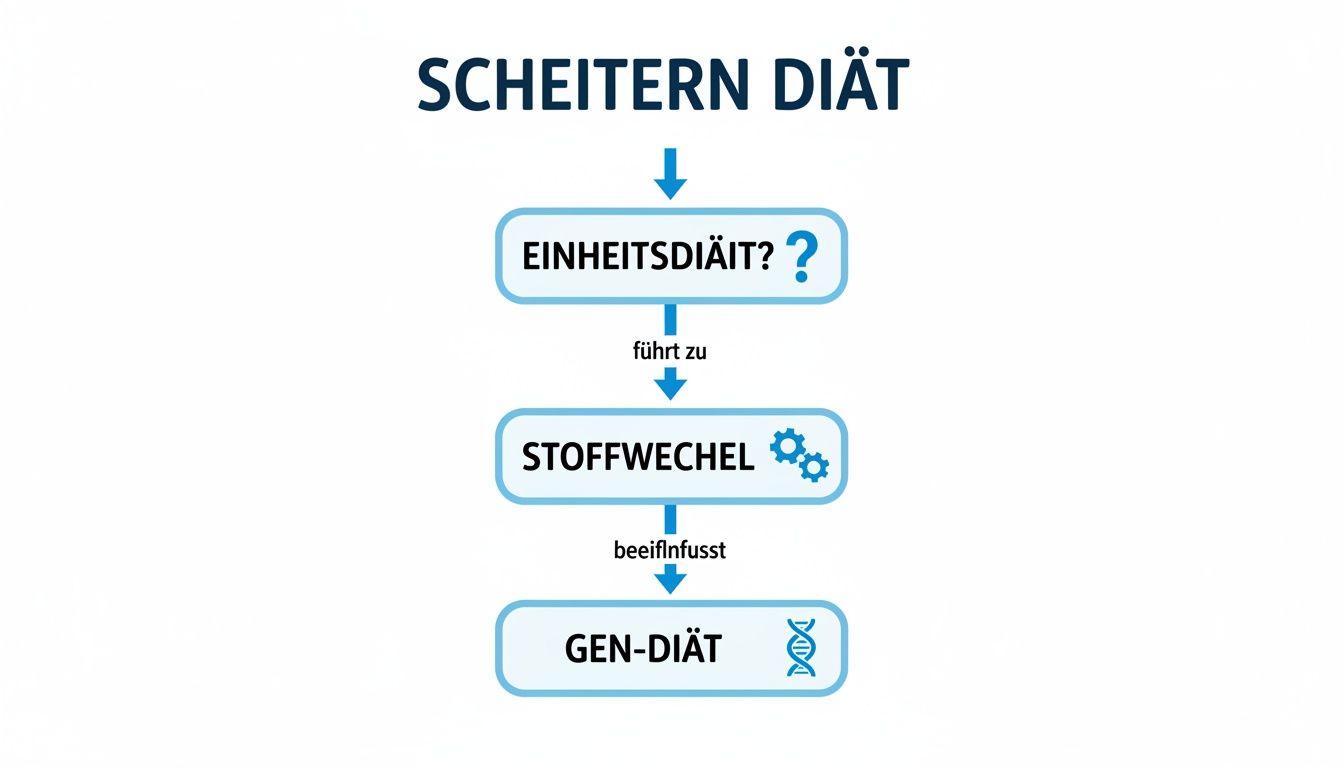
Here you can clearly see the shift away from a “one-size-fits-all” diet, which does not work for many people, toward a successful, gene-based nutrition strategy tailored to you.
Important genes that influence your weight
Certain genes play a particularly important role in weight management. They are, in a sense, the “master chefs” in your body’s kitchen and have a huge influence on how nutrients are processed in your body.
Some of the best-known genetic markers are:
- The FTO gene: Often referred to as the “obesity gene,” it influences your feelings of hunger and fullness. Certain variants may cause you to feel hungry more quickly and be more likely to reach for high-calorie foods.
- The APOA2 gene: This gene plays a role in fat metabolism. Depending on your genetic variant, your body may be more sensitive to saturated fats, which can promote weight gain if your diet is not suitable.
- The PPARG gene: It is involved in the formation of fat cells. Certain SNPs in this gene can influence how your body responds to unsaturated fatty acids—whether they are used primarily for energy or stored as fat.
These are, of course, just a few examples. Researchers have already identified 97 genes directly linked to body weight. It is estimated that 40 to 70 percent of the differences in weight between people are genetically determined.
A DNA test is not a verdict but a tool. It doesn’t tell you whether you can lose weight, but how you can do it most effectively—by adapting your diet to your unique genetic predisposition.
Once you know these genetic factors, you can finally make informed decisions. You’ll find out whether a reduced-carbohydrate, low-fat, or perhaps high-protein diet would be most effective for you. This knowledge gives you the opportunity to follow a strategy that works with your body rather than against it.
Would you like to explore the subject in greater depth? Then our article, What is nutrigenetics and how does it shape our lives?, explains it for you.
Your personal path to your desired weight, step by step
You’re probably curious about how a DNA test for weight loss actually works in practice. Don’t worry—the process is deliberately simple, so you can begin your personal nutritional journey without any obstacles. I’ll guide you transparently through every step—from the test kit in your hands to the specific recommendations you receive at the end.
It all begins conveniently at home. You don’t need to make an appointment or visit a medical practice. Your journey starts with a simple test kit containing everything you need.

The entire process is designed to give you maximum peace of mind and clarity.
Step 1: Collecting the sample at home
The centerpiece of the kit is a simple cotton swab. You use it to collect a saliva sample from your oral mucosa—it’s completely painless, takes only a few seconds, and you can do it yourself.
A detailed, easy-to-understand guide is included, of course, so nothing can go wrong. The only important thing is to collect the sample before brushing your teeth or eating, so the result is accurate and unaltered.
Then securely package the swab in the enclosed tube and prepare it for shipping.
Step 2: Free shipping to the laboratory
Your sample then goes into the prepaid return envelope, which you will also find in the kit. All you have to do is drop it into the nearest mailbox—we’ll cover the shipping costs in full.
Your sample goes directly to our ISO-certified partner laboratory. There, it is analyzed according to the strictest quality and safety standards. Scientific accuracy is our top priority.
Data protection is our top priority: Your sample is immediately pseudonymized in the laboratory. This means it is assigned a random code so that no one can connect it to your personal data. Your genetic information is securely and irreversibly destroyed after the analysis.
Step 3: Your personal analysis
Once the analysis has been completed in the laboratory, the actual “translation work” begins. Our experts evaluate your genetic data and create a comprehensive yet easy-to-understand results report. We deliberately avoid complicated technical jargon—you’ll receive clear, actionable information.
Your personal report explains everything you need to know for your success:
- Your metabolic type: You’ll learn how your body processes fats, carbohydrates, and proteins and which mix of these nutrients is ideal for you.
- Your genetic predisposition: We’ll show you how your genes influence your feelings of hunger and fullness and why you may be prone to cravings.
- Your optimal exercise type: Find out whether you’re more of an endurance or strength type and which form of exercise will get you to your goal most efficiently.
This isn’t about strict prohibitions or complicated rules. Instead, you’ll receive a personal guide to help you intelligently adapt your lifestyle to your body. This creates the foundation for sustainable success—without frustration or tedious guesswork. You’ll finally work with your body, not against it.
How to apply your genetic results in everyday life
A detailed report full of insights is a fantastic first step. But true success—your sustainable comfortable weight—lies in putting it into practice in real life. Here, you’ll get very specific tools to easily integrate the recommendations from your mybody-x DNA Test for Weight Loss into your everyday life.

Knowledge alone ultimately changes nothing. It’s the small daily decisions that get you to your goal. I’ll show you how to put theory into practice without having to completely turn your life upside down.
From knowledge to habit: What a day can look like
Imagine your report tells you that your body processes carbohydrates less efficiently and that you are more of a “Low-Carb Type.” Does this mean never eating bread or pasta again? Absolutely not! It simply means putting your meals together a little more intelligently.
A day for the “Low-Carb Type” might look like this:
- Breakfast: Instead of the classic jam-filled bread roll, have scrambled eggs with vegetables and a slice of whole-grain bread. This provides protein and healthy fats that keep you feeling full for a long time.
- Lunch: A large mixed salad with chicken breast or lentils is ideal. You simply replace the large portion of pasta with filling proteins and valuable dietary fiber.
- Dinner: Steamed fish with plenty of roasted vegetables – a light yet nutrient-rich meal that optimally supports your metabolism.
Conversely, if your body metabolizes fats less efficiently (a “Low-Fat Type”), your day will naturally look different. The focus here is on complex carbohydrates and lean proteins, while high-fat foods such as nuts, avocados, or cheese only appear on the menu in moderation.
A typical day for the “Low-Fat Type” might look like this:
- Breakfast: Porridge with fresh berries and a spoonful of low-fat quark.
- Lunch: A quinoa salad with plenty of colorful vegetables and kidney beans.
- Snack: An apple or a handful of vegetable sticks with a herbed quark dip.
As you can see, it's not about radical restriction, but about smart adjustments that are perfectly suited to your genetic profile.
Practical tips for shopping and eating out
Putting it into practice starts with your weekly shop. With the knowledge from your DNA test, the whole process becomes more targeted and, above all, easier.
- Write a shopping list: Plan your meals a few days in advance, based on your recommendations. This keeps unnecessary impulse purchases out of your cart.
- Learn to read labels: A quick look at the carbohydrate, fat, and protein content can help enormously. This way, you can make the better choice even with processed foods.
- Focus on fresh foods: Vegetables, fruit, lean protein, and high-quality sources of carbohydrates should form the basis of your shopping.
Even at a restaurant, you don't have to give up enjoying your meal. Often, all it takes is a glance at the menu to find a suitable option. And don't hesitate to ask for side dish substitutions – most restaurants will happily swap fries for a side salad or vegetables.
Your training – perfectly tailored to you
Your DNA test doesn't just give you nutritional advice—it also reveals what type of athlete you are. That's a real game-changer, because you no longer waste time on workouts that are less effective for your body.
Are you genetically more of a strength type? Then short, intense sessions such as strength training (with weights or your own body weight) or HIIT workouts (High-Intensity Interval Training) are ideal for revving up your metabolism and building muscle.
Are you more of an endurance type? Then you'll benefit especially from longer, moderate sessions such as jogging, cycling, or swimming. These activities not only burn calories but also strengthen your cardiovascular system particularly effectively.
Combining the right diet with the right training is the key to reaching your goals faster and with more enjoyment. In our guide, we show you in even greater detail how to optimize your diet based on your test results.
Your genes are your personal blueprint; they help determine how your body functions. But it's always an interplay: genes and lifestyle shape your weight together. A DNA test from mybody-x gives you the knowledge you need to shape your lifestyle so that it perfectly matches your genetic predisposition.
What else a gene-based diet can do
A diet that truly takes your genes into account is so much more than just a means to an end for changing the number on the scale. Of course, losing weight is often the main focus, but that's only a small part of a much bigger picture. When you understand what your body actually needs, you lay the foundation for an all-around good feeling.
Switching to a diet based on your DNA is like investing in your own vitality and long-term health. Instead of constantly fighting against your body, you begin to support it in a targeted way. And the best part: You often feel the positive effects after just a short time—and they go far beyond weight management.
More energy and fewer cravings
Do you know that feeling? You have lunch and then immediately hit an energy slump. Or those sudden afternoon cravings that come out of nowhere. This is often a clear sign that your body can't function optimally with what you're giving it. For example, if you're a metabolic type that has difficulty processing carbohydrates, a large portion of pasta can send your blood sugar on a roller coaster ride.
You surely know the result: First a brief high, then the deep crash—and the craving for the next sugar fix. A DNA test for weight loss shows you how to finally stabilize your blood sugar levels.
- Stable energy levels: With the right nutrient balance, you avoid the typical energy slumps and simply feel more alert and present throughout the day.
- Control over cravings: When your body gets the nutrients it can use efficiently, it no longer constantly signals false hunger.
Better digestion and improved performance
Your gut will thank you, too. When digestion is not constantly overloaded with unsuitable nutrients, bloating and feelings of fullness will soon be a thing of the past. You give your system exactly what it can process effortlessly.
At the same time, you can take your athletic performance to a new level. Your genetic predisposition not only reveals whether you are more suited to strength or endurance sports. It also shows which nutrients your body needs to build muscle and recover effectively.
Give your body the right fuel for training and recovery. You will not only see faster progress, but also simply feel stronger and fitter in everyday life.
As you can see, the holistic benefits of personalized nutrition go far beyond weight management alone. Here is a brief overview of the positive effects you can expect.
Holistic benefits of personalized nutrition
This table gives you an overview of the positive effects that go beyond weight management alone.
| Health area | Potential benefits of genetic analysis | Example |
|---|---|---|
| Energy & vitality | More stable blood sugar levels, less fatigue | A “low-carb type” feels more alert after a protein-rich breakfast than after sugary cereal. |
| Sleep quality | Better recovery, fewer nighttime awakenings | The right nutrient intake in the evening can support the production of sleep hormones. |
| Sports & fitness | More efficient muscle building, faster recovery | A “strength type” reaches their goals faster with targeted strength training and the right protein intake. |
| Mental well-being | Reduced stress from avoiding diet frustration | Knowing what your body needs builds confidence and puts an end to guesswork. |
A diet based on your DNA is not a short-lived trend but a sustainable strategy for your health. You learn to interpret your body’s signals correctly and make decisions that strengthen you in the long term and take your well-being to a new level.
You ask, we answer: Everything you need to know about the DNA test
The idea of using your own DNA to lose weight is exciting—and naturally raises questions. That is a good thing, because it shows that you are consciously engaging with your health. To give you clarity and peace of mind, I have compiled the answers to the most frequently asked questions here.
Is there real science behind it?
Yes, absolutely. The entire approach is based on nutrigenetics, a relatively young but rapidly growing field of science. At its core, nutrigenetics examines how our genes, diet, and health interact.
It is important to understand, however: A DNA test is not a magic pill that makes the pounds melt away on its own.
Think of the test instead as an incredibly detailed, personal map of your body. It shows you the most efficient routes to your destination (the right nutrients and types of exercise) while also warning you about detours and dead ends (foods that your metabolism processes less efficiently). Scientific studies increasingly suggest that personalized nutrition plans that take genetic predispositions into account lead to more sustainable success than typical “one-size-fits-all” diets.
The test is therefore a scientifically grounded tool that helps you make the right decisions for yourself and your body.
What happens to my genetic data?
Your privacy and the security of your data are our top priorities. We fully understand that genetic information is extremely sensitive. That is why we have established strict processes to protect it.
The entire process takes place in several clearly defined steps:
- Pseudonymization: As soon as your sample arrives at the laboratory, it is separated from your personal data. It is assigned a unique, anonymous barcode. From that moment on, no one at the laboratory can establish a direct connection between the sample and you.
- Secure analysis: The analysis itself takes place in an ISO-certified laboratory under the highest security standards. Only the genetic markers relevant to your report are read—not more and not less.
- Guaranteed destruction: After analysis, your biological sample is safely and completely destroyed. We do not store or use your DNA for any other purposes.
In short: Your genetic data is used exclusively to create your personal results report. We never share it with third parties such as insurance companies or employers, nor do we use it for research purposes unless you give us explicit and separate consent.
So you retain full control. If you would like to explore the subject in greater depth, you can find all the details in our comprehensive FAQ section on our website.
When can I expect results?
We know you are curious and would love to get started right away! The entire process—from sending in your sample to receiving your finished report—is designed for maximum thoroughness and accuracy.
It usually takes four to six weeks after your sample arrives at our laboratory to receive your detailed report. We will keep you updated and send you an email as soon as everything is ready for you.
And as for noticeable results? Naturally, this varies from person to person. However, many of our customers tell us about their first positive changes after just a few weeks, such as:
- More energy throughout the day
- Fewer cravings
- A better sense of fullness
- First successes on the scales
The most important thing is to be patient with yourself and your body and to stay consistent. Your body simply needs some time to adjust to the optimized diet and perhaps new training program. But this investment in your self-knowledge will pay off in the long term.
Does the test replace a medical consultation?
This question is particularly important to us, and the answer is a clear and emphatic no. A DNA test for weight loss is a fantastic tool for optimizing your lifestyle and diet. However, it is not a medical diagnostic tool.
The test does not provide information about disease risks and cannot diagnose existing health problems. Its strength lies in showing you how your body responds to certain nutrients and types of exercise, helping you better achieve your overall health and weight goals.
Think of the test as a valuable companion on your journey. However, if you have health problems, are chronically ill, or suspect you have an illness, seeing a doctor is always the first and right step.
By the way, your results report can be an excellent basis for a conversation with a nutritionist or your doctor to further refine your health strategy together. But it never replaces professional medical advice.



Share now:
Our genuine experiences with the DNA Slim test and what lies behind it
7 Steps: Checklist for Diet Optimization with Laboratory Knowledge