

Home hormone test: what a single result does and does not tell you
The essentials at a glance
A home hormone test provides a measurement at a specific point in time. It measures the concentration of a hormone at exactly the moment the sample was collected. The time of day, day of the cycle, and medications or supplements taken can shift this number without anything about how you feel having changed. Such a result describes a status, not a cause.
This article separates three things that are usually mixed together online: what a self-collected sample technically measures, what the endocrinology professional society thinks of it, and what such a number is nevertheless useful for in everyday life. Where a number is available, it is listed here with the institution and year. Where there is none, that is stated as well.
First, you will read what these tests actually measure and what the professional society says about them. Next come the signs that belong in a doctor's office, a comparison of the three ways to obtain a hormone level, and the three factors that shift every result. The latter part covers the individual hormones, preparing for sample collection, interpreting an abnormal result, and the limitations.
What to expect in this article
1. What a hormone test for home use measures
2. What the endocrinology professional society says about it
3. When a suspicion does not belong in a test
4. Comparing the three ways to obtain a hormone level
5. Why every hormone level is a measurement at a specific point in time
6. The menopause in numbers
7. Which hormones are included in a home hormone test
8. Why men look for something different in this area
9. How to prepare for sample collection
10. How to recognize a useful test
11. What you can have measured at home in this area
12. How to interpret an abnormal result
13. Limitations: what a hormone test for home use cannot clarify
14. Who may benefit from a measurement—and who may not
15. What ultimately matters
Frequently asked questions
Sources
What a hormone test for home use measures
The term covers two types of tests that have little to do with each other. One is read at home; the other is merely collected at home. If you fail to distinguish between them, you are comparing two different things when you buy one.
A readout test works like a pregnancy test: a cassette shows one line or none after a few minutes. It answers a yes-or-no question at a defined threshold and does not provide a numerical value.
A test with laboratory analysis takes a different approach. You collect the sample yourself, send it in, and receive a numerical value with a reference range. The difference is therefore not convenience, but the result: one gives a line, the other a number.
Key message
A home hormone test measures a concentration at the time of sampling. It measures neither a progression nor a cause, and it does not establish a diagnosis.
Blood, saliva, and urine: three samples, three measures
Blood tests generally determine the total amount of a hormone, meaning the bound and free fractions combined. Capillary blood from a fingertip is sufficient for many values because modern analytical instruments can work with small quantities.
Saliva contains primarily the free fraction, meaning the portion that is not bound to transport proteins. This may sound like the better measure, but it is not automatically so, because reference ranges vary more between methods and laboratories than they do for blood.
Urine reflects what the body has excreted over a period of time. This type of sample therefore answers a different question than blood and saliva, and it generally requires collection over several hours.
Why a reference range is not a target
A reference range describes which values were measured in a comparison group. It is a statistical range, not a personal target. Being just above or below it therefore does not mean you are ill, and being in the middle does not automatically mean you are healthy.
In addition, reference ranges depend on the laboratory, the method, and age. Findings from two laboratories therefore cannot be reliably compared side by side, even if both use the same unit. The information on your own test report is always authoritative.
What the endocrinology society says about this
There is a clear statement on this topic, and it does not favor the tests. On October 30, 2024, the German Society for Endocrinology commented on self-tests that people use at home to determine their hormone status.
Documented source
“The German Society for Endocrinology e.V. (DGE) advises against using these self-tests because the results are not valid.”
German Society for Endocrinology
Press release “Convenient but Uncertain: DGE Advises Against Home Hormone Self-Tests”, 2024
This sentence appears here because it is relevant to the topic, not despite being inconvenient. Anyone writing about hormone tests for home use while omitting the position of the responsible professional society is producing advertising, not a guide.
The rationale is technical and not fundamental. An assessment by Prof. Dr. med. W. Alexander Mann, a specialist in internal medicine, endocrinology, and diabetology, reproduced in the same statement reads: “It starts with the time of day at which the sample was taken. This has a very strong influence, for example, on the assessment of male hormones.”
In the same statement, the professional society recommends consulting an endocrinology practice for questions about hormone status (German Society for Endocrinology, 2024). It also mentions a counterexample: for a clear, narrowly defined question, a self-test could be helpful.
What this means for you
The objection is justified. Nevertheless, something else is decisive: what the criticism is aimed at. It is aimed at the idea that a self-obtained result could replace a medical evaluation. It is not aimed at a person wanting to have a number about themselves at all.
That is precisely why this article does not recommend clarifying a suspicion with a test. What is presented here is a description of what such a result is: a data point that you can take into a conversation if you know and provide the conditions under which the sample was collected.
When a suspicion does not belong in a test
Before considering test results, it is worth checking the following list. If any of these points apply to you, the next step is an appointment at a medical practice, not ordering a test.
These signs belong in a medical practice
Bleeding after menopause
any bleeding after your period has been absent for twelve months
Very heavy or prolonged bleeding
when their duration or intensity has changed significantly and remains that way
Significant unintentional weight loss
even though you are neither eating less nor exercising more
Absence of menstruation before the age of 40
Menopause before this age is considered premature and is investigated (IQWiG, 2023)
Visual disturbances or persistent headaches
together with hormonal symptoms, not as an isolated episode
Unfulfilled desire to have children
This is where diagnosis belongs in a medical practice from the outset, because the timing within the menstrual cycle determines what the result means.
This list is not a diagnostic framework. It identifies the point at which a number from a self-collected sample would be the wrong answer to the right question.
Many people who research this topic have already visited a medical practice and left again without an explanation. They are missing a data point, not a promise. For them, the sequence is different, and the rest of this article describes it.
Comparing the three ways to obtain a hormone level
There are three ways to obtain a hormone level. They differ in the effort involved and, above all, in what ultimately appears on paper. The table compares them using the same five criteria.
| Criterion | At-home readout test | Sample collected at home, analyzed in a laboratory | Blood collection at a medical practice |
|---|---|---|---|
| What you end up with | A line above or below a specified threshold | A numerical value for each hormone with a reference range | A numerical value, embedded in an examination and medical history |
| Who collects the sample | You yourself, with the result in a few minutes | You yourself, interpreting the result after it arrives from the laboratory | Medical staff at the agreed appointment |
| Who interprets the number | No one; there is no number | A written report; the assessment for your case remains open | A doctor, during a consultation |
| Who determines the timing | You, with all the implications for what the result means | You, following the instructions in the kit | The practice, matched to the question |
| What it is suitable for | A narrowly defined yes-or-no question | Establishing a baseline and preparing for a conversation | Investigating a specific suspicion |
The third column is not the strongest because someone wearing a lab coat is standing there. It is the strongest because the timing of sample collection matches the question being asked, not the calendar.
Why every hormone level is a time-point measurement
Hormones are not fixed quantities like height. They are secreted, take effect, and are broken down, all in a rhythm. A sample captures a single point in this progression.
Three factors determine where that point lies: the time of day, the day of the cycle, and what medications or supplements you take. You can influence all three, or at least record them, and that is precisely the difference between a useful and a worthless result.
The time of day shifts the number
Several hormones follow a daily rhythm. In its 2024 statement, the German Society for Endocrinology explicitly identifies the time of day as the first confounding factor and points out that it strongly affects the assessment of male hormones.
In practical terms, a sample taken in the late afternoon and one taken shortly after waking are not the same result with a little variation. They are two different questions asked of the same organism.
That is why anyone measuring twice measures at the same time of day. Without this condition, two values cannot show a trend, only a meaningless difference.
The day of the cycle determines what the result means
For women with menstrual cycles, there is a second axis to consider. The U.S. National Library of Medicine states regarding the FSH test that women who menstruate may need to be tested at a specific point in the cycle because FSH levels change throughout the month (NLM/NIH, 2023).
This applies even more clearly to estradiol and progesterone. Progesterone only rises after ovulation; a sample taken in the first half of the cycle therefore regularly shows a low level, and this low level is not an abnormal finding but the expected state.
This leads to a rule no test kit can replace: Note the cycle day. A report without this information is nearly impossible to interpret for cycle hormones, regardless of which laboratory performed the measurement.
Products shift the value, not the symptoms
Hormonal contraceptives act precisely on the regulatory circuits reflected by a hormone test. A value measured while taking the pill therefore describes the state under the pill, not the state of your own cycle.
The same applies to ongoing hormone therapy and thyroid medication. Dietary supplements can also interfere with laboratory procedures; which products do so in a given case depends on the laboratory's analytical method and is not stated in the test kit.
The practical consequence is unremarkable and yet rarely followed: Write down what you take, including the dose and time of use, and place this list next to the report. Without it, every doctor reads a number without context.
Menopause in numbers
Most inquiries about at-home hormone tests come from a particular stage of life. That is why it is worth looking at the timeline behind them before turning to individual values.
The timeline in years
51
Years old women are on average when they experience menopause, meaning their last menstrual bleeding
40
Years is the cutoff: If menopause occurs before this age, it is considered premature
4–5
Years hot flashes usually last, after which they gradually subside on their own
Source: Institute for Quality and Efficiency in Health Care (IQWiG), Menopausal symptoms, as of 2023
These three figures provide more context than they might seem to at first glance. Menopause is not an event but a period, and menopause itself can only be determined retrospectively: If menstrual bleeding has stopped completely for twelve months, the last bleeding was very likely menopause (IQWiG, 2023).
In the same source, IQWiG notes that although it is possible to measure sex hormones in the blood, this has no value for the practical question of contraception or treatment (2023). The stage is therefore determined by the course of bleeding and by symptoms, not by a laboratory value.
For you, this means: A hormone level does not answer the question of whether you are in menopause. It describes where your body was at the time the sample was taken, which is a different and more limited statement.
Which hormones are included in an at-home test
The composition varies depending on the test, but eight values keep recurring. They can be sorted into four groups, and each group answers a different question.
Estradiol and progesterone: the cycle hormones
Estradiol is the most potent form of estrogen, while progesterone is the hormone of the second half of the menstrual cycle. Their ratio shifts in the years before menopause, and both fluctuate more throughout the month than any of the other values mentioned here.
Because they fluctuate so strongly, they are also the values for which missing a cycle day most seriously undermines the validity of the result. What low progesterone means and what it does not is described elsewhere: Low progesterone: which symptoms indicate it and which do not.
FSH and LH: the control hormones from the brain
FSH and LH come from the pituitary gland and send signals to the ovaries. They do not show how much hormone is present, but how loudly the control center is calling.
Persistently elevated FSH is considered an indication of the menopausal transition. The U.S. National Library of Medicine notes that an FSH test is generally unnecessary for women aged 45 and older because high FSH levels are a normal sign at this stage of life (NLM/NIH, 2023).
Testosterone, DHEA-S, and SHBG: secondary factors with an impact
Testosterone occurs in smaller amounts in women and contributes to drive and muscle function. DHEA-S comes from the adrenal cortex and is a precursor to other sex hormones.
SHBG is not a hormone but a transport protein. It binds some of the sex hormones and therefore helps determine how much remains freely available. A total value without SHBG leaves this question unanswered.
TSH: the signal to the thyroid
TSH is included in almost every hormone panel for a practical reason: an underactive thyroid causes symptoms that resemble those of menopause. Fatigue, feeling cold, and a low mood are common to both conditions.
TSH is the control signal from the pituitary gland, not the thyroid hormone itself. For more information on what free hormones reveal, see the article on the optimal ratio of fT3 and fT4.
Why men look for something different on this topic
The search for an at-home hormone test comes primarily from the areas of menstrual cycles and menopause. This article follows that line of inquiry, which is why the female hormonal axis is the focus here.
In men, the situation is different, and the difference is more fundamental. In its press release of June 6, 2025, the German Society of Endocrinology makes clear that men do not experience a distinct hormonal transition comparable to menopause in women.
The same announcement defines testosterone deficiency as levels below 8 nanomoles per liter (German Society for Endocrinology, 2025). The society’s media spokesperson, PD Dr. med. Dr. jur. Birgit Harbeck, is quoted there as saying: “Testosterone is not a lifestyle product, but a vital hormone.”
For sample collection, this has a clear consequence. Testosterone is precisely the value for which the medical society identifies the time of day as the strongest confounding factor. Anyone who measures it in the afternoon measures something different from the morning, and a single afternoon value cannot guide a decision.
Chapter at a glance
In men, there is no distinct hormonal transition comparable to menopause in women; the German Society for Endocrinology explicitly stated this in 2025. According to the same source, testosterone deficiency is defined as levels below 8 nanomoles per liter. Because testosterone fluctuates throughout the day, the time of sample collection also determines what the number actually means. A single afternoon value does not answer the question of deficiency.
How to prepare for sample collection
Preparation determines the value of the report, and it takes less than ten minutes. These four steps prepare you for a conversation in a medical practice; they do not replace it.
Set the time
Ideally in the morning, shortly after getting up. Note the time, even if no field is provided for it.
Determine the cycle day
Day 1 is the first day of bleeding. As long as you have a cycle, this number belongs in the report.
Write down medications and supplements
Contraception, hormone therapy, thyroid medication, dietary supplements. Include the dose and time taken.
Send the sample back the same day
The shorter the route to the laboratory, the fewer questions remain about sample quality.
The order is not accidental. Anyone who collects the sample first and then considers which cycle day it was has a number without a reference point. Anyone who makes two notes beforehand has a result that can be used.
How to recognize a useful test
The market for tests of this kind is confusing, and the differences are rarely shown on the home page. Five points can be checked before buying, and they cost nothing but reading time.
Check before buying
Five points that should appear on the product page
Exactly which values are measured
A named list, not wording such as “all important hormones”
Which sample type is required
Blood, saliva, or urine. The sample type also determines which parameter can actually be measured
Whether the timing of sample collection is specified
A provider that says nothing about the time of day and cycle day is concealing the most important condition
What happens to your data
Health data are particularly protected; where and how long they are stored must be disclosed
What the test explicitly does not provide
A product page without a single sentence about its limitations is a warning sign in itself
A product page without a single sentence about its limitations is a warning sign in itself.
Why the marker list matters more than the price
Two tests at the same price can answer completely different questions. One measures cycle hormones; the other measures the thyroid and adrenal glands. Anyone who chooses based on price is choosing by the only factor that says nothing about usefulness.
The reverse order makes more sense. First formulate your question in one sentence, then find the test whose marker list addresses that question, and only compare prices afterward.
What certificates do and do not accomplish
A certificate describes a tested process. It says that a laboratory works according to established rules, and it says nothing about whether the measured value explains your symptoms.
A certificate safeguards the process, not the truth. This distinction is particularly important for hormone levels because the greatest source of error is not in the laboratory, but at the moment you collect the sample.
What you can have measured at home on this topic
If, after everything said so far, you want a baseline value, the way forward is a test whose sample is analyzed in a laboratory. mybody®x (MYBODY Lab GmbH) offers a blood test for this purpose that covers eight values related to menopause.
First, the qualification this article owes you: The German Society for Endocrinology advises against self-tests to determine hormone status (2024). This position also applies to the test discussed below, and it is not downplayed here. What the test provides is a laboratory-measured point-in-time result to discuss, not an evaluation or diagnosis.
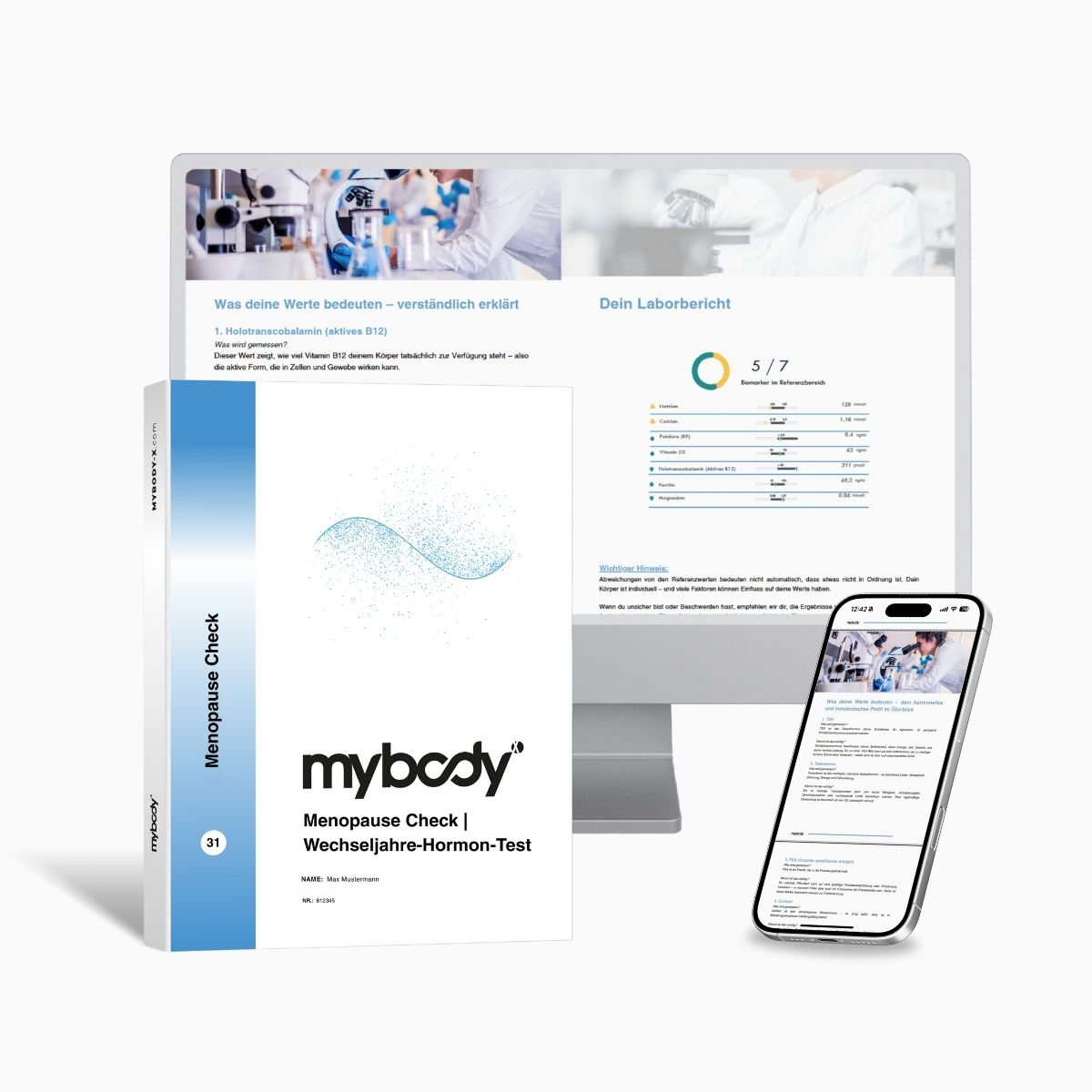
Capillary blood test
Menopause Check | Menopause Hormone Test
Eight hormone levels from one blood sample: progesterone, estradiol, FSH, LH, testosterone, DHEA-S, SHBG, and TSH. What the test cannot do: It cannot determine whether you are going through menopause—in accordance with IQWiG (2023), the course of bleeding and symptoms are decisive, not a laboratory value. The product page itself points out that estradiol, progesterone, FSH, and LH fluctuate significantly throughout the cycle and that the cycle day must be recorded as long as a cycle continues. An abnormal result should be medically assessed.
Laboratory analysis 3–5 business days after sample receipt
accessed 27 August 2026
This article focuses on the test category and on what a measurement taken at a single point in time can tell you. If you are concerned about one particular hormone, two other articles are more closely related to your question: Measuring cortisol at home describes the measurement itself, while High cortisol: symptoms in women explains the symptoms.
How to interpret an abnormal result
A value outside the reference range reliably causes concern. This is precisely what the endocrinology society warns about when it refers to unnecessary anxiety caused by inaccurate results (2024). That is why the conditions should be checked before any interpretation.
The first question is: Was the timing appropriate for the hormone? Low progesterone in the first half of the cycle is normal. A single afternoon testosterone value is not a basis for evaluation.
The second question concerns medications and supplements. A value measured while using hormonal contraception describes the state under that contraception. If you forget this when reading the result, you may interpret an expected number as an abnormal finding.
The third question is the simplest and the one most often skipped: Does the reference range come from the same laboratory as the result? Only then can the number and the range be compared at all.
If an abnormality remains after these three questions, the next step is an appointment. Bring the result, along with the time, cycle day, and your list of medications and supplements. These four details can noticeably shorten the consultation.
Limitations: what an at-home hormone test cannot clarify
The first limitation is timing. A value is a snapshot, not a trend. Anyone who wants to know how something is developing needs at least two measurements taken under the same conditions, and even then, the information remains limited.
The second limitation concerns attribution. A hormone level outside the reference range indicates a condition. The result does not say whether that exact condition is causing your fatigue, sleep disturbance, or cycle changes.
The third limitation is the most important. A capillary blood test is no substitute for an examination. Changes in the ovaries, uterus, thyroid, or pituitary gland are detected through imaging procedures and a medical examination, not through a marker.
This is further supported by the US National Library of Medicine’s guidance on at-home tests: “At-home medical tests can provide helpful information, but they are not a replacement for guidance and treatment by your provider.“ (NLM/NIH, 2024). The same source recommends following up with a doctor after a home test, regardless of the result.
And one boundary regarding my own scope: Reference ranges depend on the laboratory, method, and age. The information on your own lab report is always authoritative, not the numbers in an article.
Who a measurement makes sense for—and who it does not
Useful for you if …
you have been medically evaluated, nothing requiring treatment was found, and you are now looking for a baseline value for your own monitoring.
you can formulate your question in one sentence and know which value it concerns.
you are prepared to note the time, cycle day, and medications or supplements and proceed the same way next time.
you want to prepare for an appointment and go into the conversation with numbers rather than a guess.
Probably not if …
one of the signs from Chapter 3 applies to you. In that case, making an appointment is the right order, not placing an order.
you use hormonal contraception and want to know what your own cycle looks like. The value then describes the contraception, not you.
you want to investigate your chances of having children. This diagnostic process depends on timings determined by a medical practice.
you hope the number will give you a diagnosis. For this question, the German Society for Endocrinology explicitly refers you to an endocrinology specialist practice (2024).
What matters in the end
If you take away just one action from this article, let it be this: Before taking the sample, write down three things: the time, the cycle day, and your medications or supplements. Three notes, nothing more.
The reason is unremarkable. These three details determine whether your number becomes a finding or a random number. They cost nothing, cannot be reconstructed afterward, and are the only part of the measurement that you have complete control over.
It all started with the question of what an at-home hormone test tells you. The most honest answer is: less than the advertising promises, and more than nothing if you know and provide the conditions. The value itself is the smaller part of the work.
Frequently asked questions
What does an at-home hormone test really tell you?
It tells you how high the concentration of a hormone was at the moment the sample was taken. Nothing more. The time of day, cycle day, and medications or supplements taken can shift this number without anything about how you feel having changed. In 2024, the German Society for Endocrinology advised against self-tests for determining hormone status because, in its assessment, the results are not valid. As a starting point for a medical consultation, a laboratory-measured value can still be useful if you provide the sampling conditions.
When should I have hormonal symptoms evaluated by a doctor?
With any bleeding after menstruation has been absent for twelve months, with noticeably changed or very heavy bleeding, unintentional weight loss, and vision problems or persistent headaches together with hormonal symptoms. If menstruation stops before age 40, it is considered premature menopause and should be investigated (IQWiG, 2023). Unfulfilled desire to have children should also be addressed at a medical practice from the outset, because the timing in the cycle determines how the results should be interpreted.
On which cycle day should I take a hormone test?
It depends on the hormone, which is precisely why the cycle day should be included in every result. The U.S. National Library of Medicine states that women who menstruate may need to take an FSH test at a specific time in their cycle because levels change throughout the month (NLM/NIH, 2023). Progesterone rises only after ovulation; a low level in the first half of the cycle is therefore expected and not an abnormal finding. Record day 1 as the first day of bleeding and note the day on which you collected the sample.
Can an at-home hormone test detect menopause?
No. According to IQWiG (2023), determining hormone levels has no value for the practical questions of this phase; the course of bleeding and the symptoms are what matter. Menopause itself is determined retrospectively: if menstrual bleeding has been completely absent for twelve months, the last bleeding was very likely the menopause. On average, this happens at age 51 (IQWiG, 2023). A hormone level therefore describes a state; it does not answer the question of which stage of life you are in.
How does the pill affect the result of a hormone test?
Hormonal contraceptives interfere with precisely the regulatory circuits measured by a hormone test. A result obtained while taking the pill therefore describes your state on the pill, not the state of your own cycle. The same applies to ongoing hormone therapy and thyroid medication. If you measure anyway, record the medication, dosage, and time taken, and place this information alongside the result. Without it, every doctor reads a number without context.
Next step
Conditions first, then the number
If none of the signs from Chapter 3 apply to you and you are looking for a starting point for the conversation, the Menopause Check covers the eight values related to menopause. The linked article uses cortisol as an example to show how an individual value changes over the course of the day.
View Menopause Check Measure cortisol at homeRead more
You might also be interested in
The daily rhythm of a single hormone, explained in detail using cortisol as an example.
In case you are concerned about a single cycle value and its interpretation.
Sources
- German Society for Endocrinology: Convenient but uncertain—the DGE advises against at-home hormone self-tests (as of 2024) – endokrinologie.net
- Institute for Quality and Efficiency in Health Care (IQWiG): Menopausal Symptoms (as of 2023) – gesundheitsinformation.de
- U.S. National Library of Medicine, National Institutes of Health, MedlinePlus: At-Home Medical Tests (as of 2024) – medlineplus.gov
- U.S. National Library of Medicine, National Institutes of Health, MedlinePlus: Follicle-Stimulating Hormone (FSH) Levels Test (as of 2023) – medlineplus.gov
The verbatim quote evaluating hormone self-tests, the statement about the time of day, and the recommendation to consult an endocrinology specialist practice come from source [1]. The figures on the timeline of menopause, the twelve-month rule, the age threshold of 40, and the classification of hormone testing are based on [2]. The statements on the benefits and limitations of at-home tests come from [3], while the information on the timing within the cycle and the FSH test from age 45 comes from [4]. The information on age-related testosterone deficiency and the threshold of 8 nanomoles per liter comes from the press release of the German Society for Endocrinology dated June 6, 2025; it is attributed in the main text to the institution and date and is therefore not included in this list. Information on price, markers, sample type, and laboratory comes from the mybody®x product page, accessed on 27.08.2026; processing times follow the central specification for blood tests. All sources were accessed and reviewed on 27.08.2026.

mybody®x Editorial & Specialist Team
Hormone diagnostics Laboratory diagnostics Blood analysis interpretation Women's health
This article was created by the mybody®x editorial and specialist team. The team combines laboratory diagnostics, the interpretation of blood analyses, and nutritional science. Those who contribute to it are listed on the authors page.
Published on 25.12.2025 · Last updated on 27.08.2026
The content is for general information and does not replace medical advice, diagnosis, or treatment. Reference ranges depend on the laboratory, method, and age—your test report always provides the authoritative information.




Share now:
At-home milk protein allergy test: Understand your body’s signals
Benefits of Hormone Analysis – Understanding Individual Health