

Weight loss with vitamin D as a clever metabolism booster
Does this sound familiar? You're strictly following your diet plan, exercising regularly, but the number on the scale just won't budge. The reason could be deeper than you suspect. Sometimes, an optimal vitamin D level is the crucial piece of the puzzle to give your metabolism the boost it needs and finally get weight loss started with vitamin D.
Why your weight loss success may depend on vitamin D

Most people only know vitamin D as the "sunshine vitamin," which is good for bones. But its functions in your body are much more extensive – and they have a direct influence on your metabolism and body weight.
Imagine your metabolism like a car engine. For it to run smoothly and efficiently burn fuel – in this case, fat – it needs a kind of spark plug. Vitamin D can play precisely this role. It's involved in countless processes that are crucial for effective fat burning, your feeling of satiety, and stable blood sugar levels.
The hidden weight loss brake in the body
If this "spark plug" is missing, the engine quickly starts to sputter. An undetected vitamin D deficiency can do exactly that and sabotage your best weight loss intentions without you even realizing it.
Here's an overview of how a lack can slow down your efforts:
| How a vitamin D deficiency slows down your weight loss success |
|---|
| This table summarizes the most important links between low vitamin D levels and the challenges of weight loss. |
| Problem with weight loss |
| How vitamin D deficiency contributes to this |
| carrier of fat metabolism |
| Your body switches into a kind of energy-saving mode and clings more stubbornly to its fat reserves instead of using them as energy. |
| Constant cravings |
| Important hormones that regulate your hunger and satiety (such as leptin) become imbalanced. The result: You have a bigger appetite. |
| More belly fat |
| A deficiency is associated with elevated levels of the stress hormone cortisol. Cortisol, in turn, promotes fat storage in the abdominal area. |
In summary: A vitamin D deficiency causes you to work against your own body. Your metabolism slows down, while your hunger intensifies – a decidedly bad combination if you want to lose weight.
The true extent of the shortage in Germany
You're not alone. The problem is widespread: In Germany, around 60% of adults struggle with insufficient vitamin D levels. These are truly sobering figures that show how many people are unknowingly holding themselves back.
Studies like the National Nutrition Survey II show that a large proportion of the population does not reach the recommended daily intake. Particularly alarming: 91 percent of women fall short of this level, which can further complicate weight loss efforts. If you would like to learn more about the reasons for vitamin D deficiency in Germany, you can find further insights here .
The good news is: you can break this cycle. By knowing your vitamin D status and optimizing it, you create the biological foundation for your efforts to finally bear fruit. This isn't about a miracle pill, but about giving your body what it truly needs for an efficient metabolism. Learn more in our guide about how healthy weight loss can work in general .
How Vitamin D controls your metabolism
Think of vitamin D as the conductor of your metabolic orchestra. Without it, the individual instruments – hormones and cells – play somewhat disjointedly. The result is more chaos than a harmonious melody. Let's take a look behind the scenes and examine the three most important ways in which vitamin D directly influences your metabolism and can thus help you lose weight.
Control over hunger and satiety hormones
Your body constantly uses hormones to regulate hunger, satiety, and energy storage. Two of the most important players in this process are leptin and insulin .
Leptin, often called the satiety hormone, is produced by your fat cells. It sends a clear signal to your brain: "I'm full, stop eating." Vitamin D is crucial for how well your brain can receive this signal. A deficiency essentially makes the brain "deaf" to leptin's messages. The result: You don't feel properly full, even though you've eaten enough, which quickly leads to cravings and unnecessary calories.
At the same time, vitamin D also plays a role in insulin function. Insulin's job is to transport sugar from the blood into the cells, where it is used as energy. A good vitamin D level helps your cells respond better to insulin. This prevents sharp blood sugar spikes and ensures that sugar is burned efficiently instead of being stored directly as fat.
The direct influence on your fat cells
But vitamin D doesn't just communicate indirectly via hormones – it also speaks directly to your fat cells. It can both inhibit the formation of new fat cells and reduce the storage of fat in existing cells.
Simply put: Sufficient vitamin D levels help slow down the growth of your fat tissue. It acts like a regulator, signaling the body to create fewer new fat stores ( adipogenesis ) and instead draw on existing energy reserves.
This mechanism is invaluable if you want to lose weight. It creates an environment in your body where fat burning is easier and fat storage is more difficult. Your body therefore becomes much more efficient at using fat as fuel instead of storing it for lean times.
Combating silent inflammation
A frequently underestimated factor in weight loss is chronic, low-grade inflammation in the body. Especially in cases of obesity, fat tissue, particularly around the abdomen, is metabolically very active and produces pro-inflammatory substances. These "silent inflammations" are like sand in the gears of your metabolism: they slow it down, promote insulin resistance, and make losing weight a real ordeal.
This is where the strong anti-inflammatory effect of vitamin D comes into play. It helps the body to better regulate and reduce these low-grade inflammations. By balancing the immune system, it can dampen inflammatory processes in fatty tissue.
A good vitamin D level supports your body in the following ways:
- To lower inflammatory markers that block metabolism.
- To improve overall metabolic health by eliminating interfering factors.
- To break the vicious cycle of obesity and inflammation.
If you want to better understand the complex processes within your body, also read our article about what influences metabolism .
In summary, vitamin D orchestrates your metabolic processes on several levels. It ensures that your satiety signals are received, your blood sugar remains stable, your fat cells grow less, and inflammation is reduced. All of this creates the perfect foundation for your efforts with diet and exercise to finally bear fruit.
The vicious cycle of obesity and vitamin D deficiency
We've already seen how a vitamin D deficiency can sabotage your weight loss goals. But now comes the real crux of the matter, a dynamic that many overlook: being overweight is not only a consequence, but often also the cause of a vitamin D deficiency. This may sound paradoxical at first, but the underlying mechanism is crucial if you want to break this cycle.
Imagine your body fat as a giant sponge. The bigger the sponge, the more water it absorbs and holds onto. Vitamin D works in much the same way.
Why your fatty tissue “swallows” vitamin D
Vitamin D is fat-soluble. This means it doesn't dissolve in water, but is readily stored in fatty tissue. Therefore, the more fatty tissue you have, the more of this valuable vitamin is effectively "stored" there and withheld from the rest of your body.
This stored vitamin D is present in the body, but it's no longer available to your metabolism for all the important processes. It's essentially trapped and biologically inactive. This leads to a rather complicated situation: overweight people often need significantly more vitamin D just to maintain healthy blood levels and keep their metabolic functions running smoothly.
This connection is a real game-changer. It makes it clear that losing weight with vitamin D isn't just about correcting a deficiency. You have to understand that being overweight itself exacerbates the deficiency. It's a vicious cycle that you have to actively break.
Science confirms the connection
This dynamic is not just theoretical. Numerous genetic studies have long since confirmed this direct, causal link. A massive analysis using data from over 124,000 people has clearly demonstrated that a higher body mass index (BMI) directly leads to lower vitamin D levels.
Researchers discovered that every increase in BMI of just 1 kg/m² lowers blood vitamin D levels by an average of 1.15 percent . Particularly interesting: The study also showed that a genetic predisposition for low vitamin D levels does not, conversely, lead to obesity. The causality is therefore clear – fat tissue stores the vitamin and inhibits its absorption. You can find more about these important study findings at aerztezeitung.de .
The following infographic shows you how vitamin D acts as a central regulator on hormones, fat cells and inflammation.
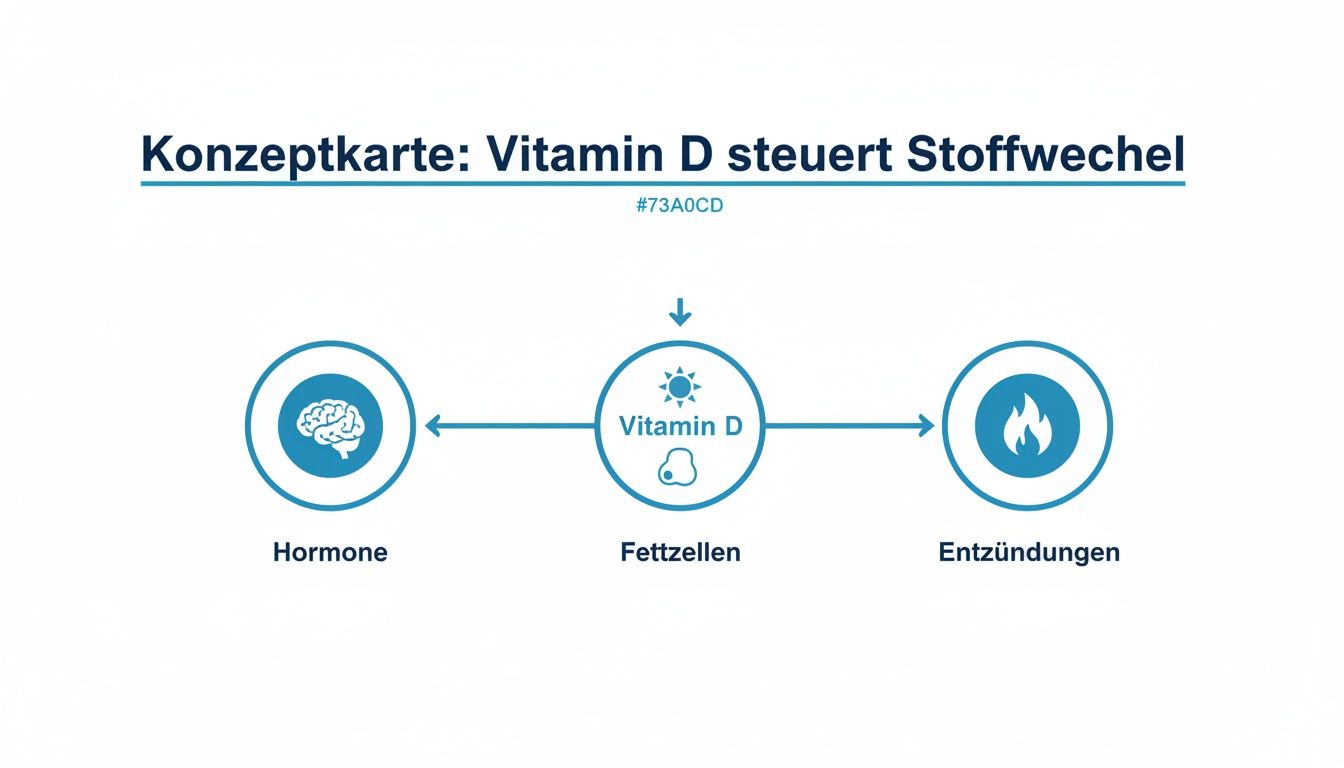
The graphic clearly shows that if this central control element is missing, it has far-reaching consequences for your entire metabolism.
The good news is: you can break this vicious cycle! Studies show that participants who optimized their vitamin D levels lost significantly more weight than the control groups. That's precisely why it's so incredibly important that you know your personal vitamin D status. Only then can you create the foundation for your weight loss success.
Here's how to easily find out your vitamin D level.
You now know about the fascinating connections between vitamin D, your metabolism, and the vicious cycle of being overweight. Naturally, the most important question arises: Where do you actually stand? Without knowing your exact vitamin D level, any action is just a shot in the dark. If you really want to make targeted progress with weight loss, the guesswork has to stop.
Many people rely on general signs like fatigue or frequent infections. The problem is: these symptoms are completely nonspecific and can have dozens of other causes. Only a reliable blood test, like the nutrient test from mybody-x.com, gives you the clarity you need to specifically address and overcome any potential weight-loss obstacles.
Why a test is the first step to success
A look at the figures in Germany quickly makes it clear why certainty is so important. According to the 13th Nutrition Report of the German Nutrition Society (DGE) , 15 percent of the population already suffers from a genuine deficiency – women over 65 are particularly affected. Looking at the values that would be optimal for a healthy metabolism makes it even clearer: just 44 percent of adults reach values above 50 nmol/l.
These figures show that a suboptimal value is more the rule than the exception. Especially if you want to lose weight, it is therefore absolutely crucial to know whether your body even has the biochemical "equipment" for efficient fat burning.
Your path to clarity with the mybody-x blood test
The good news is: finding out your vitamin D level has never been so easy and convenient. You don't need to make a doctor's appointment or sit in a waiting room forever. With the mybody®x at-home vitamin D test, you take control yourself – right from your sofa.
Our goal at mybody-x.com is to provide you with precise and understandable health data so you can make informed decisions. Instead of guessing, you'll know exactly where to start to understand your body and support your metabolism.
The entire process is incredibly straightforward and designed to offer you maximum safety and comfort:
- Simple sample collection: Everything you need comes in a small kit delivered to your home. A small, almost painless prick in the fingertip is all it takes to obtain a few drops of blood.
- Certified laboratory analysis: You send your sample free of charge to our ISO-certified partner laboratory in Germany. There, your blood will be analyzed professionally and according to the highest quality standards.
- Easy-to-understand results report: You'll receive your personalized report shortly. We translate the lab jargon for you and clearly show you your vitamin D level in nmol/l.
The advantages of the mybody®x home test
Choosing a home test offers you significant advantages on your journey to your desired weight. You not only save valuable time, but also gain full control over your health data.
- No waiting times: You don't have to wait weeks for a doctor's appointment to finally get clarity.
- Convenience: You do the test when and where it suits you best.
- Data protection: Your data will be handled strictly in accordance with GDPR guidelines and is absolutely secure.
- Concrete results: You receive an exact measurement as a basis for your next steps.
With this knowledge, you can stop guessing. A simple test provides you with the crucial information you need to break the vicious cycle and put your weight loss with vitamin D on a solid, scientifically sound footing. Learn more here about the procedure and benefits of the mybody®x at-home vitamin D test .
Your roadmap to optimal vitamin D levels
Okay, your test results are in, and you now know where you stand. But what's next? Now is the moment when information becomes concrete action. We'll give you a simple 3-pillar plan to help you effectively manage your vitamin D levels. This will finally give your metabolism the boost it needs to support weight loss with vitamin D.
This plan rests on three pillars: sun, nutrition, and targeted supplementation. Each pillar contributes, but we'll also tell you honestly where the greatest leverage for your success lies.
Pillar 1: Sun – the natural vitamin D factory
Your body is a little powerhouse. If your skin gets enough UVB radiation, it produces vitamin D all by itself. This is undoubtedly the most natural and effective way to replenish your stores – if it weren't for a few catches.
For the body's own production to even start, a few things have to be right:
- The right time: Only around midday, roughly between 11 a.m. and 3 p.m. , is the sun high enough in Germany. In the morning or late afternoon, not much happens.
- Enough bare skin: arms, legs and face should be uncovered, and without sunscreen.
- The dose makes the poison: Depending on skin type , 10 to 25 minutes is often enough. Longer exposure doesn't provide more vitamin D, but only unnecessarily increases the risk of skin cancer.
The crucial catch? In our latitudes, this only works from about April to September . From October to March, the sun is so low in the sky that practically no vitamin D production takes place. You can walk for hours in the winter sun – it simply won't be enough.
Pillar 2: Nutrition – a small but valuable aid
Vitamin D is naturally found in some foods. However, we need to temper expectations a bit: compared to sunlight or a good supplement, the contribution from food is rather small. Meeting your needs solely through diet is virtually impossible.
Nevertheless, a diet rich in vitamin D is an important component of your health. You can find the best sources here:
- Fatty fish: Herring, salmon and mackerel are the absolute stars.
- Cod liver oil: Extremely rich in vitamin D, but taste-wise... well, it's a challenge.
- Mushrooms: Especially chanterelles and button mushrooms that have grown outdoors.
- Egg yolks and fortified foods: These include, for example, some types of margarine.
As you can see, these foods aren't exactly staples in most of our diets. If you'd like to delve deeper into this topic, check out our guide to vitamin D in foods and their contribution to our vitamin D levels .
Pillar 3: Supplements – the smart and safe solution
Let's be honest: For most people in Germany, high-quality dietary supplements are the safest and most reliable way to replenish their vitamin D stores and, above all, to maintain them through the long winter. And this is precisely where your mybody®x blood test result becomes the crucial piece of the puzzle.
Instead of blindly taking anything, you can now take targeted action. Your dosage depends on whether you want to correct a deficiency (replenishment dose) or maintain a good level (maintenance dose). A common guideline for maintenance is often between 1,000 and 4,000 International Units (IU) per day.
Important note: Vitamin D is not a lone wolf. For optimal effectiveness, it needs strong partners in your body, known as co-factors.
You should definitely keep an eye on these two:
- Vitamin K2: Think of it like a traffic cop for calcium. Vitamin D helps absorb calcium. Vitamin K2 then ensures that it gets where it belongs – into the bones – and doesn't accumulate in the arteries.
- Magnesium: This mineral is essential for converting vitamin D into its active form. Without enough magnesium, your body cannot properly utilize vitamin D.
Here's a quick overview of how you can use these three pillars to your advantage:
Your 3-pillar plan for optimal vitamin D levels
A clear overview of the three ways to improve your vitamin D levels, with practical tips and realistic expectations.
| column | What you can do | Important instructions |
|---|---|---|
| Sun | Go outside for 10-25 minutes at midday from April to September (arms, legs, face uncovered). | It only works in summer. Sunscreen blocks production. Don't overdo it (risk of skin cancer)! |
| Nutrition | Regularly include fatty fish (salmon, herring), mushrooms and egg yolks in your diet. | It serves only as a supplement. Meeting the total needs through food alone is practically impossible. |
| Supplements | Take a targeted supplement, ideally in combination with vitamin K2. Ensure adequate magnesium intake. | The most reliable way to correct deficiencies and maintain values. Always determine the dosage based on a test! |
As you can see, targeted supplementation, ideally with vitamin K2 and supported by a magnesium-rich diet, is the most effective strategy for optimal levels. This creates the perfect biochemical foundation to release the brakes on your metabolism and finally get closer to your weight loss goals.
Your most burning questions about losing weight with vitamin D
Finally, we'll answer the questions we frequently receive about vitamin D and weight loss . Here you'll find clear, scientifically sound answers that debunk common myths and help you navigate this path confidently and with good information.
How quickly will I lose weight if I correct my vitamin D deficiency?
A good vitamin D level isn't a miracle cure that will make the pounds melt away overnight. Think of it more like finally releasing the handbrake on your metabolism. It creates the perfect biochemical foundation so that your efforts in diet and exercise truly pay off.
Actual weight loss, of course, only works with a calorie deficit. However, studies show that people with healthy vitamin D levels often lose significantly more weight—and especially belly fat—on the same diet than those with a deficiency. Think of it as the crucial boost that allows your body to function efficiently again. Many people experience initial positive effects, such as increased energy and improved well-being, after just a few weeks.
Is it possible to overdose on vitamin D, and is that dangerous?
Yes, an overdose is theoretically possible and can have serious consequences, such as excessively high blood calcium levels (hypercalcemia). But don't worry: this is extremely rare and almost only happens if someone takes extremely high doses uncontrollably over a long period of time.
Incidentally, you can't overdose on vitamin D from sunlight – your body has a clever protective mechanism against that. That's precisely why a blood test is so important before you start taking supplements. It gives you the peace of mind of finding the right dose for you. Typical maintenance doses of 1,000 to 4,000 IU per day are perfectly safe for most adults.
Isn't it enough to go out in the sun often in the summer?
Unfortunately not. For most people in Germany, even the summer sun isn't enough to fully replenish their energy reserves for the long, dark winter. There are several reasons for this:
- Skin type & age: Fair skin produces vitamin D faster, older skin significantly slower.
- Sun protection: Even a sun protection factor of 15 blocks vitamin D production by over 95% .
- Location & time of day: Only around midday is the necessary UVB radiation strong enough.
- Lifestyle: Let's be honest, even in summer we spend a lot of time indoors.
A test at the end of summer will provide clarity: Are your energy stores really full, or do you need some support to get through the winter?
Do I need to take vitamin K2 in addition to vitamin D?
The combination of vitamin D and vitamin K2 is highly recommended by many experts. The two are an unbeatable team for your calcium metabolism.
Imagine it like this: Vitamin D is the gatekeeper, letting calcium from the intestines into the body. Vitamin K2 is then the traffic cop, directing the calcium precisely where it's needed – in bones and teeth – while simultaneously preventing it from being deposited in the arteries.
Especially when you are taking higher doses of vitamin D, vitamin K2 is an almost indispensable supplement to optimize the effect and minimize risks.
Are you ready to release the brakes on your metabolism? Find out if a vitamin D deficiency is blocking your weight loss success! With the nutrient tests from mybody-x.com, you'll receive precise and easy-to-understand results delivered directly to your home. Take control of your health now, understand your body better, and create the best foundation for your ideal weight.
Discover the right tests for you at mybody-x.com .



Share:
For whom is a bowel analysis really suitable?
DNA analysis: Your personal guide to health and nutrition