

What are carbohydrates, simply explained?
"What exactly are carbohydrates?" Simply put: Imagine them as the most important and fastest fuel for your body. They are the energy source that keeps your brain alert and your muscles strong – practically premium fuel for your personal engine.
Your body needs more carbohydrates than you think

Carbohydrates often get a bad rap and are quickly labeled as "fattening." But this view is too simplistic and ignores their central role in your health and well-being. Without them, you simply won't have the energy for everyday life.
Think about your brain: It's a real energy powerhouse and relies almost exclusively on glucose (the simplest form of carbohydrates) as fuel. If you often feel tired, unfocused, or irritable, it's quite possible that your brain is simply running out of juice.
The basic function of carbohydrates
Their main task is to provide your body with quick energy. They are one of the three macronutrients you need daily – the other two are proteins and fats. While fats are more for long-term energy storage and proteins serve as building blocks, carbohydrates are always the first choice when it comes to immediate power.
You can learn more about the perfect interplay of the three "biggies" in our article on the balance of fats, carbohydrates, and proteins in your diet.
An adult's body consumes a considerable amount of glucose daily. One single gram of carbohydrates provides around 4.1 kilocalories of energy. Our brain alone uses about 140 grams per day to function optimally. That's why the recommendation is to get at least a quarter of your daily energy from carbohydrates, which for an average adult is approximately 100 grams.
So it's not about completely avoiding carbohydrates, but about choosing the right ones and understanding how they work in your body.
In the following sections, we will take a closer look at the types of carbohydrates available and how you can use them specifically for your health and goals.
The three types of carbohydrates – and what they do for you
To understand why some carbohydrates give you power for hours and others only ignite a brief flash, we need to divide them into their three main families. Just imagine them like LEGO bricks: Some are single blocks, others consist of two connected bricks, and still others form long, complex chains.
Each of these families affects your body, your energy, and your satiety differently. And once you know which type is in which food, you can make much more conscious decisions about what ends up on your plate.
Simple, double, or multiple? The small but significant difference
The crucial difference lies in their chemical structure – that is, how many "sugar building blocks" are linked together.
- Monosaccharides (simple sugars) are the absolute basics. They consist of only a single sugar molecule, such as glucose (dextrose) or fructose (fruit sugar). Your body doesn't need to break them down first; it can absorb them immediately. The result: a rapid rise in your blood sugar level.
- Disaccharides (double sugars) are essentially the pairs among carbohydrates. They are made up of two linked monosaccharides. The best-known example is classic table sugar (sucrose), a combination of glucose and fructose. Lactose (milk sugar) also belongs to this group. They are also digested quite quickly.
- Polysaccharides (complex carbohydrates) are the heavyweights – long chains of hundreds or even thousands of sugar molecules. Starch, as you find it in potatoes, grains, and legumes, is a typical example. Your body needs significantly longer to break down these complex structures into their individual components.
To make this even more tangible, here's a brief overview:
The three carbohydrate types at a glance
| Type | Description | Examples in food |
|---|---|---|
| Monosaccharides (simple) | A single sugar molecule. Quick energy, rapid blood sugar increase. | Dextrose, honey, fruit (especially fructose), sweets |
| Disaccharides (double) | Two linked sugar molecules. Fairly quick digestion. | Table sugar, dairy products (lactose), maple syrup |
| Polysaccharides (complex) | Long chains of sugar molecules. Slow, steady energy. | Whole grain products, potatoes, oats, lentils, beans |
The crucial advantage of complex carbohydrates is that they release energy slowly and steadily. This ensures a stable blood sugar level, keeps you feeling full longer, and prevents cravings.
This slow breakdown makes complex carbohydrates the best energy source for your everyday life. They not only provide sustainable fuel but often also bring valuable fiber, vitamins, and minerals.
So, on your next shopping trip, it's worth consciously looking for these powerhouses. Reach for whole-grain bread instead of white bread, or choose lentils as a side dish instead of a quick sweet snack. Your body will thank you for it.
How your body processes carbohydrates
What actually happens to the slice of bread or the plate of pasta after you take the first bite? The journey of carbohydrates through your body is a rather clever and perfectly coordinated process that begins in the mouth.
As soon as you start chewing, enzymes in your saliva immediately get to work, breaking down the long chains of complex carbohydrates into smaller units. This process continues in the small intestine, where the carbohydrates are finally broken down into their smallest form: glucose, or pure grape sugar. This glucose then passes through the intestinal wall directly into your bloodstream.
From plate directly into the blood
From there, glucose is transported to the cells that urgently need energy – especially your brain and muscles. It is essentially the universal fuel that gets you through the day. This entire process, from meal to energy production, is a central part of your metabolism. If you want to understand in more detail how these complex processes work in your body, you will find a simple explanation of what your metabolism actually is in our guide.
This graphic gives you a quick overview of the different carbohydrate types and typical foods that contain them.
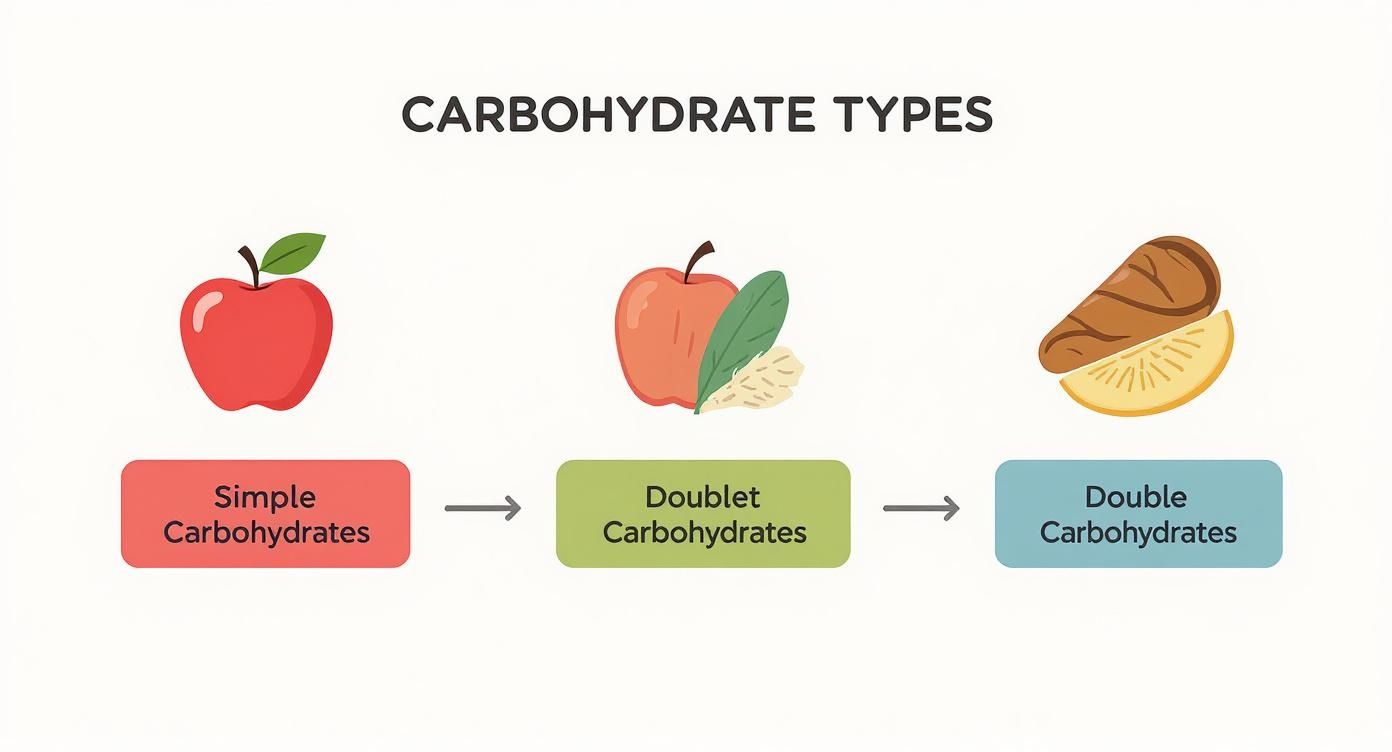
It's easy to see how the structure becomes increasingly complex from simple to complex carbohydrates – and that explains why the body takes longer for some than for others.
Fiber plays a special role here, by the way. Chemically, it's also a complex carbohydrate, but your body can't digest it. Instead of providing energy, it serves as valuable food for your beneficial gut bacteria, thus keeping your digestion on track.
The choice of your carbohydrates therefore has a direct impact on how quickly and how long your body is supplied with energy.
Blood sugar and glycemic index: What you need to know
You've probably experienced it: you eat something sweet, feel energized for a short while, and then quickly fall into a deep slump of fatigue and cravings. This constant up and down is directly related to your blood sugar level – and how certain carbohydrates affect it.
This is where the glycemic index (GI) comes in. Imagine it as your body's tachometer: it shows you how quickly a food makes your blood sugar spike. The higher the value, the faster the reaction.
How the glycemic index controls your energy
Foods can be broadly divided into three categories:
- Low GI (under 55): These foods cause a slow, steady rise in blood sugar. Energy is released consistently, which keeps you full longer and ensures stable performance. Perfect examples are whole-grain products, legumes, and most vegetables.
- Medium GI (55–70): Foods in this group cause a moderate increase. This includes, for example, regular table sugar with a GI of about 65.
- High GI (over 70): These foods rocket your blood sugar. This leads to a short energy peak, often followed by a rapid crash and renewed cravings. White bread, sodas, and sweets are the classic candidates here.
A conscious approach to the GI is a powerful tool to stabilize your blood sugar levels and improve your well-being. This is more relevant than ever: stable blood sugar helps to control cravings and can, in the long term, support maintaining a healthy weight. A simple apple, for example, only has a GI of around 39 – a big difference from many processed snacks. You can read more about how the WHO assesses carbohydrates and fats here.
By focusing on low GI foods, you provide your body with long-lasting, steady energy and prevent the typical post-meal energy slumps.
For a detailed overview of which foods fall into which category, take a look at our practical glycemic index table. It will help you make smarter everyday dietary choices and manage your energy optimally.
The best carbohydrate sources for your diet
After all the theory, it's time for practice. Which carbohydrates should you specifically put on your plate to benefit from long-lasting energy and valuable nutrients? It's about consciously choosing nature's powerhouses that truly move you forward.

The answer clearly lies in complex carbohydrates. These not only provide you with steady energy but also supply important fiber, vitamins, and minerals. They are the foundation of a truly balanced diet.
Bet on these nutrient champions
A wholesome diet should be rich in the right carbohydrate sources. Fortunately, nature offers us a huge selection of true power foods:
- Whole grain products: Whether it's oatmeal for breakfast, quinoa in a salad, or classic whole-grain bread – they are all packed with fiber. This not only keeps you full for a long time but also supports your digestion. Simply the perfect basis for any nutritious meal.
- Legumes: Lentils, chickpeas, and beans are true all-rounders. They cleverly combine complex carbohydrates with a good portion of plant-based protein. This mixture makes them an unbeatable hunger satisfier.
- Potatoes and sweet potatoes: Unjustly maligned as fattening! Especially with their skin on, potatoes are an excellent source of energy, potassium, and vitamin C. They are incredibly versatile and a healthy alternative to processed side dishes.
- Vegetables and fruits: Colorful vegetables and fruits not only add color to your plate. In addition to carbohydrates, they also provide an abundance of vitamins, minerals, and secondary plant compounds that your body loves.
By focusing on these unprocessed, natural foods, you are not just giving your body empty calories, but real nutritional value. That is exactly the key to stable energy and genuine well-being.
The German Nutrition Society (DGE) also agrees: More than 50 percent of our daily energy should come from carbohydrates – ideally, of course, from the sources mentioned. Unlike sugary products, they provide long-lasting satiety and a wide range of important nutrients.
Do you want to delve deeper? In our guide, we show you what healthy carbohydrates are and how you can effortlessly integrate them into your daily life.
Any remaining questions about carbohydrates?
Finally, we will clear up the most common myths and uncertainties. Here you'll get clear, practical answers to any questions you might still have.
Do carbohydrates in the evening really make you fat?
This is one of the most persistent myths, but the answer is a clear no, not per se. Your body doesn't have a built-in stopwatch that decides to treat calories differently after 6 PM than in the morning.
What matters is always your total daily energy balance. If you consume more calories throughout the day than your body uses, you gain weight – regardless of the time of day.
A small portion of complex carbohydrates in the evening, like a bowl of oatmeal or a slice of whole-grain bread, can even be beneficial. They can stimulate the production of the sleep hormone melatonin and thus help you get a more restful night's sleep. The problem is more about huge, fatty meals or sugary snacks that unnecessarily burden digestion.
How many carbohydrates do I need per day?
There's no one-size-fits-all answer to this question, as the perfect amount is as individual as you are. Your personal needs depend on a whole host of factors:
- Your activity level: Are you a couch potato or do you exercise several times a week? Anyone who performs a lot needs more "fuel" in the form of carbohydrates to replenish energy stores.
- Your goals: Do you want to lose weight, maintain your weight, or build muscle mass? Each of these goals requires a different nutrient distribution.
- Your age and gender: These two aspects also influence your basal metabolic rate and thus your energy requirements.
Every metabolism simply ticks differently. General recommendations, such as the DGE's suggestion of around 50% of daily calories from carbohydrates, are a good starting point. But to know it precisely and perfectly tailor your diet to your body, personalized analyses can provide clarity.
Are low-carb diets a good idea?
Low-carb diets, where you drastically reduce carbohydrates, can bring quick short-term weight loss success for some people. But they are definitely not the best or most sustainable solution for everyone.
Radical abstinence can lead to fatigue, nutrient deficiencies, or digestive problems. In the long run, a balanced diet with the right carbohydrates is often the healthier and more practical approach. It's less about strict abstinence and more about smart choices: opt for complex carbohydrates from whole grains, vegetables, and legumes instead of isolated sugar and white flour.
What is the actual difference between sugar and carbohydrates?
This question often causes confusion, but it's quite simple: Every sugar is a carbohydrate, but not every carbohydrate is sugar.
Sugar, such as glucose or common table sugar (sucrose), is the simplest form of carbohydrates (i.e., simple and double sugars). All more complex carbohydrates, such as starch, are eventually broken down into glucose by the body to produce energy.
The crucial difference lies, so to speak, in the "packaging." A potato provides you with not only starch but also valuable fiber, vitamins, and minerals. A spoon of pure sugar, on the other hand, gives you nothing but empty calories without any additional nutritional value.
Have you become curious and want to find out how your individual metabolism works and which nutrients your body really needs? The modern health analyses from mybody-x can help you scientifically optimize your diet. Discover the possibilities now at mybody-x.com.



Share:
What Is My Metabolism Type? The Guide to DNA Analysis
DNA Analysis Costs: Prices & Money-Saving Tips 2026