
TSH self-test and laboratory value: what each one can do
The essentials at a glance
Both approaches measure the same substance, and they provide two different types of result. A rapid test at home uses a fixed threshold, while a laboratory report uses a reference range and a number.
This difference has a practical consequence that you should know about. The rapid test's threshold is 5 μIE/ml (product page, accessed 15 August 2026), while the IQWiG reference range for adults ends at 3.5 mU/l (as of 20 March 2025).
You will first read about what both methods measure. This is followed by a comparison of the two, the reason for the fixed threshold, three statements in the fact check, and the question of when each approach is suitable.
What to expect in this article
1. Both measure the same substance
2. Two types of result
3. The two methods compared
4. Why a rapid test needs a fixed threshold
5. The statement that justifies both methods
6. The gap between the threshold and the reference range
7. Three statements in the fact check
8. Direction and extent
9. What a TSH-only test leaves out
10. The numbers at a glance
11. A sensible sequence
12. Who benefits from which approach
13. The two approaches at mybody®x
14. Limitations: what both methods leave open
15. What matters when comparing them
Frequently asked questions
Sources
Both measure the same substance
The first point needs to be clarified because it is often questioned: A rapid test at home and a laboratory test measure the same substance.
IQWiG describes it as follows: TSH, also called thyrotropin, is a hormone produced by the pituitary gland and released into the blood (as of 20 March 2025). It stimulates the thyroid gland to produce thyroid hormones.
The difference therefore lies not in the substance, but in the method. And that determines what each method can answer.
Two types of result
A rapid test provides a classification. The result is: above or below a specified threshold.
A laboratory report provides a number with a unit, a reference range, and a date. These three details determine the classification.
That is the real difference, and it is greater than it sounds. One classification cannot be compared with a later classification, but one number can be compared with a later number.
What this means for the trend
Two rapid tests taken one year apart, both unremarkable, do not show a trend. They say the same thing twice: below the threshold.
Two laboratory values taken at the same interval show a trend because two numbers can be compared. A medical practice determines whether that trend means anything.
The two methods compared
The table compares the two approaches using the same four questions. It provides context and does not make a diagnosis.
| Question | At-home rapid test | Laboratory report | What both leave open |
|---|---|---|---|
| What comes out | A classification: above or below the threshold | A number with unit, reference range, and date | A diagnosis—the medical practice makes that |
| From what point is it abnormal | A fixed threshold, stated as 5 μIE/ml on the product page | An age-specific reference range: 0.3 to 3.5 mU/l for adults, 0.3 to 4.5 mU/l from age 50 onward | What follows in an individual case depends on more than the value |
| What else is measured | TSH only | Depending on the order, fT3 and fT4 from the same sample as well | Thyroid antibodies, unless they were not ordered |
| How long it takes | Approximately 5 to 10 minutes until the result after performing the test | Kit shipping: 1 to 3 business days; laboratory analysis: 3 to 5 business days after the sample is received | Interpretation—the part that happens in conversation, not during reading |
The second line is the most important, and it is explained in the next chapter and the chapter after that.
Why a rapid test needs a fixed threshold
The fact that an at-home test uses a single threshold is not carelessness; it is inherent in its design.
A result that can be read by eye on a test cassette can distinguish only two states. It cannot produce a number or represent a range.
For such a test to provide any meaningful result, a point must be defined at which the display changes. This point is the threshold.
A laboratory instrument does not have this limitation. It produces a measurement value, and the reference range, which takes age and method into account, is then used for interpretation.
The sentence that justifies both methods
The fact that both approaches start with TSH at all has a common reason, and the specialist literature states it in a brief clause.
Documented source
“TSH is the most sensitive parameter for assessing thyroid function”
Laura Boucai, MD
MSD Manual, professional edition, Assessment of Thyroid Function, as of February 2024
That is why both methods start at the same point. IQWiG describes the same logic from clinical practice: thyroid dysfunction is detectable particularly early through a change in the TSH level, so initially only TSH is often measured (as of 24 April 2024).
So the analyte is the right one in both cases. The question is what each method does with it.
The gap between the threshold and the reference range
This is the point this article should clarify above all others.
The product page for the thyroid TSH self-test states a normal value of 5 μIE/ml when accessed on 15 August 2026. By contrast, the IQWiG reference range for adults is 0.3 to 3.5 mU/l, and from age 50 onward, 0.3 to 4.5 mU/l (as of 20 March 2025).
Both figures refer to the same order of magnitude, and they do not overlap. A value of 4 would be below the rapid-test threshold and at the same time above the stated adult range.
What follows in practice
An unremarkable rapid-test result means: below the test’s threshold. It does not automatically mean: within the reference range that applies to your age.
This is not a flaw in the method. It follows from the fact that a single fixed point cannot represent three age-dependent ranges.
For you, this means: If symptoms are present or the result concerns you, a laboratory value is the next step—not a repeat of the rapid test.
Three statements in the fact check
These three statements regularly come up when self-tests and laboratory values are compared.
Checked against the evidence
Commonly stated
“A rapid test measures something different from the laboratory.”
Substantiated
Both determine TSH, meaning the same hormone from the pituitary gland (IQWiG, as of 20/03/2025). The difference lies in the form of the result: a classification versus a number with a reference range.
Commonly stated
“An unremarkable rapid test means the value is within the normal range.”
Substantiated
According to the product page, the rapid test threshold is 5 μIU/ml, while the IQWiG adult reference range ends at 3.5 mU/l (as of 20/03/2025). An unremarkable rapid test means below the threshold, not automatically within the reference range.
Commonly stated
“A TSH test alone is sufficient for clarification.”
Substantiated
IQWiG describes a two-stage approach: initially, often only TSH is tested, and if this value is abnormal, the thyroid hormones T3 and T4 are also measured (as of 24/04/2024). Antibodies are added when an autoimmune reaction is suspected.
Direction and depth
At this point, the relationship between the two approaches can be summed up in one sentence.
A rapid test shows a direction. A laboratory value shows depth. Both are useful, and only one of them can be compared.
Direction is better than nothing. Anyone who previously had no indication at all has one after a rapid test—within minutes and without an appointment.
The depth is what allows conclusions to be drawn. A number with a reference range and date can be classified, compared with a later value, and taken into a conversation.
How to interpret a value within the reference range when symptoms are present is discussed in the companion article Normal TSH Level and Still Experiencing Symptoms.
What a TSH-only test leaves out
In addition to the form of the result, there is a second difference, and it concerns the scope.
A rapid test determines TSH. It does not include the two hormone levels, fT3 and fT4, which according to standard practice are tested after an abnormal TSH result.
This is not a shortcoming of the method, but rather how it is designed. However, it means that an abnormal result must always be followed by a second step.
What the two hormone values add and why the small f is crucial is covered in the companion article fT3 and fT4 alongside TSH.
The figures at a glance
Three pieces of information, each with its source and date. They provide context and do not constitute a diagnosis.
Documented information
5
μIE/ml: Threshold for the thyroid TSH self-test according to the product page, accessed 08/15/2026
0,3–3,5
mU/l: Reference range for TSH in adults; from age 50, 0.3 to 4.5 mU/l (IQWiG, as of 03/20/2025)
5–10
Minutes until the result after performing the rapid test (product page, accessed 08/15/2026)
The first two figures shown side by side illustrate the core topic of this article. They come from two different contexts and answer two different questions.
And as with every laboratory value, the relevant figure is the reference range stated on your own report, because reference ranges may vary from one laboratory to another (IQWiG, as of 02/04/2025).
A sensible order
The information so far shows when each option is suitable, without one replacing the other.
The rapid test is suitable when there are no results yet and a quick initial orientation is wanted. It costs little, takes minutes, and requires no appointment.
The laboratory option is suitable when a number is needed: for comparing results over time, for a conversation at a medical practice, or when hormone levels should be included.
And both end at the same point. What a result means is decided by a medical practice, and neither option takes that responsibility away from it.
Which option is worthwhile for whom
This comparison is not about yes or no this time, but about choosing between the two methods.
The rapid test is suitable if …
You currently have no indication at all and want an initial orientation within minutes.
You do not want to make an appointment or send in a kit.
You are aware that the result is a classification, not a number.
You would visit a medical practice anyway if the result were abnormal.
The laboratory option is suitable if …
You need a number with a reference range and date, for example for a conversation at a medical practice.
You want to compare results later. Two classifications do not show a trend, but two numbers do.
You also want fT3 and fT4 from the same sample.
Your age is close to a range boundary, so a fixed threshold is of limited help.
The two options at mybody®x
Both methods are available from mybody®x (MYBODY Lab GmbH), and neither provides a diagnosis. They differ in what they report and what they cost.
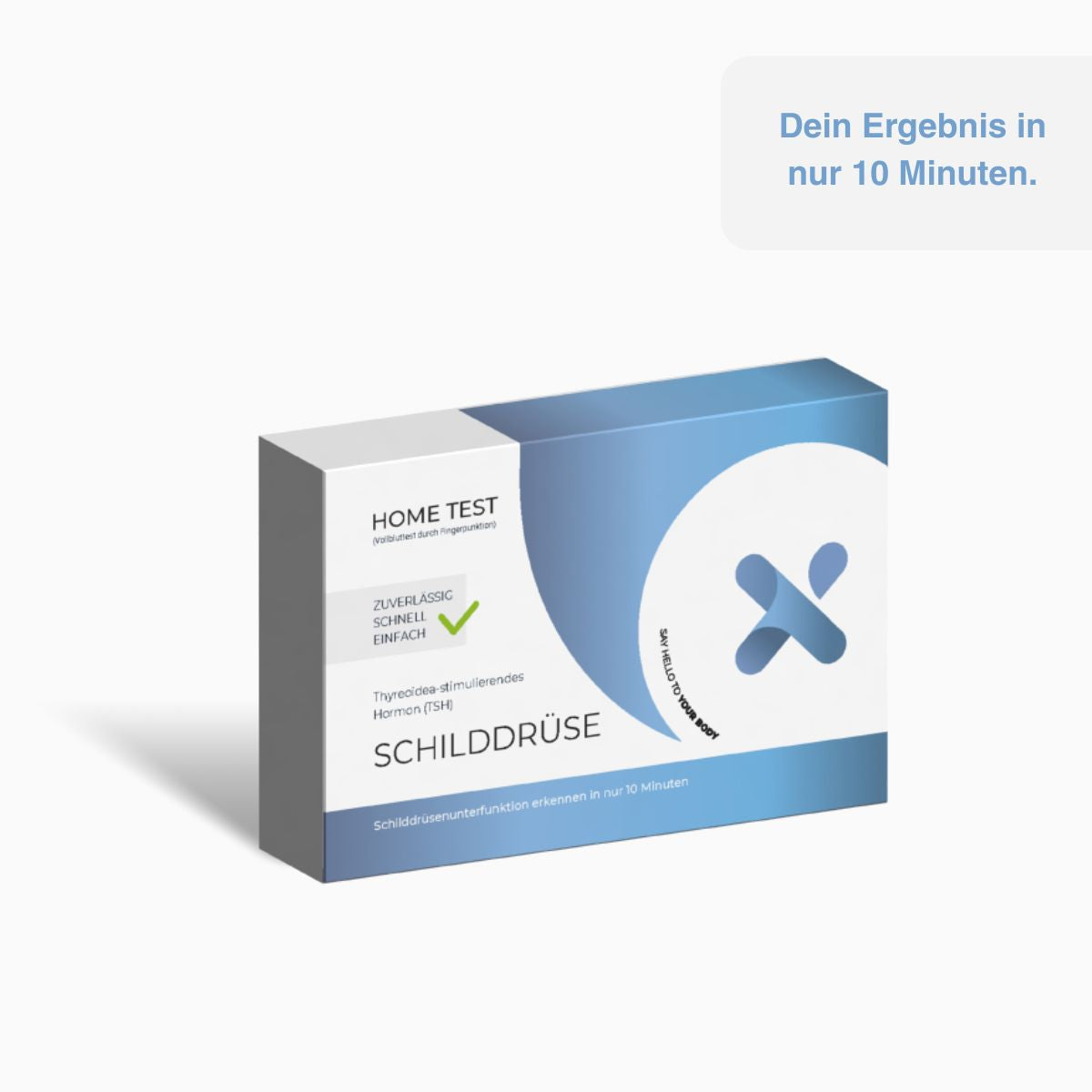
Thyroid TSH level self-test from mybody®x
Rapid home test
Thyroid TSH level self-test
certified medical laboratory
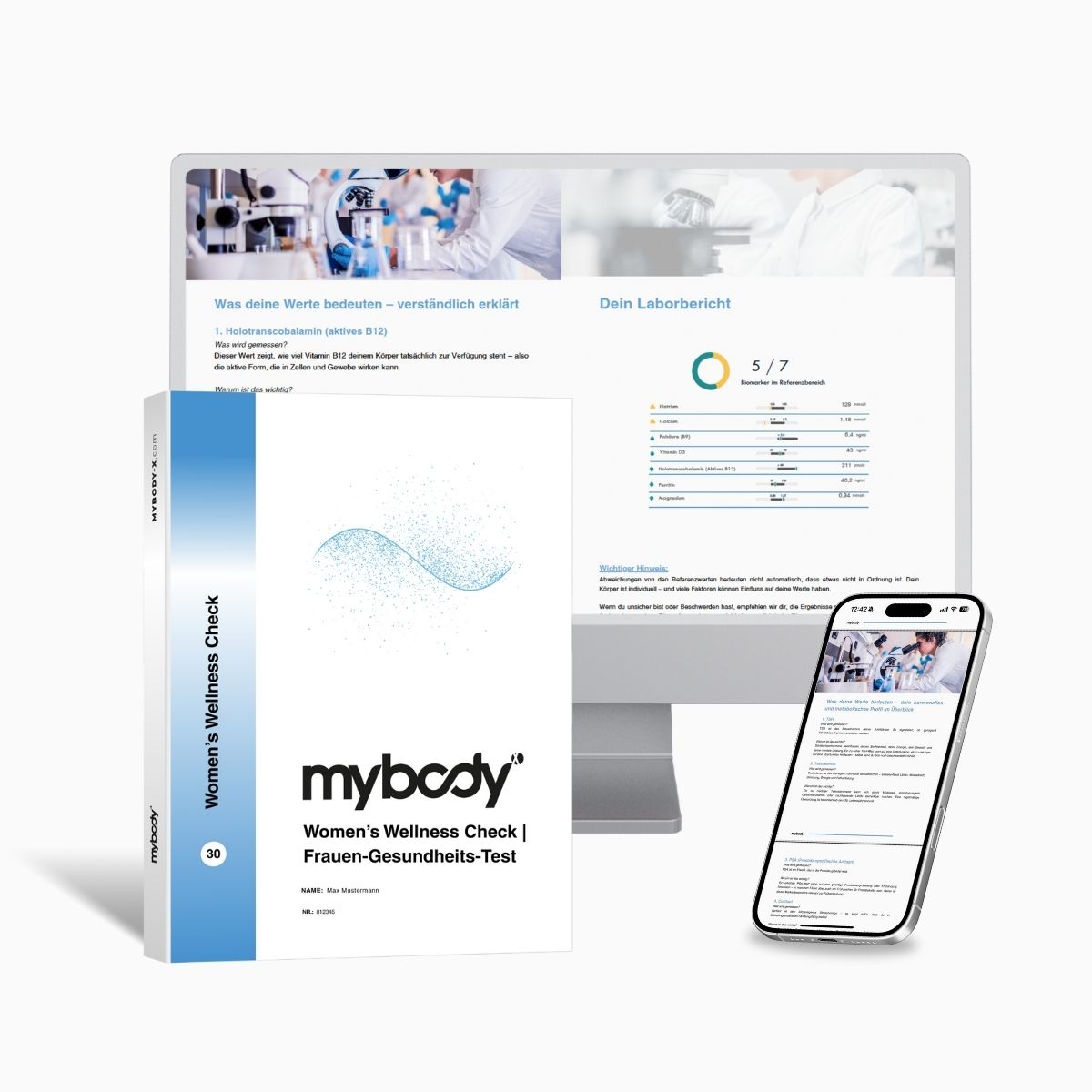
Women's Wellness Check | Women's health test from mybody®x
Laboratory testing using capillary blood | Women’s Wellness Check
Women's health test
Kit shipping 1–3 business days
certified medical laboratory
About the Women’s Wellness Check
Understand the result format
A classification is different from a number with a reference range.
Put the threshold into context
The rapid test's fixed threshold does not match the reference range.
Note the time
TSH levels are highest at night and lowest in the afternoon.
Plan the second step
If TSH is abnormal, T3 and T4 are usually tested next.
Chapter at a glance
Both methods determine TSH and do not provide a diagnosis. The rapid test provides a classification within minutes, while the laboratory method provides a number with a reference range and the two hormone values as well. Four points are decisive: understand the result format, put the threshold into context, note the time, and plan the second step.
Limitations: what both methods leave unresolved
The first limitation applies to both. Neither a rapid test nor a laboratory result constitutes a diagnosis; a diagnosis is made in a medical practice based on several factors.
The second limitation concerns the rapid test alone. A result below the threshold does not automatically mean that the value falls within the age-dependent reference range, because the threshold is 5 μIE/ml and the adult range ends at 3.5 mU/l.
The third limitation concerns the exception involving TSH itself. Normal TSH values rule out hyperthyroidism or hypothyroidism, except in cases of central hypothyroidism caused by a disorder of the hypothalamus or pituitary gland (MSD Manual, Professional Edition, as of February 2024). This applies equally to both methods.
The fourth limitation concerns scope. According to IQWiG, thyroid antibodies are added when there is a suspicion that an autoimmune reaction is impairing thyroid function (as of April 24, 2024). They are included in neither of the two methods compared here.
What matters when comparing them
If you take away just one thing from this article, let it be this: The difference lies not in the substance measured, but in the form of the result.
A rapid test classifies, while a laboratory report measures. A trend cannot be established from a classification, but it can from two numbers. And a fixed threshold cannot represent three age-dependent reference ranges.
At the outset was the question of what each one can do. The answer is: One shows a direction, the other a degree. Both are useful when you know what you are looking at.
Frequently asked questions
Does a TSH self-test measure the same thing as a laboratory test?
The same substance, yes. Both measure TSH, a hormone produced by the pituitary gland and released into the blood (IQWiG, as of March 20, 2025). The difference lies in the form of the result: A rapid test classifies the result against a fixed threshold, while a laboratory report provides a number with a reference range and date.
Does an unremarkable rapid test mean that my value is normal?
It means that the value is below the test's threshold. The product page specifies 5 μIE/ml for this (accessed August 15, 2026), while IQWiG's reference range for adults ends at 3.5 mU/l and at 4.5 mU/l from age 50 onward (as of March 20, 2025). A value in between would be classified as unremarkable by the rapid test but would be above the adult reference range.
Can I track a trend with two rapid tests?
Only to a limited extent. Two classifications against the same threshold provide the same information twice, as long as the result does not change. A trend requires two values with dates and reference ranges. Anyone wanting to compare results is therefore better served by laboratory testing.
Is TSH alone sufficient for an assessment?
As a first step, it is the usual choice. The MSD Manual, Professional Edition, calls it the most sensitive parameter for assessing thyroid function (as of February 2024). IQWiG describes the practice as follows: initially, often only TSH is measured, and if this value is abnormal, T3 and T4 are also determined (as of April 24, 2024).
Does the time of day matter for a rapid test?
TSH fluctuates throughout the day. IQWiG states: Levels are highest at night and lowest in the afternoon (dated 20.03.2025). Therefore, the time of day can matter when a result is close to the threshold. The rapid test does not provide a number, so this influence cannot be determined from it.
Next step
First the direction, then the depth
Those who have no indication at all can get one with a rapid test in minutes. Those who need a number that can be interpreted and compared later should use the laboratory. Neither option provides a diagnosis or replaces medical evaluation.
To the TSH self-testRead more
You might also be interested in
What a value within the reference range answers and what it leaves open.
What the two hormone values add and when they are measured.
Sources
- MSD Manual, Professional Edition: Assessment of thyroid function, Boucai L (complete review February 2024) – msdmanuals.com
- Institute for Quality and Efficiency in Health Care (IQWiG): Thyroid-stimulating hormone (TSH), dated 20.03.2025 – gesundheitsinformation.de
- IQWiG: Understanding thyroid examinations, dated 24.04.2024 – gesundheitsinformation.de
- IQWiG: Understanding laboratory values correctly, dated 02.04.2025 – gesundheitsinformation.de
The verbatim quotation about the most sensitive parameter and the statement about normal TSH levels with the exception of central hypothyroidism come from source [1]. The definition of TSH, age-based reference ranges, and daily rhythm come from [2]. The order of TSH first, followed by T3 and T4, as well as the note about thyroid antibodies, come from [3]. The explanation of the reference range comes from [4]. The threshold of 5 μIE/ml, the result time of approximately 5 to 10 minutes, and information on price, values, sample type, and laboratory come from mybody®x product pages, accessed on 15.08.2026; the processing times for the laboratory process follow the central requirements for blood tests. All sources were accessed and reviewed on 15.08.2026.

mybody®x Editorial & Specialist Team
Laboratory diagnostics Blood analysis interpretation Nutritional science Nutrigenetics
This article was created by the mybody®x editorial and specialist team. The team combines laboratory diagnostics, nutritional science, and the interpretation of blood analyses. Contributors are listed on the authors’ page.
Published on 15.08.2026 · Last updated on 15.08.2026
The content is intended for general information and does not replace medical advice, diagnosis, or treatment. Reference ranges depend on the laboratory, method, and age—always follow the information on your test report.




Share now:
Vitamin D, zinc, and CRP: three values, three insights
Selenium and zinc: two values with a measurement problem