

Silent inflammation: what CRP shows about it
The key points at a glance
In the sources we reviewed, we did not find the term “silent inflammation” used as a disease designation. What we did find is something different and more precise: two reference frameworks for the same substance that answer different questions.
IQWiG gives adults a CRP reference range of up to 5 mg/L (as of March 20, 2025). The MSD Manual, Professional Edition, associates high-sensitivity CRP measured at 2 mg/L or higher with an increased risk of cardiovascular events (as of December 2025).
You will first read where the term comes from. This is followed by a fact-check of three common statements, a comparison of the two frameworks, the relevant numbers, and what an unremarkable result leaves open.
What to expect in this article
1. Where the term comes from
2. What the sources say about it
3. What inflammation is and what chronic means
4. Three statements in the fact-check
5. Two reference frameworks for the same substance
6. The numbers in question
7. Why an intermediate result is difficult to interpret
8. What the term is not
9. Comparing the two methods
10. What an unremarkable result leaves open
11. Who may benefit from a measurement
12. What a capillary blood test can show here
13. Limitations: what we could not substantiate
14. What matters about this term
Frequently asked questions
Sources
Where the term comes from
“Silent inflammation” is an easy-to-understand expression. It combines two ideas: that something is happening and that you do not notice it.
Both ideas have a real basis. IQWiG describes five signs that may indicate acute inflammation: redness of the skin, warmth, swelling, pain, and impaired function (as of March 12, 2025).
These five signs are visible or perceptible. This immediately raises the question of what happens with processes that produce none of these signs.
What we searched for and did not find
In the sources we reviewed, we searched for the term as a disease designation. We did not find it there.
This does not mean that the underlying topic is unsupported. It means that the sources describe it differently, and the more precise terminology is the subject of this article.
What the sources say about it
The sentence that comes closest to the topic appears in the professional literature on atherosclerosis and contains a number.
Documented source
“An elevated C-reactive protein (CRP) level (high-sensitivity CRP ≥ 2 mg/L) is associated with an increased risk of cardiovascular events”
Attila Feher, MD, PhD
MSD Manual, Professional Edition, Atherosclerosis, as of December 2025
Three words in this sentence deserve attention. High-sensitivity describes the measurement method, “associated with” describes the nature of the statement, and risk describes a probability.
The most cautious of the three formulations is “associated with.” It says that two things occur together, and it does not say that one causes the other.
The same source lists inflammation as a separate category among the risk factors for atherosclerosis and describes a residual inflammatory risk in cases of a normal lipid profile (as of December 2025).
What inflammation is and what chronic means
Before discussing subtle processes, the foundation needs to be clarified.
IQWiG puts it this way: In the broadest sense, inflammation is a reaction of the body's own defense system to a stimulus (as of March 12, 2025). It is therefore initially a function, not a disease.
The same source uses a separate term for ongoing processes. Regarding chronic inflammatory diseases, it states that they can persist for years, sometimes even for life, with varying degrees of severity and activity (as of March 12, 2025).
This is the documented term for ongoing inflammatory processes. It refers to named diseases, not to a nameless condition.
Three statements in a fact check
These three statements regularly come up when the term is mentioned.
Checked against the available evidence
Common
“Silent inflammation is a diagnosis in its own right.”
Documented
We did not find the term used as a disease designation in the sources reviewed. For ongoing processes, IQWiG refers to chronic inflammatory diseases, which have their own names (as of March 12, 2025).
Common
“A CRP within the reference range means that nothing ongoing is happening.”
Documented
The usual reference range extends up to 5 mg/l (IQWiG, as of March 20, 2025). A high-sensitivity CRP measurement is already associated with an increased risk of cardiovascular events from 2 mg/l onward (MSD Manual, professional edition, as of December 2025). A value in between is unremarkable in one framework but not in the other.
Common
“If the CRP is normal, nothing is wrong.”
Documented
The MSD Manual notes for osteomyelitis that the erythrocyte sedimentation rate and CRP may be normal in an infection caused by indolent pathogens, and that acute-phase reactants may not be elevated under certain biologic medications (as of December 2024).
Two reference frameworks for the same substance
This is where the real core of the issue lies, and it is less spectacular and more useful than the term.
CRP is measured using two levels of sensitivity. The standard method determines whether an inflammatory response is currently underway and uses a reference range of up to 5 mg/L for adults (IQWiG, as of 20 March 2025).
The high-sensitivity method answers a different question. It is used in a cardiovascular context, where a value of 2 mg/L or higher is already considered elevated (MSD Manual, professional edition, as of December 2025).
The same substance, two questions
The same protein is measured both times. What differs is the sensitivity of the measurement and the question it is intended to answer.
Applying one framework to the other question leads to false conclusions. A value of 3 mg/L is unremarkable within the usual framework but would be considered elevated within the high-sensitivity framework.
This gives the term silent inflammation a comprehensible origin. It does not describe a hidden disease but rather the gap between two reference frameworks.
The numbers in question
Three statements, each with its source and date. They provide context and do not constitute a diagnosis.
Evidence-based classifications
up to 5
mg/L: reference range for standard CRP in women and men over 18 (IQWiG, as of 20 March 2025)
from 2
mg/L using the high-sensitivity method: associated with an increased risk of cardiovascular events (MSD Manual, professional edition, as of December 2025)
2 to 5
mg/L: the range that falls within the usual reference range while also being above the high-sensitivity threshold—calculated from the two statements above
The third statement is not a source citation but a conclusion drawn from the first two. It is explicitly labeled as such here so that it is not misunderstood as a threshold in its own right.
And as with every laboratory value, the decisive factor is the reference range given on your own report, because reference values can vary from one laboratory to another (IQWiG, as of 2 April 2025).
Why a value in between is difficult to interpret
A value in this range presents a problem that cannot be resolved by looking more closely.
The first problem is nonspecificity. Elevated C-reactive protein levels are a nonspecific indicator of an infection or inflammation (MSD Manual, professional edition, as of February 2024). A slightly elevated level does not narrow anything down.
The second problem is the snapshot. The IQWiG writes that slightly elevated CRP levels are usually harmless and adds that persistently elevated levels may increase the risk of cardiovascular disease (as of 20 March 2025). The difference lies in the word “persistently,” and a single measurement cannot answer that question.
The third problem is everyday disruption. After a marathon, the CRP level rises for a while due to muscle damage and returns to normal within a few days (IQWiG, as of 20 March 2025). A single slightly elevated result may simply be due to this.
How two measurements can be compared and what a trend can show is covered in the companion article CRP over time: why a single value has no direction.
What the term is not
At this point, the summary belongs in a single sentence so that it does not get lost among the numbers.
The term does not describe a hidden disease. It describes the gap between two reference frameworks for the same substance.
It is not a diagnosis, because we did not find it used as a disease designation in the sources reviewed.
It is not made up either. The underlying observation is documented: high-sensitivity CRP measured at 2 mg/l or above is associated with an increased cardiovascular risk (MSD Manual, professional edition, as of December 2025).
And it is not a reason for concern. The same wording that establishes the association explicitly does not say that one causes the other.
The two methods compared
The table compares the two measurement methods using the same four questions.
| Question | Standard CRP | High-sensitivity CRP | What both leave open |
|---|---|---|---|
| Intended purpose | Whether an inflammatory response is taking place (IQWiG, as of 20 March 2025) | A cardiovascular association (MSD Manual, professional edition, as of December 2025) | The trigger, because CRP is nonspecific |
| At what point is it considered abnormal | Above 5 mg/l in adults, according to the reference range | From 2 mg/l, according to the cited source | Whether this has any implications in an individual case is something a medical practice must assess |
| Type of statement | Indicates inflammation in the body | Is associated with an increased risk | A cause – a connection is not causation |
| With an unremarkable result | Rules nothing out (MSD Manual, as of December 2024) | No information on this in the sources reviewed | What a normal result means when symptoms are present |
The third line is the most important. A connection between two observations is different from a cause, and the specialist literature deliberately uses cautious wording here.
What an unremarkable result leaves open
The flip side of the issue is discussed less often and is at least as important in practice.
The MSD Manual states for osteomyelitis that the erythrocyte sedimentation rate and CRP can be normal in an infection caused by indolent pathogens (as of December 2024). An unremarkable result therefore does not rule anything out.
The same source mentions a second case: In patients taking certain biologic medications, acute-phase reactants may not be elevated (as of December 2024).
For you, when reading a test result, this means: If you have symptoms and an unremarkable CRP value, you have not received reassurance—only one piece of information. The next step is to visit a doctor's office, not take another self-test.
Who may benefit from a measurement
The comparison refers to standard CRP, as measured in a capillary blood test.
Makes sense for you if …
You have never seen your CRP value before and want to know where it stands.
You want to see the CRP together with other values from the same sample.
You want to establish a baseline value with a date for later comparison.
You want to bring numbers to a consultation at a doctor's office.
Probably not if …
You want to clarify the question of the cardiovascular connection. The high-sensitivity method is used for that.
You are hoping for confirmation or reassurance from the result. A nonspecific value cannot provide either.
You have symptoms. In that case, the right course is to visit a doctor's office.
You were under significant strain in the days beforehand. The value may be elevated for that reason.
What a capillary blood test can show here
One point should be made clear here before naming a product: The VitalCheck measures standard CRP, not high-sensitivity CRP. It therefore does not answer the question about the cardiovascular connection.
What a capillary blood self-test can do here is provide the standard CRP value with the date and reference range and place it alongside other values. It does not provide a diagnosis or rule anything out.
Two tests from mybody®x (MYBODY Lab GmbH) measure the standard CRP: the VitalCheck and the Men's Wellness Check. The VitalCheck is used here as an example because it includes the value together with the nutrient profile.
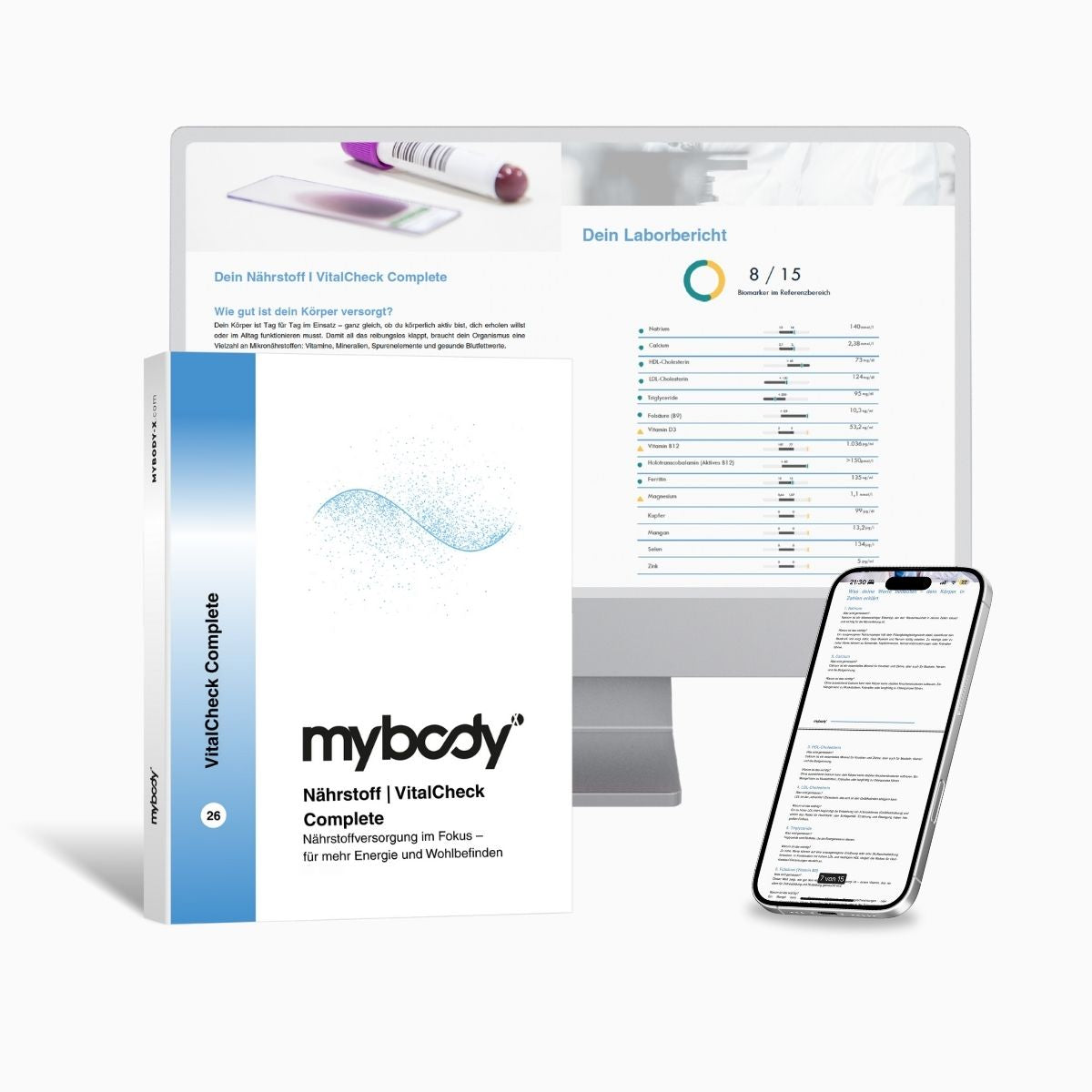
Capillary blood test
VitalCheck | Nutrient & Mineral Test Complete
Measures 18 values, including the standard CRP. It also measures vitamin D, vitamin B12, folate, ferritin, iron, transferrin, calcium, magnesium, phosphate, selenium, zinc, albumin, long-term blood sugar, as well as total cholesterol, HDL, LDL, and triglycerides. What the test does not do: It measures no high-sensitivity CRP and therefore does not answer the cardiovascular question discussed in this article. It does not identify a trigger, rule anything out, provide a diagnosis, or replace a medical examination.
Laboratory analysis 3–5 business days after sample receipt
Information from the product page, accessed 15 August 2026
Four points determine whether a CRP value becomes useful information.
Clarify the method
Whether standard or highly sensitive CRP is used determines the question being answered.
Note physical exertion
Strenuous physical exertion before the sample is taken shifts the value.
Do not interpret the result as reassurance
According to the medical literature, an unremarkable value does not rule anything out.
Discuss the interpretation
What a value means is determined by the context, not by the number.
Chapter at a glance
A capillary blood self-test provides the standard CRP with the date and reference range; it does not measure highly sensitive CRP. It does not diagnose anything or rule anything out. Four points are decisive: clarify the method, note physical exertion, do not interpret the result as reassurance, and discuss the interpretation.
Limitations: what we could not substantiate
The first boundary concerns the term itself. We did not find “silent inflammation” used as a disease designation in the sources we reviewed, so this article uses it only as a term to be discussed.
The second boundary concerns the cause. The medical literature describes an association between a highly sensitive CRP measured at 2 mg/L or above and an increased cardiovascular risk (MSD Manual, Professional Edition, as of December 2025). It does not state that one causes the other.
The third boundary concerns the benefit of lowering the level. In the sources we reviewed, we found no statement on whether deliberately lowering the value has any effect. This article therefore makes no such claim.
The fourth boundary is diagnosis. All the classifications in this article provide context and do not constitute a diagnosis. A diagnosis is made in a medical practice based on several components, and no self-test can anticipate it.
What matters about this term
If you take away just one thing from this article, let it be this: The term is based on a documented observation, not a documented disease.
The observation is that a highly sensitive CRP measured at 2 mg/L or above is associated with an increased cardiovascular risk, while the usual reference range extends up to 5 mg/L. The entire concept lies between these two figures.
The starting question was what CRP shows. The honest answer is: It depends on which method was used and what question was being asked. Without those two details, the value cannot be interpreted.
Frequently asked questions
Is silent inflammation a diagnosis?
We did not find the term used as a disease designation in the sources reviewed. For persistent inflammatory processes, the IQWiG refers to chronic inflammatory diseases and states that they can persist for years, and sometimes for life, with varying degrees of severity and activity (as of March 12, 2025). These diseases have their own names.
Does a normal CRP show that everything is fine?
No. The MSD Manual states regarding osteomyelitis that erythrocyte sedimentation rate and CRP may be normal in an infection caused by indolent pathogens, and that acute-phase reactants may not be elevated when certain biological medications are used (as of December 2024). Anyone with symptoms should see a doctor, regardless of the laboratory value.
What is high-sensitivity CRP?
The same protein, measured more sensitively and intended for a different question. The MSD Manual, professional edition, states: An elevated level of C-reactive protein—high-sensitivity CRP from 2 mg/L—is associated with an increased risk of cardiovascular events (as of December 2025). The usual reference range, on the other hand, extends up to 5 mg/L (IQWiG, as of March 20, 2025).
Is a CRP level of 3 mg/L elevated?
That depends on the method and the question. In the usual reference range of up to 5 mg/L, such a value is within the range (IQWiG, as of March 20, 2025). In the high-sensitivity context, it is above the stated threshold of 2 mg/L (MSD Manual, as of December 2025). The reference range on your own test result is decisive, and interpretation belongs in a medical practice.
Can a single value indicate persistent inflammation?
No, because “persistent” refers to a period of time, whereas a measurement describes a single point in time. The IQWiG states that slightly elevated CRP values are usually harmless and that persistently elevated values may increase the risk of cardiovascular disease (as of March 20, 2025). A single value may also result from intense physical exertion in the preceding days.
Next step
Know your own value at all
A term is difficult to relate to itself when the actual number is unknown. VitalCheck measures standard CRP together with 17 other values from capillary blood. It does not measure high-sensitivity CRP, does not provide a diagnosis, and does not replace medical evaluation.
Go to VitalCheckRead more
You might also be interested in
Why CRP is a nonspecific marker and what follows from that.
What makes two measurements comparable and how quickly the value changes.
Sources
- MSD Manual, Professional Edition: Atherosclerosis, Feher A (full review October 2025, last updated December 2025) – msdmanuals.com
- Institute for Quality and Efficiency in Health Care (IQWiG): C-reactive protein (CRP), as of 20 March 2025 – gesundheitsinformation.de
- IQWiG: What is inflammation?, as of 12 March 2025 – gesundheitsinformation.de
- MSD Manual, Professional Edition: Osteomyelitis, Lehman B (full review December 2024) – msdmanuals.com
- MSD Manual, Professional Edition: Molecular Components of the Immune System, Delves PJ (full review February 2024) – msdmanuals.com
- IQWiG: Understanding laboratory values correctly, as of 2 April 2025 – gesundheitsinformation.de
The direct quotation concerning high-sensitivity CRP from 2 mg/l, the classification of inflammation as a category among the risk factors, and the wording concerning residual inflammatory risk are taken from source [1]. The reference range up to 5 mg/l, the statements about slightly and persistently elevated values, and the marathon example are taken from [2]. The definition of inflammation, the five signs, and the statement concerning chronic inflammatory diseases are taken from [3]. The statements about normal values in indolent pathogens and about acute-phase reactants under certain biological medications are taken from [4]. The statement concerning the nonspecific indicator is taken from [5]. The explanation of the reference range is taken from [6]. The range from 2 to 5 mg/l is explicitly identified in the text as an inference from two source references and is not an independent threshold. Information on price, values, sample type, and laboratory comes from the mybody®x product page, accessed on 15 August 2026; processing times follow the central specification for blood tests. All sources were accessed and reviewed on 15 August 2026.

mybody®x Editorial & Expert Team
Laboratory diagnostics Blood analysis interpretation Nutritional science Nutrigenetics
This article was created by the mybody®x editorial and expert team. The team combines laboratory diagnostics, nutritional science, and the interpretation of blood analyses. Anyone involved can be found on the authors' page.
Published on 15 August 2026 · Last updated on 15 August 2026
The content is intended for general information and does not replace medical advice, diagnosis, or treatment. Reference ranges depend on the laboratory, method, and age—always follow the information on your test report.




Share now:
Cholesterol levels change more slowly than many people expect.
Vitamin D, zinc, and CRP: three values, three insights