

Women are often told that everything is within the normal range
The key points at a glance
The sentence is usually correct. It simply answers a different question from the one that brought you here.
Several reference ranges are set differently for women than for men. According to IQWiG, the ferritin range starts at 9 micrograms per liter for women and at 18 for men.
You will read three documented facts, the cited source quoted verbatim, the ranges in direct comparison, three common statements fact-checked, and how to phrase the question more precisely.
What to expect in this article
1. Why this sentence is said so often
2. Three documented facts
3. Where a reference range comes from
4. The documented source
5. What this means for women
6. The ranges in direct comparison
7. The difference between being within the range and being right in the middle
8. The key point in one sentence
9. Why timing matters for some values
10. Three statements in the fact-check
11. How to phrase the question more precisely
12. When your own report can help further
13. What a capillary blood panel can show
14. Limitations: what even your own numbers leave unanswered
15. What matters about this sentence
Frequently asked questions
Sources
Why this sentence is said so often
“All your values are within the normal range.” This sentence is correct in the vast majority of cases, yet it is often experienced as unsatisfactory.
The reason is not a misunderstanding between two people. It lies in the fact that two different questions use the same words.
One question is: Is this value within the range shown on the report? The other is: Does one of these values explain how I feel? A lab report answers the first question, but not the second.
This article does not claim that the answer is wrong. It shows what it does and does not cover, and highlights a particularity that applies more often to women than to men.
This particularity is not a matter of opinion. It appears in the reference tables themselves and can be demonstrated with two numbers.
Three documented facts
Three pieces of information from the reviewed sources. They provide context and do not constitute a diagnosis.
Documented information
9 instead of 18
Micrograms per liter: this is where the ferritin reference range begins for women over 18; for men over 18, it begins at 18 (IQWiG, as of 03/20/2025)
2 g/dl
the lower hemoglobin limit is lower for women over 18: 11.5 instead of 13.5 g/dl for men over 18 (IQWiG, as of 03/20/2025)
5 %
of people have results outside the reference range even though they are healthy (IQWiG, as of 02/04/2025)
The third point applies in both directions. Just as some healthy people fall outside the range, some people with symptoms fall within it.
Where a reference range comes from
A reference range is not a medical target. It is the result of measuring many people.
IQWiG puts it this way: Reference ranges are established based on measurements from many healthy people (as of 2 April 2025). In other words, a group is measured, the distribution is examined, and a portion is cut off at both ends.
It follows directly that the group determines the range. Measuring women produces a different range than measuring men because the distribution is different.
And secondly, it follows that a range describes where most people fall. It does not describe where someone should fall. We have covered this point in detail in a separate article.
The documented source
The difference can be demonstrated using a single value, and the source gives both figures directly next to each other.
Documented source
“Women over 18: 9 – 140 [µg/l] · Men over 18: 18 – 360 [µg/l]”
Institute for Quality and Efficiency in Health Care
Ferritin, reference ranges, as of 20 March 2025
Two things stand out about these figures, and both are rarely discussed.
First, the range for women begins at half the level of the range for men. A ferritin value of 12 µg/l is within the range for a woman and below it for a man.
Second, the range for women is considerably narrower. It spans 131 units, compared with 342 for men. Both are consequences of the distribution from which the ranges were derived.
What follows from this for women
These figures support one factual statement and several statements that do not follow. Both are part of the picture.
What follows is that the phrase “within the normal range” refers to a different range for women than for men. It therefore does not convey the same information, even if it sounds the same.
What does not follow is that the range for women is set too low. None of the sources reviewed supports this assessment, so we do not make it.
What does not follow is that a value at the lower end would explain symptoms. IQWiG notes that a disease cannot be inferred from a single laboratory value and that there are often harmless reasons (as of 2 April 2025).
The practical takeaway is this: anyone who knows where their own value falls within their range has more information than someone who only knows that it is within the range.
The ranges in direct comparison
The table compares how the same measurement should be interpreted depending on the reference range. It provides context and is not a diagnosis.
| Value | Women over 18 | Men over 18 | What the difference means |
|---|---|---|---|
| Ferritin | 9 – 140 µg/l | 18 – 360 µg/l | A value of 12 µg/l is within the range for women and below it for men (IQWiG, as of 20 March 2025) |
| Hemoglobin | 11.5 – 16.0 g/dl | 13.5 – 17.8 g/dl | A value of 12.5 g/dl is within range for women but below range for men (IQWiG, as of 20 March 2025) |
| Width of the range | Ferritin: 131 units | Ferritin: 342 units | The same distance from the lower limit represents a different relative position in the two ranges |
| What “within range” means | The value falls where most healthy women fall | The value falls where most healthy men fall | Reference ranges are established based on measurements from many healthy people (IQWiG, as of 2 April 2025) |
The last line is the decisive one. “Within range” does not mean “good,” but “where most values lie.”
What always matters is the range on your own report, because reference values can vary from one laboratory to another (IQWiG, as of 2 April 2025). The figures in this table are those provided by IQWiG and are not automatically those of your laboratory.
The difference between being within the range and being in the middle
A test result turns a range into a yes-or-no answer. But the actual information lies in the position within the range.
Two women with ferritin values of 11 and 130 µg/l both receive the same information: within range. The two numbers span almost the entire range.
That is why asking for the specific number is not questioning the information provided but supplementing it. It does not ask “is that correct?” but “exactly where?”
And it has a second effect: A recorded number with a date provides a point of comparison. The next result can show a direction, and directions say more than individual points.
What this means for the result
Every laboratory report shows the reference range used by the laboratory next to the measured value. This makes it possible to read the position yourself, without needing anyone else.
The unit is also useful. The same number means different things in different units, and for hemoglobin, IQWiG gives both variants: 11.5 to 16.0 g/dl corresponds to 7.1 to 9.9 mmol/l in women over 18 (as of 20 March 2025).
Anyone who records both the number and the unit can compare them later. Anyone who records only “was fine” cannot.
The core in one sentence
At this point, the topic can be brought together.
Being within the normal range is the correct answer to the question of whether a value falls where most values lie. It answers no other question.
This sentence does not diminish the information provided. It simply states exactly what it covers.
And it shifts the next question to the right place. If symptoms are present and the values are within range, that is not a contradiction but the starting point for looking for another explanation. That search belongs in a medical practice.
Why timing matters for some values
For some values, a second question is added to the question about the range: the question of when the sample was taken.
This applies especially to values that fluctuate over the course of a day or month. For them, a result without the time of collection is harder to interpret than a value that remains stable for weeks.
We have two separate articles on this: one on the correct cycle day for hormone samples and one on the time of day for cortisol collection. Both go into more detail than is possible here.
For this article, only the conclusion matters: If a value depends on the time, then the time is part of the value. A result without this information is harder to compare later.
Three statements in a fact check
These three statements come up almost every time the topic arises.
Checked against the evidence
Common
“Being within the normal range means that everything is fine.”
Documented
It means that the value falls where most healthy people’s values fall. Reference ranges are established using measurements from many healthy people (IQWiG, as of 02/04/2025).
Common
“The range is the same for everyone.”
Documented
Several ranges are separated by sex. For ferritin, IQWiG gives 9 to 140 µg/l for women over 18 and 18 to 360 µg/l for men over 18 (as of 20/03/2025).
Common
“A value at the lower end explains my symptoms.”
Documented
IQWiG states: An abnormal laboratory value alone does not allow a disease to be inferred; there are often harmless reasons for it. A laboratory value is always only one component of an overall diagnosis (as of 02/04/2025).
How to formulate the question more precisely
Everything said so far leads to a practical conclusion: The question can be formulated more precisely without calling the answer into question.
Instead of asking “are my values okay,” you can ask what number a particular value had and which reference range the laboratory used for it. Both are shown on the result and can be brought along.
Instead of asking “what is causing this, then,” you can describe the complaint that actually matters, including its onset, progression, and circumstances. This is the part no laboratory can provide and that IQWiG says is needed for interpretation.
And instead of evaluating a result at home, you can take a copy of it to a conversation. A documented value with a date, unit, and laboratory is more valuable there than a recollection.
When an individual result is helpful
The comparison concerns whether an individual, documented result adds anything in your situation.
Useful for you if …
If you want the specific figures for your values, rather than just being told that they are within range.
If you want to create a comparison point with a date and laboratory.
You have a question about values that the health check does not cover.
You want to bring documented information to a discussion at the doctor’s office.
Probably not if …
You already have a report. The value is shown there, so you do not need a second measurement.
You want to use it to disprove medical advice. A self-test is not intended for that.
You are already undergoing evaluation. In that case, the practice that began it should take the lead.
You expect an explanation for your symptoms. That comes from several components, not numbers alone.
What a capillary blood panel can show
A capillary blood self-test does not provide a diagnosis and does not replace medical evaluation. What it provides is documented figures with the date, unit, and laboratory reference range.
According to the product page, mybody®x’s (MYBODY Lab GmbH) Women’s Wellness Check measures 18 values, including several that are often relevant to this topic.
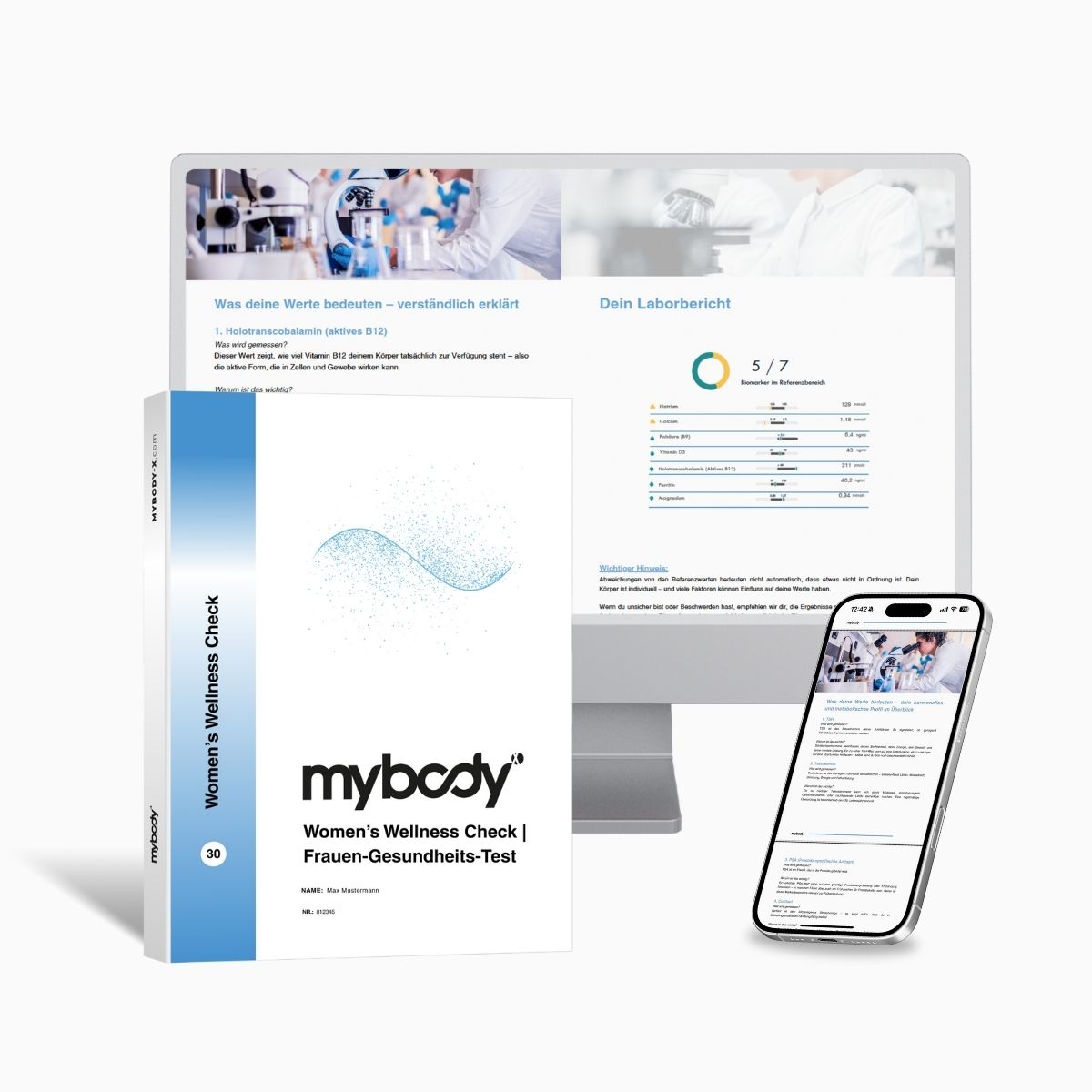
Blood test using capillary blood
Women’s Wellness Check | Women’s Health Test
Measures 18 values from the same sample: TSH, fT3, fT4, cortisol, prolactin, SHBG, ferritin, vitamin B12, 25-OH vitamin D3, total cholesterol, HDL, LDL, triglycerides, gamma-GT, GPT, cystatin C, HbA1c, and CRP. What the test does not do: It does not replace medical evaluation, and it does not include a complete blood count or minerals. It does not provide a diagnosis or disprove medical advice.
Laboratory results 3–5 business days after sample receipt
Product page information, accessed August 19, 2026
Chapter at a glance
A panel provides figures with the date, unit, and laboratory reference range. It does not replace medical evaluation, disprove medical advice, or provide a diagnosis. For values that depend on timing, the timing is part of the value.
Limitations: what even your own numbers leave open
The first limitation is interpretation. An abnormal laboratory value alone does not indicate a disease, and there are often harmless reasons for it (IQWiG, as of April 2, 2025).
The second limitation is the frame of reference. The reference range shown on your own report is decisive because reference values can vary from one laboratory to another. The figures in this article are those of the IQWiG.
The third limitation is completeness. A laboratory value must always be considered together with other values, symptoms, and findings from other examinations (IQWiG, as of April 2, 2025). A panel does not provide symptoms or other examination results.
The fourth boundary is timing. Values that fluctuate over the course of a day or month require information about when the sample was taken. Without it, later comparison is difficult.
The fifth boundary is diagnosis. All the classifications in this article provide context and do not constitute a diagnosis. A diagnosis is made in a doctor’s office, and no self-test can anticipate it.
What matters about this sentence
If you take away just one thing from this article, let it be this: “Within the normal range” is a correct answer to a narrowly defined question.
The range to which it refers is different for women than for men. According to the IQWiG, ferritin starts at 9 µg/l for women over 18 and at 18 µg/l for men over 18; for hemoglobin, it starts at 11.5 compared with 13.5 g/dl (as of March 20, 2025).
Anyone who knows this does not question the answer but supplements it with the specific number. And anyone who records that number with the date has something next time that says more than any individual result: a trend.
Frequently asked questions
Are the reference ranges really different for women and men?
For several values, yes. For ferritin, the IQWiG gives 9 to 140 µg/l for women over 18 and 18 to 360 µg/l for men over 18; for hemoglobin, it gives 11.5 to 16.0 g/dl compared with 13.5 to 17.8 g/dl (as of March 20, 2025). The range on your own report is always decisive.
Is the reference range for women set too low?
None of the sources reviewed supports this assessment, so we do not make it. What is established is that reference ranges are determined based on measurements from many healthy people (IQWiG, as of April 2, 2025). They therefore describe a distribution, not a target.
Can I have symptoms even if all my values are within the range?
A laboratory report answers the question of whether a value falls within a range. It does not answer where a symptom comes from. The IQWiG states that a laboratory value must always be considered together with other values, symptoms, and findings from other examinations (as of April 2, 2025). Symptoms should therefore be discussed with a doctor.
What should I make a note of from a lab result?
The number, the unit, the laboratory’s reference range, the date, and the laboratory’s name. These five details make a result comparable later on. “It was fine” cannot be compared.
Does the time of the blood draw matter?
For values that fluctuate over the course of a day or month, the time is part of the result. We have separate articles on hormone tests and cortisol sampling, each of which explores this in more detail. For values that remain stable over several weeks, the time is less important.
Next step
The number instead of the explanation
The Women’s Wellness Check measures 18 values from capillary blood and provides figures with the date, unit, and laboratory reference range. It does not replace medical evaluation, disprove medical advice, or constitute a diagnosis.
Go to the Women’s Wellness CheckRead more
You might also be interested in
How the numbers on the test report are generated.
When timing is part of the number.
Sources
- Institute for Quality and Efficiency in Health Care (IQWiG): Ferritin, as of March 20, 2025 – gesundheitsinformation.de
- IQWiG: Hemoglobin, as of March 20, 2025 – gesundheitsinformation.de
- IQWiG: Understanding laboratory values correctly, as of April 2, 2025 – gesundheitsinformation.de
- IQWiG: Iron deficiency and iron-deficiency anemia, as of April 19, 2023 – gesundheitsinformation.de
- Federal Joint Committee (G-BA): Directive on health examinations for the early detection of diseases, effective February 12, 2021 – g-ba.de
The verbatim quotation of the ferritin reference ranges and all ferritin figures come from source [1]. The hemoglobin reference ranges in both units come from [2]. The statement on how reference ranges are established, the figure of 5 percent, the note on harmless reasons for unusual values, the statement about considering them together with symptoms and other findings, and the explanation of laboratory dependence come from [3]. Source [4] was consulted to support the information on iron. The information on the scope of the health examination comes from [5]. Information on price, values, sample type, and laboratory comes from the mybody®x product page, accessed on August 19, 2026; processing times follow the central specification for blood tests. All sources were accessed and reviewed on August 19, 2026.

mybody®x Editorial & Expert Team
Laboratory diagnostics Blood analysis interpretation Nutritional science Nutrigenetics
This article was created by the mybody®x editorial and expert team. The team combines laboratory diagnostics, nutritional science, and the interpretation of blood analyses. Those who contribute to it are listed on the authors’ page.
Published on August 19, 2026 · Last updated on August 19, 2026
The content is for general information and does not replace medical advice, diagnosis, or treatment. Reference ranges depend on the laboratory, method, and age; the information on your test report is always authoritative.




Share now:
Before your first blood test: what you should know
Measure BCAAs in your blood instead of guessing