

Before your first blood test: what you should know
The essentials at a glance
The same questions always arise before the first blood test. What actually happens, what appears on the report afterward, and what am I supposed to do with it?
This article answers them one by one, with sources and without promises. The most important answer appears in the second chapter and is also the most sobering.
You will read the quoted source verbatim, three documented details, three common statements in a fact check, four expectations compared, and an honest list of what a self-test cannot do.
What to expect in this article
1. The questions that always come up
2. The documented source
3. How a capillary blood test works
4. Three documented details
5. What appears on the report
6. Three statements in the fact check
7. What a highlighted line means
8. The key point in one sentence
9. What happens after the result
10. Four expectations compared
11. What a self-test cannot do
12. Who a first test is suitable for
13. What a capillary blood test can show here
14. Limitations: what remains open
15. What matters the first time
Frequently asked questions
Sources
The questions that always come up
Anyone who has never done an at-home blood test before usually has the same four questions in mind.
How does it work? How long does it take? What appears on the report at the end? And the real question behind it: What do I get out of it?
This article answers them one by one. It begins with the fourth because the answer to it puts everything else into perspective.
And in several places it states what such a test cannot do. That belongs in an introductory article; otherwise it creates an expectation that no finding can fulfill.
The documented source
The most important answer appears in one sentence from a public source, and it is more matter-of-fact than advertising for blood tests usually sounds.
Documented source
“A single laboratory value is therefore always only one component of a complete diagnosis.”
Institute for Quality and Efficiency in Health Care
IQWiG, gesundheitsinformation.de, Understanding laboratory values correctly, as of 2 April 2025
This sentence answers the question of usefulness, but with an important qualification. A laboratory value is one component, not a result.
What it does not say is just as important: that individual components would be useless. A complete diagnosis is built from components, and without them it cannot be made.
Anyone approaching a first test with this expectation will not be disappointed. Anyone expecting an answer will.
How a capillary blood test works
The basic process is the same for at-home tests, while the details vary. The instructions in the kit are always authoritative.
There are two different types. A rapid test provides the result itself, in the case of the iron-ferritin self-test after approximately 5 to 10 minutes (product page, retrieved 19/08/2026). A laboratory test is sent in and analyzed in a laboratory.
For the laboratory method, VitalCheck states that kit shipping takes 1 to 3 business days and laboratory analysis takes 3 to 5 business days after the sample arrives. This means more than a week passes between ordering and receiving the report.
Both methods use capillary blood from the fingertip. What this means for the sample and which specific rules apply is covered in a separate article on this blog.
What you should clarify before opening the kit
Two points can be clarified in advance and prevent trouble later.
The first concerns timing. If the instructions specify a time of day or the timing of the last meal, include this in your planning before opening the envelope. A sample cannot be collected differently afterward.
The second concerns the return shipment. With a laboratory test, the result depends on the sample reaching the laboratory promptly. When the sample is sent is therefore part of the procedure, not a minor detail.
Everything else is stated in the instructions for the respective test. They take precedence over every general description, including this one.
Three documented details
Three details from the verified sources and the product pages. They provide context and do not constitute a diagnosis.
Documented information
3–5 business days
Laboratory analysis takes after the sample arrives; before that, kit shipping takes 1–3 business days (information on mybody®x blood tests, retrieved 19/08/2026)
5 %
of people have results outside the reference range even though they are healthy (IQWiG, as of 02/04/2025)
Every 3 years
From the age of 35, people are entitled to the general health check-up (G-BA, effective 12/02/2021)
The third detail is mentioned here because it is often overlooked. A self-test is a supplement, not a substitute for this service.
And as with every laboratory value, the decisive factor is the reference range stated on your own report, because reference ranges can vary from one laboratory to another (IQWiG, as of 02/04/2025).
What appears on the report
A laboratory report follows a fixed structure, and once you know it, you can read every subsequent one more quickly.
The name of the value appears on the left, your number and its unit in the middle, and a range on the right. Values outside this range are usually marked.
This area is called the reference range and is not a target value. It is usually established based on measurements from many healthy people, with the limits set so that 95 percent fall within the range (IQWiG, as of 02/04/2025).
The date and the evaluating laboratory are also included. Both details may seem incidental, but they are crucial for any later comparison because reference ranges can vary from one laboratory to another.
Three statements in a fact check
These three statements are particularly common before the first test.
Checked against the evidence
Common belief
“Then I’ll finally know what’s causing it.”
Documented
IQWiG writes: A single laboratory value is therefore always only one building block of an overall diagnosis (as of 04/02/2025). A report provides numbers, not an explanation.
Common belief
“A self-test replaces a visit to the doctor.”
Documented
No. The same source states that a clear picture only emerges in conjunction with other values, symptoms, and examinations (as of 03/20/2025). In addition, from age 35 onward, people are entitled to a health check-up every three years (G-BA, effective 02/12/2021).
Common belief
“If everything is within the range, everything is fine.”
Documented
A reference range describes a distribution among healthy people, not a state of health. And 5% of people fall outside it even though they are healthy (IQWiG, as of 02/04/2025).
What a flagged line means
For many people, this is the real concern before their first test: What if something is flagged?
The flag is a mathematical indication. It says that this value lies outside the limits derived from the measurements of many healthy people.
IQWiG puts this directly into context: 5 percent of people have a result outside the reference range even though they are healthy, so an abnormal value does not necessarily need to be treated (as of 02/04/2025).
What a flagged line means in an individual case is clarified at a medical practice. It is a reason for a conversation, not a result.
The core in one sentence
At this point, the topic can be brought together.
A blood test does not answer a question. It makes a question discussable.
That sounds like little, but in everyday life it is a lot. The difference between a vague feeling and a number with a date is the difference between a difficult conversation and one that can be guided.
Anyone who starts with this expectation gets more from their first report than someone who expects an answer.
That also explains why this blog so often says that interpretation belongs in a medical practice. This is not a legal formality, but a description of how the work is divided: a test provides building blocks, and a conversation turns them into a picture.
What happens after the report
The report comes back, and then the question arises that no one asks beforehand: And now?
The first step is unspectacular: keep it. The date, laboratory, and reference ranges are all part of it, because a later comparison is meaningless without these three details.
The second step depends on what it says. If nothing is flagged, you have a starting point. If something is flagged, you have a reason for a conversation at a medical practice, together with the full report.
There is no third step that you should take on your own. Neither taking a substance nor changing your diet follows automatically from a laboratory value, and this article recommends neither.
A simple system is enough for keeping them. Use a folder or a photo album on your phone in which each result is stored in full, with all pages rather than just the line that is currently of interest.
The reason for this only becomes apparent years later. No one knows today which line will matter in five years, and a photographed single line without a reference range and date is worthless by then.
Four expectations compared
The table compares four expectations with the sources’ answers. It provides context; it does not make a diagnosis.
| Expectation | Does it apply? | What the sources say about this | What is possible instead |
|---|---|---|---|
| I receive figures with a reference range | Yes, with the laboratory option | The information on your own result is authoritative (IQWiG, as of 2 April 2025) | Keep the result with the date and laboratory information |
| I find out whether I am healthy | No | A single laboratory value is always only one component of an overall diagnosis (IQWiG, as of 2 April 2025) | Take the result to a consultation at a medical practice |
| I find out what is causing my symptoms | No | Only in conjunction with other values, symptoms, and examinations does a clear picture emerge (IQWiG, as of 20 March 2025) | Have symptoms medically evaluated, regardless of the test |
| I have a baseline value for later | Yes | A previous value cannot be obtained retrospectively—that is a property of time | Record the conditions so that a later comparison is meaningful |
The fourth line is the only one a self-test fully satisfies. At the same time, it is the one people least often think about before taking their first test.
What a self-test cannot do
This list belongs in an introductory article because product descriptions rarely include it in full.
It does not provide a diagnosis. This is not a mere formality, but a description of what a laboratory value is: one component.
It does not replace an examination. A result contains no medical history, consultation, or physical examination, and an assessment arises from these components.
It identifies neither a cause nor a consequence. Nor does it replace a health check-up: from the age of 35, people are entitled to one every three years (G-BA, effective 12 February 2021).
It also does not replace medical evaluation of symptoms. Anyone experiencing something that causes concern should have it medically evaluated, regardless of what a self-test showed. An unremarkable result is no reason to delay this.
This list is deliberately placed before the product card, not after it. Anyone who has read it makes an informed decision.
Who an initial test is suitable for
The comparison concerns whether an initial at-home blood test is suitable for your situation.
It may be right for you if …
You want a dated reference point that you can compare later.
You want to bring numbers to an appointment instead of relying on a feeling.
You know that the end result is numbers, not an answer.
You want to see several values from one sample instead of individual reports from different years.
It may not be right if …
You have acute symptoms. These require medical evaluation, regardless of the test.
You expect an explanation. No report provides that.
You are already undergoing diagnostic evaluation. In that case, the practice that started it should continue.
You expect a diagnosis. That is provided by a medical practice, not a self-test.
What a capillary blood test can show here
The main argument for an initial test is this: A report with several values from the same sample is more useful as a reference point than individual numbers from different years.
The VitalCheck by mybody®x (MYBODY Lab GmbH) measures 18 values with the same date and from the same laboratory. What it does not provide is stated in the card and in Chapter 11.
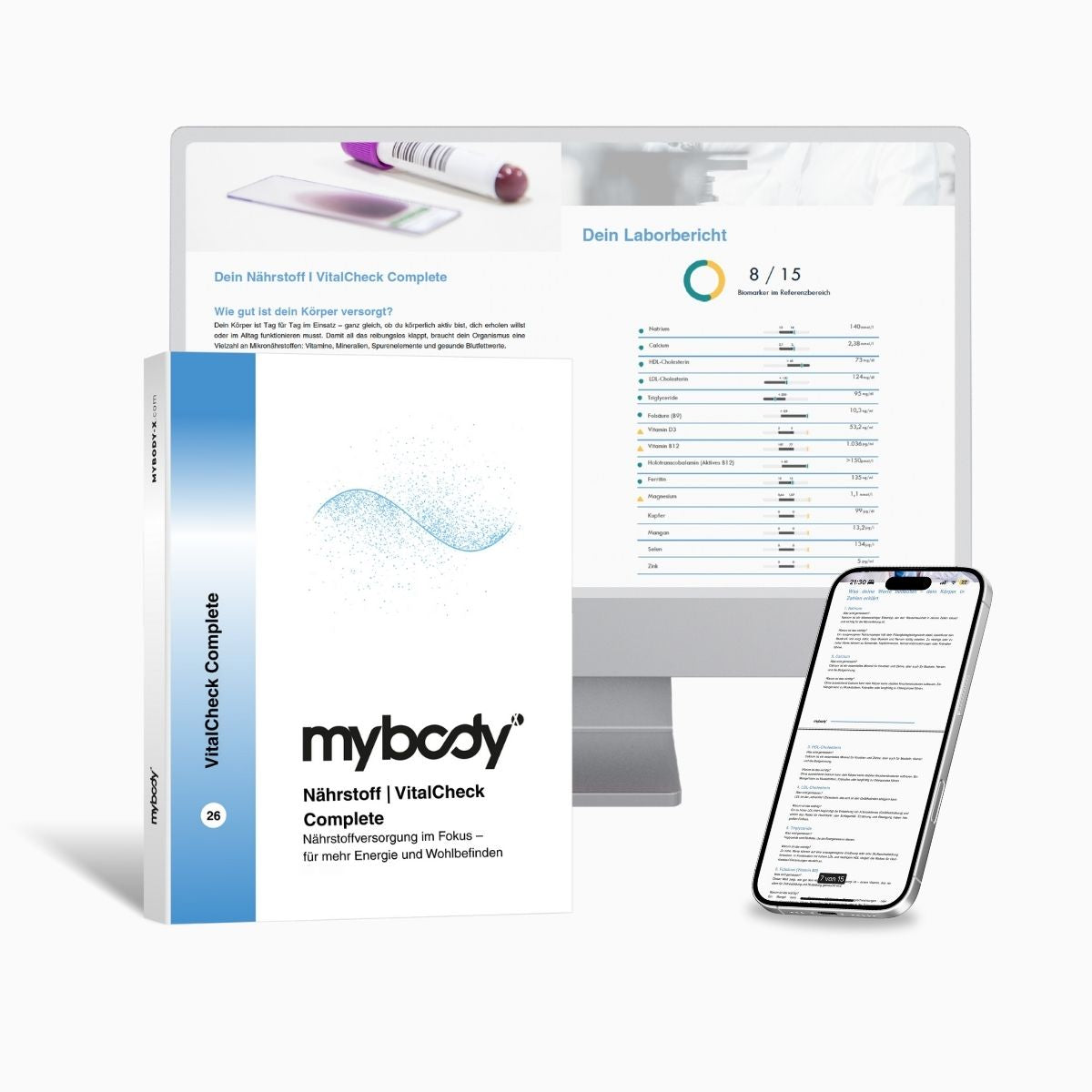
Capillary blood test
VitalCheck | Nutrient & Mineral Test Complete
Measures 18 values from the same sample, including 25-OH vitamin D3, vitamin B12, folic acid, ferritin, iron, transferrin, calcium, magnesium, phosphate, albumin, selenium, zinc, CRP, long-term blood sugar, and the cholesterol profile. What the test does not provide: no diagnosis, no cause, no substitute for a medical examination, and no substitute for the general health check-up to which everyone aged 35 and over is entitled every three years.
Laboratory results available 3–5 business days after receipt of the sample
Product page information, accessed August 19, 2026
Chapter at a glance
An initial test provides several values with a date and a laboratory, establishing a reference point for later comparison. It does not provide a diagnosis, identify a cause, or replace either a medical examination or the general health check-up.
Limitations: what remains unresolved
The first limitation is interpretation. A single laboratory value is always only one component of an overall diagnosis (IQWiG, as of April 2, 2025).
The second limitation is usefulness. Regarding screening, IQWiG states: Not all screening examinations improve health. They may also be useless or even harmful (as of September 30, 2009).
The third boundary is scope. No nutrient panel covers everything involved in an assessment, and a complete blood count is not included with these tests.
The fourth boundary is diagnosis. All the interpretations in this article provide context; they do not constitute a diagnosis. A diagnosis is made in a medical practice based on several components, and no self-test can anticipate it.
What matters the first time
If you take away just one thing from this article, let it be this: Set your expectations correctly, and everything else will fall into place.
In the end, there is a sheet containing numbers, reference ranges, a date, and a laboratory. It is one component of an overall diagnosis (IQWiG, as of 2 April 2025), a starting point for a later comparison, and a basis for a conversation.
What it does not tell you is why you feel the way you do. That answer emerges in a medical practice, and a report is a good starting point for that.
Frequently asked questions
How long does it take to receive the report?
For the laboratory route, the stated timelines for mybody®x blood tests are 1 to 3 business days for kit delivery and 3 to 5 business days for laboratory analysis after the sample is received. A rapid home test, by contrast, produces the result itself, in about 5 to 10 minutes for the iron-ferritin self-test (product page, accessed 19 August 2026).
What does the report contain?
The name of the value, your result with its unit, the laboratory’s reference range, and the date and laboratory that performed the analysis. The reference range is usually established based on measurements from many healthy people, with limits set so that 95 percent fall within the range (IQWiG, as of 2 April 2025).
What should I do if a value is flagged?
Take the complete report to a medical practice. IQWiG notes that 5 percent of people fall outside the reference range even though they are healthy, and that an abnormal value does not necessarily require treatment (as of 2 April 2025). Interpretation is a medical task.
Does a self-test replace the check-up covered by my health insurance?
No. From the age of 35, you are entitled to a general health check-up every three years; before that, you are entitled to one check-up between the ages of 18 and 35 (G-BA, Health Check-Up Guideline, effective 12 February 2021). A self-test can supplement this entitlement but not replace it.
Is a test worthwhile if I have no symptoms?
There is no general answer to this. Regarding screening, IQWiG notes that not all examinations improve health and that some may be useless or even harmful (as of 30 September 2009). Whatever a finding provides in any case is a starting point that cannot be obtained retrospectively.
Next step
Start with a baseline
VitalCheck measures 18 values from capillary blood, all with the same date and laboratory. It does not provide a diagnosis, identify a cause, or replace a medical examination or the health examination.
To VitalCheckRead more
You might also be interested in
The area next to your number, explained in detail.
Which factors have been substantiated and which have not.
Sources
- Institute for Quality and Efficiency in Health Care (IQWiG): Understanding laboratory values correctly, as of 02.04.2025 – gesundheitsinformation.de
- Federal Joint Committee (G-BA): Guideline on health examinations for the early detection of diseases, effective as of 12.02.2021 – g-ba.de
- IQWiG: Early detection examinations are not always useful, press release, as of 30.09.2009 – iqwig.de
- IQWiG: Ferritin, as of 20.03.2025 – gesundheitsinformation.de
The verbatim quotation about being a component of an overall diagnosis, the explanation of how reference ranges are established, the figures of 95 and 5 percent, the statement that treatment is not necessarily required, and the note about laboratory-dependent reference values are taken from source [1]. The information about eligibility for the health examination and the age limits is taken from [2]. The statements about the benefits of early detection examinations are taken from [3]. The sentence about considering values, symptoms, and examinations as a whole is taken from [4]. The result time of approximately 5 to 10 minutes, as well as information about price, values, sample type, and laboratory, comes from the mybody®x product pages, accessed on 19.08.2026; processing times follow the central specification for blood tests. All sources were accessed and reviewed on 19.08.2026.

mybody®x Editorial & Expert Team
Laboratory diagnostics Blood analysis interpretation Nutritional science Nutrigenetics
This article was created by the mybody®x editorial and expert team. The team combines laboratory diagnostics, nutritional science, and the interpretation of blood analyses. The people who contribute to it are listed on the authors page.
Published on 19.08.2026 · Last updated on 19.08.2026
The content is for general information and does not replace medical advice, diagnosis, or treatment. Reference ranges depend on the laboratory, method, and age—always refer to the information on your report.




Share now:
Why blood values respond slowly to changes
Women are often told that everything is within the normal range