

Measuring BCAA in the blood instead of estimating
The essentials at a glance
Leucine, isoleucine, and valine can be measured individually in the blood. An amino acid panel includes all three.
What such a measurement does not answer is the question most people come with. The German Nutrition Society states that in everyday nutrition, there is no physiological reason to use protein supplements.
You will read the quoted source verbatim, three common statements in a fact check, three documented facts, a comparison between estimating and measuring, and what a level does not determine.
What to expect in this article
1. What BCAA refers to
2. The documented source
3. Where the three values appear in the panel
4. Three statements in the fact check
5. What a BCAA level in the blood reflects
6. Three documented facts
7. Why "measure instead of estimate" is only half the answer
8. The core point in one sentence
9. What the DGE says about plant-based protein
10. Estimating and measuring compared
11. What a level does not determine
12. Who can benefit from a measurement
13. What the PerformanceCheck provides
14. Limitations: what a BCAA level leaves unanswered
15. What matters about this topic
Frequently asked questions
Sources
What BCAA refers to
BCAA stands for branched-chain amino acids. It refers to three: leucine, isoleucine, and valine.
All three are included in the MSD Manual's list of the nine essential amino acids that the body cannot produce itself and that therefore must be obtained through food (Bhupathiraju and Hu, as of November 2025).
BCAA is therefore not a medical category, but a collective term for three names originating in the sports and supplement field. In specialist sources, the three appear individually, not as a group.
This article explains what measuring these three values can do. It neither recommends nor advises against a supplement, and it makes no statement about muscle growth or recovery—for that, we lack a source of the level we require for claims of this kind.
The documented source
The clearest statement on this topic comes from a position paper by the German Nutrition Society.
Documented source
"In athletes' everyday diets, there is no physiological reason to supplement protein intake with supplements."
German Nutrition Society
Position paper on protein intake in sports, press information 13/2020
Two formulations in this sentence deserve attention because they define the scope precisely.
"In everyday nutrition" sets a boundary: The statement refers to normal daily life and not every conceivable special situation. "Physiological reason" also sets a boundary: It concerns physical necessity, not practicality or taste.
In the same paper, the DGE adds that a balanced diet is generally superior to supplements (2020). This statement also contains a deliberate qualification with “generally.”
Where the three values appear in the panel
Those who want to have the three values determined will not find them as a standalone test, but as part of an amino acid profile.
According to the product page, the mybody®x PerformanceCheck (MYBODY Lab GmbH) includes 22 values, including the nine essential amino acids. Leucine, isoleucine, and valine appear in the first three positions.
This is not a coincidence but follows the system: The essential amino acids are listed first because dietary intake is their only source. We have discussed this classification in greater detail in a separate article.
Important for expectations: You receive three individual numbers, not a combined BCAA value. The combined value is a convention from the sports field, not a laboratory parameter.
Three statements fact-checked
These three statements come up in every conversation about BCAA.
Checked against the evidence
Common claim
“Anyone who trains needs BCAA supplements.”
Substantiated
The DGE states that, in the everyday diet of athletes, there is no physiological reason to supplement protein intake with supplements (2020).
Common claim
“Plant-based protein is not sufficient for that.”
Substantiated
The DGE describes both points: Plant proteins often contain lower amounts of indispensable or branched-chain amino acids, and study results show no clear differences in their effects (2020).
Common claim
“A blood value shows whether I have enough of it.”
Substantiated
A blood value shows a concentration at the time the sample is taken. IQWiG states that an individual laboratory value is always only one component of an overall diagnosis (as of 02/04/2025).
What a blood BCAA level reflects
Before interpreting a number, it is worth asking what it actually measures.
What is measured is a blood concentration at the time the sample is taken. What is not measured is how much someone consumes, how much reaches the muscle, or how much is used.
For amino acids, the blood is a transport route, not a storage site. What is currently circulating there is closely linked to when food was last consumed—and protein is part of almost every meal.
That is why the product page points to a fasting requirement in the instructions. Anyone who does not follow it is largely measuring their last meal, making the number difficult to interpret.
Why exercise shifts the level further
In addition to the meal, there is a second factor that is particularly relevant for physically active people: the exercise itself.
Our reviewed sources do not provide figures for how strongly or for how long a training session shifts the concentrations of individual amino acids in the blood. We therefore give no figures, even though such information circulates online.
The practical conclusion is a rule of caution: Anyone who wants to compare two measurements should take both under as similar conditions as possible. The same time of day, the same interval since the last meal, and the same interval since the last training session.
This rule applies to any value that can fluctuate. It is particularly important for an amino acid profile because two influences come together here, and they can easily differ in everyday life.
Three documented figures
Three figures from the reviewed sources. They provide context and do not constitute a diagnosis.
Documented figures
3 of 9
Essential amino acids are grouped together as BCAAs: leucine, isoleucine, and valine (MSD Manual, as of November 2025)
0.8 g/kg
The DGE gives this amount of protein per kilogram of body weight per day as the recommended protein intake for adults under 65 (as of 2025)
no reason
According to the DGE, there is no physiological reason in the everyday diet of athletes to supplement protein intake with supplements (2020)
The middle figure is the most practical. It is based on body weight and can be calculated without a laboratory, while a blood value is not needed for this purpose.
Why “measure instead of estimate” is only half the answer
The sentence sounds convincing because measuring sounds more precise than estimating. Nevertheless, in this context it is misleading.
The reason: Intake is normally estimated, while concentration in the blood is measured. These are two different quantities, and one does not replace the other.
Anyone who wants to know whether they are eating enough protein calculates based on body weight and the DGE reference value. This is not estimation in the bad sense, but the method intended for this question.
Anyone who wants to know where three specific concentrations stood at the time of sampling needs to measure them. No calculation can answer that question.
A measurement value is therefore not a more precise replacement for an estimate. It is the answer to a different question, and anyone who confuses the two gets a precise number for the wrong thing.
The core in one sentence
At this point, the topic can be brought together.
Measurement does not replace estimation because the two capture different things: intake on the plate and concentration in the blood.
This sentence does not make measurement unnecessary. It merely clarifies which question is answered by which method.
And it has a welcome side effect: Anyone who frames the question properly can avoid being disappointed by a number that was never able to answer it.
What the DGE says about plant protein
One point from the position paper deserves its own chapter because it is often quoted in shortened form.
The DGE states that plant proteins often contain fewer essential or branched-chain amino acids (2020). This half-sentence is frequently quoted on its own and then appears to be an argument.
The same paper contains the second part: The study results show no clear differences in effect (2020). Only both sentences together accurately convey the position.
For this topic, that means: A difference in composition is not automatically a difference in outcome. Anyone who derives a recommendation for action from the first half of the sentence is citing the source incompletely.
This kind of shortening is, incidentally, the most common error when citing specialist sources. A sentence describing an observation is read as a recommendation, and the qualification in the subordinate clause is left out.
That is why, wherever possible, we reproduce the complete sentence in our articles and include the source and year. Anyone who wants to read further can find the reference and check for themselves whether we have understood it correctly.
Estimating and measuring in comparison
The table compares which questions can be answered by which method. It provides context and does not constitute a diagnosis.
| Question | Calculating based on body weight | Measuring in the blood | What the sources say about this |
|---|---|---|---|
| Am I consuming enough protein? | Yes, that is what the reference value is designed for | No, a concentration is not an intake | 0.8 g/kg of body weight per day for adults under 65 (DGE, as of 2025) |
| What were my leucine, isoleucine, and valine levels? | No, this cannot be calculated | Yes, as three individual values with reference ranges | All three are included in the list of the nine essential amino acids (MSD Manual, as of November 2025) |
| Do I need a supplement? | The DGE's position answers this question | No, this decision does not follow from a single value | No physiological reason for supplements in everyday nutrition (DGE, 2020) |
| Do I have a deficiency? | No | No, one value alone is not enough for that | A single laboratory value is always just one component of an overall diagnosis (IQWiG, as of April 2, 2025) |
Only one row of this table supports testing, and that is the second one. It is the only question for which a blood value is the appropriate method.
This is not a disparagement. It is the precise description of what this test was designed for.
What a value does not determine
In the end, many people are left wondering whether they should take something. This article is clear on that point: This decision is not made on the basis of a blood value.
It is determined in a consultation that brings together diet, training volume, medical history, and, where applicable, a finding. A medical practice or qualified nutrition professional is responsible for such an assessment.
The reason for this is once again explained by IQWiG: A laboratory value must always be considered together with other values, symptoms, and findings from other examinations (as of April 2, 2025).
And the DGE has already formulated a position for the standard case that takes precedence over any laboratory value: In everyday nutrition, there is no physiological reason to supplement protein intake with supplements (2020).
Who may benefit from a measurement
This comparison concerns whether measuring these values contributes anything in your situation.
It may be useful for you if …
You want to see the complete amino acid profile rather than just the three branched-chain amino acids.
You have changed your diet and want a documented snapshot.
You want to bring dated figures to a discussion with a medical practice or nutrition professional.
You can and will follow the fasting requirement in the instructions.
Probably not if …
You want to know whether you eat enough protein. The reference value based on body weight is intended for that.
You want to determine from the result whether a supplement is worthwhile. No single value can do that.
You expect a combined BCAA value. You receive three separate values.
You have symptoms. Then the matter should be evaluated at a medical practice.
What the PerformanceCheck provides in this regard
A capillary blood self-test does not provide a diagnosis and does not replace medical evaluation. It provides documented figures with the date and the laboratory’s reference range.
For this topic, that means three separate values for leucine, isoleucine, and valine, embedded in a profile of 22 values. No recommendation, assessment, or statement about intake.
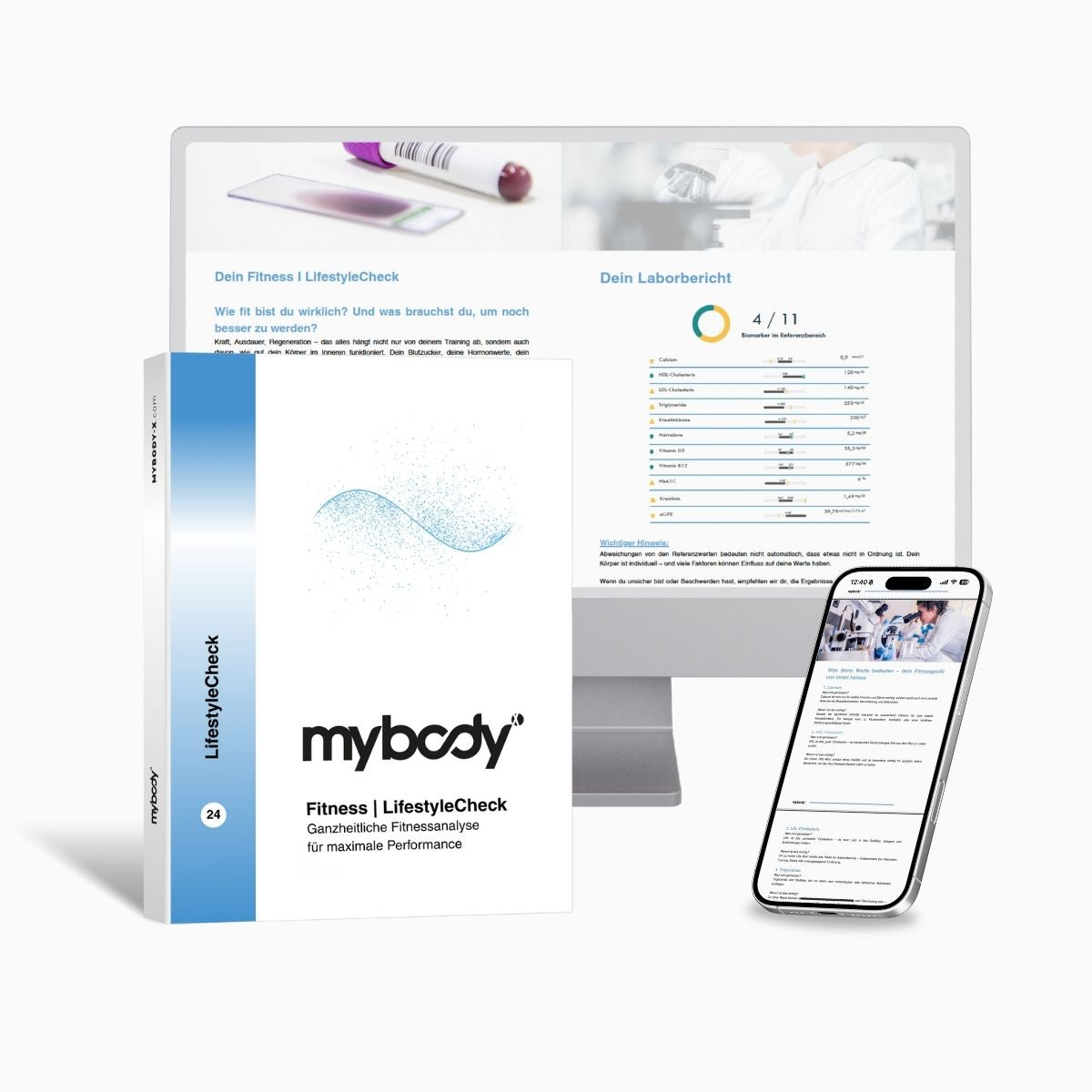
Capillary blood test
PerformanceCheck | Amino Acid Test
Measures 22 values from the same sample, including all nine essential amino acids, with leucine, isoleucine, and valine reported as separate values. What the test does not do: It does not answer whether a supplement is worthwhile, provide a combined BCAA value, or say anything about protein intake. It does not provide a diagnosis. The fasting requirement in the instructions must be followed.
Laboratory results 3–5 business days after receipt of the sample
Product page information, accessed 19 August 2026
Chapter at a glance
The test provides leucine, isoleucine, and valine as three separate values within a profile of 22 values. It does not answer whether someone consumes enough protein or whether a supplement is worthwhile. For everyday nutrition, the DGE states that there is no physiological reason for this.
Limitations: what a BCAA value leaves unanswered
The first limitation is the measurement itself. It measures a concentration in the blood—not intake and not what reaches the muscle.
The second limitation is timing. Protein is part of almost every meal, so the fasting requirement determines what the number represents.
The third limitation is inference. No value leads to a decision about a supplement. The DGE states that there is no physiological reason for one in everyday nutrition (2020).
The fourth limitation is our own source base. In this article, we deliberately make no statement about the effects of BCAAs on muscle growth, recovery, or performance because we lack a source of the standard we require for that purpose.
The fifth limitation is diagnosis. All the interpretations in this article provide context and do not constitute a diagnosis. A diagnosis is made in a medical practice based on several elements.
What matters about this topic
If you take away just one thing from this article, let it be this: First clarify which question you have, and then whether a measurement can answer it.
For the question of protein intake, there is a body-weight-based reference value: 0.8 g per kilogram per day for adults up to but not including 65 years of age (DGE, as of 2025). For the question of a supplement, there is a position: In the everyday diets of athletes, there is no physiological reason for one (DGE, 2020).
There is a measurement for the question of where leucine, isoleucine, and valine levels were at the time of sampling. It answers precisely that question and neither of the other two.
Frequently asked questions
Which three amino acids does BCAA refer to?
Leucine, isoleucine, and valine. All three are included in the MSD Manual’s list of the nine essential amino acids, which the body cannot produce itself and must obtain through food (Bhupathiraju and Hu, as of November 2025).
Will I receive a combined BCAA value?
No. An amino acid profile provides the three values separately, each with the laboratory’s unit and reference range. Combining them into a single value is a convention from the sports field, not a laboratory parameter.
Does the value tell me whether I need a supplement?
No. This decision is not based on a blood value. In its position paper, the DGE states: In the everyday diets of athletes, there is no physiological reason to supplement protein intake, and a balanced diet is generally superior to supplements (2020).
Is plant protein sufficient for branched-chain amino acids?
The DGE describes both: Plant proteins often contain fewer indispensable or branched-chain amino acids, and the study results show no clear differences in their effects (2020). Both sentences belong together; either one alone does not represent the position.
How much protein should I consume each day?
For adults up to age 65, the DGE recommends an intake of 0.8 g per kilogram of body weight per day, and from age 65 onward estimates 1.0 g/kg (as of 2025). This value is based on body weight and can be determined without laboratory testing.
Next step
Three values in one profile instead of separately
The PerformanceCheck measures 22 values from capillary blood, including leucine, isoleucine, and valine as individual values. It does not answer whether a supplement is appropriate, does not replace medical evaluation, and does not provide a diagnosis.
Go to PerformanceCheckRead more
You might also be interested in
How an amino acid profile is structured.
The order of priority for nutrient questions.
Sources
- German Nutrition Society (DGE): Position Paper on Protein Intake in Sports, Press Release 13/2020 – dge.de
- DGE: Selected Questions and Answers on Protein and Essential Amino Acids, as of 2025 – dge.de
- MSD Manual, Professional Edition: Nutrient Overview, Bhupathiraju SN, Hu F (as of November 2025) – msdmanuals.com
- Institute for Quality and Efficiency in Health Care (IQWiG): Understanding Laboratory Values Correctly, as of April 2, 2025 – gesundheitsinformation.de
The verbatim quote about the lack of a physiological basis for supplements, the note on the superiority of a balanced diet, and both statements about plant-based protein come from source [1]. The reference values of 0.8 and 1.0 g of protein per kilogram of body weight come from [2]. The classification of leucine, isoleucine, and valine as three of the nine essential amino acids and the wording about obtaining them through food come from [3]. The sentence about being one component of an overall diagnosis and the sentence about considering the results together with symptoms and other findings come from [4]. The number of values, their grouping, the fasting requirement, and information on price, sample type, and laboratory come from the mybody®x product page, accessed on August 19, 2026; processing times follow the standard policy for blood tests. All sources were accessed and reviewed on August 19, 2026.

mybody®x Editorial & Expert Team
Laboratory diagnostics Blood analysis interpretation Nutritional science Nutrigenetics
This article was created by the mybody®x editorial and expert team. The team combines laboratory diagnostics, nutritional science, and the interpretation of blood analyses. Contributors are listed on the authors page.
Published on August 19, 2026 · Last updated on August 19, 2026
The content is for general information only and does not replace medical advice, diagnosis, or treatment. Reference ranges depend on the laboratory, method, and age—the information on your test report is always authoritative.




Share now:
Women are often told that everything is within the normal range
DNA analysis for preventive healthcare: what it can and cannot do