

Recognizing and understanding the symptoms of a slow metabolism
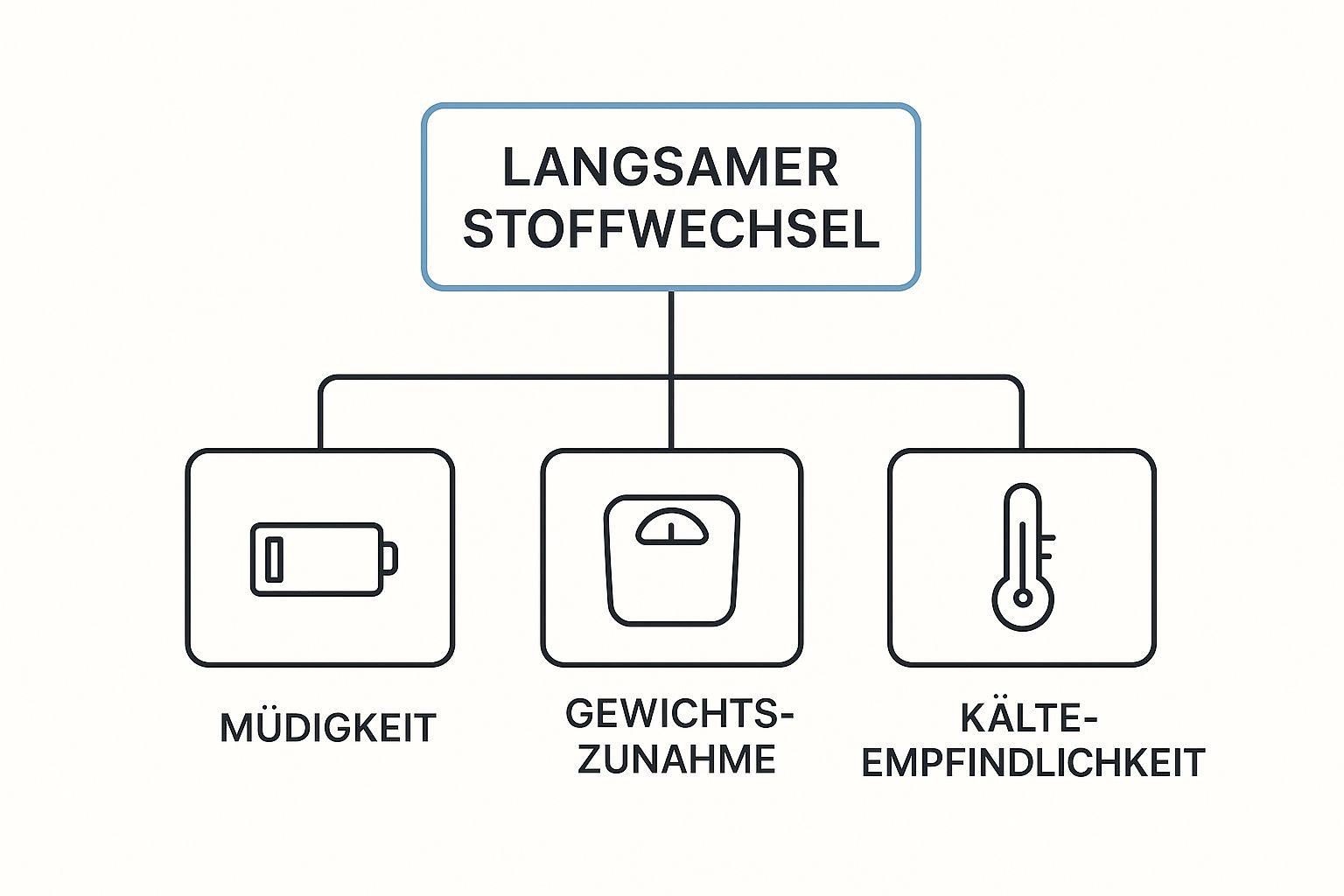
Do you constantly feel tired even though you actually get enough sleep? Or are you gaining weight without having changed your diet or exercise routine? If this sounds familiar, these could be the first signs of a slowed metabolism. Your body then switches, so to speak, into energy-saving mode, which often shows up as constantly feeling cold, unexplained weight gain, or persistent exhaustion.
Finally understanding your own metabolism
Do you sometimes feel like your body simply isn’t cooperating, no matter what you try? It is a deeply frustrating state that many people know all too well. Usually, the suspicion quickly falls on a “slow metabolism.” But what is really behind this term?
It is best to think of your metabolism as your body’s engine. Its job is to convert everything you eat and drink into the energy you need for every single activity—from breathing and thinking to exercising and repairing your cells. But when this engine starts to sputter and no longer runs at full power, you feel the effects throughout your body.
More than just fast or slow
However, it is too simplistic to classify metabolism as merely “fast” or “slow.” In reality, it is an incredibly complex network influenced by countless factors. Your lifestyle, diet, how much muscle mass you have, and above all your hormones play a crucial role. When this finely tuned system becomes unbalanced, the typical symptoms begin to appear.
In this guide, we want to shed some light and help you better understand your body’s signals. We will take a close look at which signs point to a slowed metabolism and what the underlying causes might be. This understanding is the first and most important step toward regaining control and finally feeling energetic and comfortable in your own skin again.
A slowed metabolism is not an unchangeable fate. Rather, it is your body’s sign that something has gotten out of balance—and a signal to take a closer look and take action.
This knowledge is the foundation for taking the right steps. If you would like to delve deeper into the basics, our detailed article, what metabolism actually is, explains the connections in even greater detail. Consider this guide your roadmap to uncovering the causes behind the symptoms and setting the right levers in motion.
The most common symptoms explained in detail
Your body is constantly communicating with you. You just have to learn to interpret its signals correctly. When your metabolic engine starts sputtering, it often sends a whole series of clues. Recognizing them is the first and most important step toward counteracting them and getting back on track.
So let us take a closer look at how to recognize a sluggish metabolism.
Imagine your body as a house in winter. When the heating (your metabolism) is turned down to save energy, it gets cool inside and everything slows down. That is exactly what happens when your body decides to switch to energy-saving mode.
Unexplained weight gain and difficulty losing weight
One of the most frustrating signs is when the number on the scale suddenly starts climbing, even though nothing has changed in your eating habits or workout routine. It feels as if your body is clinging to every single calorie instead of converting them into energy as usual. It stores reserves for supposedly hard times, which can make losing weight a real test of patience.
Constant fatigue and lack of drive
Do you know the feeling of getting through the day as if you were driving with the handbrake on? When your metabolism is running on low power, it logically produces less energy. The result is a deep, heavy exhaustion that cannot simply be shaken off even after eight hours of sleep. Your batteries simply no longer recharge properly.
Your body deliberately slows down energy production to conserve resources. So this fatigue is not a sign of laziness, but the direct result of an engine that cannot get up to speed.
You are constantly cold
Are you the person in the office who needs a cardigan even in summer while everyone else is complaining about the heat? That is a classic sign. Metabolic processes produce heat as a byproduct. When these processes run slowly, the body’s own heat production also decreases. The result: You get cold more quickly, especially in your hands and feet.
Your skin, hair, and nails suffer too
It is often possible to tell from the outside that something is wrong. When energy is in short supply, your body diverts it away from the “less important” tasks to supply the vital organs. Skin, hair, and nails are often the first to feel the effects.
- Dry skin: Cell renewal slows down, the skin receives less blood flow, and no longer gets all the nutrients it needs.
- Brittle nails and hair loss: Hair and nail growth stagnates. Their structure becomes weaker because important building blocks are missing. This can also be a sign of a nutrient deficiency. If you want to learn more about such warning signs from your body, you’ll find plenty of valuable information in our guide to vitamin deficiency symptoms.
- Digestive problems: Last but not least, digestion also slows down. This can lead to constipation, a feeling of fullness, or bloating because food simply remains in the digestive tract longer than usual.
Considered individually, each of these signs can have many causes. But if you recognize several of these symptoms in yourself, that’s a fairly strong indication that your metabolism has gotten out of balance. Recognizing this is the crucial first step toward improvement.
Why your metabolism hits the brakes
Your internal engine rarely starts sputtering overnight. Usually, it’s a gradual process triggered by our lifestyle habits, physical changes, or unnoticed deficiencies. So instead of merely fighting the symptoms, we need to get to the root of the problem. Only when you know the true causes can you make targeted adjustments in the right areas.
Often, several factors interact in an unfortunate way and slow down your energy expenditure. Think of it as a chain reaction in which one weak link affects the next, bringing the entire system to a standstill.
The vicious cycle of diets and the yo-yo effect
Constant crash diets in which you drastically cut calories send your body a disastrous signal: famine! It responds by switching to survival mode. It lowers your basal metabolic rate—the amount of energy you burn at complete rest—to make the limited resources last as long as possible.
The real problem begins when you return to your normal eating habits after the diet. Your metabolism often remains in conservation mode. The result? You rapidly gain the weight back, often even more than before. This notorious yo-yo effect essentially trains your body to store energy even more efficiently during your next diet.
Insufficient muscle mass as a brake on metabolism
Muscles are your body’s true powerhouses. Even when you’re lying on the couch, they burn significantly more energy than fatty tissue. So if you’re lacking muscle mass—whether due to inactivity, insufficient protein, or the natural loss that comes with age—your basal metabolic rate automatically drops.
Every muscle you do not use or build is, in a sense, a deactivated power plant in your personal energy system. Your body is pragmatic: What is not needed is broken down to save energy.
Your body is always adapting to what you ask of it. Little movement signals that it does not need energy-intensive muscles. The result: It breaks them down, and the metabolism becomes even slower.
Hormonal Imbalances and the Role of the Thyroid
Hormones are the conductors of your metabolism. When they fall out of rhythm, the entire orchestra goes haywire. The thyroid plays a particularly central role. It produces the hormones that control energy consumption in almost every single cell of your body.
An underactive thyroid is one of the most common causes of a sluggish metabolism. The body produces too few hormones, and all processes run on low power. If you would like to explore this topic in greater depth and learn how to understand your TSH thyroid levels, we have the right information for you here.
But other factors can also significantly disrupt your hormonal balance:
- Chronic stress: Constant exposure to stress hormones such as cortisol disrupts your blood sugar levels and promotes fat storage, especially around the abdomen.
- Lack of sleep: Just a few nights of too little sleep disrupt the regulation of hunger and satiety hormones. This can slow down your metabolism by up to 8%.
- Nutrient deficiencies: If your body lacks important building blocks such as iron, iodine, or B vitamins, metabolic enzymes cannot work properly. The engine sputters because it is missing the right fuel.
This Is How You Find Out What Is Really Going On
A gut feeling is a good start, but to really make a difference, you need hard facts. Instead of groping in the dark and wildly speculating about what is slowing down your metabolism, you can search for answers in a targeted way. This allows you to make decisions based on knowledge, not vague assumptions.
The classic first step is, of course, to see a doctor. A blood test is an incredibly important tool here, especially when it comes to thyroid levels. It is, so to speak, the main switch for your metabolism—and when it does not function properly, the whole body feels it.
Medical Examinations as a First Point of Reference
Your doctor will probably order a blood count first to check the most important markers. These values are usually the focus:
- TSH (thyrotropin): This hormone is the thyroid's “boss.” If the TSH level is too high, it is often a sign of an underactive thyroid. You can think of it this way: The control center has to call louder so that the thyroid finally does its job.
- fT3 and fT4: These are the free, meaning actually active, thyroid hormones. If both are too low, this often confirms the suspicion that your metabolism's engine simply is not getting up to speed.
These values already give you a very good indication. But sometimes the cause lies deeper or is a complicated combination of several factors—for example, an unnoticed nutrient deficiency that you would not initially think of.
Gain certainty from home
And this is exactly where modern health analyses come in, which you can easily perform from the comfort of your own home. Instead of waiting weeks for an appointment with a specialist, you can take the initiative yourself.
mybody-x's lab tests were developed precisely for this purpose: to give you accurate insights into your body. With a small sample, such as a few drops of blood from your fingertip or some saliva, you can get to the bottom of the specific causes of your symptoms of a slow metabolism.
For example, you could use our thyroid test to specifically check the key hormone levels. Or you can use a nutrient deficiency test to find out whether your body is lacking important building blocks such as iron, vitamin D, or B vitamins—all essential for smooth energy metabolism. We explain step by step how easy it is to test for a nutrient deficiency.
By measuring instead of guessing, you turn uncertainty into a clear action plan. You can see in black and white exactly where to make adjustments to get your metabolism back on track.
Our selection of MYBODY Lab tests gives you a clear overview of which analyses you can use to take your health into your own hands.

The best part? You don't just get a list of numbers. Our tests provide you with an easy-to-understand results report that explains exactly what your values mean and which next steps really make sense. This gives you a solid foundation for taking targeted action to improve your well-being.
What you can do now to boost your metabolism
Once you know the root of your problem, you can finally take targeted action. It’s not about turning your life upside down overnight. Rather, it’s the small but consistent adjustments in everyday life that ultimately have the greatest impact. Think of the following strategies as your personal toolbox for getting your internal engine running smoothly again.
We focus on the three main pillars: nutrition, exercise, and your lifestyle. Each plays a crucial role in not only alleviating the symptoms of a slow metabolism, but also addressing the problem at its root.
Give your body the right fuel
Your diet is the be-all and end-all for an active metabolism. Imagine trying to keep a fire burning with wet wood—it doesn’t work particularly well. Your body likewise needs the right nutrients to burn energy efficiently.
- Choose protein: Protein is not only the building material for your muscles; it also boosts calorie burning. Your body uses more energy to digest protein than it does to digest fats or carbohydrates. A protein-rich meal also protects your valuable muscle mass, especially when you’re trying to lose weight.
- Drink enough water: Every single cell in your body needs water to function properly. Even mild dehydration can slow your metabolism by up to 2%. Aim for 1.5 to 2 liters per day.
- Eat regularly and mindfully: Give your digestive system breaks, but don’t skip meals entirely. That only signals to your body that it should switch to low-power mode.
Every meal is a new opportunity to give your metabolism a little boost. Choose foods that nourish you and provide energy instead of making you feel tired and sluggish.
Build up your body's own power plants
Movement is the ignition key for your metabolism. However, the right kind of movement is especially important for achieving long-term results.
The focus should be clearly on building muscle mass. Muscles are your body's own “furnaces,” constantly burning calories even when you’re at rest. The more muscle you have, the higher your basal metabolic rate—that is, the energy you use simply by lying down. Strength training is by far the most effective tool here. You don’t have to become a bodybuilder. Two to three sessions per week with weights or your own body weight can already make a huge difference.
Optimize your lifestyle for more energy
It is often the inconspicuous habits that sabotage our metabolism the most. Two of the biggest obstacles are chronic stress and too little sleep.
Both conditions cause your body to release the stress hormone cortisol. Persistently elevated cortisol levels disrupt blood sugar, promote cravings, and cause fat to accumulate particularly around the abdomen. Good sleep—seven to eight hours per night—and targeted relaxation, such as meditation or a walk in nature, are not luxuries but essential tools for a healthy metabolism.
The situation in Germany shows how important these adjustments are. The Robert Koch Institute documented an increase in the prevalence of obesity among adults from 12.2% in 2003 to 19.7% in 2023. A slowed metabolism is often a direct consequence of being overweight and can further reinforce weight gain, creating a vicious cycle. Learn more about how overweight has developed in Germany.
Your path to greater energy and well-being

As you can see, the symptoms of a slow metabolism are not a fate you simply have to accept. Quite the opposite: You can take the reins yourself and actively make a change. Your path back to greater energy and zest for life is built on a simple but incredibly effective three-part approach: Understand, Analyze, and Act.
You have learned to better interpret your body’s often subtle signals and recognize the possible causes behind them. And you now also know that you don’t have to grope in the dark—targeted analyses, such as the MYBODY Lab Tests, can finally provide you with clarity.
Your body is your partner, not your opponent. The strategies presented here are not short-term tricks, but sustainable tools for bringing this partnership back into balance.
Now it’s about gradually integrating the recommendations for your diet, more exercise, and a mindful lifestyle into your everyday life. Take control again, listen to your body’s needs, and consciously shape your well-being. Every single step, no matter how small it may seem, brings you a little closer to your former energy.
Questions & Answers: The Metabolism Check
Finally, we'd like to answer a few questions that come up time and again in our practice. Here are the key points, briefly and clearly summarized.
Can you really “repair” a slow metabolism?
Absolutely, although “optimize” is the better word. Don't think of your metabolism as a broken light switch, but rather as an incredibly clever system that constantly adapts. With the right adjustments to your diet, exercise, and lifestyle, you can noticeably improve its efficiency and get the typical symptoms of a slow metabolism under control.
How quickly can you really boost your metabolism?
Some things take effect immediately, but unfortunately only in the short term. An intense workout or a very protein-rich meal can significantly boost calorie burning for a few hours. But real, lasting results—such as building more muscle mass—simply take time. Expect this to take several weeks to months. Patience and perseverance are the keys to success.
Does gender play a role in metabolism?
And what a role it plays! On average, men have a higher basal metabolic rate than women. That's simply because they naturally have more muscle mass. And since muscles burn significantly more energy than fatty tissue even at rest, their internal “engine” runs at somewhat higher revs right from the start.
What role does the thyroid really play?
It's the absolute chief director! The thyroid sets the pace for your entire metabolism. If it produces too few hormones—known as underactive thyroid—practically all processes in the body run on low power. That's why checking thyroid levels is often one of the very first and most important steps when you want to get to the root of the cause.
It's more serious than you might think: In Germany, one in two adults is now overweight, and around one in five is even obese. A sluggish metabolism is a common companion of obesity and massively increases the risk of secondary diseases—a development that, according to the WHO, severely affects quality of life and life expectancy. Find out more about this comprehensive health data here.
At mybody-x.com, you'll find scientifically backed lab tests that can help you get to the bottom of the causes of your symptoms yourself. Discover now how you can specifically optimize your health: Learn more at https://mybody-x.com.



Share now:
7 Examples of Diets You Should Try
What is fat metabolism? Understand its importance