
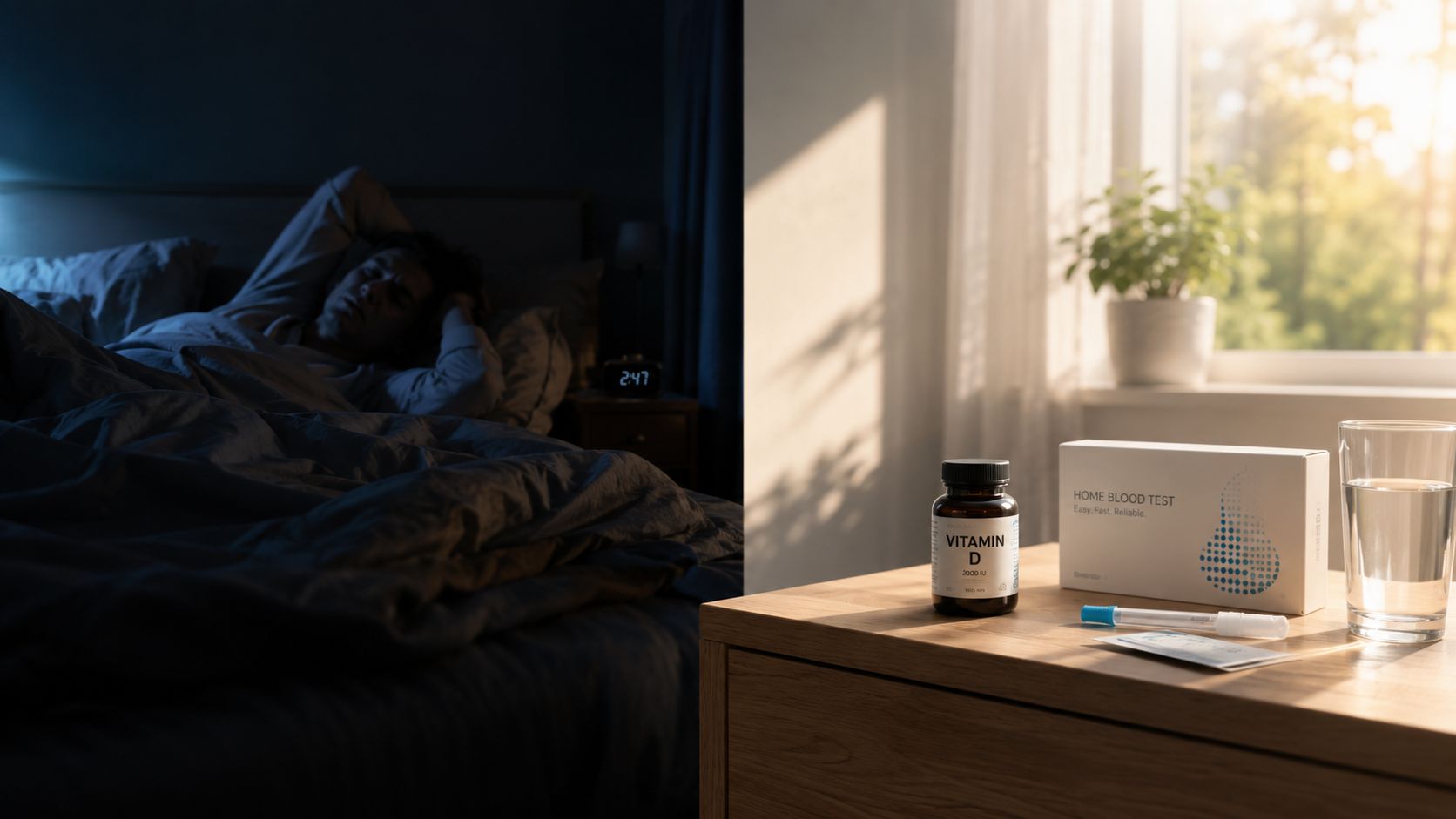
Vitamin D Deficiency and Sleep Disorders: Cause & Solution 2026
You lie tired in bed, but your mind and body simply cannot fall asleep. Perhaps you do not fall asleep until late, wake up several times during the night, or get up in the morning feeling as though your sleep has barely helped. Many people initially blame stress, screen time, or the wrong evening routine.
All of this can play a role. But sometimes something much more fundamental is behind it: a nutrient deficiency that is often overlooked—vitamin D.
Many people are surprised, especially when it comes to vitamin D deficiency and sleep disorders. Vitamin D is usually associated only with bones, sunshine, and winter. But it can also be important for your sleep. So if you have already tried a lot and still sleep restlessly, it is worth taking a closer look.
Sleepless and exhausted? You may be lacking the sunshine vitamin
Sleep problems often feel vague. You feel tired during the day but still not truly sleepy in the evening. Or you fall asleep but keep waking up and can barely get out of bed in the morning. The frustrating part is that you notice something is wrong, but the cause often remains unclear.
This is exactly where vitamin D comes in. A deficiency can affect more than just your energy. Vitamin D deficiency has been strongly correlated in several research studies with an increased risk of insomnia, general sleep disorders, and sleep apnea. People with a deficiency particularly often report fewer hours of sleep, restless sleep, daytime fatigue, and overall poorer sleep quality, as described in the article on vitamin D deficiency and sleep disorders.

Why the connection is often overlooked
Many people first look to sleep hygiene, mental load, or caffeine for the cause. That is understandable. But even the best evening routine will do little if your body is missing a building block involved in sleep regulation.
Typical thoughts include:
- “I’m just stressed.” Stress is real, but it does not explain every restless night.
- “I’m just not a good sleeper.” That sounds logical, but it is often accepted too quickly.
- “Vitamin D only affects the bones.” This very misconception stops many people from checking their levels at all.
Sleep problems are not always simply a matter of habits. Sometimes your body is showing you that it is missing something.
If you are often exhausted during the day as well as having sleep problems, the picture often fits together. You can find a deeper look at this connection in the mybody®x health portal in the article about vitamin D deficiency and fatigue.
What can really help you now
Not ruminating, but putting things into perspective. Ask yourself honestly:
- Do you have difficulty falling asleep, even though you are tired?
- Do you wake up more often during the night?
- Do you wake up feeling unrested?
- Do you experience crushing fatigue during the day?
If you recognize yourself in this, vitamin D is not an exotic idea but a plausible lead. And this lead can be investigated.
How vitamin D controls your sleep-wake rhythm
Vitamin D does not act merely like a classic vitamin in the body. For many processes, it behaves more like a timekeeper. When it comes to sleep, you can think of it as the conductor of an orchestra. The instruments are there, but without direction, the performance falls out of rhythm.
Sleep mainly involves two substances: serotonin and melatonin. Serotonin is an important precursor to melatonin. Melatonin, in turn, helps your body switch cleanly between day and night.

What happens in the brain
The connection is not merely theoretical. A significant vitamin D deficiency directly impairs the synthesis of melatonin and serotonin, as vitamin D receptors are expressed in sleep-related regions of the brain. This can lead to difficulty falling asleep, frequent nighttime awakenings, and non-restorative sleep. Optimal bioavailability for these sleep-regulating functions is achieved at serum concentrations between 75 and 100 nmol/l (30–40 ng/ml), as described in the article about vitamin D in the evening and sleep.
It sounds complicated, but it is easy to understand in everyday life: If your brain does not have enough vitamin D available, processes that keep your sleep-wake rhythm stable can become disrupted.
This is how it shows up in everyday life
Imagine two evenings.
| Situation | Possible effects |
|---|---|
| Your rhythm is stable | You naturally become tired in the evening and fall asleep more easily |
| Your rhythm is disrupted | You are exhausted but restless inside, wake up more often, and do not feel properly restored in the morning |
That is precisely why people with low vitamin D levels often report not only fatigue, but also sleep that feels “not deep” or “not restorative.”
The important point is not only whether you sleep, but how regulated your sleep is.
Why testing and supplementation belong together
If a deficiency has been confirmed, a targeted solution is needed rather than blanket assumptions. In this context, the Vitamin D3 K2 Complex Shield from mybody®x can be considered objectively. It combines high-dose D3 with K2 for optimal calcium utilization, bone health, and immune system support and, according to the product snapshot, is intended for situations in which a deficiency has been identified through DNA or blood testing.
The important thing is that a supplement does not replace testing. It may be the answer to a confirmed finding, not a shortcut around it.
Recognizing the symptoms: Could you be affected by a deficiency?
Many people do not notice low vitamin D levels through one single clear symptom. Rather, it is a pattern. Your sleep gets worse, your energy drops, and you feel that your body is not quite getting back into balance.
That is precisely why it is worth looking beyond simply asking, “Am I getting enough sleep?” and considering the overall quality of the night.
How to recognize the pattern
Look out for these typical signs:
- Staying awake for a long time in the evening. You are tired, but cannot properly fall asleep.
- Interrupted nights. You wake up several times and have difficulty falling back asleep.
- No real feeling of refreshment in the morning. You slept, but you do not feel restored.
- Daytime fatigue despite spending enough time in bed. Your energy particularly drops around midday or in the early afternoon.
This also aligns with the finding that people with lower vitamin D levels go to bed later and have a shorter overall sleep duration. Older men more frequently experienced longer periods of wakefulness during the night, as summarized in the article about vitamin D and the sleep-wake rhythm.
Who should take a particularly close look
Certain life circumstances make a deficiency more likely. These include, for example:
- Office work with little daylight
- Winter months with little sunlight
- People with darker skin types
- Older age
- A daily routine spent almost entirely indoors
At mybody®x, this pattern is also clearly evident. Among more than 50% of our customers who reported sleep problems, the D3 level was simultaneously below 25 ng/ml. We therefore see this combination strikingly often. In our view, this is physiologically understandable and not a coincidence.
If you sleep poorly and have also had little sun exposure, spend a lot of time indoors, or gone through a long winter, testing is often more useful than continuing to guess.
If you want to take a closer look at which symptoms may be associated with a deficiency, you will find a helpful overview of vitamin D deficiency symptoms in the mybody®x health portal.
A common misconception
Many people wait for “strong” symptoms. But with nutrient-related issues, the strain often begins gradually. You are still functioning, but not at your usual level. This is especially important with sleep, because you often notice the difference only when your level is back in the normal range.
Certainty in just a few days: Test your vitamin D level
You have been waking up exhausted for days, trying to go to bed earlier, limiting your screen time, and still wondering: Could it be vitamin D, or am I looking in the wrong place? At this point, gut feeling is no longer enough. A blood value turns assumptions into a clear starting point.
Many people still associate testing with coordinating a doctor’s office visit, waiting rooms, and multiple appointments. At home, it is much simpler. You collect a small sample yourself, send it to the laboratory, and receive a digital report a few days later. For people with sleep problems, this can often be a relief because they no longer have to remain uncertain.

How the test works at home
The process is straightforward and manageable for most people:
- Order the test and read through the instructions at your own pace.
- Take a small blood sample from your fingertip. It usually involves just a quick prick.
- Send the sample to the laboratory.
- Receive the results digitally and understand what the value means.
If you would like to see in advance how the sample collection and analysis are structured, you can find a detailed description in the at-home vitamin D test.
Why a test result takes so much pressure off
Sleep problems make us prone to guesswork. You start taking a supplement, then stop again, get more sunlight, then try a new evening routine. It feels proactive, but is often imprecise.
A blood test works here like looking at the speedometer instead of listening to the engine. You see not only whether your vitamin D level is low, but also how far it deviates from the target range. Only then can you make an informed decision about whether to mainly monitor it, take targeted action, or consider other possible causes.
At mybody®x, we repeatedly see a similar before-and-after pattern in anonymized case histories: Before the test, customers report vague, poor sleep and uncertainty. After receiving the results, the next step becomes much clearer because a general problem has been turned into a specific value that can be acted on.
A good test does not replace your body awareness. It complements it with data that can point you in the right direction.
If you want to take a broader look at your health
Some people not only want to know their current vitamin D status, but also want to understand which genetic factors may influence their nutrient utilization, tendency toward inflammation, or metabolism. In that case, the Longevity ALL IN ONE DNA Test from mybody®x can be a useful supplement.
When it comes to whether your poor sleep could be related to a vitamin D deficiency, however, the specific blood value remains the most direct first step.
In this context, a mybody x blood test is a practical option for determining relevant health values at home if you want to investigate symptoms such as fatigue, sleep problems, or a possible nutrient deficiency in greater detail.
Your 3-point plan for better sleep and more energy
Once your vitamin D level is available, a vague problem becomes a concrete action plan. It’s no longer just about doing “something for sleep,” but about targeting the underlying cause.

Point 1 Get more real daylight
Sunlight is the most natural source. In everyday life, however, the problem is often not a lack of knowledge but reality. If you start early, work indoors, and get little sunlight in winter, this is often not enough.
In practice, this means:
- Go outside in the morning, even if it is only for a short walk
- Deliberately take your breaks outside
- Make up for days spent indoors, instead of relying only on weekends
Light is relevant not only for vitamin D, but also helps regulate your internal clock. Especially when you fall asleep late, it is a useful foundation.
Point 2 Put nutrition into perspective
Nutrition can help, but it often cannot correct a clear deficiency on its own. Even so, it is worth considering your diet.
Examples of helpful foods include:
- Fatty fish
- Eggs
- Mushrooms
It is important to have realistic expectations. Nutrition is a good foundation, but when a low level has been confirmed, it is usually not the complete solution.
Point 3 Supplement specifically once the deficiency has been confirmed
If your test shows a deficiency, supplementation is often the most effective lever. This is also consistent with clinical observations. In veterans with chronic pain and vitamin D serum levels between 20 and 29 ng/ml, supplementation significantly improved not only pain perception but also sleep quality, as described in the article on the influence of vitamin D on sleep and pain.
From the mybody®x coaching program, we know of similar developments. One anonymized example: A 46-year-old customer had suffered from chronic difficulty falling asleep and restless sleep for years. His D3 level was 11 ng/ml. After 8 weeks of taking 4,000 IU of D3 plus K2 in the evening, he reported that his time to fall asleep had been cut in half and that he woke up less often at night, entirely without sleep medication.
This is not a promise for every individual case. But it shows what is possible when a genuine deficiency is identified and specifically corrected.
Orientation instead of blind action: Supplements make the most sense when you know your baseline and monitor your progress afterward.
To keep this from remaining vague, we focus on four simple markers in coaching:
| Parameters | What you observe |
|---|---|
| Time to fall asleep | How long it takes you to fall asleep in the evening |
| Sleep duration | How much you actually sleep |
| Nighttime interruptions | How often you wake up |
| Feeling rested in the morning | How refreshed you feel when you wake up |
If you want to address a confirmed deficiency, you can find additional guidance on addressing vitamin D deficiency in mybody®x’s health portal.
Take control of your sleep
Poor sleep can quickly make you feel powerless. You go to bed in the evening and simply hope that things will go better this time. That feeling often becomes less intense as soon as you know the cause and the next step.
When it comes to vitamin D deficiency and sleep disorders, the most important shift is not only biological but also mental. You move away from assumptions and toward data, observation, and a clear plan.
What progress really means
Many people judge sleep based on just one question: “Did I sleep well or badly?” That is too broad. It makes more sense to track your progress using a few specific points:
- How long does it take you to fall asleep?
- How long do you actually sleep?
- How often do you wake up at night?
- How rested do you feel in the morning?
We also use these four markers in coaching because they make changes tangible. You then notice not only that “things are somewhat better,” but see exactly where your sleep is becoming more stable.
A realistic perspective helps
Not every bad night immediately means a deficiency. And not every low value fully explains every symptom. But when sleep problems, fatigue, and a low vitamin D level come together, you have a starting point to work with.
That is the good news. You do not have to optimize everything at once anymore. Measure first, then take targeted action, then observe.
Good health often begins not with a perfect routine, but with a clear question. What does your level really show?
If you have been sleeping poorly for weeks or months, do not start with yet another general sleep hack. Start with clarity. A blood value can show you whether your body needs support with sleep or whether you should look elsewhere.
If you want to find out whether a low vitamin D level is behind your sleep problems, a blood test from mybody®x is a logical first step. It gives you a measurable baseline for your next decisions instead of leaving you to interpret symptoms.



Share now:
Weight gain despite eating little: Find the causes
Discover the most reliable microbiome tests for your gut flora!