
Good Nutrition: The Ultimate Guide for Your Body
You are making an effort. You buy more vegetables, watch your sugar intake, read ingredient lists, and may already have tried your third way of eating in just a few years. Yet you still do not feel as fit as you expected. Or the scales remain unchanged even though you are “doing everything right.”
This is exactly where the topic of good nutrition becomes interesting. Good nutrition is not just a list of permitted and forbidden foods. It is about what your body really needs, what it processes well, and where general rules reach their limits.
Many people search for the one perfect method. In practice, nutrition works differently. There are fundamentals that apply to almost everyone. And there are differences that explain why the same plan works well for one person but not for another.
What Good Nutrition Really Means
Good nutrition does not begin with a trend. It begins with a simple understanding of how your body works.
If you are constantly expected to choose between “low carb,” “high protein,” “clean eating,” or “intuitive eating,” confusion quickly sets in. But your body does not need buzzwords. It needs nourishment.

The foundation is macronutrients
The three main building blocks of your diet are carbohydrates, fats, and proteins.
Carbohydrates provide you with quick and reliable energy. The DGE recommends that 45–60% of daily energy should come from carbohydrates. For protein, the recommendation is at least 0.8 g per kg of body weight, or about 56 g for a body weight of 70 kg, supplemented by a fluid intake of 1.5–2 liters per day (DGE recommendations in brief).
Proteins are building blocks. Your body uses them for muscles, enzymes, hormones, and repair processes.
Fats are also essential. They help absorb certain vitamins, provide energy, and are important for cell membranes and hormone balance.
If you want to better understand the role of these three groups, mybody offers a good overview of fats, carbohydrates, and protein.
Micronutrients make the difference
Macronutrients fill the tank. Micronutrients help the engine run smoothly.
They include vitamins, minerals, and trace elements. They are involved in countless processes, such as energy production, the immune system, nerve function, and regeneration. You do not need huge amounts of them, but you do need them regularly.
This is where the first misunderstanding often arises. Many people eat “less badly” but still not truly nutrient-rich foods. A muesli bar may have fewer calories than a wholesome breakfast. That does not automatically make it the better choice.
Key point: Good nutrition is not just about “eating less,” but about nourishing your body better.
Energy balance matters, but it is not everything
Of course, energy balance plays a role. If you consistently take in more energy than you use, this affects your weight.
But calories do not explain everything. Two meals can contain a similar number of calories and still affect satiety, energy, concentration, or cravings very differently.
This simple guideline can help:
- Satiety first. A meal with protein, fibre, and few highly processed ingredients will usually keep you full for longer.
- Quality over labels. “Sugar-free,” “high-protein,” or “light” says little about overall quality.
- Consistency matters. Good nutrition comes from everyday patterns, not from a single perfect meal.
Good nutrition works in everyday life
A plan is only good if you can live by it.
If your diet constantly stresses you, limits you socially, or works only with a great deal of discipline, it rarely lasts. Good nutrition is therefore not about being as strict as possible. It is appropriate, nutrient-rich, and practical.
Common nutrition myths debunked
Many problems arise not from a lack of motivation but from bad rules. Some nutrition myths sound logical but tend to confuse you in practice.
Myth: Carbohydrates inherently make you fat
Carbohydrates are not automatically the problem. What matters is which carbohydrates you eat, how much, in what context, and how your body responds to them.
Oats, lentils, potatoes, and whole-grain products provide not only energy but often also fibre and satiety. Highly processed snacks, sugary drinks, and white-flour products have a very different effect: they are eaten quickly and often do not keep you full for long.
So the problem is not the word “carbohydrate.” The problem is the oversimplification.
Myth: Fat makes you fat
This idea also persists. Fat is energy-dense, yes. But it is not automatically the cause of weight gain.
Fats from nuts, seeds, avocado, olives, or fish can fit very well into a balanced diet. It becomes more difficult with highly processed products in which fat is combined with lots of sugar, salt, and high energy density.
If you want to explore the topic of fats in more depth, this article on what trans fats are is helpful because it shows that not every fat source should be assessed in the same way.
Myth: Eating late is inherently bad
Many people believe that eating in the evening automatically makes you gain weight. It is not that simple.
For some people, a late, heavy meal is uncomfortable because it affects sleep and digestion. For others, a light dinner is completely unproblematic. What matters more is the total amount, the composition, and your personal rhythm.
A small, protein-rich dinner may be a better fit than eating too little during the day and then making up for it uncontrollably in the evening.
Many strict dietary rules fail not because of a lack of discipline, but because they ignore daily life and individual metabolism.
Myth: More protein is always better
Protein is important. But more is not automatically better.
If someone eats little breakfast, rushes through lunch, and drinks a huge protein shake in the evening, that is not necessarily a good strategy. What matters is how you distribute your intake throughout the day and the quality of your overall diet.
In short:
| Myth | What is actually true |
|---|---|
| Carbohydrates are bad | The type, amount, and tolerability are what matter |
| Fat makes you fat | The quality of the fat and your overall diet matter |
| Eating after 6 p.m. is wrong | Timing should fit your daily routine and digestion |
| A lot of protein solves everything | Protein helps, but it does not replace a balanced diet |
Eating well becomes easier when you stop thinking in black-and-white categories.
Why general advice often fails
General recommendations are useful. They provide guidance. But they do not explain why two people respond completely differently to the same plan.
That is exactly where the limitations of the classic “one-size-fits-all” approach begin.
Knowledge is not the same as results
In Germany, 84% of people say that they eat healthily. At the same time, according to the DGE, around 66% of men and approximately 53% of women are overweight (Statista, citing Forsa and the DGE).
This gap matters. It does not show that people are not making an effort. It shows that general knowledge alone is often not enough.
Someone can eat a lot of vegetables and still constantly crave food. Another person can count calories and still not lose weight. Yet another person may eat “clean” but feel low on energy.
Bio-individuality is not an excuse
People differ in their daily routines, sleep, physical activity, stress, digestion, and eating habits. There are also differences in how they process nutrients and in their metabolism.
That is why standard statements like these only work to a limited extent:
- Just eat fewer carbohydrates
- Eat more breakfast
- Give up snacks completely
- More salad is enough
Such advice works for some people. Not for others.
Important point: A good rule for many is not necessarily the right solution for you.
The same plan can produce different results
Imagine two people starting the same meal plan.
The first feels full, steady, and light. The second gets hungry more quickly, reaches for coffee or sweets more often, and loses motivation after a few days. From the outside, it looks like a discipline problem. In reality, the plan may simply not suit the person’s body or daily life very well.
That is why interest in personalized nutrition is also growing. The idea behind it is simple. Not everyone needs the same balance, the same foods, or the same routine.
Good nutrition needs context
General advice is the starting point, not the goal.
For example, they tell you that whole grains are often beneficial, vegetables are important, and sugar should not play the leading role. But they do not reliably tell you why you feel tired after certain meals, why you tolerate coffee well or poorly, or why a diet regularly fails for you.
If you want to understand this, you need to take a closer look at your own body.
Discover your personal nutrition code
When general rules do not explain enough, the next question is logical. What exactly is causing it for you?
Part of the answer may lie in your genetics. Not as destiny, but rather as a starting point.

What a DNA nutrition test actually examines
DNA metabolism analyses examine genetic variants known as SNPs. This includes genes such as FTO, which is associated with the risk of obesity, and CYP1A2, which is involved in caffeine metabolism (description of the DNA metabolism analysis).
Such analyses do not provide a magical prediction. Rather, they show where your body is likely to respond differently from the average.
Typical questions include:
- How does your body process carbohydrates?
- How well do you tolerate certain types of fat?
- How strongly does caffeine affect your body?
- Where could individualized dietary strategies be useful?
According to the overview cited, users with gene-based dietary adjustments can achieve a 15–25% better weight-loss result than with standard diets. At the same time, it states a 95% relapse rate within 5 years for standard diets.
This is how the analysis works in everyday life
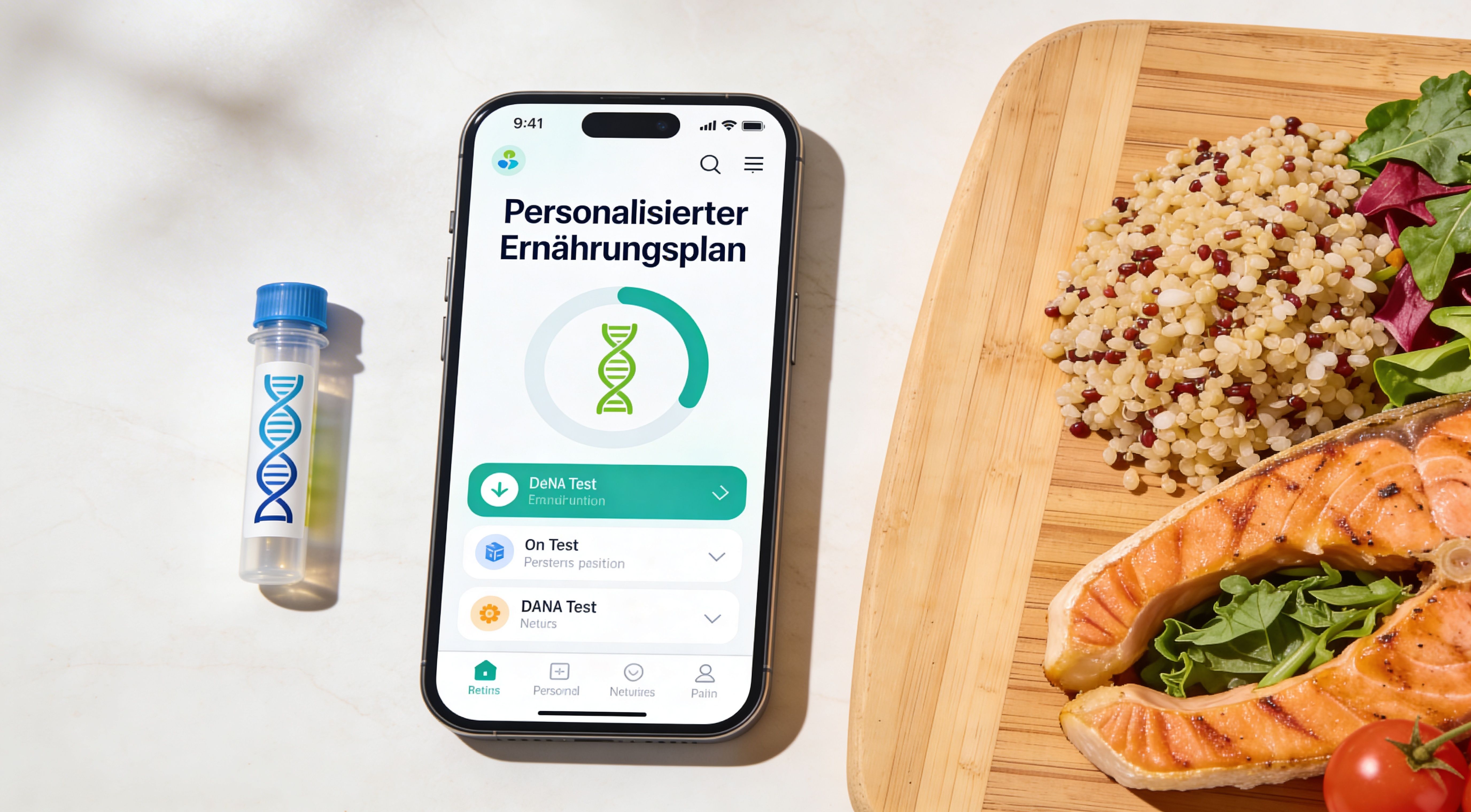
The practical part is usually straightforward. You provide a saliva sample, send it to a laboratory, and receive a report after the analysis.
The sample itself is not what matters. What matters is translating the results into action. Good results only help when they lead to clear decisions.
For example:
| Results section | What this can mean in everyday life |
|---|---|
| Carbohydrate processing | Structure meals more around protein, vegetables, and suitable carbohydrate sources |
| Fat metabolism | Choose fat sources more selectively instead of avoiding fat across the board |
| Caffeine response | Manage the timing and amount of coffee more consciously |
| Vitamin-related factors | Plan your nutrition more deliberately and investigate further if needed |
Why this is more effective than guessing
Many people switch between methods for years. First less fat, then fewer carbohydrates, then intermittent fasting, and then “just eat intuitively” again. The problem is rarely a lack of discipline. The problem is a lack of fit.
A DNA test does not replace comprehensive health diagnostics. However, it can help shorten the process of trial and error.
“When you understand how your body is likely to respond to food, you no longer plan against it, but with it.”
For exactly this purpose, MYBODY Lab GmbH also offers the DNA Nutrition Test. It analyzes genetic markers related to nutrition and metabolism and translates the results into practical recommendations for everyday life. The most important part is what follows, including an individual cookbook and recipe book, so that data becomes concrete meals.
What an analysis report should deliver
A good report shouldn’t just tell you what stands out. It should help you answer questions such as:
- What should I eat in the morning if I don’t tolerate traditional breakfasts well?
- How can I combine carbohydrates so that I stay full longer?
- Which routine fits my workday?
- Where is fine-tuning worthwhile instead of deprivation?
This suddenly makes good nutrition tangible. Not as a rigid system, but as a personal code that you learn to read.
From knowledge to a full plate
Theory is only useful when it ends up on your plate.
Let’s take a person who learns from an analysis that they probably process carbohydrates less favorably than others. That doesn’t mean “no more carbohydrates ever.” It means choosing better, combining more intelligently, and distributing them more consciously.

An example day with an adapted structure
In the morning, the day does not start with a sweet breakfast but with a meal that keeps you going for longer. For example, eggs with vegetables and some plain yogurt, or a protein-focused breakfast with nuts and berries.
At lunchtime, there is no huge portion of pasta followed by an afternoon slump. Instead, there is a plate with fish or legumes, plenty of vegetables, and a moderate portion of a filling side dish.
In the afternoon, the snack is planned rather than spontaneous. More likely a handful of nuts, plain yogurt, or vegetable sticks than something that rapidly raises blood sugar and then causes it to drop again shortly afterward.
In the evening, the meal remains light but wholesome. For example, salmon with salad and quinoa or a vegetable stir-fry with a protein source.
What changes as a result
The biggest difference is often not the number of calories. It is how you feel throughout the day.
Many people notice first:
- Less afternoon cravings
- More peace of mind while eating, because meals keep you fuller
- More consistent energy, instead of highs and lows
- Less overthinking, because not every meal has to be decided from scratch
This makes good nutrition easier in everyday life. Not perfect, but manageable.
Personalization also means considering deficiencies
Another point is often overlooked. Not every “healthy” diet automatically meets all nutritional needs.
According to the Thieme data mentioned, around 30% of people over 50 in Germany suffer from nutrient deficiencies such as vitamin D, B12, or iron despite following a diet they consider healthy (contextualized through the reference to the German Environment Agency).
This is practically relevant. People who eat a plant-focused, low-calorie, or very one-sided diet can do many things right and still have gaps.
Everyday tip: When you adjust your plan, do not focus only on weight or calories. Also monitor your energy, satiety, concentration, and recovery.
Making implementation easier
The best nutrition plan often fails because of very mundane things. No shopping, no plan, too little preparation.
That is why simple routines help:
- Shop with a basic framework. Each week, choose several staple protein sources, vegetable options, and suitable side dishes.
- Preparation instead of perfection. Pre-cooked vegetables, prepared snacks, or a base for two days take the pressure off.
- Make mindful choices when eating out. You can maintain structure even in a restaurant, for example with a protein-rich main component and a suitable side dish.
- Take your working day into account. Anyone who spends a lot of time sitting in the office or eats between meetings benefits from concrete ideas for healthy eating at work.
Personalized nutrition is useful when it does not just sound interesting but actually makes your daily eating easier.
When You Should Take a Closer Look
Not every afternoon slump is a warning sign. But if certain patterns keep recurring, it is worth taking a closer look.
Typical Signs in Everyday Life
You may recognize some of these:
- You are often tired, even though you get enough sleep
- You quickly develop intense cravings or are never full for long after meals
- Your digestion is sensitive
- You still do not feel well after “healthy” meals
- Your weight does not change, even though you are making a major effort
- Your skin, hair, or nails appear changed
- Coffee has an extremely strong effect—or hardly any noticeable effect
These observations do not automatically indicate an illness. However, they show that your current plan may not be ideal for you.
When a Test May Be Useful
A DNA test can be helpful if you keep trying the same dietary approaches and finally want to understand how your body is likely to respond to certain patterns.
A nutrient check may be worthwhile if you suspect that gaps remain despite eating a “healthy” diet. In that case, it may be wise to look more closely at testing for nutrient deficiencies to distinguish between assumptions and measurable information.
When You Need Additional Professional Support
Some situations should not be addressed through self-observation alone.
Have any symptoms assessed by a doctor or qualified healthcare professional if you experience severe exhaustion, significant digestive problems, persistent symptoms, or known medical conditions. Personalized nutrition is helpful, but it does not replace medical diagnosis.
The desire for more precise answers is growing significantly. According to the source cited, inquiries about personalized nutrition have increased by 35% since 2025 (Verival article on the development of personalized nutrition). This reflects what many people notice in everyday life. Standard advice often only gets you so far.
In the end, one simple insight remains. Good nutrition is not just healthy on paper. It has to suit your body, your life, and your goals.
If you no longer want to base your diet on guesswork, but on individual data, you can find scientifically sound at-home self-tests at MYBODY Lab GmbH. A DNA-based nutritional approach is particularly suited to this topic: it not only provides genetic insights, but also derives specific recommendations for your everyday life, including recipe ideas tailored to your profile.



Share now:
Understanding the Opportunities and Limitations of Swiss Health Portals
The 7 Most Popular Types of Diets and Trends in 2026 at a Glance