

Nutrition test for tolerance: Which method answers which question?
The essentials at a glance
A nutrition test for tolerance does not answer one single question; depending on the method, it answers a different one. The hydrogen breath test checks whether lactose is insufficiently broken down in the intestine. A blood test for IgE antibodies provides an indication of an allergy. A DNA test shows a predisposition. None of these methods alone establishes a diagnosis.
This article compares the commonly used methods: what each one measures, how it is carried out, what an abnormal finding indicates, and what it explicitly cannot be used for. It is based on the health information provided by the Institute for Quality and Efficiency in Health Care (IQWiG) and a statement from the German Nutrition Society (DGE). Where the evidence is limited, this is explicitly stated in the text.
Chapter 1 distinguishes between allergies, intolerances, and diseases. Chapter 2 compares the three most important methods in a table. Chapter 3 explains what you can observe before speaking with a doctor and which symptoms require immediate medical assessment. Chapters 4 to 6 describe how an allergy is diagnosed, how lactose intolerance is assessed, and the appropriate order of testing. Chapters 7 to 9 define the limitations.
What to expect in this article
1. What does tolerance mean in the context of nutrition tests?
2. Which method answers which question?
3. What should you observe before speaking with a doctor?
4. How is a food allergy diagnosed?
5. How is lactose intolerance diagnosed?
6. In what order is the assessment carried out?
7. What can at-home tests do—and where do their limits lie?
8. When does a DNA test contribute anything to the question of tolerance?
9. What a tolerance test cannot do
Conclusion
Frequently asked questions
Sources
What does tolerance mean in the context of nutrition tests?
Tolerance is not a uniform term. It encompasses several processes that take place in completely different ways in the body—and that is precisely why they are assessed using different methods. Anyone who skips this distinction will almost inevitably choose the wrong testing method.
Three situations are most important in everyday life: a food allergy, an enzyme deficiency such as lactose intolerance, and a disease such as celiac disease. All three can cause symptoms after eating. Only one of them can be meaningfully narrowed down at all using antibodies in the blood.
Food allergy: a reaction of the immune system
In the case of a food allergy, the immune system reacts to an ingredient in a food. According to IQWiG (2023), the blood test checks “whether the body has produced certain antibodies (usually IgE antibodies) against a food.”
This reaction can occur quickly and be pronounced. That is why evaluation of suspected food allergies belongs in the hands of medical professionals and not in a do-it-yourself kitchen experiment.
Lactose intolerance: an enzyme deficiency, not an antibody reaction
In lactose intolerance, the body lacks lactase, the enzyme that breaks down lactose. IQWiG (2024) describes the most common form as follows: “In some people, the body then no longer produces enough lactase to break down the lactose consumed through food. This is referred to as inherited or primary lactase deficiency.”
According to IQWiG (2024), there is also a secondary form. It can develop when an intestinal disease impairs the production of lactase; conditions mentioned there include coeliac disease and Crohn’s disease.
This is crucial when choosing a test: an enzyme deficiency does not produce antibodies against milk. An antibody test therefore cannot detect lactose intolerance.
Coeliac disease: an illness requiring medical evaluation
Coeliac disease is not a sensitivity but an illness. It even appears in the IQWiG information on lactose intolerance (2024) as a possible cause of secondary lactase deficiency—a sign of how much these conditions can overlap.
Anyone who suspects coeliac disease should seek medical evaluation. A dietary test, regardless of the type, does not replace this evaluation and must not delay it.
Key message: Tolerance is not a single measurable value. A food allergy is an immune-system reaction, primary lactase deficiency is an inherited enzyme deficiency, and coeliac disease is an illness—three different processes with three different diagnostic approaches.
Which procedure answers which question?
Three procedures are mentioned particularly often in connection with tolerance: the hydrogen breath test, the blood test for IgE antibodies, and the DNA test for genetic predisposition. They measure entirely different things and therefore answer different questions.
The following overview compares the three procedures according to the same five criteria. All information comes from the sources listed below; where the material provides no information, this is expressly stated in the cell.
| Criterion | Hydrogen breath test | Blood test for IgE antibodies | DNA test for genetic predisposition |
|---|---|---|---|
| What question does the procedure answer? | Whether lactose is inadequately broken down in the intestine—one of the methods used to diagnose lactose intolerance (IQWiG, 2024). | Whether the body has produced antibodies against a food, usually IgE antibodies (IQWiG, 2023). | Which genetic predispositions are present. A predisposition is not a diagnosis or a current finding. |
| How does it work? | It measures “how much hydrogen the exhaled air contains—both before and after drinking a lactose solution” (IQWiG, 2024). | Blood sample, after which the laboratory “measures the amount of certain antibodies—namely IgE antibodies—in the blood sample” (IQWiG, 2024). | Saliva sample, followed by laboratory analysis of selected genetic variations. Performed once, because genetics do not change. |
| What does an abnormal result indicate? | It supports the suspicion of lactose intolerance. IQWiG (2024) also mentions the lactose tolerance test and the elimination test. | According to IQWiG (2024), an elevated value is only an indication of an allergy, not proof; elevated values also occur without an allergy, for example in people who smoke or have a parasitic infection. | It indicates a predisposition. It does not say whether symptoms will occur or how severe they will be. |
| Who performs it? | IQWiG (2024) lists the breath test as a diagnostic procedure when lactose intolerance is suspected. The source material used does not specify where it is performed. | Blood collection and laboratory analysis; IQWiG (2024) describes blood testing as one of several allergy-testing procedures. | The provider’s laboratory after the saliva sample has been sent in. No medical appointment is needed—and no medical report is provided. |
| What is it expressly not suitable for? | Not for detecting a food allergy. According to IQWiG (2023), this usually requires a provocation test. | Not for determining lactose intolerance. An enzyme deficiency does not produce antibodies against milk. | Not as a diagnostic procedure. IQWiG (2024) expressly does not mention a genetic test for lactose intolerance. |
A fourth procedure is frequently advertised and should therefore be assessed openly: tests for IgG and IgG4 antibodies against foods. According to IQWiG (2023), such tests are “currently not recommended” for diagnosing a food allergy, “as they are not very informative.”
This assessment is deliberately presented here in full and without qualification. It is the reason why this article does not recommend or link to any IgG-based testing service—not even one from its own product range.
The table also shows what all three procedures have in common: None of them provides a definitive diagnosis on its own. They provide pieces of information that need to be interpreted.
What should you observe before your medical consultation?
The most useful preparation costs nothing: structured self-observation. It narrows down the suspicion before any test procedure is selected—and makes the medical consultation much more productive.
IQWiG (2023) puts it this way: “For persistent symptoms, it may also be useful to record them in a food and symptom diary for several days to several weeks.”
Four questions are particularly useful. They can be answered without any prior knowledge and cover exactly the points doctors ask about during consultations.
Which food is suspected?
Note the specific food, not the group. Milk in coffee and cheese are two different observations.
How quickly did the symptoms appear?
Record the time between the meal and the onset—minutes, an hour, or only in the evening.
What exactly were the symptoms?
Describe them as specifically as possible. Abdominal pain, diarrhea, skin reactions, and breathing problems point in different directions.
Did it occur reproducibly?
One-off observations are weak evidence. If the pattern recurs with the same food, it becomes meaningful.
A diary does not replace a testing procedure. But it helps sort out suspicions—and prevents entire food groups from being eliminated because of one unfortunate evening.
Warning signs: These symptoms require immediate medical evaluation
- ✓ Shortness of breath shortly after eating – a warning sign of an allergic reaction that must not be delayed.
- ✓ Swelling in the mouth and throat – also a warning sign of an allergic reaction.
- ✓ Circulatory problems after a meal – require immediate medical evaluation.
- ✓ Skin reactions shortly after eating – hives, redness, or itching occurring in connection with a meal.
- ✓ Persistent diarrhea – requires a visit to the doctor regardless of any test result.
- ✓ Significant weight loss or blood in the stool – two findings for which a self-test is not the right next step.
This list is deliberately brief and direct. Anyone who notices one of these signs should not order a test, but make an appointment with a doctor.
How is a food allergy diagnosed?
A food allergy is not diagnosed through a single laboratory result, but through a series of steps. This process usually ends with a provocation test under medical supervision.
IQWiG (2024) lists the prick test, intradermal test, scratch test, rub test, epicutaneous test—also called a patch test—the blood test, and the provocation test as allergy-testing methods.
Why the blood test for IgE antibodies is only an intermediate step
According to IQWiG (2024), the blood test measures the amount of certain antibodies—namely IgE antibodies—in the blood sample. According to the same source, an elevated level is only an indication of an allergy, not proof of one.
IQWiG (2024) gives specific reasons for this: even without an allergy, there may be more IgE antibodies in the blood, for example in people who smoke or have a parasitic infection. An abnormal result alone therefore does not justify a permanent change in diet.
The provocation test: the definitive proof
The challenge test comes at the end of the process, not at the beginning. IQWiG (2024) states: “A challenge test is only useful once the skin test or blood test has not produced clear results.”
IQWiG describes how this test is carried out and under what conditions in its information on diagnosing and treating food allergies:
“
“To confirm a food allergy, a challenge test is usually necessary, in which small amounts of the suspected food are consumed under medical supervision.”
Institute for Quality and Efficiency in Health Care (IQWiG)
“Food allergy: Diagnosis and treatment,” gesundheitsinformation.de, 2023
The four words “under medical supervision” are the core of this sentence. A challenge test is explicitly not a do-it-yourself experiment at the kitchen table—precisely because it can trigger a reaction that must be treated immediately.
Therefore, anyone who reintroduces a suspected food on their own is not carrying out a challenge test. They are merely taking a risk that would be controlled in a medical setting.
How is lactose intolerance diagnosed?
If lactose intolerance is suspected, IQWiG (2024) names three methods: the hydrogen breath test, the lactose tolerance test, and the elimination test. A genetic test is not on this list.
Hydrogen breath test and lactose tolerance test
According to IQWiG (2024), the breath test measures “how much hydrogen the exhaled air contains—before and after drinking a lactose solution.” The reason is that undigested lactose reaches lower sections of the intestine, where bacteria break it down.
The lactose tolerance test takes a different approach. According to IQWiG (2024), it involves “measuring blood sugar levels before and several times after drinking a lactose solution.”
The elimination test over approximately four weeks
As a third method, IQWiG (2024) describes the elimination test: avoiding lactose-containing products for around four weeks, followed by a challenge test. It does not require laboratory equipment, but it does require discipline and careful documentation.
This approach should also be medically supervised. Avoiding an entire food group for four weeks is a dietary intervention that should not be undertaken casually.
How common is lactose intolerance, anyway?
According to IQWiG (2024), around 5 to 15% of people in Europe cannot tolerate lactose; in Africa or East Asia, by contrast, 65% to more than 90% of adults are affected. According to the same source, lactose intolerance is least common in Northern Europe.
This range explains why genetic makeup plays a role at all when it comes to lactose. However, it does not explain whether lactose is currently causing symptoms in your case.
Key message: IQWiG (2024) names the hydrogen breath test, lactose tolerance test, and elimination test for diagnosing lactose intolerance—but not a genetic test. Genetic analysis can describe a predisposition; it does not establish lactose intolerance.
In what order does the diagnostic process take place?
The sequence is not arbitrary. It follows from what the individual procedures can do: observation narrows things down, medical assessment selects the procedure, the procedure provides findings, and only when the result is unclear does the most complex step follow.
Record symptoms and meals
According to IQWiG (2023), for persistent symptoms it may be useful to record them in a food and symptom diary for several days to several weeks. This is the least expensive and often the most informative step.
Have a doctor clarify which suspected diagnosis is being considered
An allergy, enzyme deficiency, or illness calls for completely different procedures. This decision belongs in a doctor’s office—it determines whether the right test is carried out at all.
Carry out the appropriate procedure
Depending on what is suspected: an elimination diet in which, according to IQWiG (2023), the suspected foods are avoided for 1 to 4 weeks and changes in symptoms are recorded in a food diary—or a hydrogen breath test or blood test.
If the result is unclear: challenge test under medical supervision
According to IQWiG (2024), a challenge test is only useful once a skin test or blood test has produced no clear results. It takes place under medical supervision, never independently.
Anyone who reverses this sequence and starts with a purchased test ends up with numbers without context. Going through observation and medical assessment is slower, but more often leads to a reliable answer.
What do at-home tests do—and where do their limits lie?
At-home tests have a real benefit: They lower the barrier to engaging with the topic in the first place and provide structured information. What they do not provide is a medical assessment of the overall picture.
What matters, therefore, is less whether a test is good and more whether it is clearly stated what question it answers. A provider who says this openly is more reliable than one who presents tolerance as a uniform measurement.
How to recognize a credible interpretation
- ✓ The question being addressed is named – the provider explains what is measured and what follows from it, instead of speaking generally about tolerance.
- ✓ Diagnosis and indication are distinguished – a test result is not presented as a finding or proof of illness.
- ✓ The limitations are stated clearly – not in the fine print, but where the offer is described.
- ✓ Warning signs are taken seriously – shortness of breath, swelling, or circulatory problems after eating are identified as reasons to see a doctor.
- ✓ Laboratory and data protection are transparent – the analysis location, certification, and handling of the data can be reviewed.
- ✓ No dietary changes based on suspicion – the provider does not recommend permanently eliminating entire food groups based solely on a test result.
This article provides context on the topic of tolerability: it categorizes the different methods. If you want to know how a nutrition test is generally structured and what it says about your diet, the overview article Nutrition test: What it measures and what it tells you is the right place to start. If you are specifically interested in the genetic aspect, it leads DNA nutrition test: what the analysis shows and what it does not provides more detail on the evaluation of genetic data.
In brief
At-home tests can help structure a suspicion, but they cannot provide a diagnosis. The most important quality criterion is therefore not the number of parameters tested, but clarity about which question a test answers. Where this clarity is lacking, dietary changes are made based on suspicion—with the risk that entire food groups will be eliminated without reason.
When does a DNA test contribute anything to the question of tolerability?
In this context, a DNA test answers exactly one question: which genetic predispositions are present. It does not answer whether you currently have an intolerance. This distinction is essential for using such a test meaningfully in the first place.
Regarding the evidence for personalized nutrition services as a whole, the German Nutrition Society (DGE) stated in its 2022 announcement “Rethinking Personalized Nutrition”: “Although scientific studies do indicate moderate effects from increased motivation, analyses aimed at personalization, such as genetic and blood analyses or microbiome data, generally showed no statistically demonstrable improvements in eating behavior.”
This distinction belongs here. A DNA test provides information; it does not promise effectiveness—and it does not replace a hydrogen breath test, a provocation test, or a consultation with a doctor.
mybody® (MYBODY Lab GmbH) offers DNA metabolism tests, which are evaluated in Germany in a certified laboratory. Regarding food intolerance, only one chapter of the report can be demonstrably considered relevant—and that is precisely what appears in the following product card.
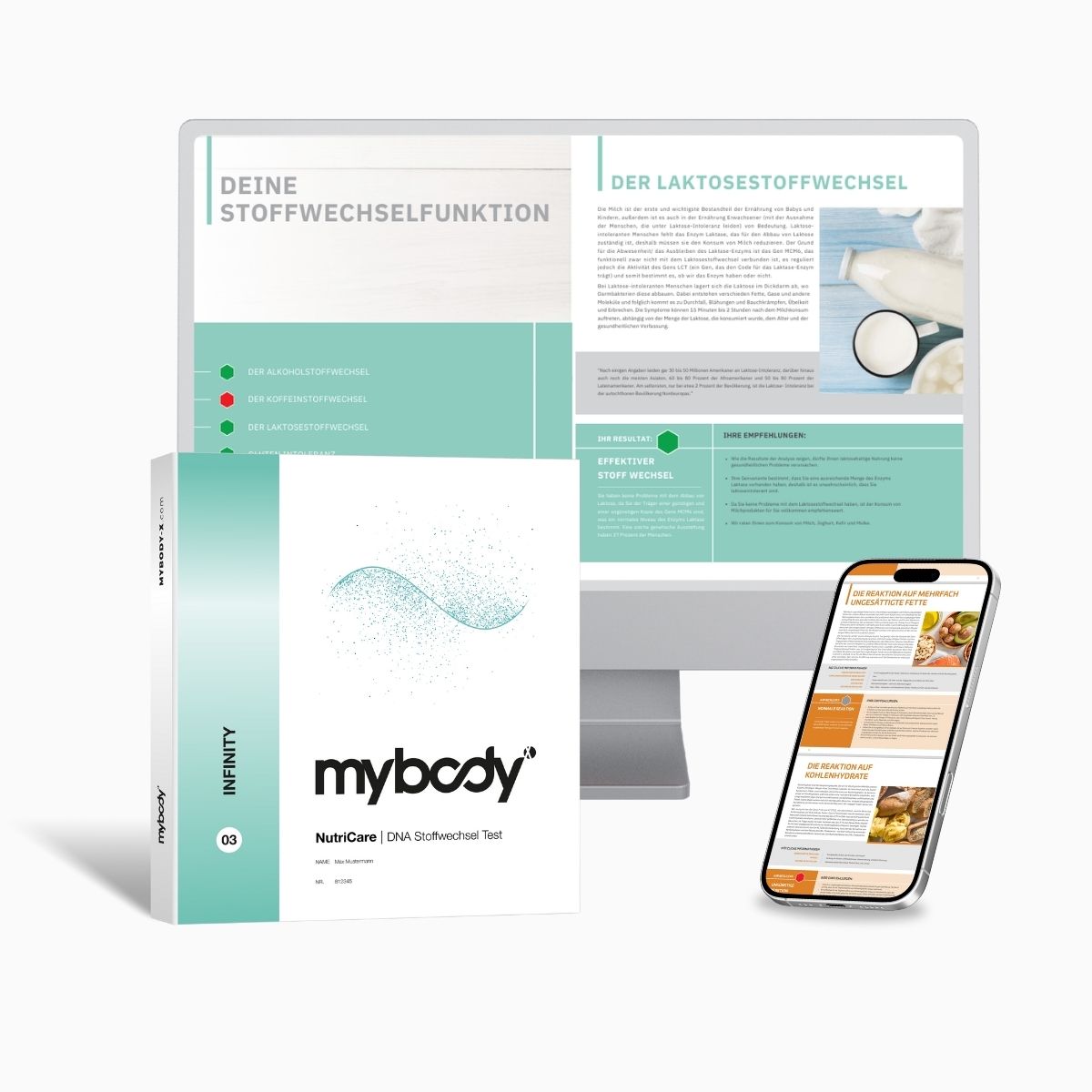
NutriCare | INFINITY DNA test
The NutriCare | INFINITY analyzes more than 140 genetic variants and provides 54 analysis reports in 8 chapters across approximately 200 pages. Regarding tolerance, only the “mybody® Metabolic Type” chapter is demonstrably relevant, with the four reports on alcohol metabolism, caffeine metabolism, lactose metabolism, and gluten intolerance. This test contains no report for any other tolerance-related topic. These four reports, too, describe a genetic predisposition, not a diagnosis: According to IQWiG (2024), lactose intolerance is determined using a hydrogen breath test, lactose tolerance test, or elimination test—not a genetic test.
Price: €269.00 · Sample type: saliva sample · Processing time: approx. 20–25 business days after receipt by the laboratory · Laboratory: ISO 27001-certified laboratory analysis
For NutriCare | INFINITYAll price and service details are as of August 3, 2026. Prices and processing times may change; the relevant product page always governs.
Whether such a test contributes anything in your situation depends mainly on which question you actually want answered. The following comparison makes this explicit—in both directions.
Useful for you if …
… you are interested in your genetic predispositions and understand a test result as information, not a medical finding.
… you have no acute symptoms and want to supplement, rather than replace, medical evaluation.
… you are specifically interested in the four reports in the “mybody® Metabolic Type” chapter: alcohol, caffeine, and lactose metabolism, as well as gluten intolerance.
… you are prepared to wait approximately 20–25 business days for the results because nothing about it is urgent.
Probably not, if …
… you need a diagnosis. A DNA test does not provide one—it describes predispositions.
… you suspect lactose intolerance. For this, IQWiG (2024) lists the hydrogen breath test, the lactose tolerance test, and the elimination test.
… you suspect a food allergy. According to IQWiG (2023), confirming one usually requires a food challenge test under medical supervision and belongs in a doctor’s office.
… you have had acute or severe reactions after eating. These require immediate medical evaluation and should not be placed in a waiting queue of several weeks.
What an intolerance test cannot do
The most honest part of this topic is listing what remains unanswered. No method in this article alone provides a definitive answer to why you feel unwell after eating.
According to IQWiG (2024), a blood test for IgE antibodies is an indication, not proof. The hydrogen breath test relates to lactose and says nothing about other foods. And a DNA test describes a predisposition that remains the same throughout life, while symptoms come and go.
A test can clarify a suspicion—but the final diagnosis is made by a doctor.
A test can clarify a suspicion—but the final diagnosis is made by a doctor. That is precisely why the sequence from Chapter 6 is more important than the choice of provider.
There is also a practical risk: anyone who permanently avoids entire food groups because of an uninterpreted test result changes their nutrient intake. The general recommendations remain unaffected—the DGE guideline value (as of 2021) for fiber is at least 30 grams per day for adults, and the estimated value for protein is 0.8 grams per kilogram of body weight per day for adults aged 19 to 65 (DGE, as of 2025).
And finally: No test predicts weight-loss success. Anyone hoping for a change in weight from a tolerance test is looking for the answer in the wrong place.
Conclusion
A nutrition test for tolerance is only as good as the question it is intended to answer. Anyone who clearly distinguishes between allergy, enzyme deficiency, and disease can arrive at a clearer answer with fewer tests than someone who has as many parameters as possible measured.
The practical approach is unspectacular: first keep a food and symptom diary for several days to several weeks (IQWiG, 2023), then have a doctor clarify which diagnosis is suspected, then undergo the appropriate procedure—and, if the result is unclear, take a challenge test under medical supervision.
Two points remain non-negotiable. According to IQWiG (2023), tests for IgG and IgG4 antibodies are currently not recommended because they are not very informative. And according to IQWiG (2024), lactose intolerance is not diagnosed using a genetic test.
A DNA test can be a supplement in this context—as information about predispositions, not as a substitute for diagnosis. If warning signs such as shortness of breath, swelling in the mouth and throat, or circulatory problems occur after eating, the only correct next step is to see a doctor.
Frequently asked questions
Which nutrition test really clarifies an intolerance?
It depends on which intolerance is suspected. If lactose intolerance is suspected, IQWiG (2024) names the hydrogen breath test, the lactose tolerance test, and the elimination test. If a food allergy is suspected, according to IQWiG (2023), a challenge test under medical supervision is usually necessary. There is no test that measures tolerance in general.
When should symptoms after eating be evaluated by a doctor immediately?
Shortness of breath, swelling in the mouth and throat, circulatory problems, or skin reactions shortly after eating are warning signs of an allergic reaction and require immediate medical evaluation. Persistent diarrhea, significant weight loss, and blood in the stool should also be evaluated by a doctor. In these cases, a self-test is not the right next step.
Can a DNA test detect lactose intolerance?
No. To diagnose lactose intolerance, IQWiG (2024) lists the hydrogen breath test, the lactose tolerance test, and the elimination diet—but not a genetic test. A genetic analysis can describe a predisposition. It cannot show whether too little lactase is currently being produced and causing symptoms.
Are IgG or IgG4 food tests useful?
Regarding tests for IgG and IgG4 antibodies, IQWiG (2023) states that such tests are “currently not recommended” because “they are not very informative.” This assessment is deliberately reproduced here unchanged. It is also why this article does not recommend any IgG-based testing service.
How is a challenge test performed?
According to IQWiG (2023), this involves consuming small amounts of the suspected food under medical supervision. According to IQWiG (2024), it is only useful once a skin test or blood test has not produced clear results. A challenge test is explicitly not a self-test to be performed at home, as it can trigger a reaction that requires immediate treatment.
Your genetic predispositions as a supplement—not a substitute
If medical evaluation is ongoing or complete and you are also interested in your genetic predispositions, here is an overview of mybody®'s DNA metabolism tests. They do not replace diagnostic testing and do not provide a diagnosis.
View NutriCare | INFINITY All DNA metabolism testsYou might also be interested in
→ What does a DNA metabolism test do?
What a genetic analysis can reveal—and where its significance ends.
→ The Difference Between DNA and Genes
The fundamentals without which no genetic report can be read meaningfully.
→ Online Nutrition Tests: What Characterizes Reputable Services
How to identify online nutrition tests that openly acknowledge their limitations.
Sources
- IQWiG / gesundheitsinformation.de: Food allergy – diagnosis and treatment (2023) — gesundheitsinformation.de
- IQWiG / gesundheitsinformation.de: What allergy tests are available? (2024) — gesundheitsinformation.de
- IQWiG / gesundheitsinformation.de: Causes and diagnosis of lactose intolerance (2024) — gesundheitsinformation.de
- IQWiG / gesundheitsinformation.de: Lactose intolerance (milk sugar intolerance) (2024) — gesundheitsinformation.de
- German Nutrition Society (DGE): Article “Rethinking Personalized Nutrition” (2022) — dge.de
- German Nutrition Society (DGE): Reference values for fiber (2021) and protein (2025) — dge.de
The statements on food challenge tests, elimination diets, nutrition and symptom diaries, and the assessment of IgG and IgG4 tests are based on [1]. Information on allergy testing procedures and blood tests for IgE antibodies comes from [2]. The procedures for diagnosing lactose intolerance and the description of primary and secondary lactase deficiency come from [3], while prevalence figures come from [4]. The assessment of the evidence for personalized nutrition comes from [5], and the reference values for fiber and protein come from [6]. Product information comes from the mybody® product pages, accessed on August 3, 2026. All other sources mentioned in the text are identified directly at the relevant point by institution and year.

mybody® Editorial & Expert Team
Food intolerance Food allergy Laboratory diagnostics Nutritional science
This article was created and medically reviewed by the mybody® Editorial and Expert Team. The team brings together expertise in nutrigenetics, microbiome and gut science, blood test interpretation, nutritional science, and laboratory diagnostics.
Published on August 3, 2026 · Last updated on August 3, 2026
Medical notice: This article is for general information only and does not replace medical advice, diagnosis, or treatment. If a food allergy, lactose intolerance, or celiac disease is suspected, clarification should be handled by a physician. A food challenge test is carried out exclusively under medical supervision. In the event of shortness of breath, swelling in the mouth or throat, or circulatory problems after eating, immediate medical attention is required.




Share now:
Foods that boost metabolism: 8 effective boosters
Calculate a calorie deficit correctly for weight loss: where the limits are