

Discover the DNA test: Your personal key to health, nutrition & fitness
A DNA test is a scientific analysis of your personal genetic information. Think of it as a personalized user manual for your body. With a simple saliva sample, you can find out how your genes influence your metabolism, your response to certain nutrients, and even your athletic predispositions. These insights are incredibly valuable if you want to take a targeted approach to improving your health, nutrition, and performance.
What a DNA test really reveals about you
Have you ever wondered why some people seem to lose weight effortlessly while you have to struggle with every pound? Or why your training partner builds muscle much faster with the same workout? The answer often lies not only in discipline, but is deeply rooted in our genetic makeup. A DNA test is like a look behind the scenes of your body—it deciphers the unique instructions that have been dormant within you since birth.
Imagine receiving a personal roadmap for your health. Instead of feeling your way through a fog of general advice that is supposed to apply to everyone but often truly works for no one, you receive clear, scientifically grounded guidance. This guidance is based not on guesswork, but on an analysis of your individual genetic markers.
Your personal blueprint for nutrition and fitness
Each of us is unique, and this is especially true of our metabolism. For example, a DNA test can show you how your body responds to the three major macronutrients—carbohydrates, fats, and proteins. This is a fundamental insight because it explains why a low-carb diet can work wonders for one person, while another may not make any progress with it at all.
Your genes provide insights into many areas that are highly relevant to your everyday life:
- Metabolic type: Are you naturally better at processing carbohydrates, or do you handle fats better? This information alone can help you plan your meals to optimally support your energy balance and avoid cravings.
- Individual nutrient needs: Could you have a genetic predisposition to a higher need for certain vitamins or minerals, such as vitamin D, B vitamins, or iron? With this knowledge, you can take targeted steps to prevent a deficiency.
- Intolerances and sensitivities: Your genetic profile may provide clues about a predisposition to lactose intolerance or increased sensitivity to gluten or caffeine.
- Sports potential: Are you more suited to long-distance endurance runs, or do you benefit more from short, intense strength workouts? Your muscle fiber composition and ability to recover are influenced in part by your genes.
A DNA test is not a verdict on your destiny set in stone. Instead, see it as a powerful tool for self-empowerment. It reveals your genetic cards so that you can play the game of your life more consciously and strategically.
From theory to practical application
Simply knowing about your genetic predispositions is of no use if you do not put that knowledge into practice. And this is exactly where the greatest value of a high-quality DNA test lies: It provides not only raw data but also clear, actionable recommendations. For example, you learn exactly which foods you should include in your diet more often and which you might be better off avoiding.
For example, if you have been trying to lose weight for years, a DNA test might reveal that your body stores fat particularly efficiently. With this insight, you can adjust your diet accordingly and focus on high-quality proteins and complex carbohydrates instead of blindly following a high-fat diet that simply does not work for you. Want to dive deeper into the fascinating world of genetics? In our article, we explain what genes are and how they work.
Ultimately, the goal is to stop viewing your body as an opponent you have to fight. It becomes your partner. By understanding how it works, you stop working against your own nature. Instead, you begin to live in harmony with it—for greater well-being, more energy, and better long-term health.
Which DNA test is really right for you?
The world of DNA tests is vast and may seem somewhat confusing at first glance. But don’t worry: Not every test is the same, and not every test answers the questions that currently matter most to you.
To shed some light on this, you should first clarify your personal goals. What exactly do you want to achieve with the insights from your genetics? A DNA test is not a “one-size-fits-all” product. It is a specialized tool that can provide very different insights depending on its focus. Choosing the right one is therefore the first and most important step.
Understanding metabolism and nutrition
Have you ever wondered why you often feel tired and drained after what was actually a healthy meal? Or why your body holds on to certain pockets of fat, no matter how hard you try? A DNA metabolism test is designed to solve exactly these kinds of mysteries. It analyzes how your genes influence the way your body processes macronutrients—carbohydrates, fats, and proteins.
Such a test can tell you, for example:
- What type of metabolism you have: Does your body respond better to a low-carbohydrate or rather a low-fat diet? This insight alone can turn your entire nutrition strategy upside down.
- Your individual nutrient requirements: You may have a genetic predisposition that results in an increased need for certain vitamins, such as vitamin D or B12. With this knowledge, you can specifically prevent deficiency symptoms.
- Sensitivities and intolerances: Your genes may also provide clues about a predisposition to lactose intolerance or increased sensitivity to caffeine or gluten.
So if your main goal is finally to optimize your diet, lose weight sustainably, or simply have more energy in everyday life, a metabolism-focused DNA test is exactly right for you.
This infographic helps you make a decision by showing how your predisposition and lifestyle lead to a personalized result.
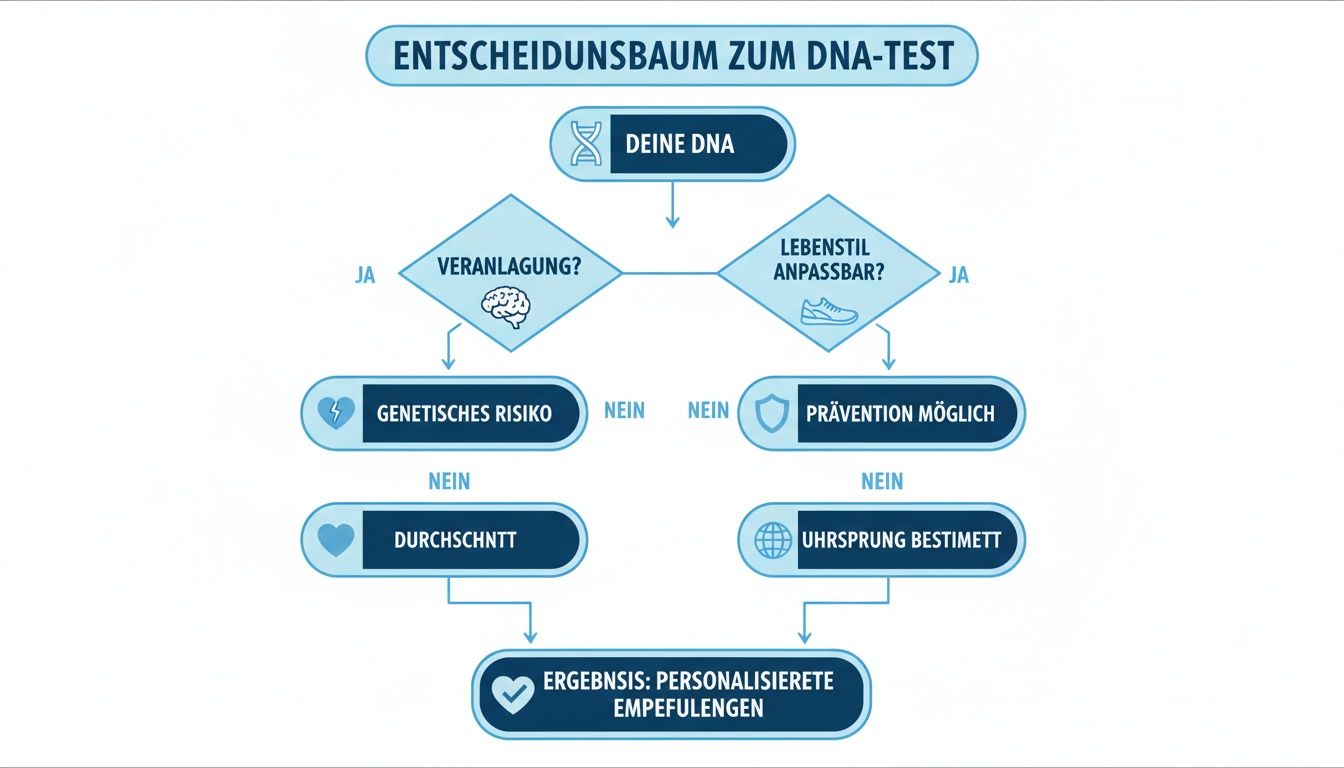
The decision tree makes it clear: Only the combination of your genetic predisposition and your individual lifestyle provides the basis for truly tailored health recommendations.
Improve athletic performance and recovery
Are you physically active but feel like you have reached a plateau? Are you wondering which type of training will really help you progress—endurance sports or short, intense strength workouts? This is where specialized performance tests come in.
These DNA tests focus on genetic markers that are crucial for your athletic performance. This gives you insights into:
- Your muscle fiber type: Are you genetically more of an endurance athlete or rather a born sprinter?
- Your recovery ability: How quickly does your body really recover after intense exertion?
- Your injury risk: Are you more susceptible to certain sports injuries, for example to tendons or ligaments?
With these insights, you can tailor your training plan to your genetic strengths, optimize your recovery, and proactively prevent injuries. If you are still unsure which test is right for your needs, our DNA Test Finder can help.
The most common DNA tests at a glance
To make your choice easier, I have summarized the most important types of tests in a table. This lets you see at a glance which test best matches your goals.
Overview of DNA test types
| Test type | Main focus | Ideal for you if... | Example insight |
|---|---|---|---|
| Health & Nutrition | Metabolism, nutrient requirements, intolerances | ...you want to optimize your diet, lose weight, or have more energy. | You metabolize carbohydrates poorly and should follow a low-carb diet. |
| Sports & Performance | Muscle fiber type, recovery, injury risk | ...you want to improve your athletic performance and adapt your training. | Your genetic muscle fiber type is predisposed to strength and sprint sports. |
| Pharmacogenetics | Response to medications | ...you or your doctor want to understand how you respond to certain active ingredients. | A particular painkiller is broken down extremely slowly in your body, which affects the dosage. |
| Ancestry | Ethnic origin, ancestors | ...you are curious about your roots and family history. | Your ancestors are 40% Scandinavian and 30% Mediterranean. |
This overview shows that there is a suitable genetic analysis for almost every question. The important thing is to choose the test that truly provides actionable insights.
Other specialized DNA analyses
In addition to the classic areas of nutrition and sports, there are other fascinating fields that could be of interest to you.
Pharmacogenetics Pharmacogenetics is a particularly fascinating field. It examines how your body responds to certain medications based on your genes. Such a test can show whether a drug is metabolized especially well, slowly, or perhaps not at all in your body. In consultation with a doctor, this can help find the right dosage and minimize side effects.
Ancestry analyses Do you want to learn more about your roots and find out which regions of the world your ancestors came from? Then an ancestry test is right for you. These tests compare your DNA with vast reference databases to create a picture of your origins. However, they are primarily intended for genealogical research and do not focus directly on health.
Your goal determines the way. Before deciding on a DNA test, take a moment to ask yourself: “What specific question about my body do I want to answer?” The answer will lead you directly to the right test.
Ultimately, choosing the right DNA test depends entirely on your individual goals. By selecting the test that best meets your needs, you can ensure that you gain truly valuable, actionable insights for your life.
How a DNA test for home use works so easily
A genetic test may sound like a highly complex process that takes place only in specialized clinics. But today, the reality is quite different. A DNA test for home use is surprisingly simple and designed so that you can carry it out conveniently and safely in your own home.
Join us on your sample's journey—from the moment you place your order to the analysis in the laboratory. You'll see that you don't need to be a scientist to benefit from the valuable insights in your genetics. It all starts with a few clicks online.
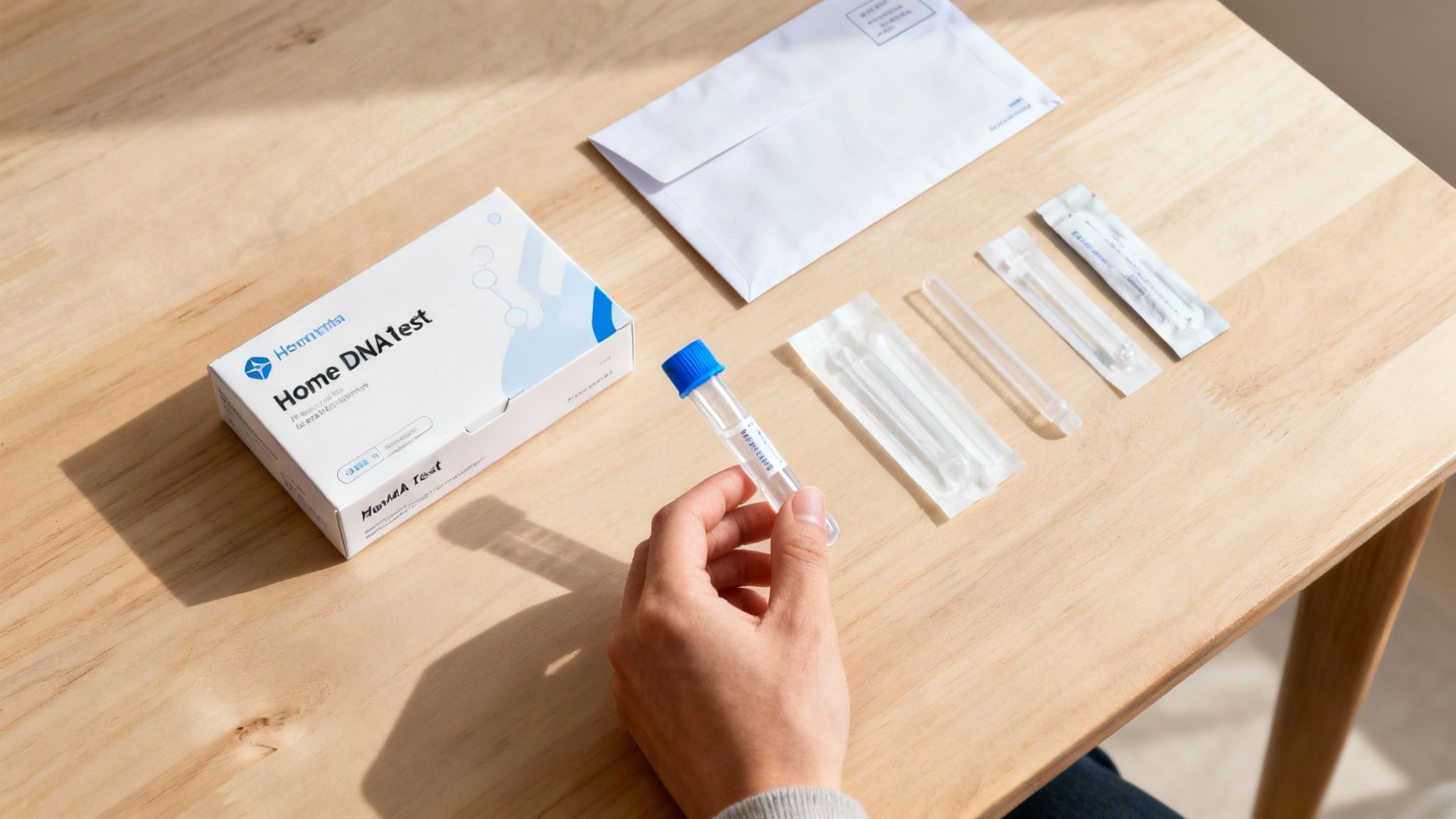
From ordering to sample collection
The first step couldn't be easier: You order your test kit online. A few days later, you'll be holding a small package containing everything you need to collect your sample.
The kit typically includes:
- A sample tube containing a special liquid that stabilizes your DNA.
- A cotton swab or funnel for collecting saliva.
- Detailed, easy-to-understand instructions.
- A prepaid return envelope for shipping to the laboratory.
The collection itself is completely painless and takes just a few minutes. You simply provide a small amount of your saliva in the designated tube. There is only one important thing to remember: do not eat or drink anything for 30 minutes beforehand to avoid contaminating the sample. You can also find detailed instructions in our guide on how a saliva test works in detail.
Once the sample is in the tube, you activate your kit online using a unique code. This step is crucial for data protection. From this moment on, your sample is pseudonymized, meaning that the laboratory works only with this code—your name and personal data are kept separate from the sample.
What happens to your DNA in the laboratory
After you send your test kit back, the real scientific work begins in a certified laboratory. There, your DNA is isolated from the cells in your saliva. Think of it as carefully picking out a single thread from a giant ball of yarn.
Modern technologies, such as so-called genotyping, then scan your DNA at hundreds of thousands of predetermined points. These points are genetic markers (SNPs) that science knows are associated with certain physical characteristics or metabolic processes.
You can recognize a reputable provider by laboratory standards such as ISO certification. This quality seal guarantees that the analysis processes are standardized, precise, and conducted at the highest scientific level. It is your proof that the results are reliable.
The technology behind these analyses is constantly evolving. The goal is to provide you with specific, personalized recommendations for your diet or lifestyle.
Your results report: clearly presented
The raw genetic data would be almost impossible for you to decipher. That is why the final—but crucial—step is translating this complex information into a clear and, above all, actionable report.
The data collected is processed by algorithms that compare it with scientific databases. The result is a detailed yet easy-to-understand report that shows you exactly what your genes reveal about you. For example, what type of metabolism you have, whether you are predisposed to certain nutrient deficiencies, or how you can optimize your training.
This entire process, from collecting the sample to receiving the finished report, usually takes between four and six weeks. In the end, you hold a personalized guide to your body, based on sound scientific facts—and the journey there was easier than expected.
Quality and data protection in DNA tests
Your genetic data is probably the most personal information there is about you. It is your body's unique blueprint. That is precisely why quality, security, and comprehensive data protection are not nice extras but the absolute foundation when you are considering a DNA test.
Choosing the right provider is absolutely crucial here. After all, you are entrusting it with extremely sensitive information.
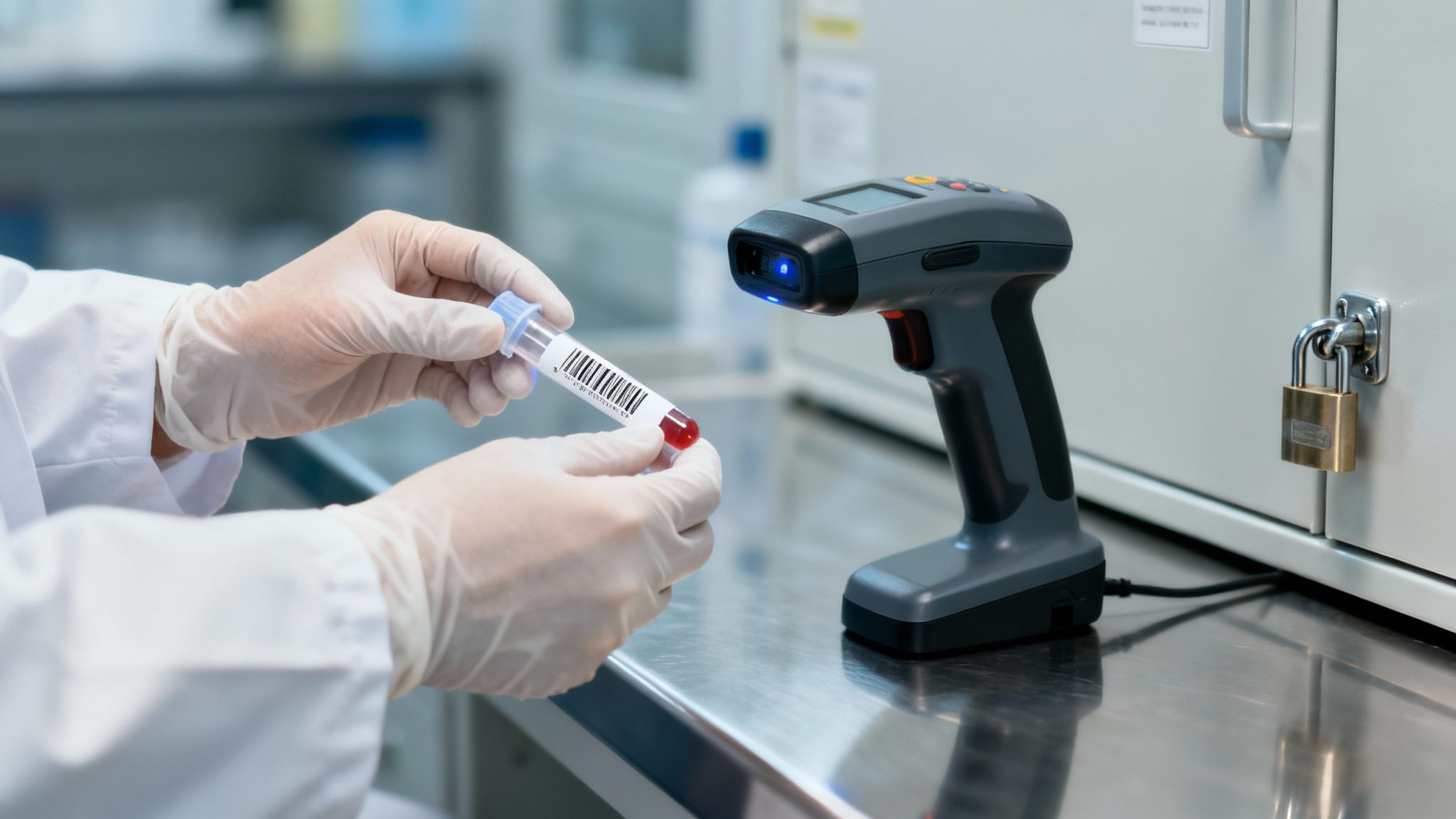
Fortunately, you are not entirely at the mercy of the provider. There are clear quality indicators that can help you distinguish a reputable provider from a less trustworthy one. With the right knowledge, you can make a safe and well-informed decision for your health.
How to recognize a high-quality laboratory
The accuracy of your results depends entirely on the quality of the laboratory analyzing your sample. A polished website says absolutely nothing about the scientific rigor behind it. So pay close attention to objective quality seals.
The most important indicator is ISO certification, for example according to ISO 15189 or ISO 17025. These international standards impose stringent requirements on the competence, impartiality, and operation of medical laboratories. Such a certificate guarantees that the analysis processes are standardized, regularly reviewed, and achieve high analytical accuracy, often exceeding 99%.
An ISO-certified laboratory is not a marketing gimmick, but tangible evidence of scientific excellence. It means that every single step—from receiving the sample to evaluating the data—is carried out according to the highest standards, so you can truly rely on the results.
Another clear sign is transparency. A reputable provider does not hide its laboratory partners or their qualifications. If a website provides no clear information about laboratory standards, you should definitely be skeptical.
Privacy first: your right to informational self-determination
Your DNA data is not just personal—it is also unique and immutable. Responsible handling is therefore absolutely essential. Here are the most important points you should check before entrusting a provider with your sample.
Pseudonymization as the gold standard One of the most important methods of protecting your identity is pseudonymization. It sounds technical, but it is very simple: As soon as you register your test kit online with a unique code, your sample is separated from your personal data, such as your name and address.
From that point on, the laboratory works only with this anonymous code. This ensures that even the scientists analyzing your DNA do not know whom the sample belongs to. Your identity remains protected.
Destruction of the sample after analysis What actually happens to your saliva sample once the analysis is complete? A crucial quality criterion is the guaranteed and secure destruction of your biological sample. Providers that want to store your sample indefinitely may have other interests—for example, using it for future, vaguely defined research purposes.
GDPR compliance Especially in Europe, the General Data Protection Regulation (GDPR) provides comprehensive protection. Make sure the provider is based in the EU or in a country with comparable data protection laws, such as Switzerland, and explicitly commits to complying with the GDPR.
Among other things, this gives you the following rights:
- Right of access: You can find out at any time what data is stored about you.
- Right to erasure: You have the right to request the deletion of your data and your account.
- No data sales: Your data must never be sold to third parties, such as pharmaceutical companies or insurers, without your express and informed consent.
Your checklist for a secure DNA test
Before you decide, quickly run through these points. A reputable provider will be able to answer each question transparently and directly.
- Laboratory quality: Is the partner laboratory certified according to international standards such as ISO 15189 or ISO 17025?
- GDPR-compliant data protection: Does the provider operate in compliance with the GDPR, and is this clearly communicated in the privacy policy? You can also find out more in our article about data protection for genetic tests in Switzerland.
- Pseudonymization: Is your sample pseudonymized immediately after registration so that the laboratory cannot determine your identity?
- Data usage: Does the provider clearly and understandably explain what your data is used for? Will you be asked for explicit consent if it is to be used for research?
- Sample destruction: Is your biological sample securely and verifiably destroyed after analysis?
- Secure data transmission: Are your data and results transmitted over an encrypted connection (HTTPS)?
Given the storage of sensitive DNA data in the cloud, a comprehensive data protection system, such as Cloud security posture management, is crucial for meeting the highest standards of data protection and compliance. By checking these criteria, you can ensure that your journey toward personalized health is not only insightful but also completely secure.
How to translate your results into everyday life
The moment has arrived: You open your results report and see, in black and white, what your genes reveal about you. Absolutely fascinating! But what comes next? How can this scientific data lead to concrete, positive changes in your life? That’s exactly where we come in. We won’t leave you alone with the information—we’ll give you a practical guide to help you put it into action.
This section is your bridge from theory to practice. Using real-world examples, I’ll show you how to immediately put insights about your metabolism, nutrient needs, or athletic potential into practice to deliberately improve your well-being.

From results to nutrition plan
Let’s imagine your DNA test revealed that you are a “protein type.” In plain terms, this means your body can use protein particularly well for energy, while with a lot of carbohydrates, it tends to store them as fat.
That alone is a real game-changer. Instead of continuing to torture yourself with low-fat diets that never really worked for you anyway, you can now completely realign your focus.
Your specific next steps could look like this:
- Change up breakfast: Replace bread with jam with scrambled eggs and vegetables or protein-rich quark with berries. This will keep you full much longer and give you steady energy throughout the morning.
- Optimize lunch: Your main meal should always contain a high-quality source of protein. How about grilled chicken, lentils, or tofu with a huge salad?
- Snack smarter: When cravings hit, don’t reach for cookies; choose a handful of nuts, Greek yogurt, or a protein shake instead.
You don’t have to turn your entire life upside down overnight. Simply start with one meal a day and notice for yourself how your energy levels and sense of satiety change.
Meeting your individual nutrient needs
Suppose your report shows a genetic predisposition to an increased need for vitamin D and magnesium. This is extremely valuable information for your long-term health, as both nutrients are involved in hundreds of bodily functions—from bone health to stress resilience.
What does this mean for your shopping list? It’s simple: You can now deliberately include foods that are rich in precisely these micronutrients.
Vitamin D example Since vitamin D is found in significant amounts in only a few foods (e.g., fatty fish), this is a clear indication that you should pay particular attention to getting enough sunlight. During the darker months, you could consider targeted supplementation in consultation with a doctor or therapist.
Magnesium example Here, you can achieve a great deal through your diet:
- Green leafy vegetables: Spinach and Swiss chard are true magnesium powerhouses.
- Nuts and seeds: Pumpkin seeds, almonds, and cashews are perfect snacks between meals.
- Whole grains: Choose oats, quinoa, or genuine whole-grain bread.
Your DNA results are not rigid rules, but your own personal guides. They point you in the right direction, but you remain the captain of your ship. Use them to act more consciously and make better-informed decisions.
Adapting your training to your genetics
Imagine finding out that your muscle fiber type is genetically more geared toward strength and speed than extreme endurance. At the same time, your report shows a tendency toward slower recovery.
Perhaps you’ve spent years forcing yourself through long jogging sessions and felt frustrated because you made hardly any progress and constantly had sore muscles. Now you know why.
Here’s what your optimized training plan could look like:
- Focus on strength training: Incorporate two to three weight-training sessions per week. You will probably see significantly faster progress in building muscle.
- Short and intense: Replace long runs with shorter interval training sessions (HIIT). This suits your genetic profile much better and really boosts your metabolism.
- Prioritize recovery: Consciously schedule rest days. Since your recovery is genetically somewhat slower, these days are crucial to your success and help prevent injuries. Make sure you get enough sleep and actively support recovery with stretching exercises or a foam roller.
The insights from your DNA test help you invest your time and energy precisely where they will have the greatest benefit. It’s not about working harder, but smarter—in harmony with your own biology. That’s exactly what makes a DNA test from mybody-x such a powerful tool on your health journey. You stop guessing and start taking targeted action.
Frequently asked questions about DNA tests
You’ve already read a lot about the world of DNA tests and their possibilities. Even so, a few very specific questions often remain—questions you may still be thinking about. Here, we’ve collected the most frequently asked ones and provide clear, easy-to-understand answers so that you can feel completely confident in your decision.
How accurate is an at-home DNA test?
That is one of the most important questions of all, of course. Trustworthy providers work exclusively with laboratories certified according to strict international standards such as ISO. There, an analytical accuracy of over 99% is achieved when analyzing your DNA. You can therefore rely completely on your raw data being read correctly.
What matters, however, is what the result ultimately means. A DNA test shows you your genetic predispositions—that is, tendencies and potentials within you. It is not a diagnosis or a fate set in stone. Your lifestyle, diet, and environment remain incredibly powerful tools that you yourself control.
Can a DNA test predict diseases?
Tests that focus on nutrition, fitness, or general well-being are not medical diagnostic procedures. Their purpose is to give you insights into your metabolism or nutrient utilization, not to detect diseases.
Lifestyle genetic tests like those from mybody-x are tools for prevention and optimization. When it comes to diagnosing or predicting diseases, you should always consult a doctor or a specialist in human genetics.
They may indicate predispositions that play a role in certain aspects of health, but they can never replace a medical examination or professional advice.
Is my genetic data sold?
Your genetic data is among the most sensitive information about you. Protecting it must be the top priority. A reputable provider will never sell your data without your explicit and informed consent or share it with third parties. It is that simple.
Be sure to look for a transparent privacy policy that complies with the strict requirements of the GDPR. These are good signs of trustworthy handling:
- Pseudonymization: In the laboratory, your sample is given only a code, not a name. This way, no one knows it is yours.
- Data deletion: You have the right to request the deletion of your data and account at any time.
- Sample destruction: After analysis, your biological sample is safely and completely destroyed.
How long does the entire process take?
You will need a little patience, because precise science takes time. From the moment you drop your saliva sample in the mailbox until you can access your completed results online, it usually takes between four and six weeks.
This period is necessary to guarantee safe transport to the laboratory, careful DNA extraction and analysis, and scientifically sound evaluation of your completely personalized results.
Are you ready to unlock the secrets of your body and take your health to a new, personalized level? Discover the DNA test at mybody-x that is tailored to your goals, and begin your journey toward a better understanding of yourself. Find out more now at https://mybody-x.com.



Share now:
Lose Weight with a Genetic Test: Your Genetic Blueprint as the Key to Success
What is weight management? Paths to better health