

Data privacy in genetic testing – protecting your DNA
Every step toward gaining more knowledge about your own health can feel like a balancing act between curiosity and responsibility. Genetic tests can help you identify genetic risks early and make informed decisions. However, the lasting and far-reaching implications of your DNA make particularly strict safeguards and clear data-processing practices necessary. Here, you will learn how genetic tests work and what you really need to know about data privacy and the legal framework in Europe.
Table of contents
- What genetic tests are and how they work
- Genetic Data: Types and Special Features
- Legal foundations for data protection in genetic testing
- How providers ensure data security
- Risks, Rights, and Protection Options for Customers
Key insights
| Point | Details |
|---|---|
| Genetic tests enable preventive measures | They help identify genetic risks early and make informed decisions about health. |
| Right to informational self-determination | Customers can control which genetic information is collected and who has access to it. |
| Technological safeguards are essential | Providers must implement strict security measures to ensure data privacy. |
| Consider psychological stress | Customers should understand the emotional impact of test results and seek counseling if necessary. |
What genetic tests are and how they work
Genetic tests are medical analyses that examine changes in your DNA, looking for genetic diseases, risk factors, or distinctive traits. Essentially, your genetic code is like a large book, and these tests examine specific pages of it. The samples typically come from your blood or a cheek swab. In the laboratory, these samples are then analyzed at the gene, chromosome, or protein level to identify changes that could be relevant to your health. Biochemical and molecular biology techniques make it possible to analyze your DNA down to the smallest details.
How does this work in practice? The process takes place in several steps. First, you collect a sample, which is then sent to the laboratory. There, the DNA is isolated and analyzed to look for specific mutations or variations. Some tests look for changes associated with certain diseases, while others analyze your genetic predisposition for things like metabolism, fitness, or food intolerances. The results then show whether you have certain genetic risks, how your body responds, or which personalized approaches may be beneficial for your health.
There are different types of genetic tests, depending on what is being examined:
Here you will find an overview of the key differences between the types of genetic tests:
| Test type | Purpose of the analysis | Typical benefits for the customer |
|---|---|---|
| Diagnostic | Identifying existing genetic diseases | Early treatment options |
| Predictive | Identifying risk factors for future diseases | Preventive health planning |
| Carrier test | Determining genetic predisposition to hereditary diseases | Family planning and preventive care |
| Metabolic | Analysis of metabolic processes | Optimized diet and lifestyle |
| Pharmacogenomic | Determining medication tolerance | Personalized medication selection |
- Diagnostic tests: Confirm or rule out suspected specific genetic diseases
- Predictive tests: Show the risk of diseases that could develop later in your life
- Carrier tests: Determine whether you carry a defective gene that you could pass on to your children
- Metabolic tests: Analyze how your body metabolizes nutrients or reacts to certain substances
- Pharmacogenomic tests: Determine which medications work best for you based on your genetic profile
The technology behind it all is fascinating. The laboratory uses methods such as sequencing to read individual base pairs in your DNA. Some tests focus on individual genes, while others analyze the entire genome. The result is detailed information about your genetic makeup and which health pathways may be particularly relevant to you.
What makes genetic tests valuable? They enable you to identify health risks early, make informed decisions about your health, and take preventive action. You gain a better understanding of your genetic strengths and weaknesses. This means you can tailor your diet, lifestyle, or even medical care to your genetic needs, long before problems arise.
Pro tip: If you take a genetic test, be prepared for the results to be only part of the picture—your lifestyle, diet, and environment influence your health at least as much as your genes.
Genetic Data: Types and Special Features
Genetic data are not just ordinary information. They are among the most sensitive personal data there are because they define you in a fundamental way. Personal genetic data include all information relating to your genetic makeup: your DNA sequences, genetic characteristics, mutations, or variants. What makes them special is that this data does not only say something about you personally but also about your biological relatives. If a test shows that you have a genetic predisposition, it affects information about your parents, siblings, or even future children. This makes genetic data fundamentally different from an ordinary phone number or address.
There are different types of genetic data, depending on what is being examined and how detailed the analysis is:
- DNA sequences: The complete or partial sequence of your deoxyribonucleic acid, that is, the exact code of your genes
- Single-gene variants: Specific changes in individual genes that are linked to certain diseases or characteristics
- Genomic data: Information about large parts of or your entire genome, revealing complex patterns and interactions
- Chromosomal data: Information about your chromosomes, such as their number and structure
- Phenotypic data: Information derived from genetic tests, such as your predisposition to certain metabolic processes or fitness characteristics
What makes genetic data so special from a data protection perspective? The core problem is their lasting and far-reaching significance. Unlike a password, which you can change, your DNA remains the same throughout your life. If your genetic data are disclosed at some point or fall into the wrong hands, you cannot simply undo that. Genetic data can also reveal more and more as technology improves. A test that shows only a specific piece of information today could reveal much more about you in five years.
The special thing is also that genetic data are predictive. They can provide indications of diseases you do not have yet, reveal risks for future generations, or uncover predispositions you would rather keep private. This is completely different from other medical data. A blood pressure reading tells you something about your current condition. A genetic test result tells you about possible futures, risks, and potentials. This predictive power is why laws such as the GDPR classify genetic data as a special category of personal data and require stricter protection.
When you take a genetic test, you should understand that you are not simply receiving information about your current health. You are disclosing data that could potentially remain relevant for decades and that affects not only you but also your relatives. That is why it is so important to know how this data is handled, stored, and protected. Companies such as mybody have recognized that trust is the foundation: Through pseudonymization, secure storage, and the destruction of samples after analysis, they ensure that your genetic data is truly secure.
Pro tip: Before taking a genetic test, read the provider’s privacy policy carefully and make sure you understand how long your genetic data will be stored and who will have access to it—this is your most important tool for maintaining control over your own data.
Legal foundations for data protection in genetic testing
When you take a genetic test, it is not only the technology and security that matter. Laws and regulations designed to protect your data also apply in the background. It is important for you to understand these legal foundations because they define what rights you have and what obligations a provider such as mybody must fulfill. In Europe, and particularly in Germany, several laws work together to protect genetic data.
The most important law is the EU General Data Protection Regulation (GDPR). It has been in force since 2018 and regulates the handling of all personal data in the European Union, including genetic data. The GDPR is strict and comprehensive: It specifies that personal data may only be processed with explicit consent, that companies must be transparent about what they do with your data, and that you have the right to know what data about you is stored. The GDPR is particularly important for genetic tests because it provides for substantial fines if a company violates these rules. We are talking about fines of millions of euros. This creates a strong incentive for providers to genuinely protect your data.
In Germany, the Federal Data Protection Act (BDSG) also applies, supplementing the GDPR with specific German regulations. It makes the requirements even more concrete and specific for German companies. The Genetic Diagnostics Act (GenDG) is even more important for genetic tests. This law specifically regulates how genetic tests may be conducted in Germany. Here are the key points:
-
Distinguishing between test types: The GenDG distinguishes between diagnostic tests (which detect an existing disease) and predictive tests (which show a future risk). Predictive tests have stricter requirements.
-
Duty to provide counseling: Particularly for predictive genetic tests, comprehensive human genetic counseling must take place. You should understand what the test means and what consequences the results may have.
-
Written consent: Your consent to the test must be given in writing. This is not optional. You cannot simply give verbal consent and then provide your blood sample.
-
Strict data protection: The GenDG imposes specific requirements on how your genetic data must be handled. It must be stored securely, pseudonymized, and retained for a limited period.
What does this mean for you in practice? If you take a genetic test with a reputable provider, you should expect the provider to be able to show that it complies with all these laws. For example, mybody follows these rules: Your samples are pseudonymized, your consent is documented, and your biological samples are destroyed after analysis. This is not only ethically right, but also required by law.
One important point: These laws apply only in Europe and are particularly strict in Germany and Switzerland. If you take a test with a provider based in the United States, different rules may apply. This is one reason why it makes sense to choose European providers that are subject to the GDPR.
Pro tip: Ask the provider which laws apply to your genetic test, where the data is processed, and how long your sample and data are retained—these questions will help you determine whether the provider takes its legal obligations seriously.
How providers ensure data security
Data security in genetic testing is not a matter of chance. Reputable providers systematically implement measures to protect your data. This may sound abstract, but it involves specific technology and organizational processes. When a company like mybody offers genetic tests, it must establish a whole range of security layers. The good news: These measures are not optional. The GDPR requires providers to implement technical and organizational measures (TOMs) to prevent misuse and data breaches.
What are these measures in concrete terms? Technically, it starts with encryption. When your genetic data is transmitted or stored, it is encoded using complex mathematical methods. This means that even if someone were to intercept the data, it would not be easily readable. A second element is access management: Only authorized employees may access your data, and even they may not see all the information. It is like a lock with several keys, where each key opens only certain doors.

But physical security also matters. Your biological sample and the data generated from it must be stored in secure laboratories. Professional facilities have access controls, monitoring, and documentation. A good provider pseudonymizes your data, meaning it replaces your personal identifying information with anonymous codes. This allows researchers and analysts to work without seeing your real names and addresses. After analysis, your biological samples are generally destroyed, so material that could be analyzed does not remain for years.
Organizationally, one of the most important tools is the data protection impact assessment (DPIA). Before a provider introduces a new test or system, it must examine what risks may arise and how to minimize them. It is like a safety inspection before something goes live. Providers must also train their employees. People are often the weakest link in the security chain. If an employee does not know how to handle sensitive data or recognize phishing emails, it can undermine everything else. Good providers invest in regular training so that their teams understand why data protection matters.
A strong signal of data security is a data protection certification. These are voluntary but valuable. Data protection certifications under Article 42 of the GDPR mean that independent auditors have examined a provider’s processes and confirmed that it meets data protection requirements. This is comparable to a TÜV seal for data protection. A provider with such certification has undergone open scrutiny, demonstrating that it takes its obligations seriously.
How can you, as a customer, tell whether a provider has actually implemented these measures? That is the crucial question. A good sign is transparency. The provider should have a detailed privacy policy explaining what happens to your data. They should have ISO certifications or similar labels. They should be able to answer your questions without becoming vague. For example, mybody is ISO-certified, explains its approach transparently, and has submitted to regulatory oversight. These are concrete indications that professional security measures are in place here—not just empty promises.
One final important point: data security is not static. Threats change, and technology continues to evolve. A good provider conducts regular security audits, updates its systems, and adapts to new requirements. This is not a one-time check but an ongoing process.
The following summarizes the data security measures used by genetic testing providers:
| Measure | Objective of the Measure | Potential Benefit for the Customer |
|---|---|---|
| Encryption | Protection During Data Transmission and Storage | Minimizes the Risk of Unauthorized Access |
| Pseudonymization | Preventing Direct Association with an Identity | Ensuring Anonymity |
| Access Control | Limiting Employee Access | Protection Against Internal Data Leaks |
| Certification (e.g., ISO) | Proof of High Data Protection Standards | Trustworthiness and Transparency |
| Security Audit | Regular Review and Adjustment | Early Detection of Vulnerabilities |
Pro tip: Before taking a genetic test, ask the provider about its certifications, security measures, and data protection policy—a reputable provider will be happy to answer these questions in detail, while unreliable providers will evade them.
Risks, Rights, and Protection Options for Customers
When you take a genetic test, you enter into a relationship that involves more than technology and data protection. It also concerns your mental well-being, your autonomy, and your control over your own information. This is important to understand because a positive test result can have effects beyond providing medical information. It can burden you, influence your decisions, and raise questions you may not have expected.
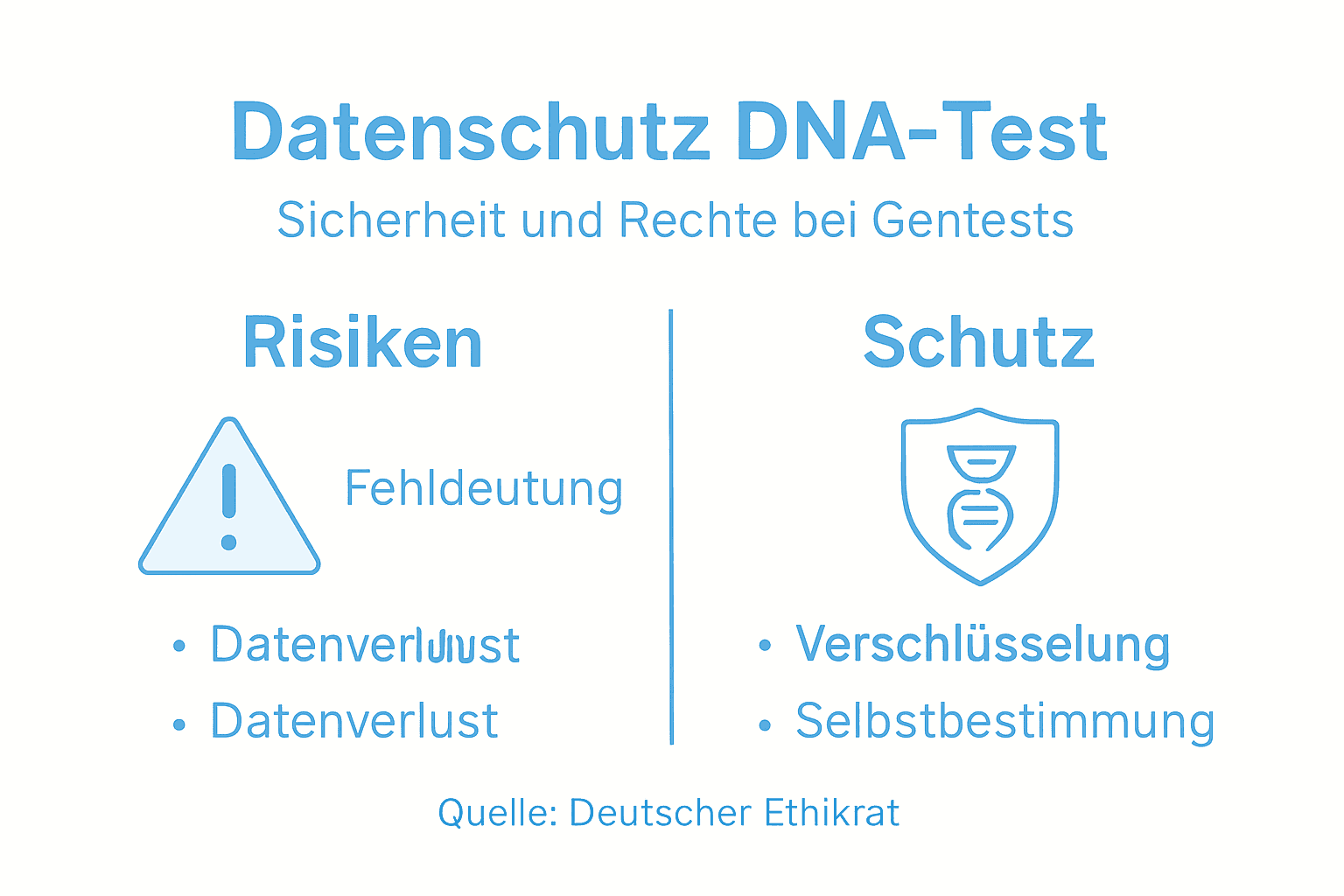
Let’s start by discussing the risks. Genetic tests are not flawless. There can be misinterpretations, where a result is misunderstood or a test indicates a risk that never materializes. A genetic test shows that you have a genetically increased risk of developing a particular disease. That does not mean you will develop the disease. It is a probability, not a guarantee. That is a major difference, and it is sometimes overlooked. Another risk is incidental findings—information discovered by chance that was not what you originally wanted to test for. A test for metabolism might suddenly reveal that you have an increased risk of cancer. This can be psychologically distressing. There is also the issue of psychological distress. Customers should carefully consider the decision to take a genetic test, as a positive result can lead to anxiety, worry, or even depression, especially when serious illnesses are involved.
What rights do you have as a customer? This is a crucial question. You have the right to informational self-determination. This means that you can control what information about you is collected and what happens to it. You also have the right to know, meaning that the provider must give you all relevant information about your test clearly and understandably. But you also have the right not to know. Yes, this is a genuine right. You can tell the provider that you do not want to know certain results, particularly if they concern future risks that cannot be treated. You have the right to data privacy, meaning that your genetic information must be handled securely. You also have the right to counseling. The Genetic Diagnostics Act requires professional genetic counseling at least for certain tests, so that you truly understand what the test means.
How can you protect yourself? There are several specific measures:
-
Pre-test counseling: Find a genetic counselor or a doctor you can talk to about the test before taking it. This is not only a legal requirement for certain tests, but also emotionally sensible. You will approach the matter informed.
-
Understanding the results: Do not simply accept a result without truly understanding it. If the provider cannot explain it clearly, that is already a red flag.
-
Review privacy policies: Read the privacy policy. Understand what happens to your data, how long it is stored, and who has access to it.
-
Written consent: Make sure you give your consent in writing, not just verbally. This is your proof.
-
Trustworthy providers: Choose providers that are transparent, have certifications, and can answer your questions. For example, mybody follows strict standards and explains its processes openly.
One important point: Communication with family. Your genetic results may affect your relatives. If you discover that you carry a gene for an inherited condition, your parents, siblings, or children may also need to be tested. These are difficult conversations, but they are important.
The German Ethics Council recommends comprehensive information, counseling, and legal regulations to protect your right to self-determination. This is not just a recommendation, but a statement that these issues must be taken seriously.
Pro tip: Before you take a genetic test, take the time to speak with a genetic counselor or a doctor you trust—this investment will help you make informed decisions and avoid psychological distress later.
Data protection for genetic tests is mybody®'s top priority
Protecting your sensitive genetic data is no coincidence. In this article, you learned how important compliance with the GDPR and the Genetic Diagnostics Act is for your security and privacy. At the same time, you now know that only providers with certified laboratories and transparent data protection policies are truly trustworthy. This is exactly where mybody® comes in. With ISO-certified analyses, pseudonymized samples, and the destruction of your biological specimens after analysis, we give you the assurance that your DNA data will remain permanently protected.
Use our At-home health tests – Discover all tests - mybody®x now to safely analyze your genetic and metabolic health aspects. Whether you want to optimize your diet with our Nutrition tests – Optimize your diet - mybody®x or improve your well-being through targeted gut analyses, we offer you tested quality with the highest data protection standards. Trust mybody® and take control of your health safely today. Learn more at mybody-x.com and start your personal journey toward greater security and well-being today.
Frequently asked questions
How is my genetic data protected in genetic tests?
The General Data Protection Regulation (GDPR) and the Genetic Diagnostics Act (GenDG) protect genetic data through strict regulations on consent, storage, and processing.
What rights do I have regarding my genetic data?
You have the right to informational self-determination, which means that you can control what information about you is collected and how it is used. You also have the right to comprehensive information about your test.
What happens to my sample after the analysis?
After the analysis, the biological samples are usually destroyed to ensure that no sensitive data remains available.
What security measures do providers take for genetic tests?
Providers implement technical and organizational measures such as encryption, pseudonymization, access controls, and regular security audits to ensure data security.



Share now:
Successfully achieve your 2026 New Year’s resolutions with mybody®
What is a self-test? Scientifically reliable at home