

Abdominal cramps and diarrhea: causes, immediate measures, and warning signs
The key points at a glance
Abdominal cramps and diarrhea usually occur together because the irritated intestine moves its contents onward more quickly and contracts spasmodically in the process. According to IQWiG (2023), the most important thing is to replace lost fluids and electrolytes. Blood in the stool, fever, significant weight loss, or signs of severe fluid loss should be assessed by a doctor.
The combination of cramps and watery stool can have very different causes: a gastrointestinal infection, unfamiliar food, a food intolerance, irritable bowel syndrome, or a chronic inflammatory bowel disease. This article categorizes the most common causes, explains evidence-based immediate measures, and honestly outlines the limitations of self-tests.
If it is acute, read Chapter 3 first: it covers immediate measures and warning signs. Chapters 4 and 5 explain the causes, while Chapter 6 compares infection, intolerance, and irritable bowel syndrome. Chapters 8 and 9 explain what a gut flora analysis can and cannot do.
What to expect in this article
1. Why do abdominal cramps and diarrhea usually occur together?
2. When is it medically considered diarrhea?
3. What helps immediately with abdominal cramps and diarrhea?
4. How common is diarrhea—and which triggers have been confirmed?
5. What causes recurrent abdominal cramps with diarrhea?
6. Infection, intolerance, or irritable bowel syndrome—how can you tell the difference?
7. What helps with recurring symptoms—and what has not been proven?
8. Can a microbiome analysis help with abdominal cramps and diarrhea?
9. What a gut microbiome analysis cannot do
Conclusion
Frequently asked questions
Sources
1. Why do abdominal cramps and diarrhea usually occur together?
Abdominal cramps and diarrhea occur together because both symptoms result from the same intestinal reaction: the intestine moves its contents onward faster than it can thicken them. According to IQWiG (2023), diarrhea is “often accompanied by abdominal pain, cramps, and bloating.”
Normally, the large intestine’s job is to remove water from the chyme. If the contents pass through the intestine too quickly or additional fluid enters the intestine, the stool remains watery. The muscles in the intestinal wall work more forcefully than usual, which is perceived as cramping or a pulling sensation.
Why fluid loss is the real risk
With acute diarrhea, the main medical problem is not the cramps but what the body loses as a result. IQWiG (2023) states this clearly: “Anyone with diarrhea loses fluids and electrolytes. Therefore, the most important thing is to replace this loss.”
Electrolytes are minerals such as sodium and potassium that are dissolved in the body and are needed, among other things, for muscle and nerve function. When they are lost along with water, weakness, dizziness, and a dry mouth can occur—symptoms that many people attribute to the gastrointestinal infection itself.
Key point: According to IQWiG (2023), when acute diarrhea is accompanied by abdominal cramps, relieving the cramps is not the top priority; replacing fluids and electrolytes is.
How a FODMAP effect draws additional water into the intestine
Certain carbohydrates can intensify the effect. The acronym FODMAP encompasses sugars and sugar alcohols that are poorly absorbed in the small intestine. According to IQWiG (2023), it is suspected “that consuming FODMAPs causes more water to enter the intestine and promotes diarrhea.”
This explains why some people regularly experience cramps and loose stools after certain types of fruit, legumes, or dairy products, while the same meal has no effect on others.
2. When is it medically considered diarrhea?
In medicine, diarrhea is defined by a clear threshold: very soft or watery stools at least three times within 24 hours. One soft stool after a heavy meal is therefore not diarrhea.
“
“Diarrhea is defined as having very soft or watery stools at least three times within 24 hours.”
Institute for Quality and Efficiency in Health Care (IQWiG)
“Diarrhea,” gesundheitsinformation.de, 2023
This definition is practically useful because it distinguishes two things: stool consistency and frequency. Both must be present. Someone who has formed stools three times a day does not have diarrhea—and neither does someone who has watery stool once a day.
Why the 24-hour rule is important for classification
The threshold helps you monitor the course rather than judge it. Anyone who records how often and how watery their stool was on a given day can prepare for a medical assessment much more precisely than by simply saying it was “a lot.”
For everyday use, just a few notes are enough: the time, approximate consistency, accompanying symptoms such as cramps, fever, or nausea, and what was eaten in the preceding hours. For recurring symptoms, this record is often more valuable than any self-test.
3. What helps immediately with abdominal cramps and diarrhea?
The top priority is replacing fluids and electrolytes—as IQWiG (2023) states, this is the most important thing when you have diarrhea. Everything else comes after that: light meals, rest, and carefully watching for warning signs.
For children and older people, IQWiG (2023) explicitly recommends a rehydration solution from a pharmacy or drugstore. These solutions contain water, salts, and sugar in a carefully balanced ratio. Which product is suitable and in what amount should be clarified at a pharmacy or doctor’s office—this article deliberately makes no recommendation and provides no dosage.
STEP 2
Replace fluids and electrolytes
Choose light, easily tolerated foods
Small portions, little fat, nothing heavily seasoned. According to IQWiG (2023), what is tolerated varies from person to person.
Watch for warning signs
According to IQWiG (2023), sunken eyes, dark urine, intense thirst, or blood in the stool are no longer symptoms to simply monitor.
Have persistent symptoms evaluated
Recurrent or persistent cramps with diarrhea should be evaluated by a doctor, not a self-test.
Medications are deliberately not included in this list. Neither over-the-counter nor prescription medicines are recommended or dosed here—this decision belongs in the pharmacy or doctor’s office because it depends on the cause, age, and pre-existing conditions.
Warning signs: When symptoms should be medically evaluated
- ✓ Blood in the stool – according to IQWiG (2023), blood in the stool “should always be medically examined to determine the cause.”
- ✓ Significant weight loss, fever, or paleness – according to IQWiG (2023), these additional symptoms are more suggestive of another intestinal disease than of irritable bowel syndrome.
- ✓ Signs of severe fluid loss – IQWiG (2023) mentions sunken eyes, faster breathing, reduced skin elasticity, intense thirst, and dark urine.
- ✓ Severe abdominal pain with a rigid abdominal wall – according to IQWiG (2026), if there is “severe abdominal pain, a rigid abdominal wall, fever, nausea, a rapid heartbeat, and general weakness,” it is “important to seek medical help promptly.”
4. How common is diarrhea—and which triggers have been confirmed?
Diarrhea is not an exception but part of everyday life: According to IQWiG (2023), adults in Germany are affected on average once a year, while children become ill even more often. This perspective takes away some of the fear associated with an individual episode.
Source: IQWiG / gesundheitsinformation.de, 2023
Causes cited by IQWiG at a glance
IQWiG (2023) cites noroviruses and rotaviruses, bacteria such as Salmonella and Campylobacter, unfamiliar foods, food intolerances, irritable bowel syndrome, chronic inflammatory bowel diseases, and side effects of antibiotics as some of the causes of diarrhea.
This list is so helpful because it contains two completely different groups. One group comes from external causes and is limited in duration—viruses, bacteria, unfamiliar food, or an antibiotic. The other group comes from within the body and affects people over a longer period.
When assessing your own symptoms, the most important question is therefore not “how severe,” but “how often and for how long.” A single episode after eating at a restaurant means something different from cramps with loose stools that have occurred several times a week for weeks.
5. What causes recurrent abdominal cramps with diarrhea?
Recurrent abdominal cramps with diarrhea have different typical causes than a single episode. The main possibilities are irritable bowel syndrome, food intolerances, inflammatory bowel disease, diverticular disease, and functional somatic symptoms.
Irritable bowel syndrome: common, burdensome, but not dangerous
According to estimates by IQWiG (2023), around 10 to 20 out of 100 people have irritable bowel syndrome. According to the same source, typical symptoms are “persistent abdominal or lower abdominal pain, cramps, and altered stools”—exactly the combination discussed in this article.
For perspective, it is important to note that according to IQWiG (2023), irritable bowel syndrome is not dangerous, and most people affected have a mild form. That is reassuring—but it does not replace medical evaluation, because the diagnosis is only made after other causes have been ruled out.
Lactose intolerance: when lactose is fermented in the large intestine
According to IQWiG (2024), around 5 to 15% of people in Europe are unable to digest lactose; in Africa or East Asia, the figure is 65 to over 90% of adults. The mechanism is well understood: if lactose remains in the small intestine, it passes into the large intestine, where it is fermented by gut bacteria.
According to IQWiG (2024), this leads to increased production of gases such as carbon dioxide and hydrogen, as well as fluid and fatty acids in the intestine—and this fluid in the intestine is precisely why cramps and loose stools so often occur together. The standard medical test for clarification is the hydrogen breath test.
Diverticular disease and inflammatory bowel disease
In diverticular disease, the inner lining of the intestine bulges outward through weak spots in the muscle. According to IQWiG (2026), it usually causes pain in the lower left abdomen; bloating, constipation, or diarrhea may also occur. About 13% of people under 50 have diverticula, compared with around 50% of those over 70.
According to IQWiG (2026), ulcerative colitis involves inflammation of the rectum and sometimes the entire colon. During an acute flare-up, abdominal pain occurs, “often accompanied by abdominal cramps—especially during bowel movements,” and the urge to have a bowel movement occurs several times within 24 hours. Experts estimate that around 400,000 people in Germany have ulcerative colitis.
The same applies to Crohn’s disease: According to IQWiG (2026), an acute flare-up “mainly causes abdominal pain and diarrhea.” In Europe, an estimated 320 out of 100,000 people have Crohn’s disease. For both conditions, no diet can replace medical treatment.
Stress and functional bodily symptoms
If no physical cause is found, medicine refers to this as functional bodily symptoms. According to IQWiG (2026), an estimated 10% of the population has symptoms for which no clear explanation can be found. The same source explicitly states: “However, this does not mean that the symptoms are merely imagined or that nothing can be done.”
Regarding the connection with the gastrointestinal tract, IQWiG (2026) states specifically: “Bowel function can be disrupted by stress, for example. This can lead to diarrhea, bloating, or constipation.” Periods of stress are therefore not an excuse, but a recognized factor.
Key message: Recurrent abdominal cramps with diarrhea are not an independent disease, but a pattern of symptoms—the classification depends on duration, accompanying symptoms, and medical evaluation, not on the severity of a single episode.
This article deliberately focuses on the combination of cramps and diarrhea. If you are more concerned with pain radiating to your back, you can find the explanation in the article on Pain in the lower abdomen and back; if a previously diagnosed intestinal inflammation is the main concern, the article Intestinal inflammation: what to do? is the more suitable place to start.
6. Infection, intolerance, or irritable bowel syndrome—how can you tell the difference?
Only a medical evaluation can provide a reliable distinction. However, the following overview shows how the three most common explanations for abdominal cramps with diarrhea differ according to the IQWiG sources used here—and where the source material deliberately makes no statement.
| Criterion | Gastrointestinal infection | Food intolerance (lactose, for example) | Irritable bowel syndrome |
|---|---|---|---|
| How does it begin? | According to IQWiG (2023), triggers include noroviruses and rotaviruses, as well as bacteria such as Salmonella and Campylobacter. The source makes no statement about the timing of onset. | According to IQWiG (2024), symptoms occur when more lactose is consumed than lactase can break down—the remainder is fermented in the large intestine. | IQWiG (2023) does not describe an acute event but rather persistent symptoms; possible factors mentioned include hypersensitive intestinal nerves and changes in the gut microbiome. |
| How long does it last? | The source material used here does not specify a duration. The only documented information is the frequency: in Germany, adults experience diarrhea an average of once a year (IQWiG, 2023). | The source material does not specify a fixed duration. It describes the connection with the amount of lactose consumed (IQWiG, 2024). | Persistent or recurring; IQWiG (2023) refers to persistent abdominal or lower abdominal pain. The source used does not specify a time period. |
| Typical accompanying signs | According to IQWiG (2023), diarrhea is often accompanied by abdominal pain, cramps, and bloating. | According to IQWiG (2024), fermentation produces increased amounts of gases such as carbon dioxide and hydrogen, as well as fluid and fatty acids, in the intestine. | According to IQWiG (2023), “persistent abdominal or lower abdominal pain, cramps, and altered stools.” |
| How is it diagnosed? | The source material used does not describe a testing method. According to IQWiG (2023), fever and blood in the stool should be medically evaluated. | Hydrogen breath test: After drinking a lactose solution, the hydrogen content of the exhaled air is measured several times (IQWiG, 2024). | Additional symptoms such as significant weight loss, blood in the stool, fever, or pallor are, according to IQWiG (2023), more indicative of another intestinal disease and should be investigated. |
| What helps? | Replenishing fluids and electrolytes—according to IQWiG (2023), this is the most important measure. For children and older people, an oral rehydration solution from a pharmacy or drugstore is recommended. | The source used here describes the testing method, not a specific form of diet. Any dietary change should be professionally supervised. | A low-FODMAP diet is being tried; according to IQWiG (2023), it carries “the risk of malnutrition.” Additional fiber supplements have not been proven effective, according to IQWiG (2023). |
What stands out is how often this table says that the source material makes no statement. That is a realistic picture of the situation: the course and duration of gastrointestinal symptoms cannot be expressed reliably in fixed figures because they depend on the pathogen, trigger, age, and pre-existing conditions.
7. What helps with recurring symptoms—and what has not been proven?
For recurring abdominal cramps with diarrhea, there is no standard solution that works for everyone. IQWiG (2023) states regarding irritable bowel syndrome: “However, how people react to particular foods is highly individual.”
Low-FODMAP diet: proven effective, but not risk-free
A low-FODMAP diet is the best-known approach for irritable bowel symptoms with diarrhea. However, it is not intended as a permanent diet: According to IQWiG (2023), “there is a risk of malnutrition because it becomes difficult to consume enough vitamins and minerals.”
That is why such an elimination phase should be professionally supervised—for example, by a nutrition specialist or the treating medical practice. Without the structured reintroduction of the omitted foods, the result is often an unnecessarily restricted diet, while the actual triggers remain unknown.
Fiber supplements and probiotics: what the evidence shows
For additional fiber supplements, IQWiG (2023) provides a clear assessment: “It has not been proven that additional fiber supplements help.” This is not an argument against fiber-rich foods—the German Nutrition Society (DGE, 2021) recommends that adults consume at least 30 grams of fiber per day—but it is an argument against expecting a supplement to solve the problem.
Regarding probiotics, IQWiG (2023) states: “In general, probiotics are well tolerated; only rarely do mild side effects such as flatulence occur.” Good tolerability, however, is not the same as proven effectiveness— a distinction that is regularly blurred in advertising for gut products.
Diet and gut flora: what the DGE describes
The fact that diet affects gut bacteria is well documented. According to a DGE statement (2021), diet shapes the composition of the bacteria, and it can be assumed that the type and amount of dietary fiber substantially influence the microbiome. The richness of the bacteria is cited there as a marker of a stable microbiome in healthy people.
At the same time, caution is warranted. The same DGE statement (2021) cites an expert assessment that reads: “So far, I do not see how a particular diet could influence the microbiome in a clearly defined direction.” This is not an institutional position of the DGE, but a voice cited there—and a useful counterweight to claims that the gut flora can be specifically remodeled.
In brief
For recurring abdominal cramps with diarrhea, reactions to individual foods are highly individual, according to IQWiG (2023). A low-FODMAP diet may be tried, but according to IQWiG (2023), it carries a risk of malnutrition and should be professionally supervised. According to IQWiG (2023), additional fiber supplements have not been shown to be effective, and although probiotics are considered well tolerated, this is not a statement about their efficacy. Diet demonstrably influences the gut flora, but according to the professional assessment cited in the DGE statement (2021), it is not yet possible to deliberately steer it in a defined direction.
8. Can a microbiome analysis help with abdominal cramps and diarrhea?
A microbiome analysis does not answer the question of why you have diarrhea today. It describes the composition of your gut flora—and for recurring symptoms, this is a useful additional component after acute and treatable causes have been ruled out by a doctor.
For this purpose, mybody® (MYBODY Lab GmbH) offers stool tests that are analyzed in an ISO-certified laboratory in Germany, operate in accordance with ISO 27001, and are conducted in compliance with the GDPR. The analysis is pseudonymized, and the results are transmitted using SSL encryption.
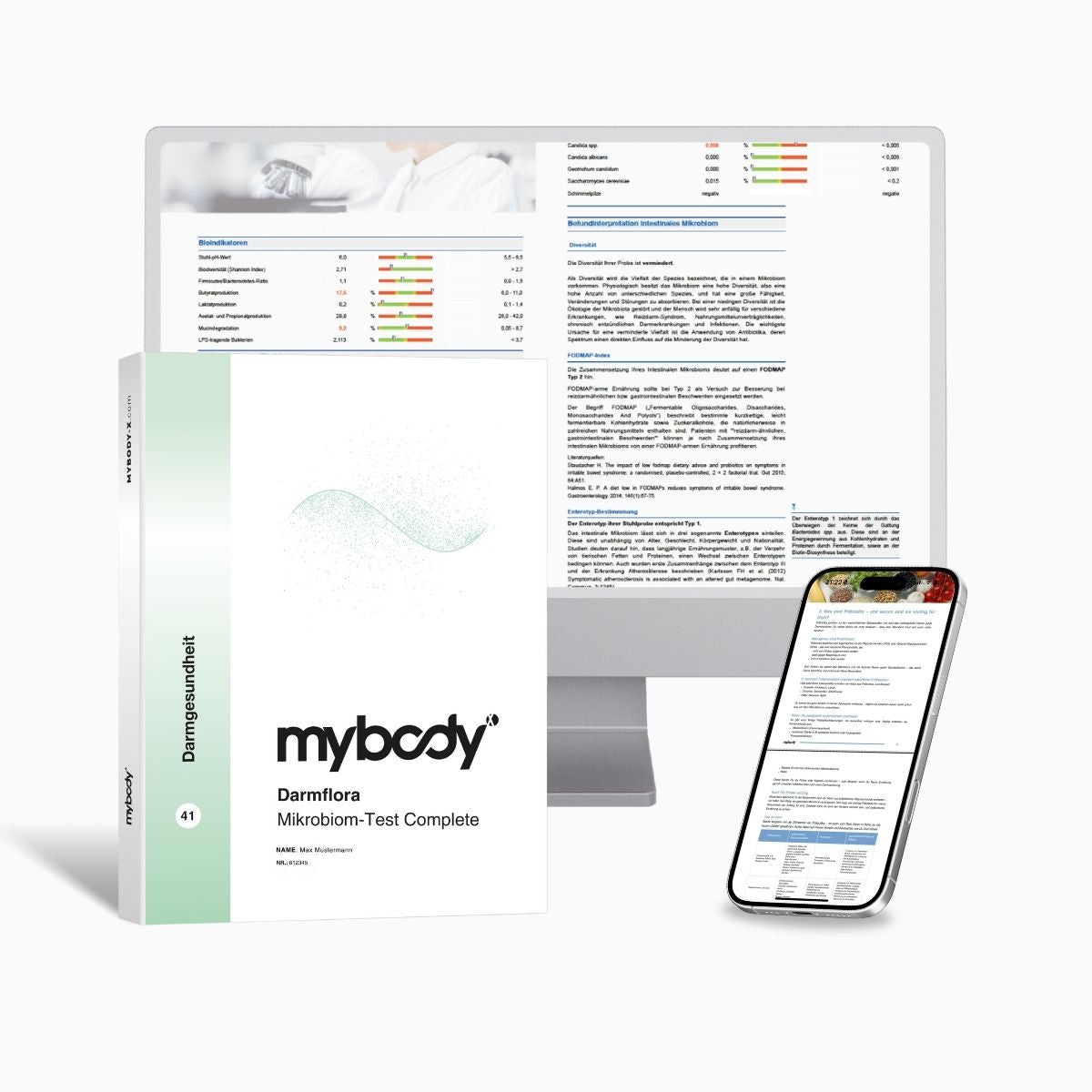
Gut Flora MICROBIOME Test Complete
Using DNA sequencing, the test examines more than 1,500 bacterial species in a stool sample and describes bacterial diversity, the ratio of protective to potentially problematic microorganisms, indications of dysbiosis, as well as a FODMAP index and enterotype classification. The report is approximately 15 pages long. The test explicitly does not detect gastrointestinal infections: Salmonella, Campylobacter, norovirus, or rotavirus are not detected, nor are antibiotic-associated side effects, inflammatory bowel disease, celiac disease, or tumors.
Price: €189.00 (instead of €219.00) · Sample type: Stool sample · Processing time: approx. 20–25 business days · Laboratory: ISO-certified laboratory analysis, ISO 27001
To the Microbiome Test CompleteIf you initially only want an overview of the composition of your gut flora, the Basic version offers a more limited introduction. It covers fewer evaluation topics but uses the same type of sample and the same laboratory standards.
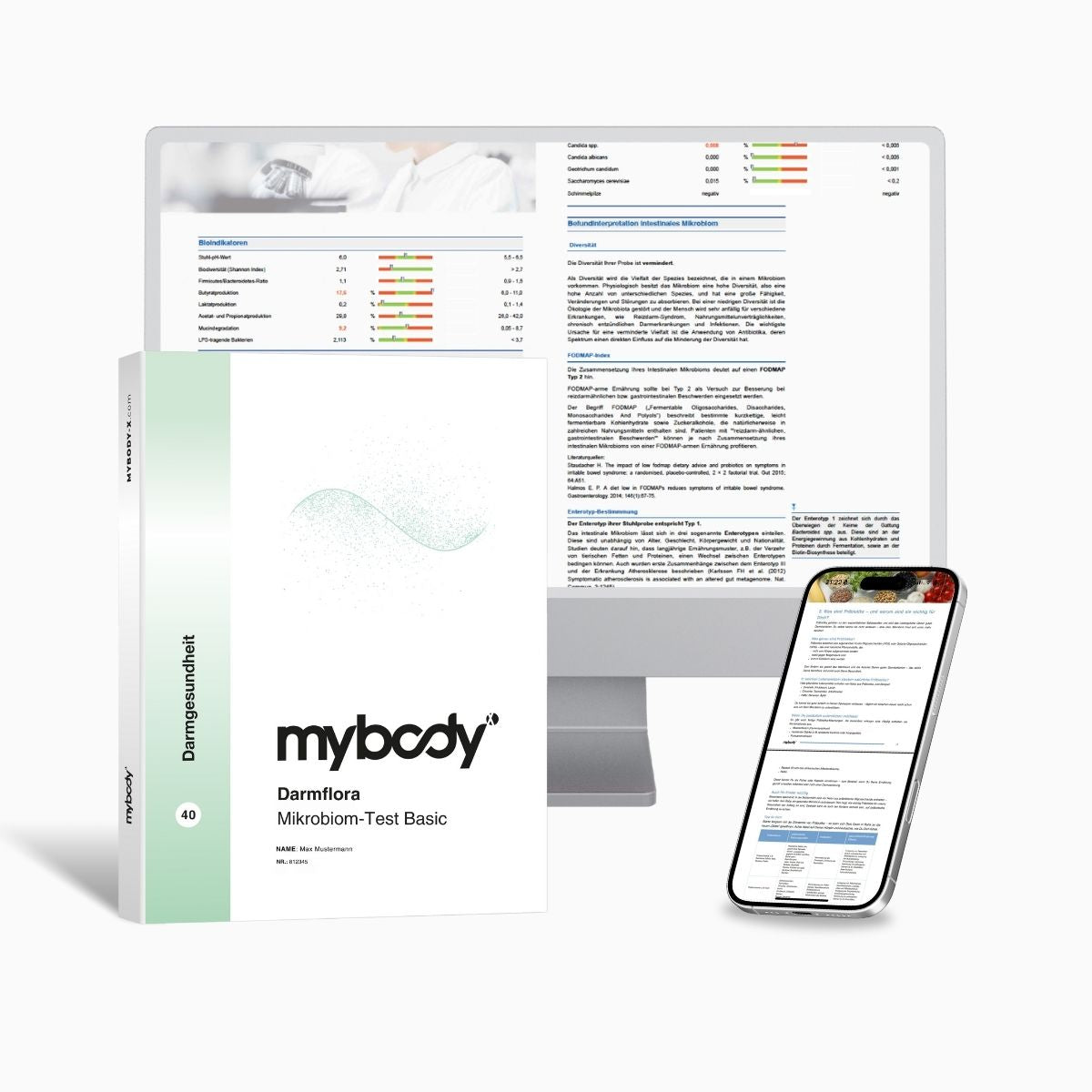
Gut Flora MICROBIOME Test Basic
The entry-level option describes the composition of the gut microbiome, the ratio of protective to potentially harmful bacteria, the gut environment based on pH, fungal colonization, and indications of dysbiosis. The report is also approximately 15 pages long. This test is not a diagnostic procedure either: It does not detect a gastrointestinal infection, Salmonella, or an antibiotic-associated side effect, and it does not replace medical evaluation in cases of acute diarrhea.
Price: €139.00 · Sample type: Stool sample · Processing time: approx. 20–25 business days · Laboratory: ISO-certified laboratory analysis, ISO 27001
About the Microbiome Test BasicAll price and service information is current as of July 28, 2026. Prices and processing times may change; the applicable product page is always authoritative.
Who may benefit from a gut microbiome analysis
Whether a microbiome analysis is worthwhile depends less on your symptoms than on the question you want it to answer. The following comparison presents both sides—including situations in which a self-test is the wrong choice.
Worth considering for you if …
… the cramps and loose stools have been recurring for weeks and acute, treatment-requiring causes have been medically evaluated.
… you want to know how diverse your gut microbiome is and whether there are indications of dysbiosis.
… you understand the analysis as a supplement to a medical evaluation and discuss it with your doctor.
Probably not if …
… you have acute diarrhea with fever or blood in your stool—this requires immediate medical evaluation, not a self-test.
… you suspect a gastrointestinal infection: Salmonella, Campylobacter, norovirus, and rotavirus are not identified by a gut microbiome analysis.
… you expect a diagnosis—a microbiome analysis does not provide one, and anyone who reads it as a diagnosis will draw incorrect conclusions.
9. What a gut microbiome analysis cannot do
A microbiome test describes a condition; it does not explain its cause. This distinction is the most important sentence in this chapter, because it determines whether an analysis is useful or misleading.
A microbiome test describes a condition; it does not explain its cause.
Specifically, this means: A gut microbiome analysis does not detect a gastrointestinal infection and does not identify Salmonella, Campylobacter, norovirus, or rotavirus. It also does not detect an antibiotic-associated side effect—although IQWiG (2023) explicitly lists antibiotics as a possible cause of diarrhea.
Nor does it diagnose chronic inflammatory bowel diseases. Ulcerative colitis and Crohn’s disease are diagnosed and treated by doctors; according to IQWiG (2026), various medications may be considered, and their selection must be left exclusively to medical professionals.
A microbiome test cannot clarify lactose intolerance either. The hydrogen breath test is the established approach: according to IQWiG (2024), after drinking a lactose solution, the hydrogen content of the breath is measured several times. mybody® does not offer a standalone lactose or fructose test product—this is part of an honest assessment.
Finally, the fundamental limitation that extends far beyond individual providers remains: According to the expert assessment cited in the DGE statement (2021), it is still unclear how the microbiome can be influenced through a specific diet in a clearly defined direction. A test result is therefore a snapshot, not a blueprint.
Conclusion
When dealing with abdominal cramps and diarrhea, the first priority is replacing fluids and electrolytes—according to IQWiG (2023), this is the most important measure. A light diet, rest, and careful attention to warning signs come next; medications should be handled with the help of a pharmacy or doctor’s office.
If it remains a single episode, it is within the usual range: according to IQWiG (2023), adults in Germany experience diarrhea an average of once a year. If cramps and loose stools recur over a period of weeks, however, systematic evaluation is worthwhile—from irritable bowel syndrome and food intolerances to chronic inflammatory bowel diseases.
In this process, a gut microbiome analysis is an additional component for the period after medical evaluation, not before it. Those who understand it this way receive a useful description of their own gut microbiome—while anyone expecting a diagnosis will be disappointed. If there is blood in the stool, fever, significant weight loss, or signs of severe fluid loss, the next step is to go directly to a doctor’s office.
Frequently asked questions
When is it actually considered diarrhea?
According to IQWiG (2023), diarrhea is defined as “having very soft or watery stools at least three times within 24 hours.” Both criteria must be met: the frequency and the soft or watery consistency. A single loose stool after eating something unusual does not yet meet this definition.
Why do abdominal cramps and diarrhea so often occur together?
Both symptoms stem from the same response: the bowel moves its contents along faster than it can remove water from them, and the intestinal muscles work more vigorously than usual. According to IQWiG (2023), diarrhea is “often accompanied by abdominal pain, cramps, and bloating.”
What is the most important thing to do when you have diarrhea?
Replacing lost fluids and electrolytes. IQWiG (2023) puts it this way: “Anyone with diarrhea loses fluids and electrolytes. That is why the most important thing is to replace this loss.” For children and older people, the same source mentions an oral rehydration solution from a pharmacy or drugstore. You can clarify which product is appropriate and in what quantity there, or at the doctor’s office.
When should I go to the doctor’s office with abdominal cramps and diarrhea?
According to IQWiG (2023), blood in the stool “should generally be medically examined to clarify the cause.” Additional symptoms such as significant weight loss, fever, or paleness, according to the same source, are more indicative of another intestinal disease. In the event of severe abdominal pain with a hard abdominal wall, fever, nausea, rapid heartbeat, and general weakness, IQWiG (2026) states that it is “important to seek medical help promptly.”
Can a microbiome test identify the cause of my diarrhea?
No. A microbiome test describes the composition of the gut flora; it does not provide a diagnosis. It does not detect gastrointestinal infections, salmonella, antibiotic-associated side effects, inflammatory bowel disease, or celiac disease. It can be useful as an additional component for recurring symptoms after causes requiring treatment have been medically ruled out.
Better understand recurring symptoms
When acute causes have been medically investigated and the symptoms nevertheless keep recurring, an analysis of your gut flora can be an additional piece of the puzzle. The analysis is performed in an ISO-certified laboratory in Germany, in compliance with the GDPR and using pseudonymized data.
View the Complete Microbiome Test All gut tests at a glanceYou might also be interested in
→ Intestinal inflammation: what to eat?
What to eat when you have inflammatory bowel symptoms—and why no diet replaces medical treatment.
→ The most reliable microbiome tests for your gut flora
How to recognize a reliable gut flora analysis and which questions it can answer.
→ Gut microbiome glossary: all bacteria and markers in your gut flora
Reference work with over 6,000 microbiome biomarkers—from protective bacteria and fiber degraders to the key metrics in the report.
Sources
- IQWiG / gesundheitsinformation.de: Diarrhea (2023) — gesundheitsinformation.de
- IQWiG / gesundheitsinformation.de: Irritable bowel syndrome (2023) — gesundheitsinformation.de
- IQWiG / gesundheitsinformation.de: What helps with irritable bowel syndrome—and what does not? (2023) — gesundheitsinformation.de
- IQWiG / gesundheitsinformation.de: Lactose intolerance (milk sugar intolerance) (2024) — gesundheitsinformation.de
- IQWiG / gesundheitsinformation.de: Diverticular disease and diverticulitis (2026) — gesundheitsinformation.de
- IQWiG / gesundheitsinformation.de: Ulcerative colitis (2026) — gesundheitsinformation.de
The definition of diarrhea, the frequency information, the list of causes, the advice on fluid and electrolyte replacement, and the signs of severe fluid loss are taken from [1]. Information on irritable bowel syndrome, the warning signs, and the advice regarding blood in the stool are taken from [2]; the statements on FODMAPs, fiber supplements, probiotics, and individual variability in responses are taken from [3]. The information on lactose intolerance, including the hydrogen breath test, is taken from [4]; information on diverticular disease and warning signs of acute inflammation is taken from [5]; information on ulcerative colitis is taken from [6]. Product information comes from the mybody® product pages, accessed on July 28, 2026. All other sources cited in the text—including information on Crohn’s disease and functional physical complaints from IQWiG (2026), the German Nutrition Society (DGE) reference value for fiber (2021), and the DGE publication on nutrition and the microbiome (2021)—are identified directly at the relevant point with the institution and year.

mybody® Editorial & Expert Team
Gut health Microbiome Diarrhea & abdominal cramps Nutritional science
This article was created and medically reviewed by the mybody® Editorial and Expert Team. The team combines expertise in nutrigenetics, microbiome and gut science, blood analysis interpretation, nutritional science, and laboratory diagnostics.
Published on July 28, 2026 · Last updated on July 28, 2026
Medical notice: This article is for general information only and does not replace medical advice, diagnosis, or treatment. It deliberately contains no medication recommendations or dosage information—not even for over-the-counter medicines. If you notice blood in your stool, fever, significant weight loss, persistent vomiting, severe abdominal pain, or signs of severe fluid loss, please contact a doctor immediately.




Share now:
Glutamate intolerance and the gut: What’s really behind symptoms after eating
How Much Protein per Day? Reference Values, Calculation, and Good Protein Sources