

How do missing electrolytes manifest themselves?
Nighttime muscle cramps, leaden fatigue, headaches after exercise, or a heart that suddenly skips a beat: Many people suspect a lack of electrolytes. Sometimes they are right—but often something else is behind it.
Missing electrolytes mainly affect the muscles, nerves, and heart. Typical symptoms include muscle cramps and twitching, weakness and fatigue, headaches, dizziness, nausea, concentration problems, as well as palpitations or skipped heartbeats. The symptoms are nonspecific: They tell you that something is wrong, but not which mineral is missing. Only a blood test can provide certainty—and pronounced or sudden symptoms should always be medically evaluated.
It is best to read this article as a guide: First, you will learn about the typical signs; then you will find out which electrolyte causes which symptoms, how a deficiency develops in the first place, how to distinguish it from other causes—and when you should stop trying to figure it out on your own.
What to expect in this article
What are electrolytes, and what do they do in the body?
What symptoms occur with an electrolyte deficiency?
Which electrolyte causes which symptoms?
How does an electrolyte deficiency develop in the first place?
How can you distinguish this from other causes?
When should you seek medical evaluation?
What helps when electrolytes are lacking?
Know your mineral status
Interpretation: What a test can—and cannot—do
Conclusion
Frequently asked questions (FAQ)
Sources
Each electrolyte has its own function in the body—and that is why a deficiency manifests differently depending on the mineral. This overview links the most important electrolytes to their typical signs. It does not replace a diagnosis, but it can help you classify your symptoms:
| Electrolyte | Function in the body | Typical signs of deficiency |
|---|---|---|
| Sodium | Regulates fluid balance and pressure within cells | Headaches, nausea, confusion, weakness |
| Potassium | Important for muscle and heart rhythm, nerve impulses | Muscle weakness, skipped heartbeats, constipation, fatigue |
| Magnesium | Involved in over 300 enzyme reactions, relaxes muscles | Calf cramps, eyelid twitching, inner restlessness, headaches |
| Calcium | Bone formation, muscle contraction, blood clotting | Tingling in the fingers and around the mouth, muscle cramps |
| Chloride | Sodium’s partner, part of stomach acid | Weakness, sluggishness—usually together with sodium deficiency |
| Phosphate | Energy metabolism, bones, cell membranes | Muscle weakness, bone pain, exhaustion |
Missing electrolytes almost always show up in four areas of the body—because electrical signals and fluid distribution play a role everywhere there:
Cramps & weakness
Calf cramps, muscle twitching, weakness, and heavy legs are the most common signals.
Headache & dizziness
Dull headache, lightheadedness, and concentration problems appear early.
Palpitations & skipped beats
Potassium in particular affects heart rhythm—this signal should always be medically evaluated.
Thirst & circulation
Dry mouth, dark urine, and circulatory weakness indicate an imbalance.
The short answer: These are the typical signs
Electrolyte deficiencies most commonly manifest as muscle cramps, muscle twitching, muscle weakness, pronounced fatigue, headaches, dizziness, nausea, difficulty concentrating, and a racing heart. These symptoms occur because electrolytes enable electrical signals between nerve and muscle cells.
One crucial point is often overlooked: These symptoms are nonspecific. A calf cramp may be caused by magnesium deficiency—or by overuse, dehydration, an unfamiliar movement, or simply shoes that are too tight. Fatigue is one of the most common symptoms of all and has dozens of possible causes.
The picture only becomes meaningful in context. If the symptoms occur after heavy sweating, following a gastrointestinal infection, while taking diuretic medication, or with a very unbalanced diet, an electrolyte deficiency is considerably more likely than in someone who occasionally feels tired without any particular strain.
Key takeaway: Electrolyte deficiencies primarily affect the muscles, nerves, and heart, causing cramps, weakness, fatigue, headaches, and palpitations. The symptoms tell you that something is out of balance, but not which mineral is missing.
Another important difference is the speed at which they develop: A slowly developing, mild deficiency often emerges gradually over weeks with vague symptoms. An acute loss—for example, due to severe diarrhea or heat exhaustion—can lead to noticeable symptoms within hours and is a medical emergency if confusion, seizures, or impaired consciousness occur.
What are electrolytes, and what do they do in the body?
Electrolytes are minerals that exist in the body as electrically charged particles. The most important include sodium, potassium, calcium, magnesium, chloride, phosphate, and bicarbonate. They are dissolved in every bodily fluid—in the blood, in the fluid inside cells, and in the space between cells.
Their most important function is transmitting electrical signals. Every muscle movement, heartbeat, and thought depends on charged particles moving through the cell membrane and triggering a change in voltage. Without electrolytes, there would be no nerve impulses or muscle contractions.
Why the ratio matters more than the amount
Electrolyte balance is less about absolute amounts than about ratios. Sodium is found predominantly outside cells, while potassium is found predominantly inside them. This unequal distribution is the basis of the electrical voltage across the cell membrane—and the body continually expends energy to maintain it.
That is why an imbalance can develop even when you are actually taking in enough. Drinking a great deal of plain water dilutes your sodium without reducing how much you consume. And when you sweat heavily, you lose sodium and water at the same time—but often replace only the water.
The role of the kidneys as regulators
The kidneys are the central control organ of electrolyte balance. They filter large amounts of blood every day and, under hormonal control, determine what returns to the body and what is excreted in the urine. In healthy kidneys, this system works with great precision.
That is precisely why a true electrolyte deficiency is rare in healthy people with a normal diet. It is more common when this regulatory system is disrupted—by kidney disease, diuretic medications, or losses that occur so quickly that regulation cannot keep up.
What symptoms occur with an electrolyte deficiency?
The following symptoms are among the most common signs. They rarely occur alone, but usually in combination—and their intensity depends on how severe the imbalance is and how quickly it developed.
Muscle cramps and muscle twitching
Muscle cramps are the best-known sign. They occur when the electrical excitability of muscle cells is disrupted and muscle fibers contract uncontrollably. Typical examples include nighttime calf cramps, cramps in the foot or thigh during or after exercise, and fine twitching of the eyelid.
Cramps are particularly common with magnesium deficiency because magnesium acts like a brake in muscle cells and supports relaxation after contraction. Without this brake, the muscle is more likely to remain cramped. But beware of jumping to conclusions: most nighttime leg cramps have no detectable mineral deficiency as their cause.
Fatigue, exhaustion, and muscle weakness
Persistent fatigue and a feeling of lacking strength are also typical. The reason lies in energy production: magnesium and phosphate are directly involved in the cell’s energy metabolism, while potassium is involved in muscle excitability.
With pronounced potassium deficiency, muscle weakness becomes particularly noticeable: people report heavy legs, suddenly finding it strenuous to climb stairs, and, in extreme cases, a marked tendency toward paralysis. Such symptoms require medical attention.
Headaches, dizziness, and lightheadedness
Headaches and lightheadedness often occur when sodium and fluid levels are out of balance. When the sodium level in the blood falls, water shifts into the cells—including brain cells. This explains why sodium deficiency so often affects the head.
This pattern is typical after long, strenuous activities that cause heavy sweating, when plenty of fluids were consumed but no salt was replaced. Headaches and dizziness are also common symptoms of electrolyte loss after a gastrointestinal infection involving vomiting and diarrhea.
Palpitations, skipped beats, and arrhythmias
The heart is a muscle whose rhythm depends directly on electrolytes—above all potassium, but also magnesium and calcium. If the potassium level falls outside the normal range, this may manifest as palpitations, skipped beats, or an irregular pulse.
Both low and high potassium levels can disturb the heart rhythm—so potassium should never be taken in high doses without medical supervision. This is especially important in cases of impaired kidney function and when taking medications that affect potassium balance.
Tingling, numbness, and inner restlessness
Tingling in the fingers, toes, or around the mouth is a classic sign of a low calcium level. Calcium stabilizes the nerve membrane; when it is lacking, nerves become more excitable and send signals of abnormal sensation without any external stimulus.
Many people with magnesium deficiency also report inner restlessness, nervousness, and poorer sleep. The same applies here: These symptoms are common but nonspecific—stress, lack of sleep, and caffeine can produce exactly the same symptoms.
Nausea, loss of appetite, and digestive problems
The gastrointestinal tract also relies on muscles that depend on electrolytes. A potassium deficiency can slow intestinal movement and lead to constipation and bloating. Sodium deficiency often manifests as nausea and loss of appetite. Particularly tricky: Vomiting and diarrhea further worsen the electrolyte balance—a self-reinforcing cycle.
Which electrolyte causes which symptoms?
Although the symptoms overlap, there are typical patterns. They do not replace a diagnosis, but they can help you prepare for a conversation with your doctor.
Sodium deficiency (hyponatremia): Head and circulation
Sodium is the electrolyte associated with the most pronounced neurological signs. A low sodium level manifests as headaches, nausea, confusion, fatigue, and weakness; in severe cases, disorientation, seizures, and impaired consciousness may also occur.
Drinking too much while consuming too little sodium can lead to dangerous dilutional hyponatremia during prolonged endurance exercise (Hew-Butler et al., 2017). Anyone who drinks only plain water during a marathon or long bike rides risks exactly this problem.
Potassium deficiency (hypokalemia): muscles and heart
Potassium deficiency primarily affects the muscles and heart: muscle weakness, rapid fatigue, calf cramps, palpitations, and sluggish digestion are typical. Common causes include diuretic medications, persistent diarrhea, frequent vomiting, and laxative abuse.
According to the German Nutrition Society (DGE), plant-based foods such as vegetables, potatoes, legumes, fruit, and nuts are particularly rich in potassium. People who eat very little of these foods while also taking diuretic medications are at increased risk.
Magnesium deficiency: cramps and restlessness
Magnesium deficiency classically manifests as calf cramps, eyelid twitching, muscle tension, headaches, inner restlessness, and sleep problems. It is more common with an unbalanced diet, chronic alcohol consumption, intestinal diseases that impair absorption, and certain medications.
One special feature is that the magnesium level in the blood reflects overall magnesium status only to a limited extent, because most magnesium is stored in the bones and cells. A normal blood level does not reliably rule out a mild deficiency—so assessment by a doctor is especially important in this case.
Calcium deficiency: tingling and muscle spasms
A low calcium level causes tingling in the hands, feet, and around the mouth, along with muscle spasms and, in severe cases, a tendency to have seizures. A common contributing factor is vitamin D deficiency, because vitamin D regulates calcium absorption from the intestines.
That is why it is worth considering calcium and vitamin D together. Anyone who gets too little sunlight for months and eats few calcium-rich foods can develop an inadequate supply of both at the same time—with symptoms that reinforce each other.
How does an electrolyte deficiency develop in the first place?
An electrolyte deficiency is almost never caused simply by someone “eating too few minerals.” Increased losses or impaired regulation are much more common. In practice, these are the most relevant causes:
Common causes of electrolyte deficiency
- ✓ Heavy, prolonged sweating during exercise, in hot weather, or during physical work
- ✓ Diarrhea and vomiting – the fastest route to an imbalance
- ✓ Diuretic medications and certain blood pressure or heart medications
- ✓ Kidney, heart, or liver disease that disrupts regulation
- ✓ A very unbalanced or severely calorie-restricted diet
- ✓ Regular, high alcohol consumption that increases excretion
- ✓ Drinking excessive amounts of plain water without replacing salt during prolonged exertion
Sweating: water and salt are lost together
Sweat is not just water; it mainly contains sodium and chloride, along with smaller amounts of potassium and magnesium. Anyone who sweats for hours loses measurable amounts of salt as a result—visible as white marks on dark sports clothing.
The crucial mistake happens afterward: if you only drink more water, the sodium concentration in your blood continues to fall even though the volume has returned to normal. This is exactly what causes headaches, nausea, and reduced performance after long sessions.
Gastrointestinal infections: the fastest route to imbalance
With diarrhea and vomiting, the body loses large amounts of fluid and electrolytes within a short time. That is why the World Health Organization (WHO) recommends oral rehydration solutions in these cases, containing sodium, potassium, chloride, and glucose in defined proportions.
These solutions are not a wellness product, but a targeted medical measure for a limited period. Rehydration is especially important for children and older people because they become dehydrated more quickly.
Medications and pre-existing conditions
Diuretics directly affect the kidneys’ electrolyte regulation and are one of the most common causes of potassium and sodium imbalances. Proton pump inhibitors, certain laxatives, and some antidepressants can also affect electrolyte levels. Anyone taking such medications long term should have their levels checked by a doctor—and should never take high doses of potassium or magnesium without medical advice.
How can you distinguish this from other causes?
Because the symptoms are so nonspecific, it is worth considering possible alternative explanations. Fatigue, headaches, and muscle complaints are much more often caused by something other than an electrolyte deficiency.
This comparison can help you make an initial assessment—it does not replace a diagnosis, but shows what to look out for:
| Symptom | More likely to indicate an electrolyte deficiency | More likely to indicate another cause |
|---|---|---|
| Muscle cramps | After heavy sweating, diarrhea, or while taking diuretics | After unaccustomed exertion, in cases of circulatory problems |
| Fatigue | Along with cramps, weakness, and circulatory problems | Lack of sleep, iron deficiency, thyroid problems, stress |
| Headaches | After prolonged exercise with plenty of water but no salt | Migraine, tension, screen use, caffeine withdrawal |
| Heart palpitations | While taking diuretics, after diarrhea | Heart disease, thyroid problems, caffeine, anxiety—always get it checked |
| Inner restlessness | Along with eyelid twitching and tension | Stress, lack of sleep, caffeine, overactive thyroid |
A practical rule of thumb: The more clearly a triggering event can be identified—a hot day, a marathon, a gastrointestinal infection, or a new medication—the more plausible an electrolyte deficiency is. If there is no such event and the symptoms have persisted for weeks without an apparent cause, other causes are more likely.
Electrolyte deficiency and iron deficiency are particularly often confused. Both cause fatigue and reduced performance, but they have completely different causes and treatments. Anyone who takes magnesium for weeks when the actual problem is iron deficiency is losing time—and treating the wrong problem.
When should you seek medical evaluation?
Mild, occasional symptoms after a strenuous, sweaty day are usually harmless. However, if you notice any of the following signs, do not try to treat the problem yourself; seek medical advice:
These warning signs require medical evaluation
- ✓ Heart palpitations, a racing heart, or an irregular pulse—regardless of the suspected cause
- ✓ Confusion, disorientation, or impaired consciousness—call emergency services immediately in this case
- ✓ Pronounced muscle weakness that restricts everyday activities
- ✓ Seizures or persistent, painful muscle spasms
- ✓ Persistent diarrhea or vomiting lasting more than one or two days
- ✓ Symptoms while taking diuretic medication or with known kidney or heart disease
- ✓ Symptoms that persist for weeks despite a balanced diet
The reason for this caution is simple: Electrolyte imbalances cannot be identified from symptoms alone; they can only be measured. And some of them—especially potassium and sodium imbalances—can be dangerous in either direction. Self-treating “just in case” with high-dose supplements can make the situation worse.
Prepare well for your doctor’s appointment: Make a note of how long the symptoms have been present, the situations in which they occur, which medications and dietary supplements you take, and whether there were any particular triggers. This information is often more valuable for assessing the situation than any speculation about a single mineral.
What helps when electrolytes are lacking?
The best foundation is a balanced diet. Vegetables, potatoes, legumes, and fruit provide potassium; nuts and whole-grain products provide magnesium; dairy products and green vegetables provide calcium—and most people get plenty of sodium from salt anyway.
In the case of acute losses, targeted replacement is needed instead. After prolonged sweating, a drink that contains sodium as well as water is useful—for example, a juice spritzer with a pinch of salt or a sports drink. In cases of diarrhea and vomiting, oral rehydration solutions from a pharmacy are the better choice because their composition is precisely designed for this purpose.
Key message: Replace specifically what you have lost—not everything indiscriminately. Taking electrolytes in advance offers no benefit because the body cannot store them and excretes excess amounts through the kidneys.
When choosing ready-made electrolyte products, pay attention to the sugar content and the dosage of the individual minerals. For everyday use, sugar-free options are the better choice; during prolonged endurance exercise, some carbohydrates can help because they support the absorption of sodium and water.
And don't forget the simplest measure: drink enough, but not excessively. For healthy people, thirst is a reliable regulator. Only in very hot weather, during prolonged exertion, or when ill is it worth managing your intake more consciously—and keeping an eye on your salt intake as well. You can find more information in our article “Is it healthy to drink electrolytes every day?”.
Know your mineral status
Because the symptoms are so nonspecific, guessing is of little benefit. Anyone with recurring complaints will gain more from assessing their own levels than from trying out various supplements.
The Nutrient | VitalCheck Complete from mybody® (MYBODY Lab GmbH) measures 15 values from a capillary blood sample collected at home—including the minerals sodium, calcium, and magnesium, as well as vitamin D, vitamin B12, iron (ferritin), folic acid, zinc, selenium, copper, and manganese. The sample is analyzed in an ISO-certified laboratory in Germany that complies with the GDPR. To be clear: potassium is not included in this test, and a self-test does not replace a medical diagnosis.
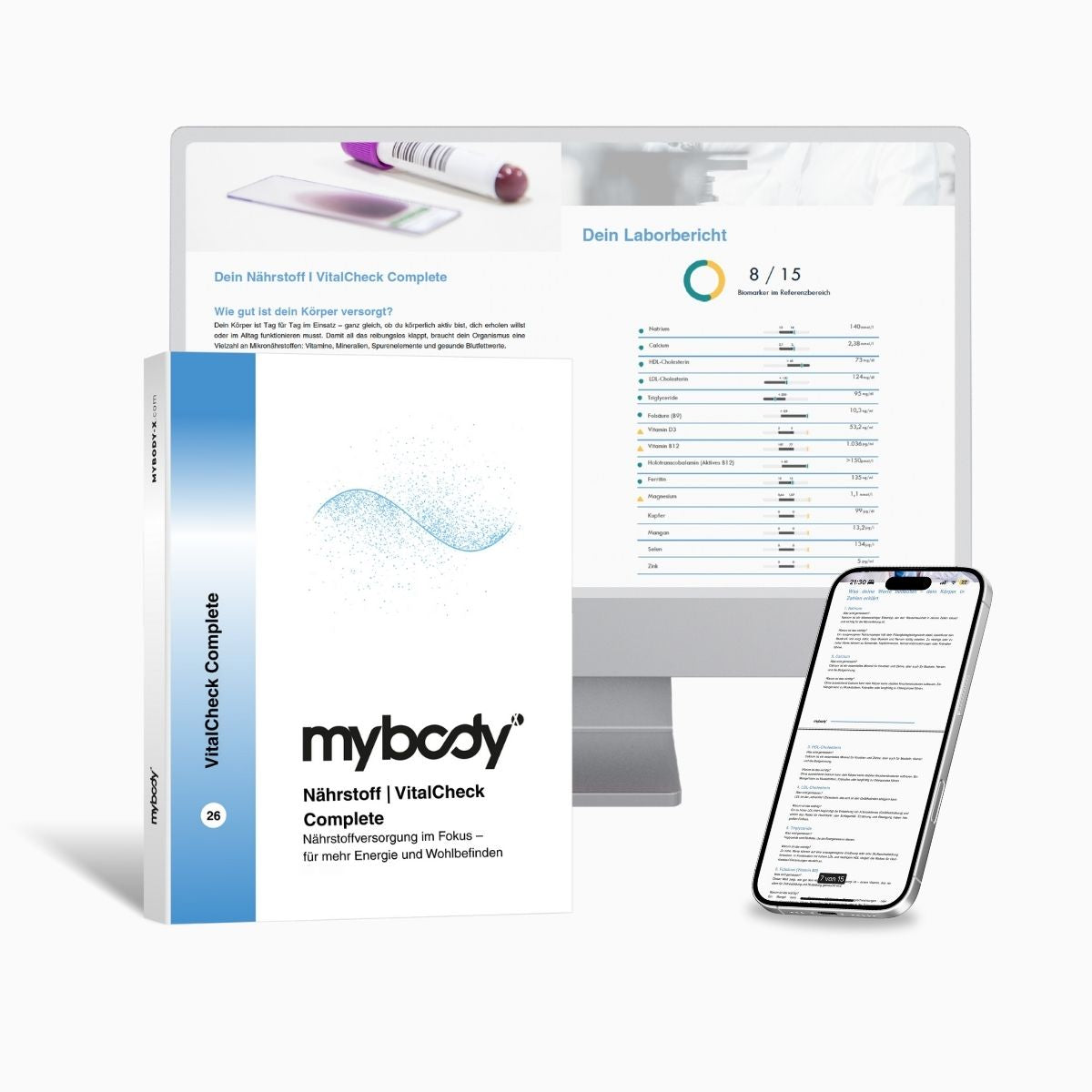
Nutrient | VitalCheck Complete
Comprehensive at-home blood analysis—including the minerals sodium, calcium, and magnesium, as well as important vitamins and trace elements. For an informed overview instead of taking supplements on speculation.
Price: €169.00 (instead of €199.00) · Sample type: Capillary blood (at home) · Processing time: approx. 10–15 business days · Laboratory: ISO-certified, GDPR-compliant
View the Nutrient CheckInformation on the price, sample type, processing time, and markers comes from the mybody® product page (as of July 2026) and may change. A self-test does not replace a medical diagnosis.
Interpretation: What a test can—and cannot—do
A blood test makes individual mineral levels visible and provides a basis for decisions. It shows whether your levels are within the reference range and helps you avoid taking supplements blindly.
At the same time, every test has limitations. Blood electrolyte levels are a snapshot that the body regulates closely—and for some minerals, especially magnesium, the blood level reflects overall status only to a limited extent because most of it is bound in bones and cells.
A test therefore does not replace a medical diagnosis. It answers the question “Where do I currently stand?”, but not automatically the question “What is causing my symptoms?”. Abnormal values should be medically interpreted, as should symptoms that persist despite normal results.
The most useful way to use a test is therefore as preparation: You can enter the conversation with concrete numbers rather than vague assumptions—and decide together whether further examinations are needed or a targeted dietary change is sufficient.
Conclusion
A lack of electrolytes primarily affects the muscles, nerves, and heart: muscle cramps, muscle twitching, weakness, fatigue, headaches, dizziness, nausea, tingling, and palpitations are typical signs. The symptom alone cannot show which electrolyte is lacking.
The context is crucial: After heavy sweating, diarrhea or vomiting, while taking diuretics, and with a very one-sided diet, an electrolyte deficiency is plausible. Without such a trigger, other causes such as sleep deprivation, iron deficiency, or thyroid problems are significantly more likely.
In practical terms, this means replacing what you have specifically lost rather than replenishing everything as a precaution. And if symptoms persist, worsen, or affect your heart, the next step is not a new supplement but testing and a discussion with a doctor.
Frequently asked questions (FAQ)
Measure instead of guessing
If cramps, fatigue, or weakness keep recurring: The nutrient | VitalCheck Complete shows you your mineral status (including sodium, calcium, and magnesium) from an at-home blood sample—ISO-certified and GDPR-compliant.
Discover nutrient testsYou might also be interested in
→ Is it healthy to drink electrolytes every day?
Why daily electrolytes are unnecessary for most people—and who may benefit.
→ Test for nutrient deficiencies: Recognize symptoms and address them specifically
Which signs indicate a deficiency and what really helps.
Sources
- Hew-Butler, T. et al. (2017): “Exercise-Associated Hyponatremia: 2017 Update” (Frontiers in Medicine) – development and symptoms of dilutional hyponatremia. frontiersin.org
- World Health Organization (WHO): “Oral rehydration salts” – composition and use of oral rehydration solutions in cases of fluid and electrolyte loss. who.int
- World Health Organization (WHO): “Sodium reduction” – recommendation of less than 5 g of salt (2 g of sodium) per day for adults. who.int
- German Nutrition Society (DGE) – reference values for the intake of sodium, potassium, calcium, and magnesium, as well as food sources. dge.de
- European Food Safety Authority (EFSA): Dietary Reference Values – scientific reference values for minerals and water. efsa.europa.eu
- IQWiG / gesundheitsinformation.de – clear, accessible health information on symptoms, diagnostics, and medical evaluation. gesundheitsinformation.de
The statements on dilutional hyponatremia during endurance exercise are based on [1], the recommendations for oral rehydration in cases of diarrhea and vomiting on [2], and the information on salt and sodium intake on [3]; reference values and food sources are based on [4] and [5], while general guidance on seeking medical evaluation is based on [6]. Product-related information from mybody® (price, sample type, processing time, markers) comes from the respective product page on mybody-x.com and may change.

mybody® Editorial & Expert Team
This article was created by the mybody® editorial and expert team, which brings together expertise in nutritional science, blood analysis interpretation, laboratory diagnostics, and sports and metabolic science. Learn more about our team on our editorial and authors’ page.
Published on July 27, 2026 · Last updated on July 27, 2026
Medical notice: This article is intended for general information and does not replace medical advice, diagnosis, or treatment. If symptoms persist, you experience heart palpitations, pronounced muscle weakness, have pre-existing conditions (e.g., affecting the heart or kidneys), or take medication, please consult a doctor.




Share now:
Is it healthy to drink electrolytes every day?
Strengthening the immune system is important—what’s the right way to do it?