
Plant-based iron: why absorption matters
The essentials at a glance
There are two forms of iron, and they are absorbed differently. The MSD Manual, Professional Edition, describes the difference in two sentences (as of May 2025).
This explains why, on this topic, the content of a meal says less than the question of how much of it is absorbed. It also explains why, on a test report, the storage value is more informative than the iron value.
First, you will read what distinguishes the two forms. This is followed by a comparison of the values, a fact check of three common statements, the figures from the key sources, and the question of which value is appropriate when.
What to expect in this article
1. Two forms, one element
2. The sentence that describes the difference
3. The surprising proportion
4. The values compared
5. Why the iron value alone says little
6. Three sentences in the fact check
7. The key point in one sentence
8. What the source says about absorption
9. The figures from the key sources
10. Why the storage value is the better question
11. Who can benefit from a measurement
12. Two options at mybody®x
13. Limitations: what the values leave open
14. What matters about iron
Frequently asked questions
Sources
Two forms, one element
Iron is an element, yet the specialist literature distinguishes two forms of it in food.
The difference lies in the chemical bond. Heme iron is contained within a specific molecular framework, while non-heme iron is bound differently.
For the body, this is not a detail. It determines how much of the iron on the plate actually enters the bloodstream.
IQWiG explains why this matters at all: iron is an essential trace element that the body needs to produce the red blood pigment that transports oxygen (as of March 20, 2025).
The sentence that describes the difference
The specialist literature summarizes the difference in two sentences and explicitly names both sources.
Documented source
“Heme iron is found mainly in animal products. It is absorbed significantly better than non-heme iron, which is found in plants and grains.”
Larry E. Johnson, MD, PhD
MSD Manual, Professional Edition, Iron Deficiency, as of May 2025
The crucial word is “absorbed.” It describes absorption from the intestine into the body, not the amount in food.
A classification without a number is clearly better here. We did not find a percentage figure for the difference between the two forms in this source, so we do not include one.
What follows from this is a perspective: for this element, the question of absorption is more precise than the question of content.
The surprising proportion
A second statement from the same source turns a common assumption on its head.
The MSD Manual, professional edition, states: Non-heme iron is responsible for over 85 percent of the iron in the average diet (as of May 2025).
This figure refers to the average diet overall, not to any particular type of diet. Even with a mixed diet, by far the largest share of iron comes from the less readily absorbed form.
Thus, the question of absorption is not unique to a plant-based diet. It arises with every type of diet, but with varying importance.
The values compared
The table compares four quantities mentioned in connection with iron. It provides context and does not constitute a diagnosis.
| Quantity | What it describes | What the sources say about it | What it leaves open |
|---|---|---|---|
| Heme iron in food | The form found mainly in animal products | Is absorbed significantly better than non-heme iron (MSD Manual, as of May 2025) | A percentage indicating the extent of the difference |
| Non-heme iron in food | The form found in plants and grains | Accounts for more than 85 percent of the iron in the average diet (as of May 2025) | How much of it actually reaches the body in an individual case |
| Serum iron level | The amount in the blood at the time the sample is taken | Has little significance on its own because the values fluctuate considerably over the course of a day (IQWiG, as of 20 March 2025) | The store—a low value alone is not meaningful |
| Ferritin | The store, not the moment | According to IQWiG, one of the values used to interpret the iron level together with other values (as of 20 March 2025) | The cause of a change |
The third line is the practically most important entry, and it is explained in the next chapter.
Why the iron level alone says little
When reading a test result, this is the most common stumbling block, and the source is unusually clear on this point.
IQWiG writes: The value has little significance on its own because iron levels fluctuate considerably over the course of a day (IQWiG, as of 20 March 2025).
And it gives the reason: It temporarily rises after eating something and falls when you have not consumed anything for a longer period (as of 20 March 2025).
The conclusion is stated by the same source itself: A low iron level alone is not meaningful and does not necessarily mean that something is wrong with iron metabolism. It is interpreted together with other laboratory values such as ferritin, transferrin, and transferrin saturation (as of 20 March 2025).
Three statements in the fact check
These three statements regularly come up when discussing iron from plant sources.
Checked against the evidence
Commonly held
“If there is enough iron in the food, there is enough iron available.”
Substantiated
The MSD Manual distinguishes between content and absorption: Heme iron is absorbed significantly better than non-heme iron, which is found in plants and grains (as of May 2025). The iron content of a meal therefore does not indicate how much is absorbed.
Commonly held
“The absorption problem only affects plant-based diets.”
Substantiated
According to the same source, non-heme iron accounts for more than 85 percent of the iron in the average diet (as of May 2025). The less readily absorbed form therefore predominates even in a mixed diet.
Commonly held
“A low iron value means iron deficiency.”
Substantiated
IQWiG states: A low iron value alone is not meaningful and does not necessarily mean that something is wrong with iron metabolism (as of March 20, 2025). It should be interpreted together with ferritin, transferrin, and transferrin saturation.
The core in one sentence
At this point, the topic can be condensed into one sentence.
With iron, it is not how much is on the plate that matters. What matters is how much is absorbed.
This difference explains why nutrition tables are less informative for iron than for other nutrients. They describe the content, and here the content is only half the story.
And it explains why, on this topic, a laboratory value is more useful than a calculation. The value describes what is actually present, regardless of how it got there.
What the source says about absorption
The professional literature gives one detail concerning factors affecting absorption, which we reproduce without turning it into a recommendation.
The MSD Manual, professional edition, states: The absorption of non-heme iron can be increased when it is consumed with animal protein and vitamin C (as of May 2025).
This is the source’s statement about two factors. It contains no quantity, timing, or recommendation, and this article adds none of these.
What we did not find
The reviewed source contained no statements about substances that inhibit absorption. Guide texts regularly mention various components in this context; we cannot substantiate this using the sources reviewed here.
This gap therefore remains open. Anyone who needs information on this should seek medical or nutritional advice rather than relying on this article.
The figures from the key sources
Three pieces of information, each with its source and date. They provide context and do not constitute a diagnosis.
Documented information
over 85%
of the iron in the average diet is non-heme iron (MSD Manual, professional edition, as of May 2025)
40–150
µg/dl serum iron for women over 18; for men over 18, it is 60 to 160 µg/dl (IQWiG, as of 2025-03-20)
below 30
ng/ml ferritin: threshold for the iron-ferritin self-test according to the product page, accessed 2026-08-15
The third figure is a threshold for a method, not a reference range. The reference range stated on your own report is decisive because reference values can vary from one laboratory to another (IQWiG, as of 2025-04-02).
Why the storage value is the better question
The information above suggests a practical order for reading a test result.
The iron value describes a moment, and according to IQWiG, that moment depends in part on when you last ate. The storage value, by contrast, describes a reserve.
For a question arising from your diet and developing over months, a storage measure is more appropriate than a snapshot.
The sister article Blood Values on a Plant-Based Diet covers which five values may be relevant overall for a plant-based diet.
Who may benefit from testing
The comparison concerns the question of which of the two options is right for you.
Useful for you if …
You only know an iron value so far and the corresponding storage value is missing.
You have changed your diet and want to establish a dated baseline value.
You want to see the storage value together with iron and transferrin from the same sample.
You want to bring dated figures to a consultation at a medical practice.
Probably not if …
If you hope to draw conclusions about your diet. A laboratory value does not assess a diet.
If you want to use the result to decide about an iron supplement. That belongs in a medical practice.
If you are already undergoing medical evaluation. In that case, the practice that started it should guide you.
If you expect a diagnosis. That comes from a medical practice, not a self-test.
Two options from mybody®x
Both options are available from mybody®x (MYBODY Lab GmbH), and neither provides a diagnosis. One gives a classification within minutes; the other provides a number with a reference range and additional values alongside it.
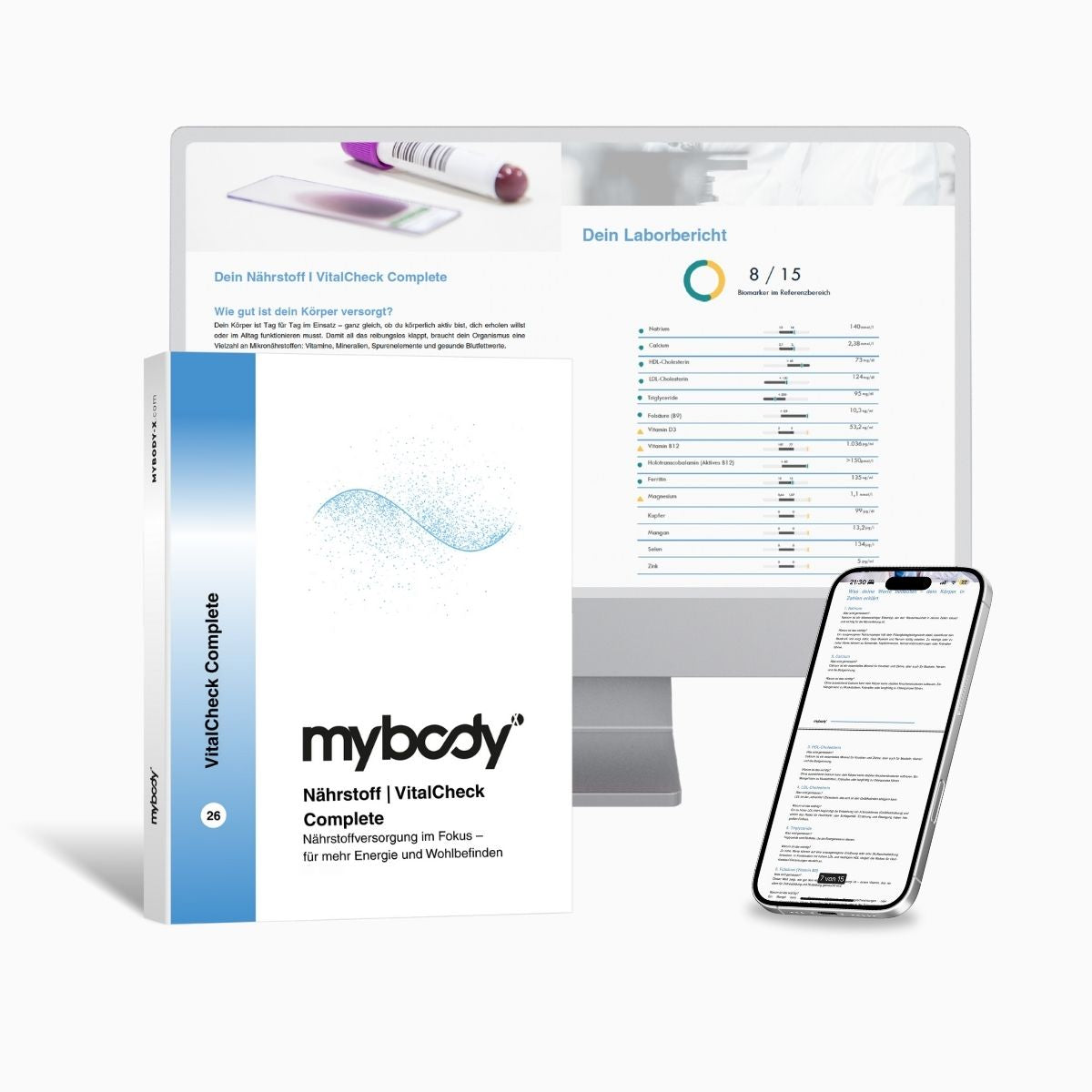
Laboratory testing from capillary blood
VitalCheck | Complete Nutrient & Mineral Test
Provides 18 values, including ferritin, iron, and transferrin from the same sample—the parameters IQWiG identifies for joint interpretation. It also includes vitamin B12, folate, vitamin D, calcium, magnesium, phosphate, selenium, zinc, albumin, long-term blood glucose, CRP, and the cholesterol profile. What the test does not do: It does not determine transferrin saturation, assess a dietary pattern, provide a diagnosis, or replace a medical examination.
Laboratory analysis 3–5 business days after receipt of the sample
Product page information, accessed 15 August 2026
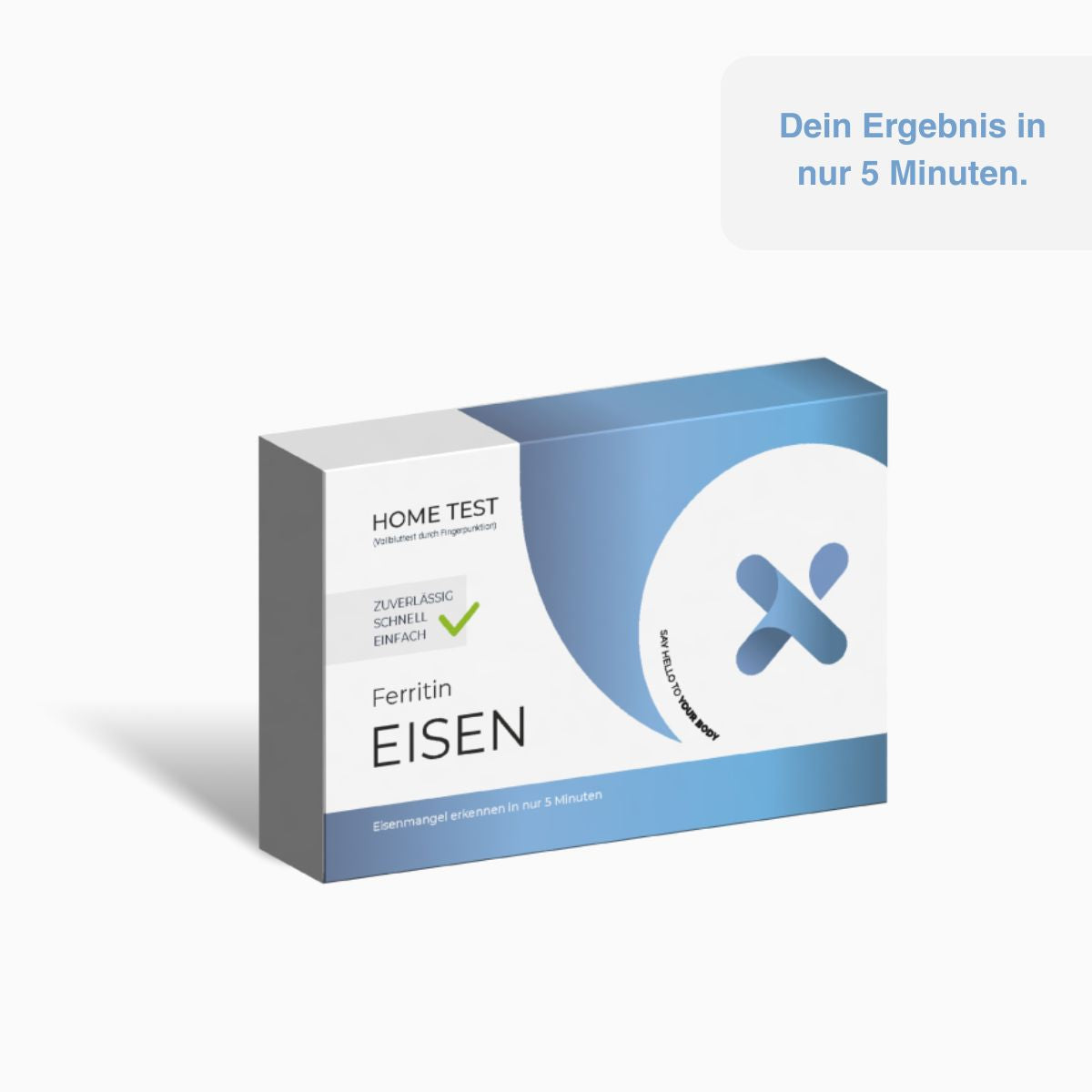
Rapid test for home use
Iron-Ferritin Self-Test
Determines ferritin from capillary blood and assigns the result to a fixed threshold, according to the product page a ferritin concentration below 30 ng/ml. What the test does not do: It does not provide a numerical value, measure iron or transferrin, allow comparison between two points in time, provide a diagnosis, or replace a medical examination.
Product page information, accessed 15 August 2026
Four points determine whether an iron result becomes useful information.
Interpret storage levels
According to IQWiG, the iron level alone has little significance.
Note the meal
The iron level rises after eating and falls during a longer break.
Absorption rather than content
A nutrition table describes the content, not absorption.
Discuss the interpretation
What follows from a result is determined by a medical practice.
Chapter at a glance
A rapid test assigns the ferritin value to a threshold, while laboratory testing provides ferritin, iron, and transferrin as numerical values. Neither provides a diagnosis. Four points are crucial: interpret storage levels, note the meal, focus on absorption rather than content, and discuss the interpretation.
Limitations: what the values leave open
The first limitation is the missing percentage. The reviewed source does not say exactly how large the absorption difference between the two forms of iron is. It says “significantly better,” and that is where this article leaves it.
The second limitation is the inhibiting factors. The reviewed source contained no information about substances that reduce absorption, and this article does not invent any.
The third limitation is the cause. A low storage value says nothing about where it comes from. This should be clarified in a medical practice, and supplementation without this clarification is expressly not the subject of this article.
The fourth limitation is diagnosis. All the explanations in this article provide context and are not diagnoses. A diagnosis is made in a medical practice based on several factors, and no self-test can anticipate it.
What matters with iron
If you take away just one thing from this article, let it be this: With iron, absorption matters, not content.
Heme iron from animal products is absorbed significantly better than non-heme iron from plants and grains. And the less readily absorbed form accounts for more than 85 percent of the iron in the average diet.
The question at the outset was about absorption. The practical answer leads away from the plate and toward the test result: The storage marker shows what is actually present, regardless of how it got there.
Frequently asked questions
Is plant-based iron absorbed less efficiently?
The MSD Manual, professional edition, states: Heme iron is found mainly in animal products. It is absorbed significantly better than non-heme iron, which is found in plants and grains (as of May 2025). The source does not give a percentage for the extent of the difference.
Does this apply only to vegetarian or vegan diets?
No. The same source states that non-heme iron accounts for more than 85 percent of the iron in the average diet (as of May 2025). The less readily absorbed form therefore predominates even in a mixed diet.
Why does the iron level in the blood tell us so little?
IQWiG writes: The value has little significance on its own because iron levels fluctuate considerably over the course of a day. It rises temporarily after eating something and falls when you have not eaten for a longer period. A low iron level on its own is not meaningful (as of March 20, 2025). Interpretation is carried out together with ferritin, transferrin, and transferrin saturation.
Can absorption be influenced?
The reviewed source makes one statement on this: The absorption of non-heme iron can be increased when it is consumed with animal protein and vitamin C (MSD Manual, professional edition, as of May 2025). It does not specify an amount or timing, and this article makes no recommendation on the matter. The source contains no information about factors that inhibit absorption.
What reference ranges apply to serum iron?
IQWiG gives 40 to 150 µg/dL for women over 18 and 60 to 160 µg/dL for men over 18 (as of March 20, 2025). The reference range on your own test result remains decisive because reference values can vary from one laboratory to another. In any case, the value should not be interpreted on its own.
Next step
Look at the stores, not the moment
Iron levels fluctuate throughout the day, while storage levels do not fluctuate in the same way. VitalCheck measures ferritin, iron, and transferrin along with 15 other values from capillary blood. It does not assess any dietary pattern, provide a diagnosis, or replace medical evaluation.
To VitalCheckRead more
You might also be interested in
Which values belong on a list and why.
What IQWiG writes about the benefits of dietary supplements.
Sources
- MSD Manual, Professional Edition: Iron Deficiency, Johnson LE (fully reviewed May 2025) – msdmanuals.com
- Institute for Quality and Efficiency in Health Care (IQWiG): Iron, as of 20.03.2025 – gesundheitsinformation.de
- IQWiG: Understanding laboratory values correctly, as of 02.04.2025 – gesundheitsinformation.de
The verbatim quotation on heme and non-heme iron, the figure of over 85 percent, and the statement about increasing absorption with animal protein and vitamin C are taken from source [1]. The definition of iron as an essential trace element, the reference ranges of 40 to 150 µg/dl and 60 to 160 µg/dl, the statements about daily fluctuations and the lack of significance of a single low result, as well as the mention of ferritin, transferrin, and transferrin saturation, are taken from [2]. The explanation of the reference range is taken from [3]. No percentage figure for the difference in absorption or statements about inhibitory factors were found in the sources reviewed; this is explicitly stated in the text. Information on price, values, sample type, threshold, and laboratory comes from the mybody®x product pages, accessed on 15.08.2026; the processing times for the laboratory process follow the central specification for blood tests. All sources were accessed and reviewed on 15.08.2026.

mybody®x Editorial & Expert Team
Laboratory diagnostics Blood analysis interpretation Nutritional science Nutrigenetics
This article was created by the mybody®x editorial and expert team. The team combines laboratory diagnostics, nutritional science, and the interpretation of blood analyses. Those who contribute to it are listed on the authors page.
Published on 15.08.2026 · Last updated on 15.08.2026
The content is for general information only and does not replace medical advice, diagnosis, or treatment. Reference ranges depend on the laboratory, method, and age; the information on your test report is always authoritative.



Share now:
Interpreting blood sugar after eating correctly
Calcium in the blood says little about the bones