

Blood calcium reveals little about the bones
The key points at a glance
Calcium and bones belong together. Blood calcium levels and the condition of the bones do so only to a very limited extent.
The reason lies in two figures and a regulatory circuit: Almost all calcium is in the bones, and the blood level is kept so tightly under hormonal control that it can still look normal even when something is happening in the bones.
You will read three documented facts, the cited source verbatim, three common statements checked against the facts, four questions with the values relevant to each, and a clear statement of what a blood value cannot tell you here.
What to expect in this article
1. What a calcium level measures
2. Three facts about calcium
3. Where the calcium actually is
4. The documented source
5. Why the blood level remains so stable
6. Three statements in the fact check
7. What albumin has to do with the calcium level
8. The key point in one sentence
9. What actually assesses the bones
10. Four questions and the values that answer them
11. Vitamin D as the value to check alongside it
12. Who may benefit from a calcium test
13. What a capillary blood test can show here
14. Limitations: what the value leaves unanswered
15. What matters for this value
Frequently asked questions
Sources
What a calcium level measures
Calcium is the mineral that almost everyone associates with bones. IQWiG describes it as an important mineral obtained through food and notes that by far the largest proportion is bound in the teeth and bones, making them stable (as of March 20, 2025).
This leads to an understandable expectation. If calcium is stored in the bones, then a blood calcium level should tell us something about the bones.
This expectation is not borne out, and the reason is well documented. It has to do with the distribution of calcium in the body and with a regulatory circuit that keeps the blood level stable for precisely this reason.
This article explains what a calcium level can tell you, what it cannot tell you, and which value should sensibly appear next to it on a test report.
Three facts about calcium
Three pieces of information from the reviewed sources. They provide context and are not a diagnosis.
Documented information
99 %
of the calcium contained in the body is stored in the bones, mainly as hydroxyapatite crystals (MSD Manual, professional edition, as of June 2025)
40 %
of total calcium in the blood is bound to plasma proteins, especially albumin (MSD Manual, as of June 2025)
2,20–2,54
mmol/l is the stated reference range for women and men over 18; this corresponds to 8.8–10.2 mg/dl (IQWiG, as of March 20, 2025)
The first and third figures together provide the picture presented in this article. A very narrow reference range describes a very small portion of a very large reserve.
And as with every laboratory value, the key factor is the reference range stated on your own report, because reference values can vary from one laboratory to another (IQWiG, as of April 2, 2025).
Where the calcium actually is
Distribution in the body is the first reason why the blood calcium level reveals little about the bones.
The MSD Manual states that approximately 99 percent of the calcium in the body is stored in the bones, mainly as hydroxyapatite crystals (as of June 2025). The remainder is distributed among cells and body fluids, and only part of it is what a laboratory measures in serum.
The same source gives a second figure that is even more revealing: Approximately 1 percent of the calcium stored in bone is freely exchangeable with extracellular fluid and is therefore available to compensate for changes in calcium balance (as of June 2025).
The bone is therefore not a passive store, but a buffer with an open door. What is missing from the blood can be supplied from there, and that is exactly what makes the blood value look unremarkable.
The documented source
The mechanism behind this appears in a single sentence from a public source.
Documented source
“Blood calcium levels are normally regulated very precisely by various hormones: when blood calcium levels fall, the hormone known as parathyroid hormone releases calcium from the bones.”
Institute for Quality and Efficiency in Health Care
IQWiG, gesundheitsinformation.de, Calcium, as of March 20, 2025
This sentence describes not a side effect, but the system’s main task. The blood level is the quantity being regulated, and the bone is one of the levers used to regulate it.
This leads to the central point of this article. A normal blood calcium level shows that the regulation is working. It does not show where the calcium is currently coming from.
A measuring device that measures a regulated quantity also measures the regulation. This is not a deficiency of the measurement, but a feature of how it works.
Why blood calcium levels remain so stable
How tightly this system operates is shown by the reference range itself.
For women and men over 18, IQWiG gives a range of 8.8 to 10.2 mg/dL, or 2.20 to 2.54 mmol/L (as of March 20, 2025). The lower and upper limits therefore differ by just over 15 percent, and the same range applies to both sexes.
For comparison: For women, the same source gives a copper range of 10.7 to 26.6 µmol/L, a span of well over twice the lower value. The ranges for ferritin are even wider.
A narrow reference range is therefore an indication of tight regulation. And tight regulation means that the level changes only when something happens within the regulatory system itself—not as soon as the reserve changes.
Three statements under the microscope
These three statements come up as soon as a calcium result is on the table.
Checked against the available evidence
Widespread
“My calcium level is normal, so my bones are fine.”
Documented
Blood calcium levels are regulated very precisely by various hormones, and when they fall, parathyroid hormone releases calcium from the bones (IQWiG, as of March 20, 2025). This keeps the level within the normal range even when regulation draws on the bones.
Widespread
“A value outside the range always means something.”
Documented
IQWiG notes in the same article: Healthy people also sometimes have values outside the reference range (as of March 20, 2025). Elsewhere, the same source quantifies this as 5 percent (as of April 2, 2025).
Widespread
“The calcium level measures calcium.”
Documented
A total calcium measurement also measures the transport protein. Approximately 40 percent of the total calcium in the blood is bound to plasma proteins, primarily albumin, and under normal conditions, ionized calcium accounts for approximately 50 percent of total serum calcium (MSD Manual, as of June 2025).
What albumin has to do with the calcium level
The third point from the fact-check deserves its own chapter because it becomes immediately practical when reading a test result.
The MSD Manual describes the distribution as follows: Approximately 40 percent of the total calcium in the blood is bound to plasma proteins, primarily albumin, and under normal conditions, ionized calcium is assumed to account for approximately 50 percent of total serum calcium (as of June 2025).
An ordinary laboratory report gives the total calcium level. This figure therefore contains both fractions: bound and free calcium.
This leads to a rule for reading a test result: A calcium value is more informative together with the albumin value than on its own. If the albumin level shifts, the total calcium level shifts with it, even though the free fraction does not necessarily change.
How a laboratory handles this mathematically and whether a separate measurement of ionized calcium makes sense in an individual case is decided by a medical practice. This article does not provide a formula for it.
The core in one sentence
At this point, the topic can be brought together.
The calcium level does not measure the stores. It measures how well the stores are regulated.
That is not an argument against measuring it. A value that reflects the regulation is a meaningful value as soon as it is interpreted as such.
That is an argument against deriving a statement about the bone from it. This question is different and is answered by other means.
What actually assesses the bone
If a blood value does not answer the question about the bone, it should be stated who does answer it.
Assessing the bone is a medical task. It is based on the medical history, the physical examination, and imaging or measurement procedures ordered by a medical practice or clinic.
A capillary blood self-test has nothing to do with that, nor does it claim to. It provides laboratory values, and laboratory values are one of several building blocks.
This article deliberately names neither diseases nor thresholds at which someone should take action. Both belong in a conversation with someone who knows the full medical history.
Why the expectation nevertheless seems plausible
Confusing the calcium value with the condition of the bones is not due to carelessness. It arises from a linguistic habit.
When a source says that calcium is bound for the vast majority in teeth and bones and makes them stable (IQWiG, as of 20 March 2025), it is referring to the substance, not the laboratory value. In our minds, however, the two still merge because they have the same name.
The same effect occurs with other values. A serum iron value is not the body's iron stores, and a serum magnesium value is not the body's magnesium content. In all three cases, a number bears the name of a substance and measures one aspect of it.
Once this distinction is clear, each of these test results is read differently. The question is no longer whether a value is good, but which aspect it shows.
Four questions and the values associated with them
The table assigns four questions to the values that may be relevant to answering them. It provides context and does not constitute a diagnosis.
| Question | Does the calcium value answer this? | What the sources say about it | Where the question belongs |
|---|---|---|---|
| Is the blood level within range? | Yes, that is exactly its purpose | Reference range 2.20–2.54 mmol/l for women and men over 18 (IQWiG, as of 20 March 2025) | A laboratory test result with a date, interpreted using the reference range of the relevant laboratory |
| How are the bones doing? | No | When the blood level falls, parathyroid hormone releases calcium from the bones (IQWiG, as of 20 March 2025)—the value nevertheless remains within range | A medical practice, with the examinations provided there |
| Am I getting enough calcium? | No | 99% of the body's calcium is found in the bones, and 1% of that is freely exchangeable (MSD Manual, as of June 2025)—intake is not reflected by the blood value | A dietary assessment evaluated in a medical practice or during a consultation |
| Has something shifted the value? | Partly, when albumin is listed next to it | 40% of total calcium in the blood is bound to plasma proteins, especially albumin (MSD Manual, as of June 2025) | A test result containing calcium and albumin from the same sample |
The second line is the reason this article was written. It is also the only one where common expectations and the available evidence clearly diverge.
Vitamin D as the value next to it
Anyone interested in calcium will inevitably come across a second value.
Vitamin D and calcium are linked because vitamin D is involved in the absorption of calcium from the intestine. It therefore makes sense for the two to appear next to each other on a test result.
Vitamin D does, however, call for a degree of caution of its own. The IQWiG states: Low blood levels alone do not yet constitute a vitamin D deficiency (as of 15 November 2023).
This means the two values share one characteristic. They can each be measured separately and are difficult to interpret on their own; both only become more meaningful in conjunction with other values, symptoms, and an examination (IQWiG, as of 20 March 2025).
Who benefits from a calcium test
The comparison relates to whether a documented calcium value would help you.
Makes sense for you if …
You want to see the calcium value together with albumin and vitamin D from one sample.
You want to bring dated figures to a discussion at your medical practice.
You want to establish a baseline before changing something about your diet.
You want to see several values at the same time instead of collecting individual reports.
Probably not if …
You expect information about your bones. This value does not provide it.
You want to know whether you are eating enough calcium. The blood value does not reflect that.
You are already undergoing evaluation. In that case, follow the practice that initiated it.
You expect a diagnosis. That is provided by a medical practice, not a self-test.
What a capillary blood test can show here
A capillary blood self-test does not provide a diagnosis or assess bones. What it can do is show several values from the same sample side by side.
That is the actual benefit for this topic. Calcium alone is difficult to interpret; calcium together with albumin is easier to read, and with the vitamin D value alongside it, the context appears on one sheet.
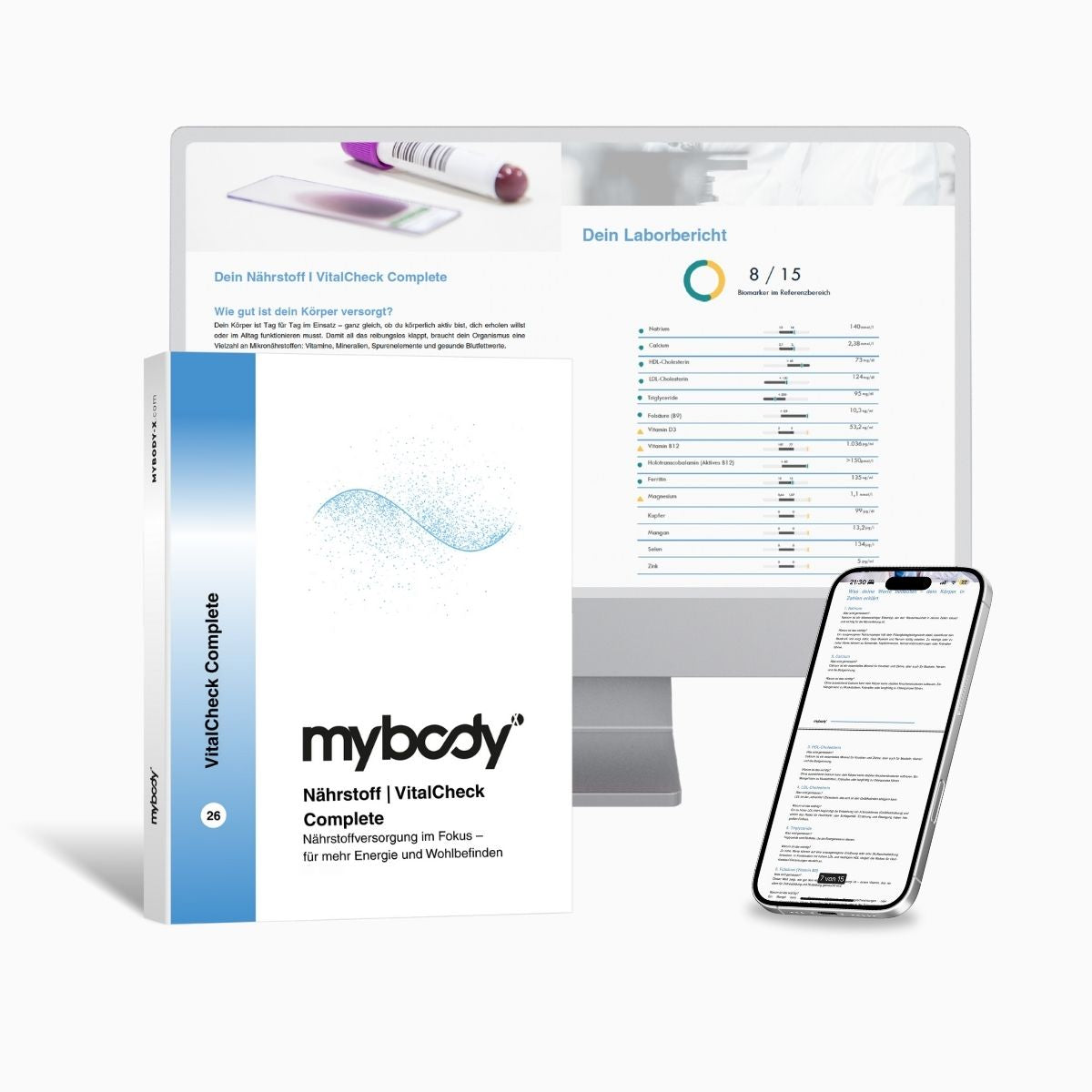
Capillary blood test
VitalCheck | Nutrient & Mineral Test Complete
Measures 18 values from the same sample, including calcium, albumin, 25-OH vitamin D3, magnesium, phosphate, ferritin, iron, transferrin, vitamin B12, folate, selenium, zinc, CRP, long-term blood sugar, as well as total cholesterol, HDL, LDL, and triglycerides. What the test does not do: It does not assess bones, measure bone density, reflect calcium intake, provide a diagnosis, or replace a medical examination.
Laboratory evaluation 3–5 business days after sample receipt
Product page information, accessed August 17, 2026
The test is from mybody®x (MYBODY Lab GmbH). It says nothing about the bones, and neither does this article.
Chapter at a glance
A capillary blood test measures calcium, albumin, and vitamin D from the same sample and thus makes the result easier to interpret. It does not assess the bones, and all three values should be interpreted in a medical practice.
Limitations: what the value leaves unanswered
The first limitation concerns the bone. A blood value cannot answer this question because hormonal regulation is specifically designed to keep the blood level stable regardless of it (IQWiG, as of March 20, 2025).
The second limitation is intake. How much calcium someone gets through their diet cannot be determined from a blood value. That is because 99 percent of the supply is in the wrong place for this purpose (MSD Manual, as of June 2025).
The third limitation is the value itself. A total calcium measurement includes the portion bound to albumin, and without the albumin level alongside it, it remains unclear whether a change comes from the calcium or the protein (MSD Manual, as of June 2025).
The fourth limitation is diagnosis. A single laboratory value usually cannot establish a disease; only when considered together with other values, symptoms, and examinations does a clear picture emerge (IQWiG, as of March 20, 2025).
What matters about this value
If you take just one thing away from this article, let it be this: The calcium level in the blood answers a different question from the one most people are asking when they look at it.
It shows whether hormonal regulation is maintaining its target level. It does not show how much calcium is present in the body, how much of it has been absorbed, or what is happening in the bones. This is because 99 percent of the reserve is stored in the bones and the blood level is regulated very precisely by hormones.
What this value can do, on the other hand, is often underestimated: Together with the albumin and vitamin D levels from the same sample, it is a clearly interpretable building block for a conversation. This conversation takes place in a medical practice.
Frequently asked questions
Does a normal calcium level tell me anything about my bones?
According to the cited sources, very little. IQWiG explains that the calcium level in the blood is regulated very precisely by various hormones and that parathyroid hormone releases calcium from the bones when the blood level falls (as of March 20, 2025). The blood level therefore remains within range. Bone health should be assessed in a medical practice.
How much calcium is actually in the blood?
The MSD Manual states that approximately 99 percent of the calcium in the body is stored in the bones, mainly as hydroxyapatite crystals (as of June 2025). About 1 percent of the calcium stored in the bones is freely exchangeable with extracellular fluid.
Why should albumin be listed alongside the calcium level?
Because a total calcium measurement also reflects the transport protein. Approximately 40 percent of the total calcium in the blood is bound to plasma proteins, primarily albumin, while ionized calcium accounts for approximately 50 percent of total serum calcium under normal conditions (MSD Manual, as of June 2025). A medical practice determines whether a separate measurement is appropriate in an individual case.
Which reference range applies to calcium?
IQWiG gives 8.8 to 10.2 mg/dL or 2.20 to 2.54 mmol/L for women and men over 18 (as of March 20, 2025). The reference range on your own test report is always decisive, because reference values can vary from one laboratory to another. The same source notes that healthy people sometimes also have values outside the reference range.
Does the calcium value show whether I eat enough calcium?
No. Dietary intake is not reflected by the blood value. The reason is the same as with the question about bones: Almost the entire supply is stored in the bones (MSD Manual, as of June 2025), and the blood level is tightly regulated by hormones (IQWiG, as of 20 March 2025). Information about intake comes from a dietary assessment, not from a laboratory value.
Next step
How to read calcium together with the adjacent value
The VitalCheck measures 18 values from capillary blood, including calcium, albumin, and 25-OH vitamin D3 from the same sample. It does not assess bones, reflect intake, provide a diagnosis, or replace medical evaluation.
To the VitalCheckRead more
You might also be interested in
Why three values from one sample do not measure the same thing.
A proven connection and a figure that does not exist.
Sources
- Institute for Quality and Efficiency in Health Care (IQWiG): Calcium, as of 20 March 2025 – gesundheitsinformation.de
- MSD Manual, Professional Edition: Overview of disorders of calcium concentration, Lewis JL III (as of June 2025) – msdmanuals.com
- IQWiG: Vitamin D deficiency, as of 15 November 2023 – gesundheitsinformation.de
- IQWiG: Copper, as of 20 March 2025 – gesundheitsinformation.de
- IQWiG: Understanding laboratory values correctly, as of 2 April 2025 – gesundheitsinformation.de
The verbatim quotation on hormonal regulation and parathyroid hormone, the description of the mineral, the reference range for adults over 18, the sentence about healthy people outside the reference range, and the sentence about the significance of an individual laboratory value are taken from source [1]. The figures of 99 percent, 1 percent, 40 percent, and 50 percent come from [2]. The sentence about low vitamin D blood levels comes from [3]. The copper reference range cited for comparison comes from [4]. The explanation of the reference range and the figure of 5 percent come from [5]. Information on price, values, sample type, and laboratory comes from the mybody®x product page, accessed on 17 August 2026; processing times follow the central requirements for blood tests. All sources were accessed and reviewed on 17 August 2026.

mybody®x Editorial & Specialist Team
Laboratory diagnostics Blood analysis interpretation Nutritional science Nutrigenetics
This article was created by the mybody®x editorial and specialist team. The team combines laboratory diagnostics, nutritional science, and the interpretation of blood analyses. Everyone involved is listed on the author page.
Published on 17 August 2026 · Last updated on 17 August 2026
The content is intended for general information and does not replace medical advice, diagnosis, or treatment. Reference ranges depend on the laboratory, method, and age—always refer to the information on your test result.




Share now:
Plant-based iron: why absorption matters
The second blood test answers what the first one shows.