

Get your hormone levels tested and finally gain clarity
Do you often feel simply exhausted, are easily irritable, or struggle with unexplained weight fluctuations? This isn't always just the usual everyday stress. Often, it's your hormones pulling the strings behind the scenes and causing chaos. Having your hormone levels tested is often the first and most important step to finally gaining clarity and taking control of your well-being again.
When is a hormone test really useful for you?
Your body is constantly sending you signals – sometimes subtle hints, sometimes unmistakable cries for help. Persistent fatigue, inexplicable mood swings, or stubborn skin problems are not just side effects of a hectic life. Rather, they can be direct indications that your internal hormonal orchestra is out of rhythm.
Think of hormones like estrogen, progesterone, testosterone , and the stress hormone cortisol as the conductors of your body. They control your sleep, your energy, your mood, and even your metabolism. Even tiny shifts in this delicate balance can have a massive impact on your daily life. So, if you feel like you're not quite yourself anymore, looking at your hormone levels can provide crucial answers.

Typical symptoms and life stages that suggest a test
Certain life phases and symptoms practically scream for a hormone check. It's about correctly interpreting your body's messages and taking a proactive approach, instead of dismissing the symptoms as "normal".
The following table will help you establish a connection between your symptoms and possible hormonal causes.
| Symptom or life situation | Possible hormones involved | When a test is particularly revealing |
|---|---|---|
| Menstrual cycle problems & PMS (mood swings, pain) | Estrogen, progesterone | When the days leading up to your period become a real ordeal, or your cycle is unpredictable. |
| Persistent fatigue & sleep disturbances | Cortisol, thyroid hormones (TSH, fT3, fT4) | When you wake up feeling exhausted in the morning, even though you've had enough sleep. |
| Unfulfilled desire to have children | FSH, LH, progesterone, AMH | If pregnancy isn't working out and you want to check the biological prerequisites. |
| Weight fluctuations & cravings | Insulin, cortisol, thyroid hormones | When the scale goes crazy even though you pay attention to your diet and exercise. |
| Menopause (Perimenopause & Menopause) | Estrogen, progesterone, FSH | For hot flashes, night sweats and low moods, to gain clarity about this new phase of life. |
This overview is, of course, only a guide. The connections are often complex, but a test gives you a solid starting point for asking the right questions and searching for targeted solutions.
A hormone test isn't a guessing game; it provides you with a data-driven foundation. It allows you to take targeted action instead of groping in the dark and randomly trying different approaches.
Nowadays, modern at-home hormone tests, like those from mybody-x , make taking this important step incredibly easy. You can discreetly and conveniently collect a sample from the comfort of your own home and receive a thorough analysis directly from a certified laboratory. This gives you valuable insights, helps you understand the cause of your symptoms, and finally allows you to take targeted steps to improve your health.
Choose the right hormone test for your needs
So you've decided to get your hormones checked – a great first step! Now you're facing the next important decision: Which testing method is actually best for you? Thankfully, the days when the only option was a trip to the doctor's office for a blood test are over. Today, there are flexible and discreet alternatives like saliva or capillary blood tests that you can easily do from home.
Which test is right for you depends primarily on which hormones you want to examine more closely. Each method has its own strengths and is better suited for certain hormones. The key is to make a well-informed choice that aligns with your goals, your daily routine, and your health concerns.
Blood test vs. saliva test – what's the difference?
The classic blood test you're familiar with from your doctor measures the total concentration of a hormone in your blood. The problem with this method is that it detects both the free, biologically active hormones and those that are tightly bound to transport proteins and thus essentially "inactivated." For determining thyroid hormones like TSH , T3 , and T4 , or the pituitary hormones FSH and LH (often important when trying to conceive), this method remains the gold standard.
A saliva test, on the other hand, measures almost exclusively free, unbound hormones. And that's precisely the crucial point: these are the hormones that actually bind to your cells and perform their function. Especially for sex hormones— estradiol , progesterone , and testosterone —and also for the stress hormone cortisol, a saliva test often provides a much more accurate picture of your actual hormone status. Moreover, this method is not only precise but also completely painless and straightforward.
Saliva tests are becoming increasingly popular, and for good reason. Statistically, they already account for 15–20% of preventive hormone analyses because they detect biologically active hormones. A survey even revealed that around 85% of users find saliva sampling significantly more pleasant than a blood test. You can read more about the advantages of saliva diagnostics at ladr.de.
Home testing: the smart alternative for greater flexibility
This is precisely where mybody-x's at-home hormone tests come in. They combine the precision of certified laboratories with maximum convenience for you. Instead of waiting weeks for a doctor's appointment and spending time in a waiting room, you can take your sample simply and discreetly in the comfort of your own home.
The advantages are obvious:
- Flexibility: You take the sample exactly when your cycle or daily routine requires it. This is crucial for truly meaningful results, especially with hormones that fluctuate significantly.
- Discretion: No one will know about your test if you don't want them to. The test kit will be delivered discreetly to your home, and you send it directly to the lab.
- No needles: Especially with saliva tests, the blood draw from a vein, which is unpleasant for many, is eliminated.
These tests are ideal for getting a clear picture of your hormonal balance – whether it's related to menstrual irregularities, your stress levels, or your overall well-being. If you also suspect that your symptoms are related to your metabolism, it can be helpful to consider a weight-loss metabolic test to gain a better understanding of the bigger picture.
Your hormone test at home – explained simply
Getting your hormone levels tested often sounds like complicated doctor's appointments and long waiting times. Many people immediately think of needles and lab visits. But it doesn't have to be that way anymore. I'll show you how surprisingly easy it can be to find out your hormone levels using a home test – from the first click to your very own results report.
The entire process is designed to give you control. You simply order the test kit that suits your needs online, and it arrives discreetly packaged directly at your home. Inside, you'll find everything you need for sample collection, including instructions that anyone can understand.
The right preparation for accurate results
Good preparation is half the battle for reliable results. This is truly crucial. Especially for women, the correct timing within the menstrual cycle is absolutely essential. Hormones like estrogen and progesterone fluctuate significantly throughout the cycle. Therefore, for most tests, the second half of the cycle – approximately 6 to 8 days before the expected period – is the perfect time.
But what if your cycle is irregular or you no longer have one? No need to worry. There are clear recommendations for this as well, which you can find in the instructions for your mybody-x kit. The day of sample collection itself is also important: Ideally, take the sample immediately after waking up. That is, before you brush your teeth or take your first sip of coffee, to avoid influencing the results.
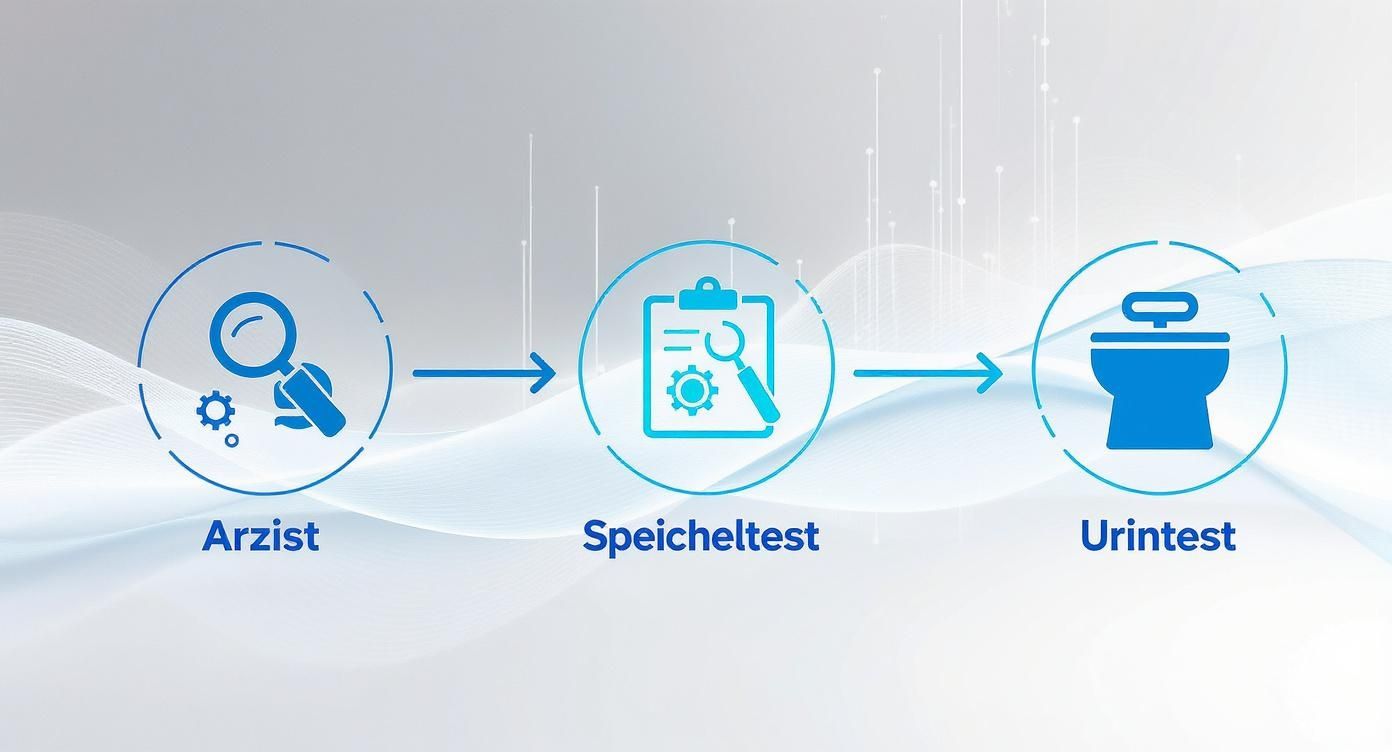
This graphic makes it clear: home tests, whether using saliva or urine, are a clever and direct alternative to the classic blood draw in the doctor's office.
This overview will ensure that you are optimally prepared for your hormone test and receive accurate results.
Checklist for successful sample collection
| Preparation step | Why this point is important | My practical tip |
|---|---|---|
| Cycle timing | Hormone levels fluctuate greatly; the timing is crucial for the validity of the results. | Note down the first day of your last period. A cycle tracker on your phone is invaluable here. |
| Stay sober | Eating, drinking (except water) and brushing teeth can distort the measurements in saliva. | Place the test kit right next to your bed the night before. That way you won't forget it in the morning. |
| Avoid stress | Stress hormones like cortisol can directly influence other hormone levels. | Perform the test on a morning when you are as relaxed as possible, ideally on the weekend. |
| Read the instructions | Each test kit has specific requirements. A quick look inside will answer all your questions. | Don't read the instructions just five minutes before taking the sample; read them carefully the day before. |
If you follow these simple points, you will create the best conditions for a meaningful result.
From sample to results report
Taking the sample is really straightforward. For a saliva test, you simply collect a small amount of saliva in the provided tube. That's all there is to it. Then you securely package the sample in the enclosed return envelope – which is already prepaid – and take it to the post office. From there, it goes directly to our certified partner laboratory in Germany.
The entire process is designed to ensure your peace of mind. Your data is handled strictly in accordance with GDPR guidelines , and the analysis is performed in an ISO-certified laboratory . This guarantees you the highest quality and absolute confidentiality.
As soon as the lab analysis is complete, which usually only takes a few business days, you'll receive an email notification from us. Your personalized results report will then be waiting for you in your secure online customer account. The report is designed to be easily understood, even without prior knowledge. It not only shows you the raw numbers but also provides you with specific, personalized recommendations for action.
If you'd like to know more, feel free to check out our detailed step-by-step guide for our mybody-x tests . This will equip you perfectly to easily and reliably gain valuable insights into your body from the comfort of your own home.
Hormones and their role in fertility and menstruation
An irregular cycle or a desire to have a child that just won't come true – that can be incredibly emotionally draining. Often, however, there's no major problem behind it, but rather a subtle yet crucial hormonal imbalance. So, if you're hoping for a baby or simply want to better understand your cycle, taking a closer look at certain key hormones is absolutely the right first step.
You can think of these hormones as the conductors of an orchestra, controlling your entire reproductive system. They ensure that an egg matures each month, ovulation occurs on time, and your body prepares for a possible pregnancy. If this precise interplay gets out of sync, it can lead to menstrual irregularities or delay conception. Having your hormone levels tested provides you and your doctor with incredibly valuable insights into these complex processes.
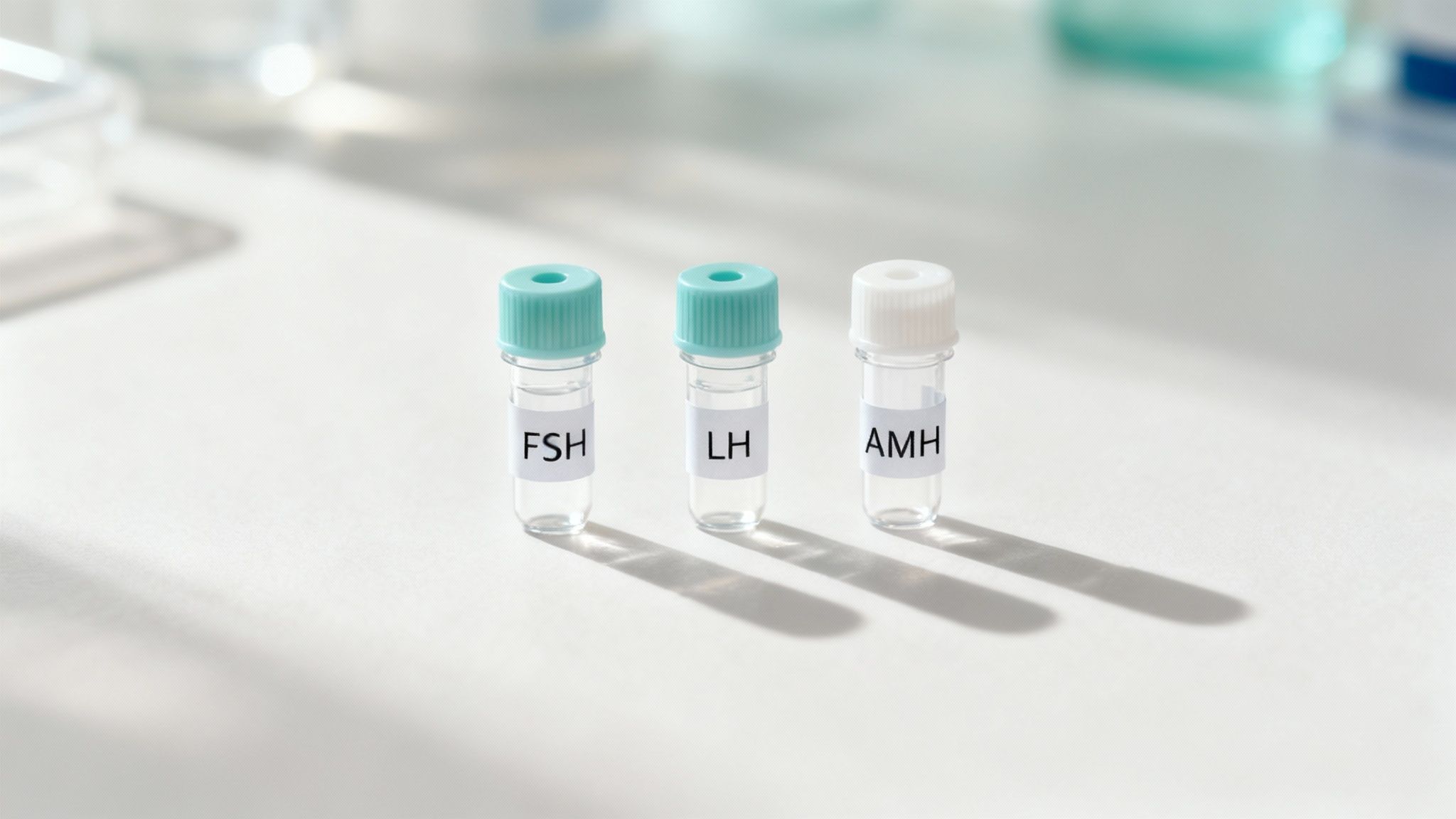
The most important hormones for your fertility
To understand what's actually going on in your body, let's take a closer look at the main players. Each of them plays a very specific role in the monthly cycle:
- FSH (follicle-stimulating hormone): Triggers the maturation of egg cells in the ovaries. Elevated levels can indicate declining ovarian function.
- LH (Luteinizing Hormone): Its sudden surge – the famous "LH peak" – is the signal that triggers ovulation. An imbalance between FSH and LH is often a typical indicator of polycystic ovary syndrome (PCOS).
- Estradiol (an estrogen): Is responsible for building up the uterine lining and also plays an important role in egg maturation.
- Progesterone: Produced only after ovulation, it prepares the uterus for implantation. A deficiency of this hormone can increase the risk of early miscarriages.
- AMH (Anti-Müllerian Hormone): This hormone provides a good indication of your remaining egg reserve. It is an important indicator for better assessing fertility.
When a woman is struggling to conceive, determining these hormone levels is often crucial. For approximately 70% of women undergoing fertility treatment, lab tests are a key component of the diagnostic process. Low AMH levels (below 0.7 ng/ml), for example, can indicate a diminished ovarian reserve – information that is incredibly important for further planning. You can find out more in this article about the importance of hormone tests for women at vidafertility.com.
A hormone test from mybody-x gives you the opportunity to conveniently check these key values from the comfort of your own home. You will receive a clear and easy-to-understand analysis that will finally help you understand the processes within your body.
This knowledge is a real game-changer for specifically supporting your fertility and planning the next, right steps together with a doctor. Incidentally, the targeted intake of certain nutrients can also make a difference. Learn more here, for example, about the effects of L-arginine on women and how it can promote blood circulation.
What really happens hormonally during menopause
Menopause is not an illness. It's a natural, often even powerful new phase of life that every woman experiences uniquely. However, this transition brings profound hormonal changes that are responsible for typical symptoms such as hot flashes, sleep problems, or sudden mood swings. So if you feel like your body is going haywire – you're definitely not alone.
It's precisely during this phase that having your hormone levels tested can be a huge relief. It's about finally gaining clarity and understanding what's going on in your body. Instead of groping in the dark, you receive concrete data that shows you where you currently stand hormonally.
Your hormones on a rollercoaster ride
Even during perimenopause, the years leading up to your final menstrual period, the finely tuned balance of your female hormones begins to falter. The two main players in this process are estradiol, our most important estrogen, and progesterone.
- Progesterone: It's usually the first hormone to decline. A deficiency often manifests as shorter cycles, restless sleep, and general inner tension.
- Estradiol: Your estradiol levels begin to fluctuate unpredictably – sometimes they shoot up, then they plummet again. It is precisely these wild fluctuations that are often behind the dreaded hot flashes, night sweats, and dry skin.
A hormone test makes these fluctuations visible. It helps not only you, but also your doctor to clearly distinguish the symptoms of perimenopause from other possible causes, such as an underactive thyroid, which can cause very similar symptoms.
In Germany alone, around 9 million women are going through menopause. Therefore, the German Menopause Society recommends that women between 40 and 45 years of age with typical symptoms have their hormone levels checked. And practice shows that approximately 60–70% of women who visit a gynecologist during this period are advised to undergo a hormone test to obtain a clear diagnosis. You can read more about this in the recommendations for individual consultation at frauenaerzte-im-netz.de .
A test like the one from mybody-x provides you with a solid foundation for making informed decisions. Whether you're considering hormone replacement therapy, want to try herbal remedies, or want to adjust your lifestyle – with the results in hand, you'll know which path is right for you.
Menopause is a time of transition, but one you don't have to passively endure. By understanding your body better, you can actively and autonomously shape this phase. If you'd like to learn more about how to support your body naturally, take a look at our guide on how to naturally regulate female hormones.
At-home hormone tests: Your questions, our answers
Are you considering a hormone test, but still have some questions? That's perfectly understandable. Let's answer the most frequently asked questions so you can start with confidence.
How much does a home hormone test cost?
It depends entirely on what exactly you want to examine. The cost depends on the scope of the test. A single value, such as the stress hormone cortisol, is naturally cheaper than a complete hormone profile that analyzes several messenger substances simultaneously.
At mybody-x, we value complete transparency. With every test, you can clearly see the costs you will incur – without any hidden fees.
What should I do if my test results are not within the normal range?
First of all: don't panic. A deviation from the norm is primarily an important clue that you can investigate further. Our results reports are specifically designed to be easy to understand and provide you with directly actionable recommendations.
Important to know: A home test provides a valuable snapshot and guidance, but it does not replace a medical diagnosis. We always advise you to discuss any abnormal results with your doctor or therapist. Together you can then determine the best next steps for you.
How quickly will I receive my results?
We know you're waiting for your results. As soon as your sample arrives at our certified German partner laboratory, we'll get started. The analysis itself usually only takes a few business days.
As soon as everything has been evaluated, we will notify you immediately by email. You can then log in to your secure customer account and access your personal report.
Do you have any further questions about the process or our tests? Take a look at our FAQ page , where we've compiled many more answers for you.
Are you ready to finally gain clarity and understand what your body is trying to tell you? Discover the precise and simple hormone tests from mybody-x and take the first step towards greater well-being and hormonal balance.



Share:
Nutrition for Hashimoto's: How to boost your well-being with the right diet
Why am I not losing weight? The real reasons and how to find them