

Determining your hormone levels is the key to your well-being
Constant fatigue, an irregular cycle, or rollercoaster emotions? Often, determining your hormone levels is the first and most important step to finally understanding what's really going on in your body. This involves measuring the concentrations of crucial hormones like estrogen, progesterone, and cortisol. This gives you a clear picture of your internal balance, allowing you to take targeted action.
What your body is trying to tell you about your hormones
Do you know that feeling when your body speaks a language you just don't understand? One day you feel like you could move mountains, the next you can barely get out of bed. Your cycle is all over the place, your skin does whatever it wants, and your mood swings from ecstatic to utterly miserable – for no apparent reason. These aren't just whims of nature, but often clear messages from your hormonal system.
Imagine your hormones as a perfectly tuned orchestra. Each hormone is a musician with a very specific role. As long as they all play in time, you feel fit, balanced, and simply good. But even a single out-of-tune instrument—caused, for example, by chronic stress or poor diet—can disrupt the entire harmony.

Why listening is so important
Young women, in particular, often feel alone and uncertain when experiencing such symptoms. A Forsa survey has revealed just how great the need for information actually is: an incredible 69 percent of women aged 18 to 29 want more information about hormonal connections. The stress hormone cortisol and thyroid hormones, in particular, raise many questions. You can read the fascinating results of the survey at aerztezeitung.de .
Behind the signals from your body could be very specific hormonal imbalances:
- Persistent fatigue could indicate a problem with the thyroid gland or a permanently elevated cortisol level.
- Menstrual cycle irregularities can often be traced back to an imbalance between estrogen and progesterone.
- Mood swings are often triggered by fluctuating sex hormones, but also by stress hormones.
A hormone test from mybody-x is like a translator for your body's signals. It doesn't provide you with blanket diagnoses, but rather a data-driven foundation to finally understand the causes of your symptoms and take targeted action against them.
Determining your hormone levels is therefore much more than just a medical test – it's your first active step towards taking responsibility for your own health. Instead of continuing to grope in the dark, you give yourself the chance to truly get to know your body. For example, if you want to know how high cortisol manifests in women, you can find more information here . A simple at-home hormone test from mybody-x can help you gain valuable initial insights – conveniently and discreetly.
Understanding the key players in your hormonal balance
Your hormonal system is a finely tuned orchestra of highly specialized messenger substances that work tirelessly together. To understand why determining your hormone levels can be so revealing, let's take a closer look at the key players and their roles. Think of them not as abstract concepts, but as the conductors of your body.
When this team works in perfect harmony, you feel energized, balanced, and productive. However, if even one component is out of sync, it can have far-reaching consequences for your overall well-being.
Estrogen: The manager for energy and vitality
Estrogen is so much more than just a female sex hormone. Think of estrogen as your personal energy manager . It influences not only your cycle and fertility, but also your skin, bones, mood, and even cognitive abilities. Optimal estrogen levels promote radiance, energy, and a positive outlook on life.
However, if the level is too high or too low, you'll often notice it quite quickly. Symptoms such as water retention, mood swings, or an irregular cycle can indicate an imbalance. A deeper understanding of exactly what estrogen is and how it works will help you better interpret your body's signals.
Progesterone: The calming influence in your system
Progesterone is the natural counterpart to estrogen and acts as a major calming influence in your body. It ensures a stable cycle, promotes restful sleep, and has a calming, anxiety-reducing effect. You could also call it the "feel-good hormone" of the second half of the cycle.
When the balance between estrogen and progesterone is disrupted – often there is a progesterone deficiency in relation to an excessively high estrogen level (estrogen dominance) – symptoms such as PMS, sleep disturbances or inner restlessness can result.
Cortisol: The crisis manager for stressful times
Cortisol is your crisis manager . It's released in stressful situations to provide you with short-term energy and make you alert and focused. However, in today's often hectic world, this mechanism frequently runs at full speed.
Chronically elevated cortisol levels due to persistent stress can lead to exhaustion, sleep problems, weight gain (especially around the abdomen), and a weakened immune system. A test can clearly show you whether your stress response system is overloaded.
Thyroid hormones: The powerhouse of your metabolism
Your thyroid gland is the powerhouse of your body, and the hormones TSH, fT3, and fT4 are the crucial regulators. They control your metabolism, body temperature, and energy consumption.
Think of your thyroid like your body's accelerator. An underactive thyroid (too few hormones) slows everything down, which can lead to fatigue and weight gain. An overactive thyroid (too many hormones) speeds everything up and can cause nervousness and a racing heart.
To give you a quick overview, we have summarized the most important hormones and their functions in a table.
Overview of the most important hormones and their functions
This table summarizes the key hormones, their main functions in the body, and typical symptoms of an imbalance.
| hormone | Main function | Possible symptoms of imbalance |
|---|---|---|
| estrogen | Regulation of the female cycle, bone health, skin condition, mood | Menstrual irregularities, mood swings, PMS, weight gain |
| progesterone | Preparation for pregnancy, calming the nervous system | Sleep disorders, anxiety, PMS, infertility |
| Cortisol | Stress response, energy supply, inflammation reduction | Exhaustion, sleep problems, belly fat, susceptibility to infections |
| Thyroid hormones (fT3, fT4) | Control of metabolism, energy production, body temperature | Fatigue, weight gain/loss, hair loss, rapid heartbeat |
| testosterone | Muscle building, libido, energy (important for both women and men) | Low libido, fatigue, depressed mood, muscle loss |
As you can see, everything is interconnected. A hormone test from mybody-x measures these crucial values and gives you a precise picture of your hormonal balance. This allows you to clearly see which components in your body might need support to regain their equilibrium.
When your hormone levels deserve a closer look
You might be wondering whether a hormone panel is even right for you. The short answer is: yes, if your body is persistently sending you signals that something is out of balance. It's not about rushing to the lab for every little mood swing, but about paying attention to recurring patterns and symptoms that just won't go away.
A hormone test from mybody-x can finally bring clarity in such moments. Think of it as a valuable tool that helps you find the root cause of your discomfort, instead of just treating the symptoms on the surface.
Typical signs that should make you sit up and take notice
Certain life phases and symptoms are like red flags, indicating that a look at your hormone levels could be invaluable. Does any of this sound familiar?
- Unexplained weight gain: You pay attention to your diet and exercise, but the kilos still climb upwards, especially around your stomach.
- Persistent exhaustion: You actually get enough sleep, but constantly feel like you have the handbrake on – tired, weak and without motivation.
- Menstrual irregularities: Your period comes when it wants, is extremely painful, doesn't come at all, or you struggle with severe PMS every month.
- Skin problems and hair loss: Acne suddenly appears, your skin goes crazy, or you notice that your hair is thinning.
- Suspected PCOS: Signs such as an irregular cycle, increased hair growth in unusual places, or acne make you suspicious.
In these cases, a hormone test acts like a compass. It shows you whether your hormones are indeed the cause and gives you a clear direction for the next steps.
Menopause: A time of hormonal upheaval
Particular attention is paid to the perimenopause and menopause. This phase, which often begins gradually in the late 30s, is characterized by a natural shift in hormone production. It is a time of intense changes, often accompanied by considerable uncertainty.
That's precisely when a hormone test is incredibly valuable. It helps you to correctly identify symptoms like hot flashes, sleep disturbances, or low moods and to clearly distinguish them from other health issues.
In Germany, approximately 9 million women are currently going through menopause. The official S3 guideline on peri- and postmenopause recommends hormone testing for women between 40 and 45 years of age with unclear symptoms, as hormone levels can fluctuate significantly during this period. This highlights the importance of individual analysis rather than general assumptions. You can find more information in the recommendations of the German Menopause Society at frauenaerzte-im-netz.de .
A home hormone test from mybody-x offers a straightforward way to gain initial data-based insights and create a solid foundation for your further decisions.
Which test method provides the correct answers
So you've decided to get to the bottom of your hormone levels – great! Now you're faced with the next question: How exactly does determining your hormone status work? At first glance, the world of hormone tests, with its various methods such as blood, saliva, or urine tests, can seem quite confusing. But don't worry, each method has its merits and its own particular strengths.
Choosing the right test is crucial for getting truly reliable answers to your questions. Think of it like a toolbox: there's a screwdriver for every screw. It's the same with hormones – for every value, there's an optimal measurement method that will give you the clearest results.
The following infographic gives you a quick overview of whether a test is even worthwhile for you right now.
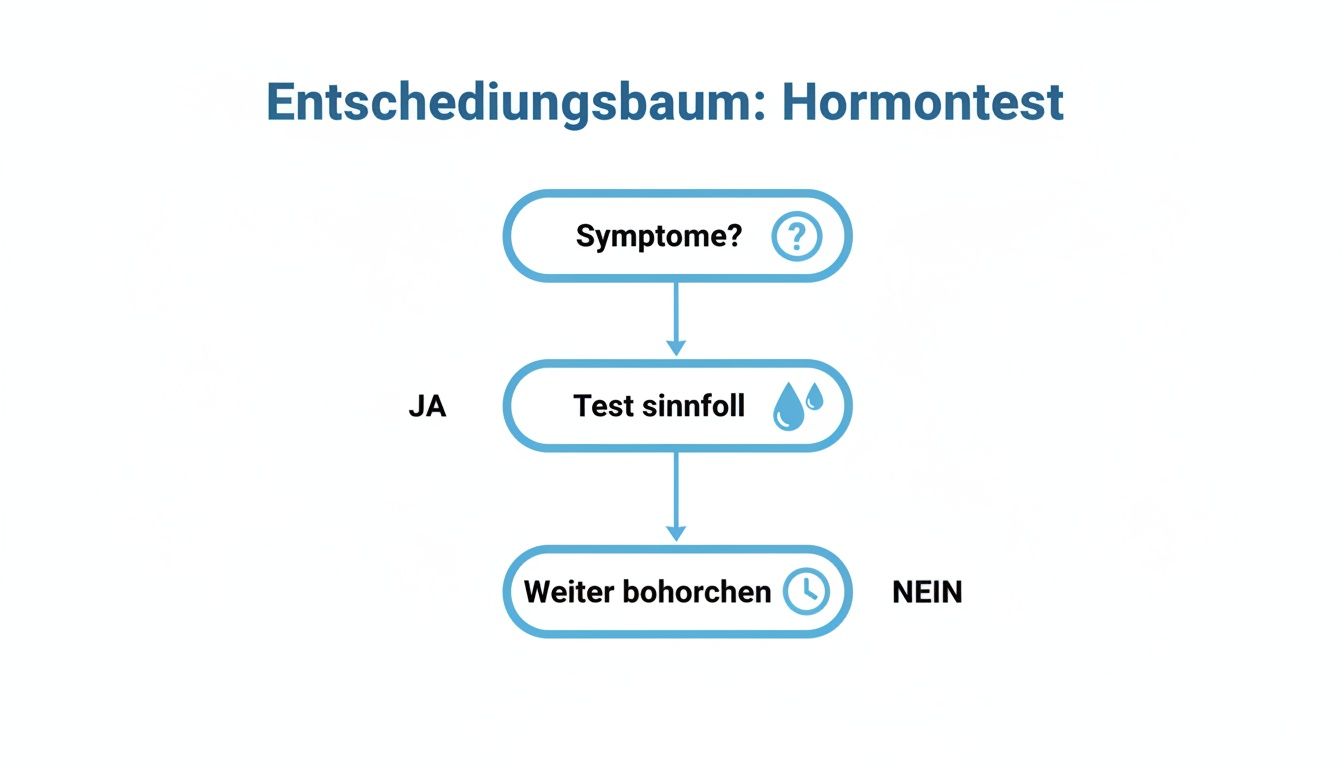
As you can see, symptoms are usually the decisive impetus to even consider getting tested.
The blood test: the scientific gold standard
The blood test is the most reliable and scientifically sound method for hormone analysis. You can think of it like this: your hormones travel through your body like passengers in a taxi – most are bound to transport proteins and thus essentially "occupied." Only a small portion is freely available and can exert its effects in the cells.
A blood test typically measures the total concentration, meaning both the bound and free components of a hormone. This gives us a very comprehensive and, above all, stable picture of your hormone levels in the bloodstream.
For certain hormones, the blood test is simply unbeatable and is considered the undisputed gold standard . These include, above all:
- Thyroid hormones (TSH, fT3, fT4): A blood test is essential to accurately assess the function of your thyroid gland.
- Pituitary hormones (FSH, LH): These control the female cycle and are crucial when it comes to menopause or fertility issues.
- Total testosterone: The blood test provides a reliable overview of the total testosterone level, which is important for many health aspects.
Mybody-X hormone tests utilize precisely this kind of advanced laboratory technology. You conveniently take a small blood sample at home, send it in, and it's analyzed in a certified laboratory. If you'd like to learn more about what a blood test actually is , take a look at our comprehensive guide.
Saliva and urine tests for special insights
Of course, besides blood tests, there are other methods that have their advantages for very specific purposes. Saliva tests , for example, measure almost exclusively the free, i.e., biologically active, hormones. This makes them particularly interesting for hormones whose concentrations fluctuate significantly throughout the day.
One could say: A saliva test is like a snapshot of the active players on the field, while the blood test captures the entire team, including the substitutes.
It is therefore often used to create a daily profile of the stress hormone cortisol . Several samples taken throughout the day beautifully illustrate the natural rhythm between waking up and going to bed.
The urine test , often performed as a 24-hour urine collection, measures the breakdown products (metabolites) of hormones. It can provide a good overall picture of hormone production over a whole day, but is naturally much more complex to perform.
Comparison of test methods for hormone determination
To help you decide, we've compared the three most common methods directly in a table. This way, you can see at a glance the advantages and disadvantages of blood, saliva, and urine tests and which method is best suited to your needs.
| method | Advantages | Disadvantages | Ideal for |
|---|---|---|---|
| Blood test | Scientifically validated (gold standard), measures total and free hormones, a broad spectrum of hormones is measurable. | Requires a blood sample (invasive), a snapshot that can be influenced by stress. | Comprehensive hormone analyses, thyroid function, fertility, menopause, total testosterone. |
| Saliva test | Non-invasive and painless, it only measures free, active hormones, good for daily profiles. | Lower hormone concentrations, prone to contamination, not suitable for all hormones. | Cortisol day profile, measurement of free steroid hormones such as estrogen, progesterone. |
| Urine test | Non-invasive, measures hormone metabolites over a longer period (e.g. 24h), providing insight into hormone metabolism. | Elaborate collection reflects excretion, not the current concentration in the blood. | Analysis of hormone breakdown products, comprehensive metabolic analyses. |
For a reliable and comprehensive overview of the most important hormones in your body – from the thyroid to the sex hormones – a blood test remains the clear method of choice. It offers the accuracy and broad data base you need for a sound assessment of your hormonal balance.
Determine your hormone levels from home with mybody-x
Are you ready to take control and get to the bottom of your hormone levels? That's a huge step towards more control over your own health. And the best news first: the days when getting your hormone levels checked always involved long waits at the doctor's office are over. With a home hormone test from mybody-x, you can easily, discreetly, and conveniently get this important insight right at home.
Don't worry, the process is much simpler than you might think. We'll guide you through it step by step so you know exactly what to expect.
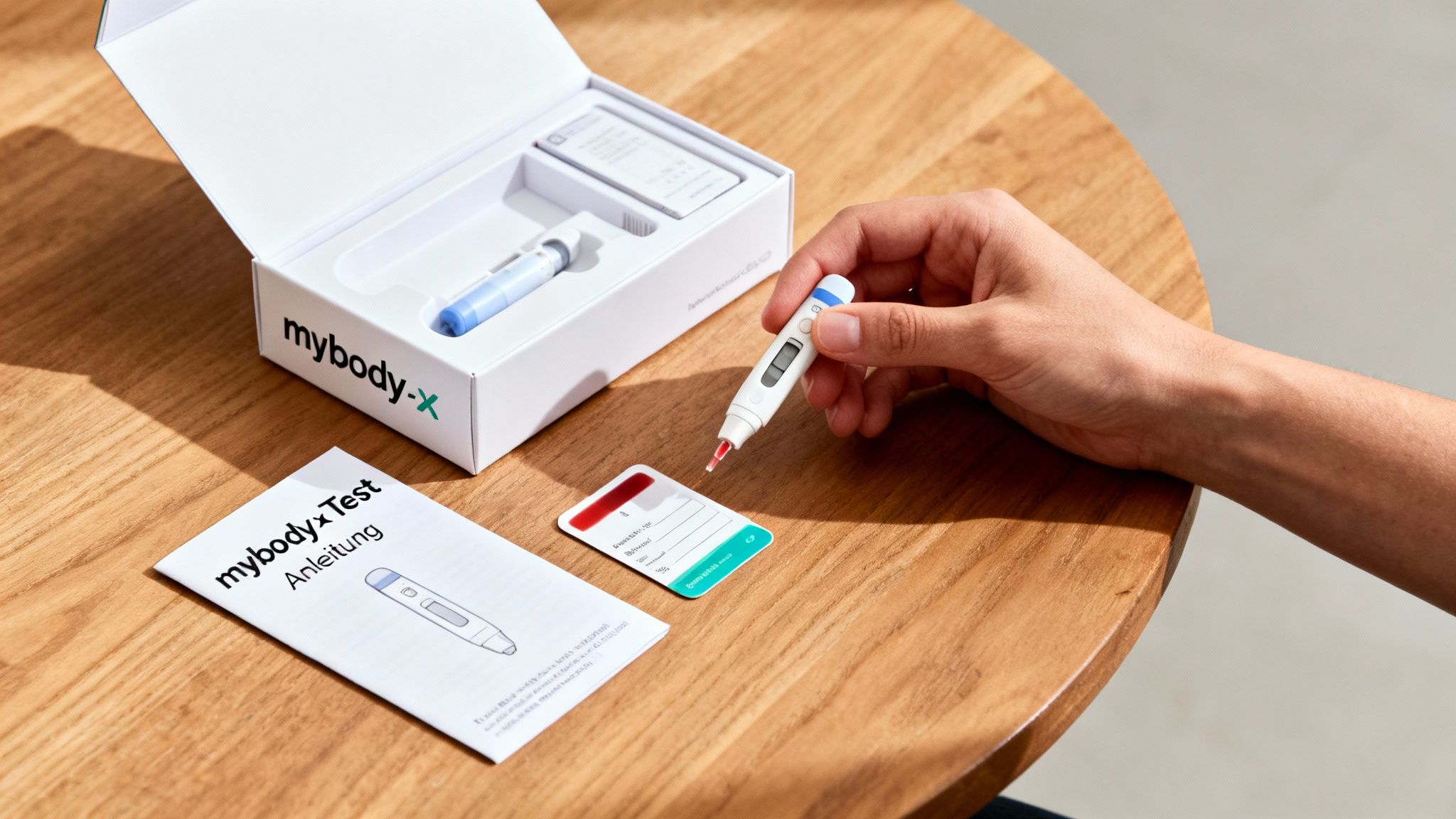
This is how easy your hormone test works
The entire process is designed to offer you maximum security and clarity. From ordering to your personal results report, every step is transparent and incredibly easy.
- Order & Get Started: Choose the right hormone test on our website. Your test kit will then arrive quickly and in discreet packaging directly at your door.
- Everything you need is included: Your set contains super easy-to-understand instructions, disinfectant wipes, lancets for a small, painless prick in the fingertip and the tube to collect the blood.
- Taking the sample: Simply follow the instructions to obtain a few drops of blood. The whole process only takes a few minutes and is really quite simple.
- Free return to the lab: Pack your sample in the enclosed return envelope and send it free of charge to our certified German specialist laboratory.
Nobody knows your body as well as you do. A hormone test from mybody-x provides you with the data to support your feelings and observations – exactly when and where it suits you best.
What happens after you submit the sample?
As soon as your sample arrives at the lab, medical experts take over. Using state-of-the-art analytical technology, the concentration of the hormones relevant to you is determined with pinpoint accuracy in your blood. This process guarantees you lab-quality results that are just as reliable as those obtained from a doctor.
You'll receive a notification within just a few days: your results report is here! You'll find it in your personal, secure online account. Instead of incomprehensible columns of numbers, we present your data in an appealing graphical format and explain clearly and concisely what it means for you. This way, you can see at a glance where you stand.
If you're still wondering which test is right for you, why not browse through the various mybody-x hormone tests ? This way you can find the analysis that perfectly matches your questions and take the first step towards greater clarity about your body.
How to correctly interpret your hormone levels – and take action
You finally hold your results in your hands – the first, important step is complete. But now comes the crucial part: What do you do with these values? A mybody-x test result doesn't provide you with dry columns of numbers, but a clear, understandable analysis so you know exactly where you stand.
Your test results always show you so-called reference ranges . Imagine them like guardrails on a road – they indicate the range in which the values for healthy people normally fall. Your personal value is displayed right next to it. This way, you can see at a glance whether everything is within the normal range or whether you might be straying a little too far to the left or right of the target.
From knowledge to action
Very important: A test result is not a diagnosis you make for yourself. See it as a valuable, data-based foundation for a conversation with your doctor, therapist, or alternative practitioner. Your results only make sense within the overall picture – together with your symptoms, your lifestyle, and your personal history.
Especially during certain phases of life, such as menopause, which affects around 9 million women in Germany, such a data foundation can be invaluable. A guideline-compliant determination of hormone levels , such as FSH levels, can help you and your doctor make an informed decision for or against hormone replacement therapy. If you would like to delve deeper into this evidence-based approach, you can find more information in this publication from the German Bundestag .
Your test result is like a personal compass. It not only shows you where you currently stand, but also points you in the right direction to specifically improve your well-being.
Based on your diagnosis, you can often achieve a lot with small but effective adjustments in your daily routine.
First steps you can take yourself to address typical hormonal imbalances:
- Elevated cortisol levels: Is your stress level too high? Consciously incorporate relaxation into your day. This could be yoga, a short meditation, or simply a walk in nature. Perhaps skip that afternoon coffee.
- If you have estrogen dominance: Pay attention to a high-fiber diet. Cruciferous vegetables like broccoli or kale are especially beneficial right now. A well-functioning digestive system helps your body get rid of excess estrogen more easily.
- In case of a thyroid imbalance: Your thyroid needs the right building blocks. Make sure you get enough iodine, selenium, and zinc through your diet – these nutrients are essential for its function.
Of course, these tips are not a substitute for medical advice. But they are a fantastic first step to actively support your body in finding its natural balance again. This completes the cycle – from measurement to conscious action for your health.
Your questions, our answers about hormone levels
A hormone test often raises many questions. That's perfectly normal! To help you feel well-prepared and know exactly what to expect, we've compiled the answers to the most frequently asked questions here.
When is the best time to get a hormone test?
Timing is everything – at least for women with a regular cycle. Many hormones essentially dance to the beat of your cycle. Progesterone , for example, reaches its peak in the second half of the cycle. Therefore, it's ideal to measure this level between days 19 and 21 of your cycle to get a meaningful picture.
But what if your cycle is irregular or doesn't occur at all? No problem! In this case, you can simply take the test on any day.
Do I need to fast for the blood test?
The good news first: For most hormone tests, you don't have to skip breakfast. However, there are exceptions. The stress hormone cortisol, for example, reacts to food intake, which can influence the results.
Don't worry about doing anything wrong. In the instructions for your mybody-x test, we explain clearly and simply what you need to pay attention to during your specific test. This ensures that your results are absolutely reliable.
Important to know: A home hormone test provides you with a valuable snapshot of your current status. It's a fantastic basis for your further health steps, but it does not replace a medical diagnosis.
How long will I have to wait for my results?
We know you're eagerly awaiting your results! Once your sample has arrived safely at our certified German laboratory, everything will happen very quickly. The analysis itself usually only takes a few business days .
As soon as the evaluation is complete, you will receive an immediate notification from us via email. You can then view and download your personal and easy-to-understand results report at any time in your secure online account.
Are you ready to finally understand your body's signals? With mybody-x hormone tests, you'll gain precise insights into your hormonal balance – easily and conveniently from home. Start your journey to greater well-being now and discover the right analyses for you at https://mybody-x.com .



Share:
Understanding the causes of high inflammation levels and taking targeted action.
DIY allergy test explained simply