
Face Mapping Pimples: Understand Your Skin’s Signals and Find the Causes
Pimples on the face are a nuisance, especially when they seemingly appear for no reason over and over again in the same places. This is exactly where the idea of face mapping comes in: The pattern of your blemishes is not supposed to be a coincidence, but rather a clue to what is happening in your body—from stress and hormonal fluctuations to diet.
What face mapping reveals about your skin
Have you ever wondered why a pimple sprouts on your forehead just before an important meeting? Or why the blemishes along your jawline seem to have a standing appointment shortly before your period? Face mapping tries to decode precisely these recurring patterns. Think of it as a map of your face that can provide initial clues about where the true causes of your skin problems might be hidden.
Your body is an interconnected system. What happens inside—whether stress, an unbalanced diet, or hormonal ups and downs—can show up on your skin. Face mapping, which has its roots in Traditional Chinese Medicine (TCM), divides the face into different zones and connects them with certain internal processes or organs.
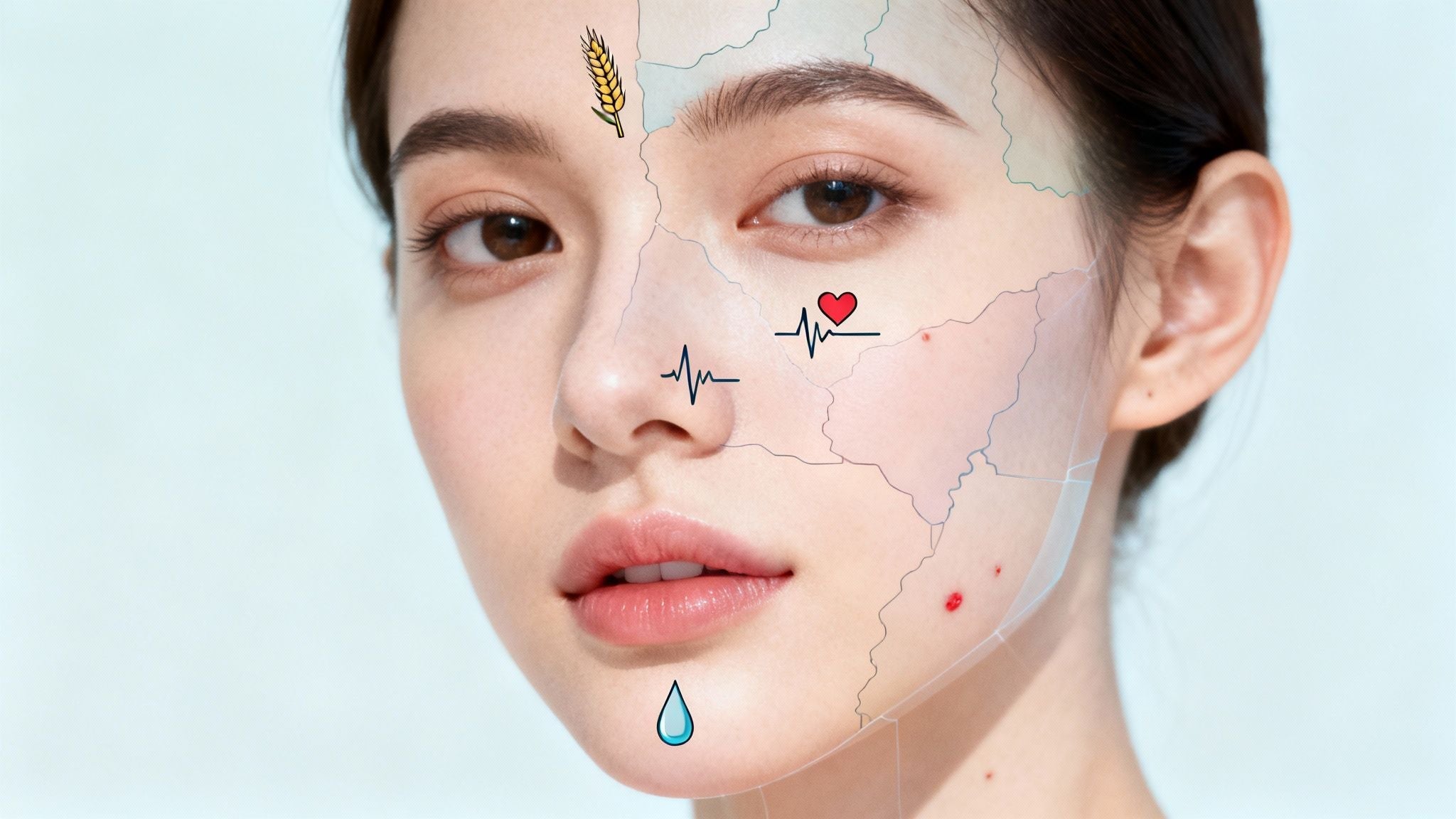
This concept map shows you the three most common zones and their potential connections at a glance.

The graphic makes it clear: Pimples on the forehead are often associated with stress, blemishes on the chin with the hormonal system, and pimples on the cheeks more with external influences.
A first step toward understanding your body
One thing must be made clear: Face mapping is not an exact science and does not replace a medical diagnosis. There is no solid scientific evidence of a direct one-to-one connection between a specific organ and a facial zone. Nevertheless, many experts acknowledge that the observed patterns can provide valuable clues.
Do not consider face mapping a definitive diagnosis, but rather an intelligent observational tool. It helps you ask the right questions and follow the clues that lead to the true triggers of your skin problems.
Instead of blindly trying one skincare product after another, this principle invites you to take a step back. It encourages you to take a closer look at your lifestyle, diet, and hormonal balance—in keeping with a holistic understanding of health.
The most common zones and what they mean
To make it easier for you to get started, we have summarized the most important zones and their possible meanings in a clear table.
Face-mapping zones at a glance
A compact overview of the most common facial zones and their potential meanings according to face-mapping theory.
| Facial zone | Possible related cause according to face mapping | Suitable mybody-x test |
|---|---|---|
| Forehead | Often associated with stress, lack of sleep, and the digestive system (e.g., an unbalanced diet). | Food intolerance test |
| Cheeks | May indicate external factors (dirty phone, pillowcase) or internal influences (lung function, diet, nutrient deficiency). | Nutrient test |
| Chin & jawline | Considered the classic “hormonal zone,” especially in cases of cyclical blemishes during the female menstrual cycle. | Hormone test for women |
| Nose | Sometimes associated with the cardiovascular system or the pancreas, often due to dietary factors. | Food intolerance test |
| Between the eyebrows | Often linked to liver function or the consumption of alcohol and fatty foods. | Nutrient test |
This table provides an initial guide. For example, if you repeatedly struggle with pimples on your forehead, you could take a closer look at your stress levels or keep a food diary. The aim is to identify patterns and take a holistic view of your health rather than merely scratching the surface.
The forehead as a reflection of stress and digestion
The forehead is probably one of the most well-known areas for blemishes. According to face mapping, this is often no coincidence, as this area is traditionally closely associated with our digestive system and stress levels. So if you repeatedly struggle with stubborn pimples on your forehead or between your eyebrows, your body could be sending you important signals.
Think of your gut as the epicenter of your well-being. If it gets out of balance—whether due to highly processed foods, too much sugar, or an unbalanced diet—this can show up directly on your skin. The body then tries to eliminate excess substances through the skin, which can quickly lead to inflammation and clogged pores, especially around the forehead.
Recognizing internal and external triggers
But it’s not only internal processes that play a role. Very often, external influences also block the pores on your forehead and lead to what are known as mechanical breakouts.
- Hair care products: Oily serums, heavy conditioners, or hairsprays can leave residue on the skin that practically seals the pores when they come into contact with your forehead.
- Headwear: Beanies, caps, and headbands create an ideal warm, humid environment for bacteria through friction and trapped sweat.
- Frequent touching: We all do it unconsciously—resting our heads on our hands or running our fingers over our foreheads. This transfers dirt and bacteria from our hands directly to our faces, which can promote inflammation.
So it is almost always a combination of what is happening inside your body and what affects your skin from the outside. The good news is that you can actively influence both areas.
Your first action plan for a clear forehead
If you feel that stress or your diet could be the root cause of your forehead pimples, there are specific steps you can take right away. The goal is to support your body and minimize sources of irritation.
Your lifestyle is the key. Small, intentional changes in your daily life can often have a greater impact than the most expensive skincare cream because they address the problem at its root.
Here are some practical tips you can implement right away to give your skin a break:
- Actively manage stress: Incorporate short moments of relaxation into your day. Just five minutes of deep breathing, a short meditation, or a walk in the fresh air can lower cortisol levels. Chronic stress is a known accelerant of inflammation in the body.
- Eat for a healthy gut: Try to reduce sugar, white flour, and highly processed foods. Instead, focus on a high-fiber diet rich in vegetables, whole grains, and fermented foods such as yogurt or kefir. This feeds your beneficial gut bacteria.
- Adjust your skincare routine: Take a look at the ingredients in your hair care products. Are they “non-comedogenic”? Always cleanse your face thoroughly in the evening to remove all traces of makeup, sweat, and styling products.
If you notice that constant pressure plays a major role in your life, it is worth taking a closer look. Learn in our article how to measure your cortisol levels at home and better understand your personal stress level.
Cheeks and nose as indicators of diet and environmental factors
While the forehead is often the stage for internal states such as stress, the cheeks and nose tell a somewhat different story. According to the principles of face mapping, these central areas of your face are often directly connected to external influences and your diet. Blemishes that appear here can therefore provide valuable clues about what you eat and what your skin comes into contact with every day.
In face-mapping theory, the cheeks are often associated with the respiratory system. This may relate to allergies that strain your airways, but also to very tangible, everyday habits. Your phone screen, which you constantly hold against your face, or the pillowcase you sleep on are often veritable breeding grounds for bacteria. These come into direct contact with the sensitive skin on your cheeks and can clog pores and trigger inflammation.
Think of your smartphone as a kind of “third hand” that you use constantly but rarely clean. Regularly disinfecting your screen is one of the simplest and most effective hacks for preventing pimples on your cheeks.
In addition to these external influences, your diet can also provide direct clues about the condition of your skin. A conscious and tooth-friendly diet is an important building block for your body's overall health—and this is often reflected first in the appearance of your skin.
The T-zone as an indicator of your diet
The nose, together with the forehead, is part of the famous T-zone, known for its high density of sebaceous glands. According to face mapping, pimples on the nose may indicate an overloaded liver, possibly due to excessive alcohol consumption or consuming dairy products. The pores in the T-zone are particularly sensitive to highly processed foods, excessive sugar, and unhealthy fats. These can further stimulate sebum production, creating the perfect environment for pimples to develop.
Your action plan for clear cheeks and nose
If you notice blemishes in these areas, there are specific measures you can take. This is less about reducing stress and more about making very concrete adjustments to your daily routine.
- Rethink your hygiene routine: Make it a habit to clean your smartphone screen every day and change your pillowcases every few days. This significantly reduces the bacterial load your skin is exposed to.
- Keep your hands off your face: Observe yourself for a moment. How often do you unconsciously touch your cheeks or nose? Try to break this habit to minimize the transfer of dirt.
- Keep a food diary: Write down what you eat for one to two weeks. Pay particular attention to dairy products, sugar, and highly processed foods. Do you notice a connection between certain foods and new blemishes?
If you suspect that certain foods are triggering your skin problems but aren't sure which ones, a test can provide clarity. Find out in our guide how a food intolerance self-test works and can help you make targeted adjustments to your diet. Such a test analyzes your reaction to a wide range of foods and provides a scientifically sound basis for optimizing your diet—for skin that radiates from within.
Chin and jawline: The stage for your hormones
Does this sound familiar? Right before your period, these deep, painful pimples appear along your chin and jawline. If so, you are definitely not alone. In face mapping, this area is considered the “hormonal zone” above all—the place where the ups and downs of your cycle are most clearly reflected.
The reason is a particular sensitivity of the sebaceous glands in this area. They react extremely sensitively to fluctuations in male sex hormones, known as androgens (such as testosterone). Although they are considered “male” hormones, every woman has androgens in her body, and their levels naturally change throughout the menstrual cycle.
Your cycle and what it does to your skin
To understand why these pimples are so persistent and cyclical, we need to take a brief look at the female cycle. In the second half of the cycle, after ovulation, estrogen levels fall, while progesterone and testosterone levels rise relative to them.
This hormonal imbalance can stimulate the sebaceous glands to overproduce sebum. The sebum becomes thicker and oilier, making it much easier for the pores to become clogged. This creates the perfect breeding ground for the unwanted, often inflamed and cystic pimples that are so typical of hormonal acne.
Face mapping attributes pimples on the chin and jawline to these exact hormonal fluctuations. Although the direct connection to internal organs has not been scientifically proven, many people recognize the cyclical patterns that suggest this area is highly sensitive to androgens.
Stress as an additional accelerant
But your cycle isn't the only factor. Stress also has a direct and often underestimated impact on your hormones and, consequently, your skin. When you're under pressure, your body releases more of the stress hormone cortisol.
Cortisol can also stimulate sebum production and intensify inflammatory processes in the body. This explains why pimples on the chin and along the jawline can get worse during particularly stressful periods—completely independently of your cycle.
Hormonal acne is more than just a superficial problem. It is a direct signal from your body that there is an imbalance inside. Understanding this is the first step toward improvement.
Your action plan for hormonal balance
If you recognize yourself in this pattern, there are targeted strategies that can help restore your skin’s balance. The goal is to support your body from within.
- Adjust your skincare routine to your cycle: Pay close attention to your skin. During the second half of your cycle, when it tends to become oilier, clarifying masks with salicylic acid or gentle exfoliants can help prevent clogged pores.
- Be mindful of your diet: Reduce foods with a high glycemic index, such as sugar and white flour. These raise insulin levels and can stimulate androgen production. Instead, choose anti-inflammatory foods such as leafy green vegetables, berries, and omega-3-rich fats (e.g., in salmon or flaxseed).
- Manage your stress strategically: Find ways to reduce your stress levels. Whether it’s yoga, meditation, walks in nature, or simply taking regular breaks—find out what does you good and make it a fixed part of your daily routine.
If you feel that your hormonal balance has been persistently disrupted and are looking for clarity beyond the observations of Face Mapping, a targeted analysis may be useful. A hormone test for women provides precise data about your hormone status. This allows you to understand the causes of your skin problems on a scientific basis and address them in a targeted way.
From suspicion to certainty: Why a self-test is the next logical step
Face Mapping is a brilliant starting point. You’ve learned to interpret your body’s signals, recognized patterns, and perhaps even made a few small changes to your daily routine. But what if you no longer want to guess and finally want to know what’s really behind your skin problems? This is exactly where the circle closes—from attentive observation to solid insight.
The theories of Face Mapping—stress on the forehead, hormones on the chin—give you a starting point. But to counteract these factors in a truly targeted and effective way, you need reliable data. This is where mybody-x’s self-tests come in: They are the logical next step for turning your suspicions into scientifically sound facts and gaining real clarity.
Instead of fumbling in the dark and trying different diets or skincare products on a whim, you can address the root cause directly. A test gives you a very personal picture of your internal balance and shows you in black and white where you need to start.
Which test is right for each facial zone?
The insights from face mapping can help you find exactly the test that is most relevant to you. Think of it as a signpost system that guides you directly to the right analysis and helps you precisely narrow down the causes of your face mapping pimples.
-
Pimples on the forehead & nose (digestion zone): Do you suspect that your diet plays a role? The food intolerance test analyzes your reaction to a wide range of foods. Your body may be reacting unnoticed to gluten, dairy products, or certain types of fruit, causing low-grade inflammation that appears on your skin.
-
Pimples on the chin & jawline (hormone zone): Do your blemishes occur cyclically and prove particularly persistent? The hormone test for women gives you precise insights into your hormonal balance. It measures key hormones and can reveal whether, for example, an imbalance between estrogen and progesterone or elevated androgen levels is the cause.
-
Generally dull skin & inflammation: Do you often feel tired, does your immune system seem weakened, and does your skin simply look lifeless? A nutrient test can reveal deficiencies in important vitamins and minerals such as zinc, selenium, or vitamin D. These nutrients are absolutely essential for healthy skin function and the regulation of inflammation.
A self-test replaces guesswork with knowledge. It is your personal compass, showing you which specific measures your body really needs to regain its balance.
The easy way to find your answers
The thought of a lab test may sound complicated, but the process at mybody-x has been deliberately designed to be simple and convenient. You can take care of everything from home, without making appointments or sitting in a waiting room.
The process couldn’t be simpler:
- Order a test kit: Choose the test that best matches your suspicions and have it delivered directly to your home.
- Collect your sample: Follow the simple, illustrated instructions to collect your sample. Depending on the test, this may be a small blood sample from your fingertip or a saliva sample. Everything you need is included in the kit.
- Return it free of charge: Place your sample in the enclosed return envelope and send it to our certified German specialist laboratory.
- Receive your results: After a few days, you’ll receive a notification that your personal results report is available for you in your secure mybody-x account.
Your result is not incomprehensible technical jargon. We present your data clearly and understandably, explain exactly what the values mean, and provide you with specific, personalized recommendations for action based on them. You’ll learn which foods you may want to avoid or prioritize, which nutrients you could supplement, or how you can adjust your lifestyle to address your specific issue.
With this precise information, you no longer have to speculate. You can work purposefully on your skin health because you finally know the true causes—and that is the crucial step toward clear skin that radiates from within.
Your roadmap to clear skin from within
You’ve now learned a lot about Face Mapping and the possible causes of your blemishes—this is the most important first step. But knowledge only turns into results when you take action. Think of this roadmap as your personal guide to building a routine that addresses your skin health at its root: from the inside out.
Based on the insights from Face Mapping and the hard facts that a mybody-x self-test can provide, you develop a strategy that is finally not based on guesswork, but on your body’s real needs.
The three pillars of clear skin
Skin that comes into lasting balance is supported by three key pillars. Each one is important on its own, but together they form an unbeatable foundation for your well-being. Don’t view them as rigid rules, but as flexible building blocks that you can adapt to your life.
1. Nutrition as your medicine
What ends up on your plate has a direct connection to the inflammatory processes in your body—and therefore to your skin as well.
- Eat anti-inflammatory foods: Add foods rich in omega-3 fatty acids to your meal plan, such as salmon, flaxseeds, or walnuts. Dark leafy greens, berries, and the spice turmeric are also true powerhouses against inflammation.
- Replenish your nutrient stores: Certain micronutrients are vital for your skin. These include zinc (found in pumpkin seeds), selenium (in Brazil nuts), and vitamin A (in sweet potatoes and carrots). A nutrient test can show you clearly whether there are any gaps.
- Avoid your personal triggers: Does your face mapping indicate digestive problems, or did your food intolerance test show a positive result? Then try consciously reducing potential triggers such as dairy products or gluten for a while.
2. Your lifestyle as the foundation
Your daily habits form the foundation of your health. Your skin often reacts like a highly sensitive seismograph.
- Find your stress outlet: Everyone needs a way to unwind. Whether it’s 10 minutes of meditation in the morning, a walk during your lunch break, or yoga in the evening, regular breaks lower cortisol levels, which are often behind hormonally triggered breakouts.
- Prioritize your sleep: Your body regenerates while you sleep. Try to get 7–8 hours per night. A dark, cool room and avoiding screens shortly before bedtime can work wonders for your sleep quality.
3. Targeted skincare as support
The right external care is the perfect partner for the healing processes you initiate from within.
- Cleanse gently but thoroughly: Use mild, pH-neutral cleansing products. The goal is to protect the skin barrier, not attack it.
- Choose the right active ingredients: Ingredients such as salicylic acid can help keep pores clear, while niacinamide has a calming effect and balances sebum production.
Patience is your most important active ingredient. Your skin renews itself in a cycle of around 28 days. Give your body time to respond to the positive changes. In the end, consistency always beats perfection.
The personalized recommendations from the mybody-x analyses are your compass. They help you develop a routine based not on guesswork, but on data about your body. With this knowledge, you can finally take your skin health into your own hands and create the foundation for a radiant complexion that reflects your inner balance.
Your questions about face mapping – answered briefly and clearly
Do you still have unanswered questions about face mapping and pimples? No problem. Here you will find clear answers to the most frequently asked questions, so you can interpret your skin's signals even better.
Is face mapping a scientifically recognized method?
To be completely honest: No, classic face mapping from Traditional Chinese Medicine is not an exact science. There is no solid evidence that a pimple on the chin always indicates a problem with the ovaries. That is an oversimplification.
But—and this is the exciting part—many dermatologists acknowledge that these patterns can provide valuable clues. Pimples on the forehead may be triggered by stress, blemishes on the chin by the hormonal cycle, and irritation on the cheeks by constantly holding your phone there. So don't view face mapping for pimples as a rigid diagnosis, but rather as a kind of map. It is a clever observation tool that can point you toward the true causes.
How quickly can I expect results when I address the causes?
Skin needs time. That is the most important rule. Your skin's natural renewal cycle takes about 28 days. So if you change your diet, reduce stress, or adjust your skincare routine specifically, you need a little patience. Initial visible improvements often appear after four to six weeks.
Consistency is everything. Instead of feeling your way in the dark and simply trying things at random, a mybody-x test helps you set the right measures in motion from the outset. This allows you to reach your goal more deliberately and often more quickly.
Which mybody-x test is best suited to my skin problems?
It all depends on where your skin most frequently sounds the alarm. Face mapping provides an excellent starting point for finding the right test for you:
- Pimples on the chin (the classic hormone zone): If your chin breaks out in sync with your menstrual cycle, the hormone test for women is the best choice for identifying hormonal imbalances.
- Pimples on the forehead (often the digestive zone): If blemishes appear here frequently, a food intolerance test can clarify whether certain foods are putting a strain on your system.
- Generally tired and dull skin: Does your skin feel powerless overall? A nutrient test reveals possible deficiencies that may be draining your skin's energy.
Stop guessing and start knowing. Turn your assumptions into tangible facts and target the true causes of your skin problems. Discover the right health tests from mybody-x and start your journey toward clear skin from within at https://mybody-x.com.



Share now:
Nutrition for vaginal yeast infections that really helps: Your guide
How are the intestines and bladder connected, and what helps with symptoms?