
Understanding SIBO and restoring balance to the gut
Do you often feel inexplicably bloated, does your stomach constantly gurgle and rumble, and do you have no idea why? SIBO could be the cause. The abbreviation stands for Small Intestinal Bacterial Overgrowth and describes an overgrowth of bacteria in the small intestine. These are not “bad” bacteria, but rather normally beneficial gut bacteria that have simply spread to the wrong place—and are causing considerable chaos there.
What is SIBO and why your gut is rebelling
Imagine your digestive tract as a well-organized city. The large intestine is the lively marketplace where trillions of beneficial bacteria live, break down fiber, and produce important nutrients. The small intestine, on the other hand, is more like a quiet residential neighborhood. This is where most nutrient absorption takes place, which is why it should naturally contain very few bacteria.
With SIBO, the following happens: The noisy party guests from the marketplace (the large intestine) move into the quiet residential neighborhood (the small intestine). Once there, they pounce on food that should not be digested until much later—especially carbohydrates and sugars. They begin fermenting these nutrients far too early, producing gases such as hydrogen and methane.
The core problem with SIBO: This massive gas production takes place in the small intestine, an organ that is not designed to handle such quantities of gas. The result is painful pressure that leads to the typical symptoms of SIBO.
From bloating to irritable bowel syndrome
This bacterial imbalance triggers an entire cascade of symptoms that can severely limit your quality of life. The effects of gas production are often extremely unpleasant and go far beyond simple bloating.
- Severe bloating: Your abdomen feels like a tightly inflated balloon, especially shortly after eating.
- Abdominal pain and cramps: The gases stretch the sensitive wall of the small intestine and cause pain.
- Changes in bowel movements: Depending on which gases dominate, this can lead to diarrhea (often with hydrogen dominance) or constipation (typical with methane dominance).
- Constant belching: The pressure in your abdomen seeks a way upward. If you want to learn more about the causes of stomach pressure, read our article on constant belching and stomach pressure.
SIBO and its close connection to irritable bowel syndrome
Do these symptoms sound familiar? Many of them sound suspiciously like irritable bowel syndrome (IBS), which is why the two conditions are often confused. The overlap is so extensive that experts now believe a large proportion of IBS diagnoses are actually attributable to undetected SIBO.
It is estimated that in up to 60 percent of the more than eleven million people in Germany with irritable bowel syndrome, small intestinal bacterial overgrowth is the actual cause. This insight is a real game changer and opens up entirely new treatment options for those affected.
Understanding that your bloated abdomen isn't merely a “freak of nature” but has a specific biological cause is the first and most important step. It's not that you're doing anything wrong. It means there's an imbalance in your gut that can be addressed in a targeted way.
How to correctly interpret the most common SIBO symptoms
Do you often feel like an overinflated balloon, especially after eating? Do you struggle with sudden diarrhea or agonizing constipation without finding a clear trigger? These aren't merely your body's whims. They're signals, and it's worth listening closely. SIBO symptoms can be extremely diverse and often resemble those of other digestive problems.

The main culprits behind all this chaos? Gases. Imagine the bacteria in your small intestine throwing a wild party with the carbohydrates from your food. The result of this party is gases such as hydrogen (H₂) and methane (CH₄), which create enormous pressure in the sensitive small intestine.
Depending on which bacteria and gases gain the upper hand, the symptoms can vary considerably. Understanding this is the key to correctly interpreting your body's signals.
The direct connection to the gut: hydrogen versus methane
The type of gas produced has a direct impact on how your digestion behaves. There are two main dominant types, each causing very characteristic symptoms.
- Hydrogen-dominant SIBO (SIBO-D): When hydrogen-producing bacteria are primarily responsible, they draw water into the intestines. This greatly accelerates intestinal transit and typically leads to frequent, sudden, or chronic diarrhea.
- Methane-dominant SIBO (IMO): Methane-producing microorganisms (known as archaea) have exactly the opposite effect. Methane gas slows intestinal movement, leading to persistent constipation, severe bloating, and painful flatulence. This is now often referred to as intestinal methanogen overgrowth (IMO).
The symptoms of SIBO are therefore not coincidental. They are the direct consequence of the bacteria’s metabolic activity in the small intestine and provide important initial clues about the type of imbalance.
It is also possible, of course, for both types of gas to be produced together. The result is often a frustrating alternation between diarrhea and constipation. These symptoms often resemble those of food intolerances. If you are unsure which foods trigger symptoms for you, a comprehensive intolerance test can finally help you get clarity.
When SIBO extends beyond the gut
However, the effects of small intestinal bacterial overgrowth are not limited to the abdomen. The bacteria compete with your body for vital nutrients and can damage the intestinal lining. As a result, nutrients such as vitamin B12, iron, or fat-soluble vitamins are no longer absorbed properly.
This nutrient deficiency and chronic inflammation can trigger a whole range of symptoms throughout the body—symptoms that you might not initially associate with the gut.
These so-called systemic symptoms are often diffuse and difficult to attribute:
- Unexplained tiredness and exhaustion: A lack of B vitamins or iron simply drains your energy.
- Concentration problems (“brain fog”): Certain bacterial metabolites can cross the blood-brain barrier and cloud your thinking.
- Skin problems: Rashes, rosacea, or acne can be a direct reflection of an imbalance in the gut.
- Joint pain: Chronic inflammatory processes in the gut can spread throughout the body.
- Mood swings: The gut-brain axis is a sensitive connection; intestinal problems can intensify anxiety or depressive moods.
To give you a better overview, we have summarized the most common symptoms in a table. It distinguishes between local complaints that occur directly in the abdominal area and systemic symptoms that can affect the whole body.
SIBO symptoms at a glance
This table summarizes the most common local (gastrointestinal) and systemic (whole-body) symptoms of SIBO.
| Symptom category | Common complaints | Possible explanation |
|---|---|---|
| Local (gastrointestinal tract) | Bloating, fullness, belching | Gas production (hydrogen, methane) through bacterial fermentation in the small intestine. |
| Diarrhea (often with SIBO-D) | Hydrogen gas draws water into the intestines and accelerates intestinal transit. | |
| Constipation (often with IMO) | Methane gas slows intestinal movement and leads to hard stools. | |
| Abdominal pain, cramps | Stretching of the intestinal wall caused by gas and fluid. | |
| Heartburn, reflux | Increased pressure in the abdominal cavity pushes stomach acid upward. | |
| Systemic (whole-body) | Chronic tiredness, exhaustion | Nutrient deficiencies (e.g., vitamin B12, iron) due to malabsorption. |
| “Brain fog,” difficulty concentrating | Toxic bacterial byproducts enter the bloodstream. | |
| Skin problems (acne, rosacea) | Chronic inflammation and a leaky gut (“Leaky Gut”). | |
| Joint pain | Systemic inflammatory reactions originating in the gut. | |
| Mood swings, anxiety | Disrupted communication along the gut-brain axis. | |
| Unintentional weight loss | Inadequate absorption of calories and nutrients. |
This wide range of signs shows how central a healthy gut is to your overall well-being. If you recognize yourself in this mosaic of symptoms, you are not alone. It is a clear sign that it is time to give your digestion the attention it deserves.
Uncovering the hidden causes and risk factors
An SIBO diagnosis is an important step, but it is rarely the actual root of the problem. Think of it this way: The bacterial overgrowth is usually just the loud symptom of a much deeper disorder. To get SIBO under control sustainably, you have to play detective and find out why the bacteria had the opportunity to spread throughout the small intestine in the first place.
Imagine that your small intestine has a built-in cleaning function—a kind of “cleaning wave” that regularly sweeps through it. This ensures that food remnants and bacteria are reliably pushed onward into the large intestine, preventing anything from accumulating in the small intestine. When this self-cleaning process fails, the perfect chaos arises, allowing bacteria to multiply explosively.
When the gut’s motor falls out of rhythm
The most important mechanism for this cleansing is the so-called Migrating Motor Complex (MMC). This is a powerful, wave-like muscle contraction that travels through the small intestine whenever you are not eating—that is, between meals. The MMC is essentially your gut’s natural cleaning crew.
The MMC is activated approximately every 90 to 120 minutes while fasting. Every small snack in between immediately interrupts this cycle and prevents the small intestine from being effectively cleared.
When this rhythm is disrupted, bacteria and food residues simply remain in place. They then have all the time in the world to multiply and produce gas. There are numerous factors that can disable this crucial mechanism and thereby pave the way for SIBO.
Structural problems and medications as disruptive factors
Sometimes, very tangible mechanical changes or medication-induced changes upset the balance. These are among the most common and most clearly identifiable triggers of SIBO.
- Adhesions after surgery: Scar tissue in the abdominal cavity, for example after an appendectomy or cesarean section, can practically constrict the small intestine or restrict its freedom of movement.
- Impaired stomach acid production: Stomach acid is not only important for digestion. It is one of your most important defenses against germs and kills a large proportion of the bacteria you ingest with food.
- Chronic stress: Constant stress puts your body into “fight-or-flight” mode. In this state, digestion is deemed unimportant and simply shut down—which also paralyzes the MMC and reduces stomach acid production.
Long-term use of acid-reducing medications, especially proton pump inhibitors (PPIs), is a major risk factor. Studies show that this significantly increases the risk of SIBO, particularly in older patients. Approximately 30 percent of patients who take PPIs for an extended period develop small intestinal bacterial overgrowth. Without the protective acid barrier, bacteria essentially have free rein. You can read more about the research findings in this context here.
Underlying conditions as silent drivers
SIBO is also often an unwelcome companion to other chronic conditions. In these cases, treating the underlying condition is the real key to keeping SIBO under control in the long term.
- Celiac disease or gluten intolerance: The chronic inflammation caused by celiac disease can damage the nerves in the intestines responsible for controlling the MMC. Learn more about this connection in our article on celiac disease and gluten intolerance.
- Crohn’s disease: This chronic inflammatory bowel disease can also severely impair the structure and motility of the intestines.
- Hypothyroidism: Thyroid hormones set the pace throughout the body. When they are lacking, metabolism slows down, along with the entire digestive process.
- Diabetes: Persistently elevated blood sugar levels can damage the nerves over time (diabetic neuropathy). This can also affect the nerves responsible for digestion.
Finding the cause is the most important part of the entire SIBO journey. Only by identifying and addressing the true trigger can you prevent the symptoms from coming back again and again. The goal is to restore your gut's ability to heal itself.
SIBO diagnosis: Find out whether you are affected
You feel that your symptoms could point to SIBO, but how can you be sure? The path to the right diagnosis may seem a little confusing at first, but don't worry. We'll go through it step by step together now. That way, you'll know exactly what to expect and can go into your conversation with your doctor or therapist well prepared.
It all begins with a thorough medical history. An expert takes a close look at your symptoms, medical history, and living circumstances. This is extremely important for ruling out other possible causes of your symptoms and strengthening the suspicion of small intestinal bacterial overgrowth.
This infographic shows you the typical process—from the first signs to a conclusive result.
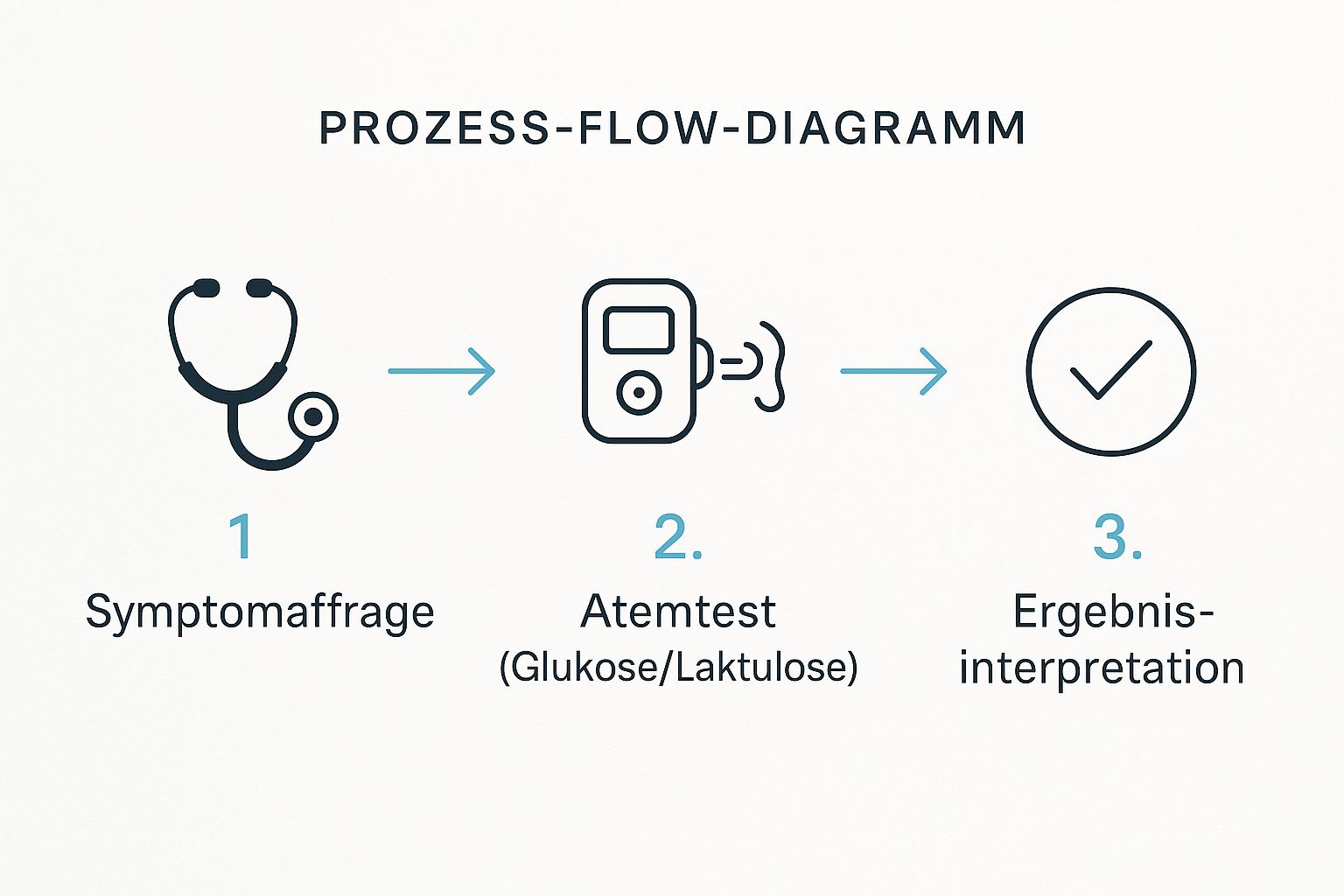
As you can see, the process is structured logically and ultimately leads to a crucial test that should finally provide clarity.
The breath test: How to track down bacteria
If SIBO is suspected, the so-called breath test is the method of choice. It is considered a non-invasive and reliable gold standard for detecting bacterial overgrowth in the small intestine. The idea behind it is quite clever: the gases produced by the bacteria are measured directly in your breath.
And this is how the test works:
- Baseline measurement: First, you blow into a device while fasting to determine the normal gas content of your breath.
- Drink a sugar solution: You will then be given a special sugar solution to drink. This is usually either lactulose or glucose.
- Blow regularly: Over the next two to three hours, blow into the measuring device again at regular intervals (e.g., every 20 minutes).
The sugar solution is essentially the bacteria’s “food.” If too many of them are in the small intestine, they immediately swarm to it and begin fermenting the sugar. This produces gases such as hydrogen (H₂) and methane (CH₄). These gases enter your bloodstream and travel to your lungs, where you exhale them. A significant increase in these gases in your breath is the decisive evidence.
What the test result really means
You have a positive result if the concentration of hydrogen or methane rises sharply within the first 90 to 120 minutes after drinking the solution. This early increase is the key criterion. It shows that fermentation is already taking place in the small intestine—not later in the large intestine, where it actually belongs.
The level and exact timing of the gas increase provide valuable clues. A rapid and substantial increase indicates a problem in the front part of the small intestine. If the levels rise only later, the overgrowth is probably located farther down.
For the test to really provide meaningful results, however, you need to prepare properly. This is essential. In general, that means:
- Special diet: For one or two days before the test, you will follow a very restricted diet with as few fermentable carbohydrates as possible.
- Fasting: On the day of the test, you must be completely fasting.
- Medication break: Certain medications, especially antibiotics or laxatives, often need to be stopped several weeks in advance.
Your doctor or the laboratory will give you very precise instructions. Be sure to follow them! This is the only way to ensure that the result truly reflects your current gut situation and that the diagnosis is based on a solid foundation.
Treating SIBO holistically: Your roadmap to gut health
A SIBO diagnosis is not an endpoint, but the starting point for taking charge of your gut health again. It is not simply about eliminating a few bacteria. Rather, we want to create a healthy balance that lasts in the long term. Truly successful treatment is based on four pillars that work together like interlocking gears.
The first step is usually to end the excessive bacterial party in the small intestine. There are various ways to do this, which must be tailored to you individually. Only then can your gut finally settle down and begin to regenerate.
Pillar 1: Curbing bacterial overgrowth
To reduce these unwelcome guests in the small intestine, we need to decrease their numbers. Both conventional medical and herbal methods have proven effective for this.
- Antibiotics: The best-known approach is treatment with the antibiotic rifaximin. Its major advantage is that it acts almost exclusively in the gut and barely enters the bloodstream. This largely spares the important microbiome in the colon.
- Herbal alternatives: Herbs such as oregano oil, berberine, and neem are true powerhouses from nature. They have strong antimicrobial properties and have proven highly effective alternatives in practice. They are often combined to target as broad a spectrum of bacteria as possible.
Interestingly, Germany currently has no official S3 guidelines for treating SIBO. Treatment therefore relies heavily on specialists’ experience and is tailored to each individual. In Germany, rifaximin is officially approved only for traveler’s diarrhea, which does not make things any easier.
Pillar 2: The right diet as a powerful ally
Alongside reducing the bacteria, your diet plays a central role. Imagine cutting off the bacteria’s fuel supply by depriving them of their favorite food—without neglecting important nutrients for yourself.
The low-FODMAP diet is one of the best-known strategies here. FODMAPs are certain carbohydrates that are like a feast for SIBO bacteria. If you reduce them, you effectively “starve” the bacteria. The result is often rapid relief from bloating and pain.
Very important: A low-FODMAP diet is a short-term therapeutic measure, not a long-term diet! In the long run, it can restrict the diversity of beneficial gut bacteria in the colon. Be sure to work with an expert while following it.
Pillar 3: Addressing the root cause to prevent relapses
This may be the most important step of all. SIBO is almost always just a symptom of an underlying problem. Once we have the overgrowth under control, we need to make sure it does not flare up again immediately.
This is where the Migrating Motor Complex (MMC)—your gut’s “cleaning wave”—comes into play again. To reactivate it and stimulate natural intestinal movement, so-called prokinetics are used. These can be herbal remedies such as ginger or certain medications. They help your gut resume cleaning itself.
Pillar 4: Building a sustainable gut environment
Once we have cleared things out, your gut is ready to rebuild. Now the goal is to support the good bacteria and heal the intestinal lining so that it can become strong and resilient again.
This is where probiotics come in. During the acute reduction phase, they can sometimes do more harm than good. But afterward, they are essential for specifically recolonizing the gut and restoring balance. The key is to use the right bacterial strains at the right time.
Over time, prebiotic fiber can also be reintroduced to specifically provide beneficial bacteria in the large intestine with food. A detailed analysis of your microbiome can show you exactly where to start. Find out how a comprehensive microbiome test can help take your gut health to the next level.
Questions and answers about SIBO
When you start looking into SIBO, many questions can quickly start swirling around in your head. That is completely normal, because the road back to a healthy gut is rarely a straight line. To give you a little more clarity, we have compiled the most frequently asked questions we receive.
We want to provide you with clear, practical answers. This will help you better understand the connections and take the next steps on your journey in an informed and confident way.
Can SIBO go away on its own?
This is a question many people affected by SIBO ask themselves with hope. But the honest answer is: In the vast majority of cases, unfortunately not. The reason is actually quite logical: SIBO is rarely the actual problem; it is usually just a symptom of an underlying disorder.
Think of it like a burst water pipe in the basement. SIBO is the water flooding the basement. You can keep pumping out the water, but until the leak—the actual cause—is repaired, the basement will keep flooding. SIBO works the same way. A short-term diet may relieve the symptoms because you are giving the bacteria less food. But the cause, the bacterial overgrowth, remains.
Without targeted therapy that both reduces the bacteria and addresses the root of the problem—such as impaired gut motility (MMC)—the symptoms are highly likely to return. Long-term success requires a holistic approach.
What role do probiotics play in SIBO?
Probiotics are an important but also tricky topic when it comes to SIBO. The key factor here is choosing the right timing. Most experts advise against taking probiotics during the acute phase, when the goal is to reduce the bacteria in the small intestine. The reasoning is that you do not want to add even more bacteria to an already overcrowded system.
Once the bacterial load has been successfully reduced, however, the situation looks completely different. High-quality probiotics are then a crucial building block for specifically rebuilding the gut flora and strengthening the healthy balance in the colon.
They help stabilize the intestinal barrier and prevent a relapse. So it is not about a “yes” or “no” to probiotics, but about the right timing and choosing the appropriate bacterial strains for your situation.
How long does SIBO treatment take?
Patience is probably your most important companion during SIBO treatment. The duration varies greatly from person to person and depends heavily on the severity of the overgrowth, its cause, and your general state of health. It is not a sprint, but rather a marathon with several stages.
- Phase 1: Reduction Simply combating the bacteria with antibiotics or herbal remedies usually takes between two and six weeks.
- Phase 2: Addressing the causes & prevention This part is often the longest. Getting intestinal motility (MMC) working properly again and treating the underlying cause can take several months.
- Phase 3: Rebuilding Building up a healthy gut flora sustainably and allowing the intestinal lining to heal is also a process that can take several months.
Overall, you should be prepared for the entire journey from diagnosis to a stable, symptom-free state to take six months to more than a year. But every individual step is worthwhile for your quality of life.
The path to a better gut feeling begins with understanding your body. At mybody-x, we support you in gaining well-founded insights into your gut health. With our science-based analyses, you can find out what your microbiome is missing and get the tools to improve your well-being in a targeted way. Discover the possibilities now at https://mybody-x.com.



Share now:
Leaky Gut Syndrome: What’s really behind it
Leaky Gut Nutritional Therapy: Your Path to a Healthy Gut