
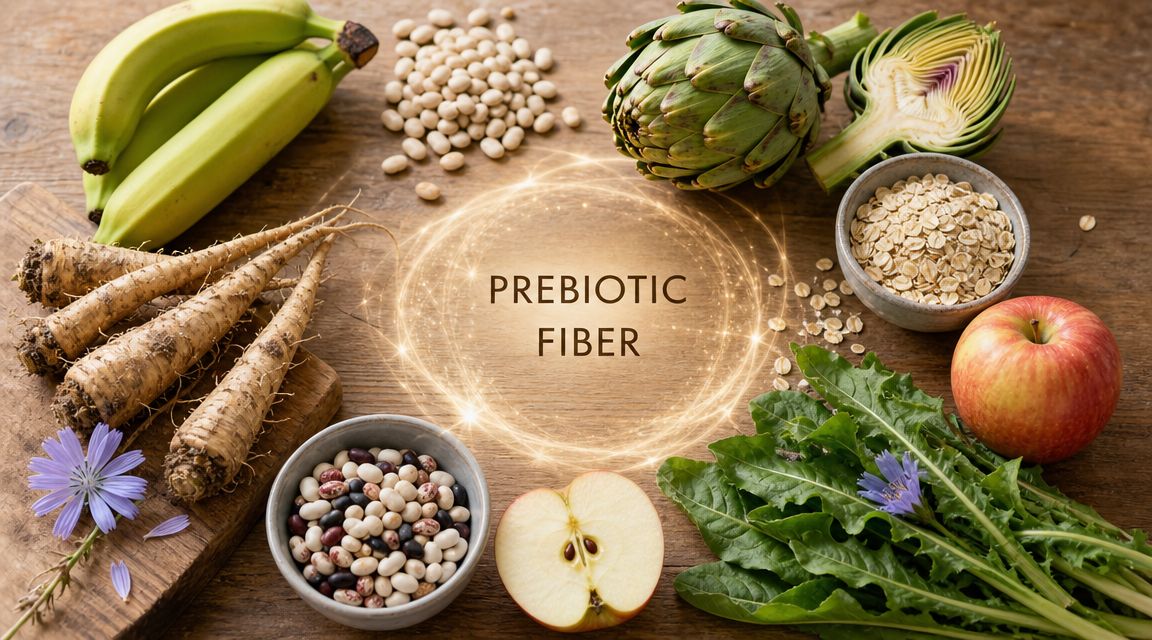
Prebiotic Fiber: Your Guide to Healthy Digestion
Do you know that feeling when your stomach feels tight after eating, your digestion is sluggish at times and unsettled at others, and you think: I actually eat pretty well, so why does it still not feel quite right? This is where many people end up. Not because they are not trying hard enough, but because there is often a gap between general nutrition advice and what the gut really needs.
Often, this is not about exotic superfoods, but about something much more down-to-earth. Prebiotic fiber. It is not a trendy buzzword, but the daily food for the microbes that help out in your large intestine.
A healthy gut starts with food
Many people first look for that one remedy for bloating, a feeling of fullness, or irregular digestion. Then they turn to teas, capsules, detox ideas, or lists of foods to avoid. That may seem interesting in the short term, but it often misses the point.
Because your gut is not an empty tube. It is more like a garden. And bacteria live in this garden that need to be fed. If they do not get enough suitable food, the bacteria you would like to encourage will not necessarily grow.
That is precisely why it is worth taking a closer look at prebiotic fiber. It provides beneficial gut bacteria with what they need to do their job. This is often a more practical lever than constantly cutting things out.
A simple example: Someone has a high-protein breakfast, snacks during the day, eats something quick for lunch, and has a large bread-based dinner. It sounds normal at first. But if there are only a few vegetables, legumes, fruits, or other fiber-rich foods on the plate, the microbiome is often missing exactly the material it needs to make something beneficial.
Your gut does not only react to what you cannot tolerate. It also reacts to what it lacks in the long term.
That is what makes the topic so fascinating. You do not have to overhaul everything right away. Often, simply shifting your focus is enough. Away from just counting calories or macros. Toward the question: What am I actually feeding my gut flora?
If you want to take a deeper dive into how nutrition affects your bacterial ecosystem, the article Building a healthy gut flora through nutrition is a useful addition.
What really are prebiotic fibers
You actually eat pretty well. Bread, some fruit, and the occasional salad. Even so, your stomach does not always feel as though it has really gotten what it needs. This is exactly where it helps to take a closer look at prebiotic fiber.

Dietary fibers are not all the same
Fiber is an umbrella term. Prebiotic fiber is a specific subgroup within it. The difference is easy to overlook in everyday life, but quite important for your microbiome.
Regular dietary fiber helps, among other things, to soften stool and support digestion. Prebiotic fiber can do even more. It serves as food for certain gut bacteria when it passes largely undigested through the small intestine and is only metabolized in the large intestine.
A simple distinction can help:
- General dietary fibers act more like structural components of your diet.
- Prebiotic fibers are targeted food for certain gut bacteria.
- Not every type of fiber is prebiotic. What matters is whether gut bacteria can actually use it in the large intestine.
Many people confuse prebiotics with probiotics. The difference is simple: Probiotics are living microorganisms; prebiotics are their food. If you want to clearly distinguish the two, you can find an easy-to-understand explanation of the difference between probiotics and prebiotics here.
Why this distinction is more than just theory
For your gut, it makes a major difference whether you simply eat more fiber or whether your diet also includes fibers with prebiotic effects. Your microbiome responds not only to the amount of food, but also to its type.
This is exactly where looking at real measurements becomes interesting. The Darmflora MIKROBIOM-Test Complete can be used to assess the current composition of your gut flora, including bacterial diversity, dysbiosis, inflammation markers, and indications of leaky gut. This is practical because it makes recommendations more precise.
A typical example from microbiome practice: Two people eat similarly fiber-rich diets but react differently. In one person, mybody® analyses show a low presence of Bifidobacteria. In that case, prebiotic fibers such as inulin or oligofructose are often particularly interesting, because these bacteria can make good use of such substrates. For another person, overall fiber diversity may be more important, because the goal is to support the entire range of bacteria rather than a single strain.
This is the point that general nutrition advice often leaves out. “More fiber” is a good start. “Which types of fiber suit your microbiome?” is a much more precise question.
You can quickly see in everyday life why this is relevant. If you eat whole grains but only rarely eat onions, leeks, legumes, chicory, or slightly green bananas, you may be consuming fiber, but less of the types that specifically nourish certain beneficial bacteria.
Prebiotic fiber is therefore not a specialist topic reserved for nutrition professionals. It is the part of your diet that can turn “I eat a high-fiber diet” into more targeted nourishment for your gut flora.
The hidden work in the gut and how prebiotics work
You eat lentil soup with onions for lunch and wonder why such a simple meal often does more for your gut than you notice at first glance. The real effect only occurs hours later, when certain fibers reach the place where your gut bacteria are waiting for them.

The journey to the large intestine
Some prebiotic fiber is barely broken down in the small intestine. That is precisely its strength. It reaches the large intestine largely undigested, where it serves as food for selected microorganisms.
It works like a small home kitchen. You provide the ingredients. Certain bacteria process them further. In the end, substances are produced that your body can put to good use.
Bifidobacteria and lactobacilli in particular are known for being able to use certain prebiotic fibers effectively. The mybody® microbiome analyses make this especially tangible: When bifidobacteria are only weakly represented in a person, fibers such as inulin or oligofructose are often interesting because these bacteria can work well with them. Prebiotics therefore do not simply work universally. They always work in combination with what is already present in your gut.
What is produced during fermentation
When gut bacteria break down these fibers, fermentation takes place. That may sound technical, but it is easy to understand: Bacteria obtain energy from indigestible plant fibers and produce new substances in the process. The most important of these include short-chain fatty acids.
These substances are interesting for the gut because they help nourish the intestinal lining and influence processes related to digestion and satiety. Food that you cannot fully digest yourself thus becomes a raw material for beneficial metabolic products.
In short: You are not feeding yourself directly, but your gut inhabitants first. They then give something back.
That is exactly why prebiotics and probiotics are often confused. Probiotics provide live microorganisms. Prebiotics provide their food. If you want to clearly understand the difference, you can find it in the article about the difference between probiotics and prebiotics.
Why the effect varies from person to person
This is where confusion often arises. If two people eat the same prebiotic food, the effect does not have to be the same. The reason is simple: not every gut starts with the same bacterial composition.
In practice, the mybody® analyses show exactly these kinds of differences. For someone with a lower proportion of Bifidobacteria, inulin may be especially suitable because these bacteria benefit from it. For someone else, a broader range of different fibers may be more useful, so that more bacterial groups receive nourishment. Prebiotics therefore work a bit like the right fertilizer in a garden. Which plant responds to it depends on what is already growing in the bed.
What you may notice in everyday life
The effects are usually not spectacular from one day to the next. Instead, over time you may notice calmer digestion, more regular bowel movements, or a longer-lasting feeling of fullness after eating.
Consistency is what matters. Your microbiome responds to regular nourishment, not to individual perfect meals. Those who repeatedly include prebiotic fibers give beneficial bacteria a better chance to establish themselves.
The most important prebiotics and their best sources
Theory helps. In everyday life, however, the key question is: What exactly do I eat?
In Germany, inulin, oligofructose or FOS, and GOS are considered particularly well-documented prebiotic fibers. They pass through the small intestine undigested and are specifically fermented in the large intestine by beneficial bacteria such as Bifidobacteria, as Nutrimmun explains in its information on prebiotics and dietary fiber.
The most interesting everyday candidates
Based on the additional insights from mybody®, three groups are particularly interesting in practice: inulin, pectin, and resistant starch. They are considered especially reliable promoters of Bifidobacteria and Lactobacilli.
This does not mean that other fibers are unimportant. It only shows that some forms may work more specifically than others.
| Prebiotic | Top food sources | Notable effect |
|---|---|---|
| Inulin | Chicory, Jerusalem artichoke | Described in mybody® microbiome analyses as particularly interesting for Bifidobacteria |
| Oligofructose FOS | Onions, garlic | One of the best-documented prebiotic soluble fibers |
| GOS | Legumes | A prebiotic fiber group specifically utilized by beneficial gut bacteria |
| Pectin | Apples, carrots | mybody® classifies it as reliable support for beneficial bacteria |
| Resistant starch | Cooled rice, cooled potatoes | According to mybody®, particularly relevant for butyric acid-producing bacteria |
This is how you can recognize the differences more easily
A few memory aids can help:
- Inulin is often found in more bitter root vegetables such as chicory or Jerusalem artichoke.
- You are more likely to find pectin in classic fruits and vegetables such as apples and carrots.
- Resistant starch often forms when starchy foods are cooked and then eaten after cooling.
When you get prebiotics from food, you usually automatically eat a more varied diet. And this diversity is often good for the gut.
When shopping, it is often easier not to think in chemical names but in terms of dishes. A salad with chicory. An apple with the peel. Lentil dishes. Cooled potatoes as a salad. You can find more ideas in the overview of high-fiber foods.
Where personalization becomes interesting
Not everyone responds to the same sources in the same way. Some people tolerate raw onions poorly but do perfectly well with cooled potatoes. Others benefit more from fruit pectins than from highly fermentable fibers.
If you want to take an even more individual approach to nutrition, the NutriCare | INFINITY DNA test may be relevant. It analyzes genetic nutrient utilization, food intolerances, micronutrient requirements, and metabolic type as the basis for a personalized nutrition plan.
Your benefits: what prebiotics do for your health
The most interesting question is not what a fiber is called chemically. The most interesting question is: What does it do for you in real life?
A well-nourished microbiome can help your intestinal environment function more stably. Many people primarily want three things: less digestive discomfort, greater regularity, and a better physical feeling after eating. This is exactly where prebiotic fibers often come in.
What is practically relevant as an effect
For a measurable prebiotic effect, German expert sources cite typical daily doses in the range of 2.5 to 10 g. Some sources already consider at least 5 g per day a practical threshold, as Kijimea writes about prebiotics.
This is important because it corrects a common misconception. A product or food may sound prebiotic. But that does not automatically mean that you are also reaching a level that is relevant in everyday life.
A real example from the mybody® analyses
An anonymized example makes this tangible: A 45-year-old customer had hardly any bifidobacteria in the initial test and reported chronic bloating. After 8 weeks with 8 g of inulin daily, the proportion of bifidobacteria had doubled, and the symptoms had significantly decreased. This was visible in the follow-up test.
Such a case does not prove that everyone reacts in the same way. But it clearly illustrates why targeted prebiotics are often more sensible than trying things blindly.
Why the benefits extend beyond digestion
When bacteria ferment prebiotic fibers, they produce metabolites that play a role beyond the gut itself. For many people, the key point is that prebiotics may influence satiety and the gut barrier.
That is one of the reasons why this topic is not only relevant to people with digestive problems. Anyone working toward long-term improvements in nutrition, metabolism, or healthy aging can also benefit from not treating the gut as a side issue.
As a complementary perspective, the Longevity | ALL IN ONE DNA test may be interesting. It analyzes genetic risk factors for aging, inflammation, nutrient utilization, and metabolism.
Integrating prebiotics safely into everyday life
The most common mistake is simple. People start too quickly. They suddenly eat far more fiber than usual and then wonder about bloating or stomach rumbling.
This does not mean that prebiotics are not suitable for them. It usually just means that the gut needs time to adjust.

How to proceed sensibly
The information from mybody® suggests the following practical target ranges:
- Inulin at 5 to 10 g per day, introduced gradually
- Pectin at 5 to 8 g per day from fruit and vegetables
- Resistant starch at 15 to 20 g per day through meals
What matters is not only the target amount but also how you get there. Start small and observe how your stomach reacts.
It is better to start with a small, well-tolerated change that you can manage every day than with a perfect three-day plan.
Simple ways to implement this on ordinary days
- At breakfast, add an apple or combine oats with pectin-rich fruit.
- At lunchtime, add legumes if you tolerate them.
- In the evening, incorporate cooled potatoes or rice into a meal.
- In salads, try chicory if you want to increase your inulin intake through food.
Fluid intake also plays a role. German expert sources point out that adequate drinking is important when consuming “extra fiber,” because swelling and fermentation can affect stool consistency and transit time. If you are sensitive, it may also be helpful to test individual sources separately rather than increasing everything at once.
Reading labels without falling for advertising
Since 2014, dietary fiber has no longer had to be listed mandatorily in the nutrition table of packaged foods, although it may be included voluntarily. If manufacturers advertise a product as containing fiber, they must state the amount. To qualify as a “source of fiber”, a product must contain at least 3 g per 100 g or 1.5 g per 100 kcal; to qualify as “high in fiber”, it must contain at least 6 g per 100 g or 3 g per 100 kcal, as explained by the consumer advice center on prebiotic fiber.
This helps you put things into perspective. A label that merely appears “prebiotic” does not by itself mean that the amount is truly relevant to you in everyday life.
If you want to approach the process more systematically, the article Building a microbiome offers further practical approaches.
Conclusion: why your personal microbiome is decisive
Prebiotic fibers are not a minor detail. They are the fuel your gut uses to build part of its internal stability. Some forms, such as inulin, pectin, or resistant starch, may be particularly interesting. But they do not work the same way for everyone.
That is precisely the crucial point. Your microbiome is individual. If certain bacteria are underrepresented in your gut, one prebiotic may be very suitable, while another may barely make a noticeable difference or may even cause discomfort.
That is why adding supplements blindly is a bit like gardening without looking at the soil. You can water and fertilize, but without knowing what is missing, you are working more by instinct than by plan.

If you want to understand which bacteria in your gut may need more support and what kind of nourishment could suit them, an individual analysis is often the most logical next step. This turns general nutrition knowledge into a more personalized strategy.
If you no longer want to guess about your microbiome but understand it more purposefully, take a look at the health analyses from MYBODY Lab GmbH. There you will find scientifically grounded tests for gut health, nutrition, metabolism, and DNA-based analyses that can help you assess prebiotics and other dietary levers in a way that better suits your body.



Share now:
Your microbiome test: A guide to gut health in 2026
Microbiome Test: What Is Scientifically Proven and When Is It Useful?