
Leaky Gut Test: Find the cause of your intestinal problems
Do you often feel tired, struggle with bloating, or wonder about sudden food intolerances? If you're looking for answers, a leaky gut test could be the crucial next step. It provides clarity on whether your intestinal barrier is intact or if it has "holes" through which unwanted substances could enter your body and trigger your symptoms.
What exactly is leaky gut syndrome? An easy-to-understand introduction.

You may have heard the term "leaky gut" before, but what does it really mean? Imagine your intestinal lining as a top-notch bouncer at an exclusive club. This bouncer—a layer of highly specialized cells—has a very clear job: deciding who gets in and who has to stay out. Valuable nutrients are allowed in, while toxins and pathogens are repelled.
In a healthy gut, this protective mechanism works perfectly. But what happens when the gatekeeper is overloaded and leaves the door ajar? This is precisely where the problem begins that we call leaky gut syndrome – or medically, "increased intestinal permeability." The tight connections that hold the intestinal cells together like a zipper loosen.
These tiny gaps can suddenly allow things to enter the bloodstream that have absolutely no business being there: undigested food particles, toxins, or bacterial fragments. Your immune system immediately sounds the alarm. It recognizes the intruders as hostile and launches a massive defense response.
The far-reaching consequences of a leaky intestinal barrier
This constant state of alert by your immune system does not come without consequences. It triggers a chain of inflammatory reactions that spread throughout the body like a smoldering fire and can lead to a wide variety of often vague symptoms.
Many sufferers would never connect their symptoms to their gut. But it is precisely here, at the heart of your health, that the root of the problem often lies. A disrupted intestinal barrier can manifest itself in a variety of ways.
Typical symptoms and their connection to leaky gut syndrome
This table provides a quick overview of common complaints and explains why they might be related to a leaky intestinal barrier.
| symptom | Possible link to leaky gut |
|---|---|
| Digestive problems | Persistent bloating, diarrhea, or constipation are direct signs that something is wrong in the intestines. |
| Food intolerances | If incompletely digested particles enter the bloodstream, the immune system can overreact and trigger new sensitivities. |
| skin problems | Acne, eczema, or rosacea can be triggered by systemic inflammation originating in the gut. |
| Fatigue & “Brain Fog” | Constant immune activity and inflammatory processes rob the body of a tremendous amount of energy and can impair cognitive function. |
| Joint pain | Chronic inflammation can spread throughout the body and lead to painful or stiff joints. |
These symptoms are not imagined, but important warning signals from your body that the delicate balance in the gut has been disrupted.
It's important to understand that a leaky gut is not a disease in itself. Rather, it's a condition that can open the door to a whole range of other health problems – often it's the hidden cause behind chronic ailments.
The good news is: you're not helpless in the face of this condition. A targeted leaky gut test from mybody-x can finally give you certainty. By measuring specific biomarkers that indicate increased permeability, it helps you understand the cause of your symptoms. With this knowledge, you can take targeted steps to strengthen your intestinal barrier and take control of your health again.
If you want to delve even deeper into the fascinating world of your gut microbiome, then be sure to read our article What is the microbiome and learn more about its crucial role in your well-being.
What is really behind a leaky intestinal barrier?
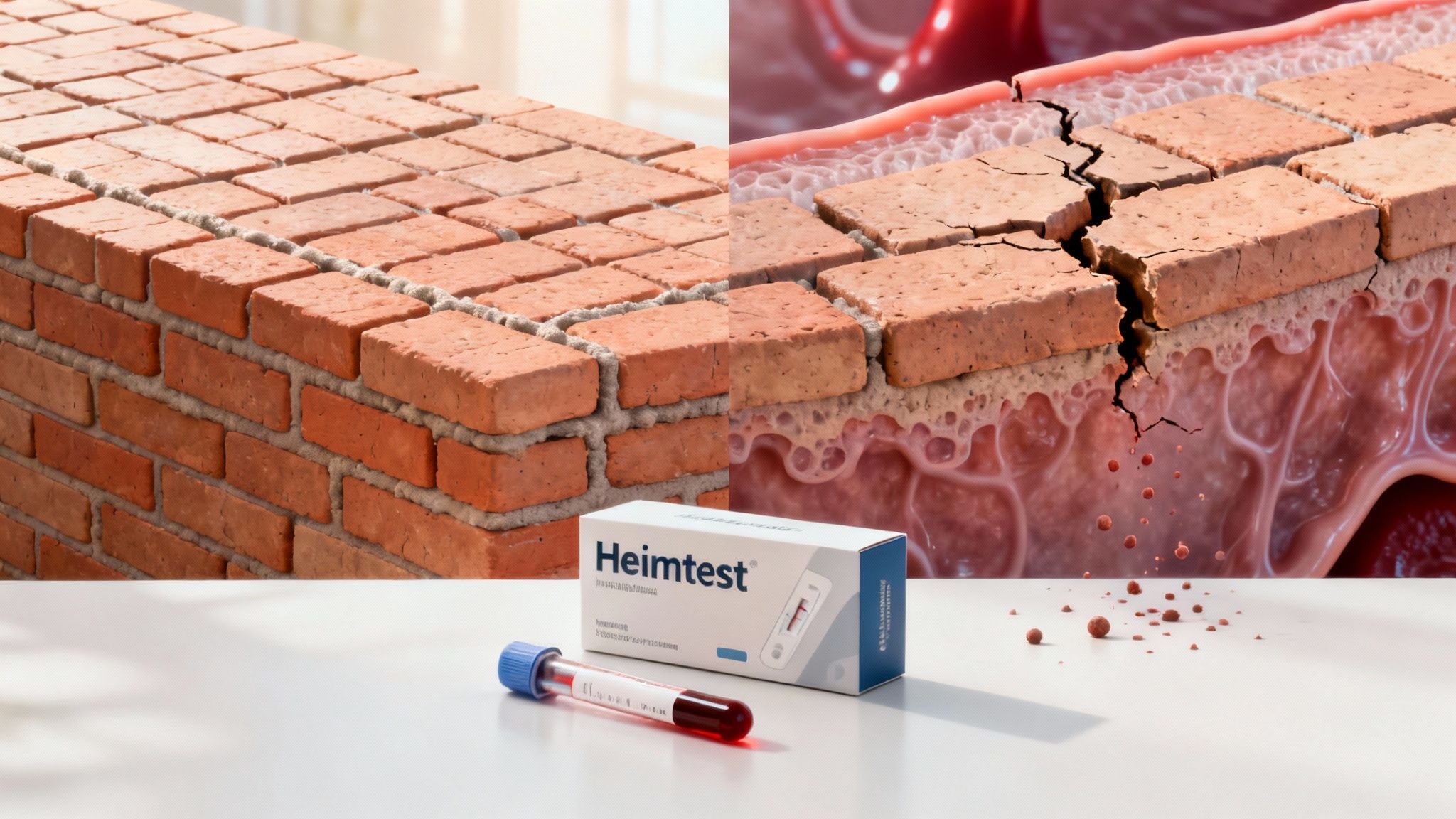
To understand what a leaky gut test actually measures, we need to take a closer look at what happens in your gut. Don't just imagine your intestinal wall as a passive tube, but as an extremely intelligent, living wall. The bricks of this wall are your intestinal cells.
And what holds these bricks together? A special "mortar" that scientists call "tight junctions." These connections are what make your intestinal wall stable and, above all, airtight. The ingenious thing about them is that they aren't rigid, but can open briefly and deliberately to allow important nutrients and water to pass through, and then immediately close again.
In a healthy gut, all of this runs like a perfectly oiled clock. Problems only arise when this mortar becomes brittle. Then tiny gaps form between the cells, the barrier becomes permeable and begins to "leak."
Zonulin: The keymaster who opens the gates
This is precisely where a crucial player comes into play: the protein zonulin . Zonulin can be imagined as a universal keyholder, controlling the locks of the tight junctions. If too much of it is produced, it unlocks the gates between the intestinal cells and leaves them open for quite some time.
This is actually a clever protective mechanism of the body, allowing it to quickly "flush out" pathogens during an infection. The problem arises when the zonulin level remains permanently elevated.
There are various triggers that can summon this key master and open the gates wide:
- Certain foods: Gluten is one of the best-known triggers that can boost zonulin production in many people.
- A disrupted microbiome: When "bad" bacteria gain the upper hand, they can directly irritate and weaken the intestinal wall.
- Chronic stress: The stress hormone cortisol has been proven to attack the tight junctions and make the barrier porous.
- Infections and toxins: Pathogens or environmental toxins can also trigger a severe zonulin reaction.
An elevated zonulin level is therefore a fairly direct indication that the intestinal barrier is open. This is precisely one of the key values that modern leaky gut tests analyze to determine the stability of your intestinal barrier.
The chain reaction that follows in the body
Once the intestinal barrier is compromised, undigested food particles, bacterial fragments (such as lipopolysaccharides, or LPS), and other foreign substances can freely enter your bloodstream. Your immune system, a full 80% of which resides in the gut, immediately sounds the alarm. It recognizes the invaders as a threat and launches a massive defense response.
This constant state of alert leads to something called silent inflammation . It's not a fire that burns openly, but a low-level smoldering throughout the body that, over time, drains an incredible amount of energy and can create fertile ground for countless chronic ailments.
The connection between a healthy gut and overall well-being is now undeniable. In Germany alone, for example, around 70 percent of patients with irritable bowel syndrome (IBS) also suffer from leaky gut. Since IBS affects up to 15 percent of the population, we are talking about millions of people whose symptoms are often related to a permeable intestinal barrier. Specialized diagnostics are increasingly confirming this link, as can be seen in recent reports on the connection between IBS and leaky gut .
At the end of the day, your gut barrier is so much more than just a digestive surface – it's the foundation of your immune system and your overall health. To grasp the complexity of this topic, it's worth looking beyond the obvious, for example, at the importance of gut health in pets. The fundamental principles of an intact barrier are universal. A test can show you whether this crucial foundation might have developed any cracks in your gut.
A comparison of different testing methods for leaky gut
You suspect you might have a leaky gut and are now faced with the big question: Which test will give me clarity? The market is full of options, and keeping track of them all isn't easy. Let's shed some light on the subject together and look at the most common methods so you can make an informed decision.
There isn't one single, universal leaky gut test . Instead, the various approaches function like detectives, gathering different clues to paint a comprehensive picture of your gut health. Whether blood, stool, or urine – they can all provide valuable information about the function of your intestinal barrier.
This graphic beautifully illustrates how a healthy gut can gradually become a "leaky gut" due to certain triggers.

It's immediately clear: Leaky gut is not a sudden event, but the result of factors that slowly but surely weaken our protective intestinal wall.
The zonulin test as a direct trace reader
We have already learned about zonulin as the "keymaster" that opens and closes the gates between intestinal cells. A test that measures precisely this value is therefore one of the most direct methods for detecting increased intestinal permeability.
This test can be performed in two ways:
- In the blood: A blood test measures zonulin, which circulates throughout the body. An elevated level is a strong indication that the tight junctions are currently open, allowing unwanted substances to enter your bloodstream. The self-tests from mybody-x utilize precisely this mechanism.
- Stool analysis: A stool sample reveals the zonulin concentration directly in the intestine. This can be an important indicator of local processes that are putting a strain on your intestinal barrier.
It is not without reason that an elevated zonulin level is often associated with diseases such as irritable bowel syndrome or Crohn's disease – this underlines its high significance.
The lactulose-mannitol test: The clinical gold standard
In research and specialized clinics, the lactulose-mannitol test is often considered the most reliable method for measuring intestinal permeability. In this test, you drink a solution containing two different sugars: the large molecule lactulose and the small molecule mannitol.
The idea behind it is quite clever: Mannitol is so small that it is easily absorbed even through a healthy intestinal wall. Lactulose, on the other hand, is too large and should normally barely be able to pass through the barrier. If a high ratio of lactulose to mannitol is suddenly found in the urine, this is a clear sign: The gates are open and allowing even large molecules to pass through. A ratio above 0.025 is considered a strong indication of leaky gut syndrome.
Although this test is very informative, it is quite complex in practice and is usually only offered in specialist clinics.
What other markers reveal about your gut
In addition to direct tests, there are other biomarkers that contribute to the overall picture like pieces of a puzzle. They often don't reveal the leaky gut itself, but rather the associated symptoms such as inflammation or immune responses.
It's important to know that a truly comprehensive test often examines several markers simultaneously. This creates a multifaceted picture that not only shows whether your barrier is leaking, but also provides clues as to why this might be the case.
This includes, above all:
- Calprotectin: An elevated level in stool is an established marker for inflammation in the gastrointestinal tract. This can be both a cause and a consequence of leaky gut syndrome.
- Antibody tests (IgA/IgG): Your immune system produces antibodies when it wants to fight off foreign substances. IgG tests for certain foods can indicate that incompletely digested food components are slipping through a leaky intestinal wall and triggering your immune system.
- Lipopolysaccharides (LPS): These molecules originate from the cell wall of certain bacteria. Their presence in the blood is a warning sign – it means that bacterial fragments have breached the intestinal barrier.
Comparison of common leaky gut testing methods
This table helps you quickly get an overview of the different types of tests, their sample type, what they measure, and their respective significance.
| Test method | What is being measured? | Sample type | Significance & Scope |
|---|---|---|---|
| Zonulin test | The concentration of the protein zonulin, which regulates tight junctions. | Blood, stool | Direct indication: Shows whether the "gates" between the intestinal cells are currently open. Useful for an initial assessment and monitoring of progress. |
| Lactulose-Mannitol Test | The ratio of two sugar molecules after ingestion. | urine | Gold standard: Considered a very accurate measurement of permeability. More commonly used in clinical settings due to its complexity. |
| Calprotectin test | A protein that is released during inflammation in the intestine. | Chair | Inflammatory markers: Indicates whether there is inflammation that may be related to leaky gut. |
| Antibody tests (IgG) | Immune reactions (IgG antibodies) to certain foods. | blood | Indirect indication: May point to an overreaction of the immune system due to a leaky intestinal wall. |
| LPS test | Bacterial components (lipopolysaccharides) in the blood. | blood | Warning sign: Clear evidence that bacterial substances have overcome the intestinal barrier and are triggering an immune response. |
Each test therefore has its strengths and provides a specific piece of the puzzle.
Of course, analyzing the microbiome itself plays a huge role, as an imbalance of gut bacteria is one of the most common causes of a weakened intestinal barrier. In our guide, you'll learn how to test your microbiome and use the results to your advantage.
Choosing the right test therefore depends heavily on your individual situation and symptoms. A convenient at-home blood test like the one from mybody-x often combines several relevant markers to provide you with a practical and informative result.
How a mybody-x blood test provides clarity
You now have an idea of which markers can truly provide insights into your gut health. But let's be honest: Does the thought of doctor's appointments, referrals, and weeks of waiting for results hold you back from finally taking action? This is precisely where modern at-home tests come in. They make gaining valuable insights into your body as easy and accessible as possible.
The idea behind the mybody-x Leaky Gut Test is quite simple: You should be able to take control of your health. Conveniently, discreetly, and without compromising on quality. We make the entire process transparent for you, so you know exactly what happens to your sample and why you can trust the results.
Your path to clarity in just four steps
The entire process is designed to fit seamlessly into your daily routine. You don't need any prior medical knowledge and can do everything comfortably from home.
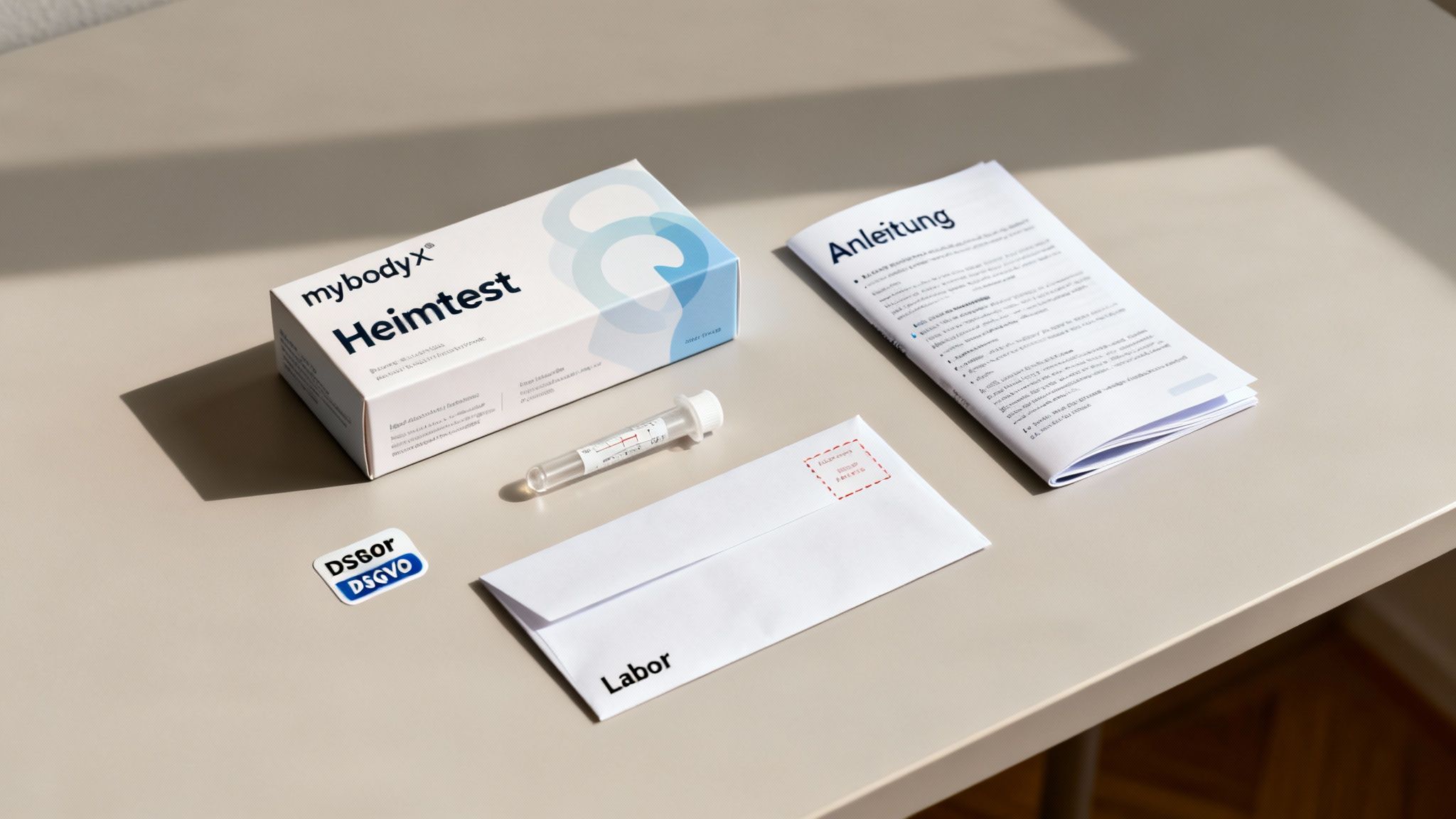
- Order & Get Started: Simply order your test kit online at mybody-x.com. Within a few days, a discreetly packaged parcel containing everything you need will arrive in your mailbox.
- Taking a sample is easy: The kit includes a super clear, illustrated step-by-step guide. It only takes a small prick of the fingertip for a blood sample. The whole process only takes a few minutes.
- Free return to the lab: Simply pack your sample securely in the enclosed return envelope and take it to the post office. Shipping to our specialized partner lab in Germany is completely free for you.
- Analysis & your result: As soon as your sample arrives at the lab, our specialists will analyze it. Shortly afterwards, you will receive a message: Your personal results report will be waiting for you in your secure mybody-x account.
Your trust is our most valuable asset. That's why we work exclusively with ISO-certified specialist laboratories in Germany. This guarantees you the highest standards in analysis and therefore maximum precision and reliability of your results.
Quality and safety are paramount.
There are no compromises when it comes to health data. We know how sensitive this information is and handle it with the utmost care. Your privacy is not an empty promise for us, but a technical and organizational standard.
Strict data protection guidelines (GDPR): Your personal data is strictly separated from your sample data and processed anonymously. The entire process is subject to strict German and European data protection laws. You can therefore be sure that your information is protected with us.
ISO 27001 certification: This internationally recognized standard for information security is proof that we meet the highest requirements for the protection of your data – from ordering to providing your results.
What actually happens to your sample in the lab?
As soon as your sample arrives at the lab, the actual analysis begins. Using established scientific methods, such as the ELISA (enzyme-linked immunosorbent assay), the specific biomarkers in your sample are quantified. This means that the analysis doesn't just check if a marker like zonulin is present, but measures its exact concentration.
These precise measurements form the basis for your individual diagnosis. This way, you receive not just a vague indication, but a solid, data-driven assessment of your gut health. Whether you choose a blood or stool test for home use makes no difference to the reliability, as validated analytical methods exist for both sample types.
A mybody-x home test removes the obstacles and gives you a powerful tool. It enables you to be proactive and make informed decisions for your well-being – based on facts that come directly from your body.
How to correctly interpret your test results

The moment has arrived: You're holding your personal mybody-x results in your hands. Finally, you have it in black and white what might be behind your symptoms. But what do all the numbers and technical terms mean? Don't worry, we won't leave you hanging. Consider this section your personal guide, helping you understand the lab results and translate them into a concrete plan for your health.
Your test results are much more than just a list of values. They are the starting point for positive change – a tool that makes your body's language understandable. We translate the "lab jargon" so you can fully grasp what's happening in your gut.
Your biomarkers – what they reveal to you
The core of your report lies in the individual biomarkers. Each one tells a part of the story of your gut health. Your individual measurements are clearly displayed alongside the scientifically established normal ranges. This allows you to see at a glance where everything is within the normal range and where action might be needed.
So what does it mean if your zonulin level is out of range?
-
Zonulin: We've called it the "keymaster" that opens the gates between intestinal cells. An elevated level is a pretty direct indication that your intestinal barrier is currently more permeable than it should be. This can explain why you suddenly react to certain foods or often feel run down.
-
Calprotectin: This value is an important indicator of inflammation in the gut. An elevated level means your immune system is working overtime in the intestinal tract. Such inflammation can be both a cause and a consequence of a weakened intestinal barrier. If you want to delve deeper into this topic, read our article about inflammation markers in the blood .
Establish the connection to your symptoms
Now comes the most important step: connecting the data with your personal experience. Your diagnosis gives your symptoms a name and a measurable basis. Suddenly, the unexplained fatigue, skin problems, or digestive issues are no longer a mystery.
Perhaps your test shows a high zonulin level and you've been struggling with food sensitivities for months. Now it makes sense: because your intestinal barrier is leaky, incompletely digested food components enter your bloodstream and trigger your immune system. This insight is invaluable, because it shows you exactly where you need to start.
A mybody-x diagnosis is not a judgment, but an opportunity. It gives you the chance to stop groping in the dark and instead specifically address the causes of your symptoms and regain control.
From knowledge to action – your personal roadmap
A diagnosis alone doesn't change anything. That's why our service doesn't end with mere data analysis. Based on your individual results, you'll receive concrete, scientifically sound recommendations for action – essentially your personal roadmap to a healthy intestinal barrier.
These recommendations are divided into clear areas:
- Nutrition: You will receive specific suggestions for foods that have been proven to strengthen the intestinal wall and reduce inflammation. These include, for example, anti-inflammatory omega-3 fatty acids, fiber-rich vegetables, and fermented foods.
- Lifestyle: We'll show you how to effectively manage stress – one of the biggest enemies of your gut barrier. The importance of good sleep and moderate exercise will also be re-examined based on your individual health profile.
- Targeted nutrients: Sometimes the test results also show an increased need for certain micronutrients. We'll explain which building blocks, such as L-glutamine, zinc , or vitamin D, are particularly important for repairing the intestinal lining right now.
This turns your leaky gut test into an active tool in your hands. You'll not only get the answer to the question "What's going on?", but also to the crucial question: "And what can I do now?". With these personalized tips, you can get started immediately and improve your gut health in a targeted and sustainable way.
Your questions about the leaky gut test – Our answers
The topic of leaky gut can be quite confusing at first. That's perfectly normal, since it concerns the core of our health: the gut. To give you more clarity and reassurance, we've compiled the most frequently asked questions.
Is "leaky gut syndrome" even scientifically recognized?
Yes, absolutely. The term "leaky gut" might sound a bit colloquial, almost sensationalist. However, in science and medicine, the term "increased intestinal permeability" has long been used. It sounds complicated, but it means exactly the same thing: a more permeable intestinal lining.
Numerous studies now confirm the link between a weakened intestinal barrier and the development of autoimmune diseases, chronic inflammation, and food intolerances. The existence of a "leaky gut" is therefore not a myth, but a central tenet of modern functional medicine. A leaky gut test thus measures a tangible and medically relevant condition.
How long does it take for the intestinal barrier to recover?
That's the big question, and there's no standard answer. Regeneration is a very individual process. It depends on the extent of damage to your gut, your overall health, and, most importantly, how consistently you follow the necessary steps.
The good news is: The cells of your intestinal lining, the enterocytes, renew themselves at a rapid pace – about every 3 to 5 days . Your body is therefore a master at quickly replacing the "bricks" of the intestinal wall.
But be aware: It's not just about renewing the cells. The "mortar" in between, the so-called "tight junctions," also needs to regenerate and regain its full sealing function. And that takes time.
With a targeted plan – that is, an anti-inflammatory diet, smart stress management, and the right nutrients – many people experience a significant improvement after just four to six weeks . However, complete and stable healing of the intestinal barrier can easily take several months up to a year. Patience and perseverance are your most important companions here.
Does a test make sense even without severe symptoms?
Yes, absolutely. Leaky gut often develops gradually, without you noticing it immediately. Long before serious digestive problems or chronic pain occur, the body often sends out much more subtle signals.
These include, for example:
- Unexplained fatigue and the feeling of never being truly awake.
- Frequent infections because the immune system is overloaded.
- Minor skin problems such as blemishes or redness
- Mood swings or concentration problems (the famous "brain fog")
A leaky gut test is a fantastic preventative tool. It helps you identify a weak point in your intestinal barrier early on, before it becomes a chronic problem. This allows you to proactively manage your health instead of only reacting when symptoms have already appeared. Think of it as an investment in your long-term vitality.
What role does stress play in leaky gut syndrome?
A huge one! Stress is one of the biggest saboteurs of a healthy gut barrier. Our brain and gut are directly connected via the so-called brain-gut axis – imagine it like a data highway.
If you're under constant stress, your body releases stress hormones like cortisol. These hormones can directly attack and weaken the tight junctions, the delicate connections between intestinal cells. You could say: stress makes the mortar of your intestinal wall crumbly.
And the whole thing is a vicious cycle:
- A stressed brain can promote a "leaky" gut.
- An inflamed, leaky gut, in turn, sends stress signals to the brain, which can increase anxiety, tension, and irritability.
As you can see, stress management isn't just a "nice-to-have," but a fundamental building block of any successful leaky gut strategy. Techniques like meditation, yoga, breathing exercises, or simply a walk in nature not only calm your mind but also directly heal your gut.
Are you ready to take the first step and finally gain clarity about your gut health? With a mybody-x blood test, you'll not only receive precise results from a certified German laboratory, but also concrete, personalized recommendations. Find out now what your body is trying to tell you and take control. Discover the right tests for you here .


Share:
Rebuilding gut flora after diarrhea: Your ultimate guide
What white bits in stool really say about your health