

Home gut test: which test answers which question
The essentials at a glance
A home gut test is not a single examination. The term covers at least four different methods: a stool test for occult blood, an analysis of the gut flora, tests relating to intolerances, and individual stool markers such as calprotectin. Each of these methods answers a different question. None answers them all.
This article separates the four areas and explains for each one what it shows and what it explicitly does not show. In doing so, it answers the question that comes before ordering: Which method fits what you want to know? Every technical statement here is accompanied by an institution and year.
You will first read why the term is so vague. This is followed by the four areas individually, a chapter on your own question, the signs that mean an appointment should come before any test, the practical process at home, and a comparison of all four approaches. The final section covers limitations and who can benefit from taking a test at home.
What to expect in this article
1. What “home gut test” can mean
2. Area 1: The stool test for occult blood
3. Area 2: Microbiome and gut flora analyses
4. Area 3: Tests relating to intolerances
5. Area 4: Calprotectin, zonulin, and other single markers
6. What question are you actually trying to answer?
7. When a home test is the wrong first step
8. What a home gut test involves in practice
9. The four test areas side by side
10. Which gut tests you can take at home using a stool sample
11. Who a home test is suitable for and who it is not
12. Limitations: what a home gut test cannot answer
13. What ultimately matters when choosing
Frequently asked questions
Sources
What “home gut test” can mean
People looking for a home gut test are usually looking for an answer, not a method. That is exactly where the problem begins. Under the same term, four examinations are offered that have as little in common with one another as a fever thermometer and a set of scales.
The stool test for occult blood looks for an indication of a disease. A microbiome analysis describes which bacteria are present and in what proportions. An intolerance test focuses on individual foods. A single marker such as calprotectin measures exactly one parameter in the stool.
Four methods, four questions, four results. Anyone who orders one of them without first identifying their own question will very likely receive a result they cannot use. Not because it is wrong, but because it relates to a different question.
Key message
"Home gut test" is a collective term for four different types of examination. The choice is determined neither by the price nor by the provider, but by the question you want answered.
Why the term has become so vague
All four methods follow the same process. A kit arrives by mail, the sample is collected at home, a return envelope is sent to the laboratory, and a report comes back. From the outside, they look identical.
The difference lies one level deeper—namely, what the laboratory is looking for. And because this level is rarely visible in a product overview, the four fields merge in people’s minds into a single product called a gut test.
Why the search for the best gut test leads you astray
The most common wording in searches is essentially: Which gut test is the best? This question has no answer until it is clear what the word refers to. A method that looks for blood cannot be compared with a method that counts bacteria.
Tests are comparable only within a field. Two microbiome analyses can be compared because they have the same goal. Comparing a microbiome analysis with a stool test for hidden blood, however, is like comparing a measuring stick with a scale.
That is why this article does not begin with a ranking but with a classification. Only once it is clear which field your question belongs to does a comparison within that field make sense.
Four fields, four areas of responsibility
Two of the four fields belong in the hands of a doctor; you can arrange the other two yourself. The stool test for hidden blood is part of an organized screening program. Individual markers such as calprotectin are ordered when there is a specific suspicion, and they are interpreted in the context of everything else known about you.
By contrast, analysis of the gut flora and some of the questions about intolerances are self-pay services. This says nothing about their value and everything about their role: they describe; they do not diagnose. What statutory health insurance covers in this area and what it does not is a separate question, answered in the article Microbiome Test and Health Insurance. This article is about the product category, not the payer.
Field 1: The stool test for hidden blood
The immunological stool test, or iFOBT for short, detects blood in stool that cannot be seen with the naked eye. According to the German Cancer Research Center’s Cancer Information Service (as of April 1, 2025), it detects “antibodies that bind specifically to the blood pigment hemoglobin.” It is part of colorectal cancer screening and is ordered by a doctor.
The same source states the entitlement: “From the age of 50, everyone insured in Germany is entitled to regular examinations for the early detection of colorectal cancer.” The test is therefore carried out at home, but it is not ordered or evaluated at home.
The figures from the Center for Cancer Registry Data at the Robert Koch Institute for the 2023 year of diagnosis show why this section appears at the beginning.
Colorectal cancer in Germany, year of diagnosis 2023
30.250
Men diagnosed with colorectal cancer in 2023
25.070
Women diagnosed with colorectal cancer in 2023
12.357
Deaths among men in the same year
10.313
Deaths among women in the same year
Source: Center for Cancer Registry Data at the Robert Koch Institute, year of diagnosis 2023, data as of 08/25/2026
What an abnormal result means—and what it does not
A positive stool test is not a diagnosis, but a reason for further investigation. In the same text, the Cancer Information Service makes clear that bleeding can also have harmless causes, and it states the converse just as clearly: “Not every malignant tumor bleeds.”
Documented source
“The cause must be clarified by a doctor through further examinations. This primarily includes a colonoscopy.”
German Cancer Research Center, Cancer Information Service
Colorectal cancer screening: colonoscopy and stool test, as of 01/04/2025
This leads to the sentence that stands above this entire article and that no subordinate clause further down captures again: No at-home bowel test replaces colorectal cancer screening. Neither a microbiome analysis, nor an intolerance test, nor a single-marker test looks for what the screening program is designed to detect.
Anyone who has reached the age limit makes use of this entitlement. Anyone who has not yet reached it and notices blood in their stool should not wait for a test result to arrive in the mailbox, but should have the cause medically investigated.
Two pathways belonging to the same program
In its text on early detection, the Cancer Information Service lists colonoscopy and stool testing side by side. Both belong to the same program; they differ in the effort involved and in what they can reveal in an emergency.
For choosing a test for home use, one point is particularly important: Both pathways are medically supervised. A kit that you order yourself belongs to neither pathway, even if it uses a stool sample and the same type of sample.
The sample type is therefore not an indication of which service is responsible. The fact that two tests both use a stool sample says just as little about their purpose as two letters in the same envelope say about their contents.
Section 2: Microbiome and gut flora analyses
A microbiome analysis answers a descriptive question: Which bacterial species are present in your stool sample, and what is their ratio to one another? To determine this, the bacteria’s genetic material is sequenced and assigned to known species.
The result is a snapshot. The gut microbiome changes with what you eat, with medication, with an infection, and over time. That is precisely why a second measurement after several months is often more informative than the first one alone.
The bacterial species and markers that may appear in such a report can be looked up in advance in the Gut Encyclopedia. Anyone who looks there before ordering will know what kind of information to expect.
What a gut microbiome analysis does not answer
It does not tell you what is causing your symptoms. A report describes a condition; it does not identify a cause. In an individual case, the path from a composition to an explanation for a symptom cannot be substantiated, and a report that claims it goes too far.
The analysis is expressly not intended to investigate irritable bowel syndrome. The joint S3 guideline of the German Society for Gastroenterology, Digestive and Metabolic Diseases and the German Society for Neurogastroenterology and Motility (version 2.0, June 2021) states in recommendation 4.12: “Microbial analysis of the commensal gut microbiota should not be performed.”
This does not contradict what an analysis can provide; it is a boundary of responsibility. The guideline describes how a diagnosis is made. A microbiome analysis does not make a diagnosis, nor does it claim to replace one. We do not sell diagnostic testing, but a description.
What a description can still be useful for
A gut microbiome analysis is most meaningful where something is being changed anyway. Anyone changing their diet can use a measurement beforehand and a follow-up check after three months to obtain two data points instead of relying on a feeling.
The second useful application is preparing for a conversation. A printed report together with a symptom diary makes the next question more specific. The medical practice remains the point of contact for follow-up.
Section 3: Tests related to intolerances
This is the most confusing area because several completely different biological processes are grouped under one term. Lactose intolerance is caused by an enzyme deficiency. Celiac disease is a condition with a clearly defined diagnostic process. A food allergy is an immune system reaction involving IgE antibodies. These three things have little to do with one another.
The S3 guideline on irritable bowel syndrome (version 2.0, 2021) classifies the approach in recommendation 4.14 as follows: “In cases of clear evidence of symptomatic carbohydrate malabsorption or IgE-mediated food allergies, these should be investigated using appropriate methods.” In practice, for lactose and fructose, this means a method that tests absorption in the intestine—not an antibody level from the blood.
The diary comes before the test
It is noteworthy where the same guideline begins. Recommendation 4.13 states: “When the medical history indicates a food intolerance, a food-and-symptom diary should be kept to identify the symptom triggers, followed by an initially time-limited, targeted trial elimination diet addressing the identified symptom triggers.”
So the first step costs nothing except two weeks of attention. Anyone who records what they eat and when symptoms occur will then have a list of suspects. Without this list, every test is a shot in the dark; with it, the selection becomes considerably smaller.
Grains require a different sequence. Recommendation 4.16 of the same guideline states: “When the medical history indicates that grain products trigger or worsen symptoms, coeliac disease and wheat allergy should first be ruled out.” Importantly, avoiding gluten before the assessment makes the result unusable.
Why a single value is rarely enough here
In the case of intolerances, a laboratory value alone rarely provides the answer. What matters is the connection between an amount, a point in time, and a symptom—and that connection emerges through observation, not in a test tube.
An everyday example illustrates the pattern. If someone tolerates a food differently in the morning on an empty stomach than in the evening after a large meal, the issue is one of quantity and timing. A value that recognizes only yes or no cannot capture this.
That is why the guideline places the diary before the elimination phase and the elimination phase before any further measure. This sequence is inconvenient because it takes time. Nevertheless, it is the only one that produces a reliable account of your everyday life.
IgG tests: what must be said about them
Some of the tests on offer measure IgG antibodies against foods. There is a clear professional consensus on this, and it belongs in every text that addresses the subject.
Allergology societies do not recommend IgG tests for diagnosing food intolerances. Elevated IgG levels indicate contact with a food, not necessarily an intolerance.
The S3 guideline on irritable bowel syndrome (Version 2.0, 2021) makes the same point within its scope in recommendation 4.15: “Testing for food-specific IgG should not be performed.” At most, such a result may serve as a starting point for a structured food diary, ideally with the support of a qualified nutrition professional. It is not suitable as evidence.
IgE and IgG are not two versions of the same thing. IgE testing is part of recognized allergy diagnostics; IgG testing is not. Treating both as equivalent blurs precisely the distinction that matters.
Field 4: Calprotectin, Zonulin, and Other Individual Markers
The fourth field consists of individual values from stool. This is not describing or screening; rather, a single measure is determined, usually because of a specific suspicion.
The best-known representative is calprotectin. MedlinePlus, published by the U.S. National Library of Medicine (as of 09/01/2024), describes the purpose as follows: The test is used “to help tell the difference between inflammatory bowel disease (IBD) and irritable bowel syndrome (IBS)”. Thus, it shows whether inflammation is involved in the intestines.
The same source states the limitation in the same breath: The test “can find out whether your intestinal condition involves inflammation. But it can't diagnose the specific cause.” An elevated value says that something is inflamed. It does not say what.
Zonulin and the desire for a barrier test
Zonulin is offered as a measure of intestinal mucosal permeability. The evidence is weaker than the marketing suggests. Ajamian, Steer, Rosella, and Gibson concluded in PLOS ONE (2019): “These findings confirm that current commercial zonulin assays are not detecting the actual protein as prehaptoglobin-2.”
The authors draw an explicit conclusion from this and advise exercising caution for the time being when assessing the measurement of serum zonulin as a marker of the intestinal barrier. Anyone who finds such a value in their test results should therefore not treat it as a definitive measure.
What is not stated here about alpha-1-antitrypsin
Alpha-1-antitrypsin regularly appears on marker lists. For this value, the sources reviewed for this article contain no substantiated information that would support an interpretation for home use. That is why none is provided here.
This is not an omission for the sake of convenience. An explanation of a marker without evidence sounds competent and is still worthless. Single markers belong in the context in which they were ordered anyway, and that context is created in a conversation, not in a report.
This leads to the rule for this fourth field. A single marker answers a very narrow question, and it answers it usefully only when that question has been asked beforehand. Anyone who has it measured without a specific reason gets a number without a frame of reference.
An out-of-range value is therefore not a finding, but a reason to ask the next question. This applies to calprotectin as it does to any other marker in this field, and it is why these values are ordered in a medical practice and interpreted there as well.
What question is actually on your mind?
The choice becomes simple once the question is clear. It becomes impossible as long as it exists only as a vague unease. One sentence is enough, and it is worth formulating before anything is ordered.
Fictional scenario for illustration
Example: Marie, 38
Marie has had fluctuating digestive symptoms for six months and searches in the evening for a home stool test. First, she puts an intolerance test in her shopping cart, then a microbiome analysis, and then both. When she writes down her question, it says: “Why do I feel worse after lunch at the office than on the weekend?” No laboratory can answer that question. A two-week diary can. Marie keeps records, identifies two recurring triggers, and takes the list to her doctor's office. She orders the microbiome analysis later, when she actually changes her diet and wants a baseline value.
The pattern behind this is simple and yet rarely followed. First the question, then the method. Anyone who reverses the order buys results, not answers.
When a home test is the wrong first step
There are situations in which a test kit should not come first, but an appointment. Visible or unusual blood in the stool is the first of them. The Cancer Information Service states this unequivocally: the cause must be medically evaluated, primarily through a colonoscopy.
Unexplained weight loss, persistent fever, symptoms that wake you at night, and a sudden, lasting change in bowel movements also belong in a medical practice. The same applies if colorectal cancer or inflammatory bowel disease has occurred in your close family.
The S3 guideline on irritable bowel syndrome (version 2.0, 2021) describes the underlying principle in recommendation 4.4: “For a positive diagnosis, serious, potentially life-threatening diseases should in particular be ruled out.” This order cannot be shortened by mailing a stool sample from your mailbox.
The objection is valid: An appointment takes time, while a test kit is delivered tomorrow. That is true. Nevertheless, something else is decisive: a result without anyone responsible for interpreting it does not save time; it costs time.
Chapter at a glance
Blood in the stool, unexplained weight loss, fever, nighttime symptoms, and persistently changed digestion are reasons to make a doctor's appointment, not to place an order. The S3 guideline on irritable bowel syndrome from DGVS and DGNM (2021) puts ruling out serious diseases first. A home test is the second step when these signs are absent, and the wrong first step when any of them apply.
How a home stool test works in practice
The process is similar for all stool tests, and it takes longer than the ordering process might suggest. Two time periods run one after the other: shipping the kit and evaluating it in the laboratory. Anyone who combines them into a single number estimates the result more closely than it actually is.
The kit arrives
Kit shipping takes 1 to 3 business days. The package contains tubes, instructions, and the prepared return envelope.
Take the sample at home
Read the instructions beforehand, not on the side. The most common mistakes happen when collecting the sample.
Return on the same day
The shorter the sample is in transit, the better. Mailing it on Friday evening unnecessarily lengthens the journey.
Evaluation and report
Laboratory evaluation 5 to 10 business days after the sample is received. The report will then be available in the portal.
The instructions for collecting the sample correctly are provided in detail in How to collect a stool sample correctly. The effort is worthwhile because an unusable sample means starting the entire schedule over again.
One point that is often overlooked: Antibiotics and acute gastrointestinal infections significantly alter the picture. A result obtained in the middle of such a phase describes that phase, not your usual state.
Start with the question, then choose the method. Anyone who reverses the order buys results, not answers.
The four test areas side by side
The following overview compares the four areas according to the same five criteria. It does not replace professional advice, but it shows at a glance which area corresponds to which type of question.
| Criterion | Stool test for blood | Microbiome analysis | Intolerance | Individual marker |
|---|---|---|---|---|
| What is measured | non-visible blood in the stool | Composition of the gut bacteria | Reaction to or absorption of individual foods | a single value, such as calprotectin |
| What question it answers | Is there an indication that needs to be investigated? | What is my current state? | Does a particular food suit my symptoms? | Is inflammation involved? |
| Who orders it | medical, as part of the screening program from age 50 | you, as a self-pay service | partly medical, partly self-administered | medical, in cases of a specific suspicion |
| What it explicitly does not show | the cause of the bleeding | the cause of symptoms | with IgG, no intolerance can be detected | what condition is behind it |
| Role in relation to screening | is part of it | does not replace it | does not replace it | does not replace it |
The last line is the most important. Three of the four areas have nothing to do with colorectal cancer screening, and none of them replaces it.
Which gut tests you can take at home using a stool sample
For the second area, the description of the gut flora, mybody®x (MYBODY Lab GmbH) offers two tests based on a stool sample. Both are self-pay services, and both describe the findings without providing a diagnosis. The prices are as of 27 August 2026.
One point should be stated openly at the outset: Both product pages describe the same scope of testing, namely DNA sequencing covering more than 1,500 identified bacterial species. The content-related difference between Complete and Essential is not documented there. Therefore, this section makes no claim about it and provides this note instead.
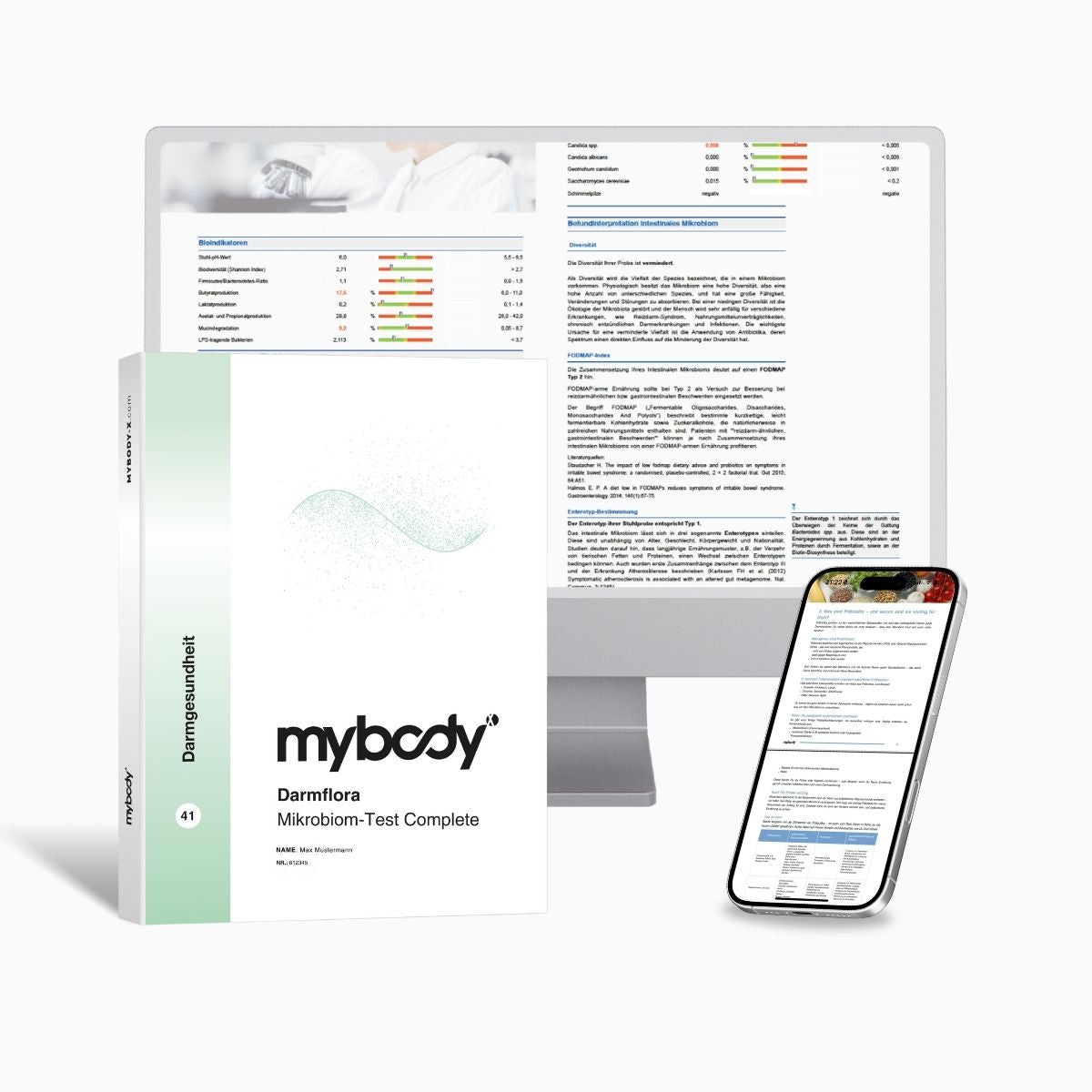
Gut test from a stool sample
Gut microbiome test | Complete
It records more than 1,500 bacterial species in the gut flora through DNA sequencing and classifies its composition. What the test does not do: The product page names diet, digestion, and everyday routines as areas of application and explicitly states that it does not provide a medical assessment. It does not look for blood in the stool, does not test for intolerances, and replaces neither colorectal cancer screening nor medical evaluation.
Laboratory analysis 5–10 business days after receipt of the sample
Product page information without location, accessed 27 August 2026

Gut test from a stool sample
Gut flora microbiome test | Essential
The less expensive of the two options for a gut flora description. The product page describes the same scope as the Complete, namely DNA sequencing and more than 1,500 bacterial species; no difference in the scope of testing is specified there. This test also describes a state, does not provide a diagnosis, and does not replace colorectal cancer screening.
Laboratory analysis 5–10 business days after receipt of the sample
Product page information without location, accessed 27 August 2026
There is deliberately no recommendation here for the other three areas. Testing stool for occult blood is done through a medical practice, individual markers are requested there, and the professional assessment quoted above applies to IgG tests. An article that gives an assessment and offers a suitable product alongside it undermines its own statement.
Who a home test is suitable for and who it is not
The decision depends less on the symptoms than on the intention. Description and investigation are two different objectives, and only one of them can be started at home.
Makes sense for you if …
you are changing your diet and want a baseline that you can compare with a follow-up test after three months.
you are interested in the composition of your gut flora and understand that you will receive a description, not an explanation.
you are preparing for a conversation and want to ask more specific questions with a finding plus a diary than with a feeling.
Probably not if …
one of the signs from Chapter 7 applies. Then an appointment is needed, and the test only delays it.
you are expecting a diagnosis. A description of the gut flora is not a diagnosis, nor will a longer report make it one.
you are currently taking antibiotics or have had a gastrointestinal infection. Then you are measuring the exception, not your normal state.
Those who find themselves in the right-hand column save money and time by waiting. This is not a disadvantage of the procedure, but a matter of timing.
Limitations: what an at-home gut test cannot answer
The first limitation is early detection. It has already been covered above and will not be softened here: None of the tests in this article looks for what the colorectal cancer screening program looks for.
The second limitation is the question of causes. A description of the gut microbiome says what it looks like, not why it looks that way, and certainly not what follows from it. Anyone seeking the cause of persistent symptoms should look for it through a consultation and examination.
The third limitation concerns expectations about change. This article does not link a test finding to the disappearance of symptoms anywhere, not out of caution, but because such a link cannot be substantiated in an individual case.
The fourth limitation is comparability between providers. Methods, analysis, and presentation differ, so two reports from two providers cannot simply be compared side by side. Anyone who wants to monitor changes over time should stick with the same method.
And one limitation concerns the product itself: Complete costs 60 euros more than Essential. The product pages as of 08/27/2026 do not reveal what substantive difference lies behind this. Overlooking this point here would be convenient and would perpetuate precisely the uncertainty this article aims to reduce.
One final limitation concerns when the sample is taken. A snapshot describes the day on which it was collected. Travel, taking antibiotics, or a week of significantly changed eating habits can shift the picture without this becoming a permanent state.
Anyone who wants to draw conclusions about changes over time needs at least two measurements under comparable conditions. A single report is a point, not a line.
What ultimately matters when making a choice
It began with the observation that “at-home gut test” refers to four different things. That is precisely why the choice is simpler than it seems: There is not one test with many providers, but four questions, each with its own appropriate method.
The practical next step costs nothing. For two weeks, keep track of what you eat and when symptoms occur. This list answers more than most people expect, and it makes any later test result more useful because you can relate it to something.
If any of the warning signs from Chapter 7 apply, the appointment should come first. If none apply and the question remains about the current state, a gut microbiome profile is a sensible second step, ideally with a follow-up check after three months.
If you are unsure which of the four categories your question belongs in: The consultation is free, and it will not try to sell you anything.
Frequently asked questions
Which at-home gut test is right for me?
That depends on your question, not the product. If you want to know whether a condition needs to be evaluated, you should see a doctor. If you want a description of your current state, a microbiome analysis is appropriate. If you are concerned about a single food, start with a food and symptom diary. If you suspect inflammation, an individual marker such as calprotectin must be ordered by a doctor.
Can an at-home stool test replace colorectal cancer screening?
No. The stool test for occult blood is part of the early-detection program and is ordered by a doctor; according to the Cancer Information Service of the German Cancer Research Center (as of April 1, 2025), people aged 50 and over are entitled to regular examinations. An abnormal result must be evaluated by a doctor, which primarily includes a colonoscopy. Microbiome analyses, intolerance tests, and individual markers look for something else and do not replace it.
Does a microbiome analysis show what is causing my symptoms?
No. It describes the composition of your gut bacteria at a particular point in time and does not identify a cause. It is not intended for evaluating irritable bowel syndrome: the S3 guideline on irritable bowel syndrome issued by DGVS and DGNM (version 2.0, 2021) states in recommendation 4.12 that microbial analysis of the commensal gut microbiota should not be performed. It remains useful as a baseline and reference value when changing your diet.
How reliable are IgG tests for foods?
Allergy specialists do not recommend IgG tests for diagnosing food intolerances. Elevated IgG levels indicate contact with a food, not necessarily an intolerance. The S3 guideline on irritable bowel syndrome (version 2.0, 2021) states in recommendation 4.15 that testing for food-specific IgG should not be performed. Such a finding can, at most, provide clues about which foods to observe first during a supervised elimination phase.
How long does it take to receive my results?
Two time periods run consecutively and are listed separately. Kit shipping takes 1 to 3 business days. Laboratory analysis takes 5 to 10 business days after your sample arrives. The return transit time for your sample is added to this; it is shorter if you mail it on the same day. There is deliberately no single total figure here because it would obscure the part you can influence yourself.
Next step
When your question concerns the current state
You collect both samples at home from a stool sample. They describe the composition of your gut flora; they do not provide a diagnosis and do not replace medical evaluation. First, clarify which question you want answered.
Gut microbiome test | Complete Gut flora microbiome test | EssentialRead more
You might also be interested in
In case the selection has been clarified and the question is who pays for the examination.
The most common sampling errors and how to avoid them.
For looking up which bacterial species and markers appear in a finding and what they mean.
Sources
- German Cancer Research Center (DKFZ), Cancer Information Service: Colorectal cancer screening – colonoscopy and stool test (as of 1 April 2025) – krebsinformationsdienst.de
- Center for Cancer Registry Data at the Robert Koch Institute: Colorectal cancer, disease year 2023 (data as of 25 August 2026) – krebsdaten.de
- German Society for Gastroenterology, Digestive and Metabolic Diseases (DGVS) and German Society for Neurogastroenterology and Motility (DGNM): Update to the S3 Guideline on Irritable Bowel Syndrome, Version 2.0, June 2021, AWMF Registry Number 021/016 – dgvs.de
- MedlinePlus, U.S. National Library of Medicine: Calprotectin Stool Test (as of 9 January 2024) – medlineplus.gov
The verbatim information on the immunological stool test, eligibility from age 50, and the clarification of an abnormal result comes from source [1]. The figures for new cases and deaths for the 2023 disease year come from [2]. The verbatim recommendations 4.4, 4.12, 4.13, 4.14, 4.15, and 4.16 come from [3]. The information on the purpose and limitations of the calprotectin stool test comes from [4]. The finding on commercial zonulin testing is attributed in the body text to the authors, specialist journal, and year (Ajamian, Steer, Rosella, Gibson, PLOS ONE 2019) and is therefore not included in this list. The note on IgG tests reflects the assessment of the allergy specialist societies. Information on price, scope of testing, sample type, and laboratory comes from mybody®x product pages, accessed on 27 August 2026; processing times follow the central specification for gut tests. All sources were accessed and reviewed on 27 August 2026.

mybody®x Editorial & Specialist Team
Microbiome and gut science Laboratory diagnostics Stool diagnostics and sampling Nutritional science
This article was created by the mybody®x editorial and specialist team. The team combines microbiome and gut science, laboratory diagnostics, and the interpretation of findings. Those who contributed to it are listed on the authors page.
Published on 25 September 2025 · Last updated on 27 August 2026
The content is intended for general information and does not replace medical advice, diagnosis, or treatment. Information on examinations and benefit entitlements reflects the status as of 27 August 2026; the decisive factors are the medical assessment in each individual case and the applicable guidelines.




Share now:
Promote gut health for greater well-being
Leaky Gut Tests 2025: The best analyses for your gut health