
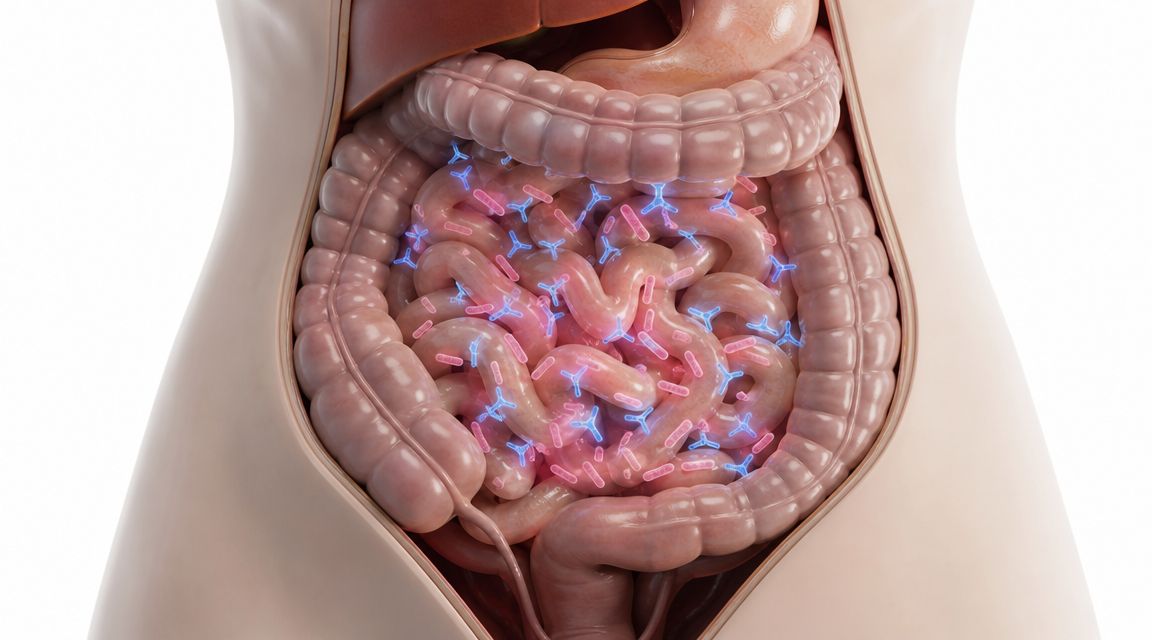
Lactobacilli and bifidobacteria: Optimal gut health
Maybe you are sitting there with a coffee right now, have just read something else about gut health, and are thinking: Everyone is talking about lactobacilli and bifidobacteria, but what am I actually supposed to do now? Eat more yogurt? Drink kefir? Buy a probiotic? Or is this all just another health trend with complicated names?
If you feel uncertain or even a little annoyed by this, that is completely understandable. Many people are already making an effort to eat consciously and still feel as though they are just guessing when it comes to the microbiome. That is exactly where frustration arises. Not because you are doing too little, but because general tips often remain too general.
Lactobacilli and bifidobacteria: Everywhere, but where to start?
You encounter these terms constantly in everyday life. On yogurt containers, in dietary supplements, in podcasts, and in social media posts about gut feelings, skin, energy, and the immune system. At first, that sounds helpful. In reality, it leaves many people feeling more uncertain.
Maybe you know this: You buy fermented foods, pay attention to fiber, and try to eat in a “gut-friendly” way. But your stomach remains unpredictable. Some days everything is calm; on others, you have bloating, a feeling of fullness, or simply the feeling that your gut is not cooperating.
General gut tips sound simple. Your own body often isn’t.
That is exactly why it is worth untangling the topic properly. Lactobacilli and bifidobacteria are not buzzwords, but important groups of bacteria in the gut. They are mentioned so often because they have long played a central role in microbiome research.
A German-language specialist report on breast milk research even describes that colonization of the gut probably begins before birth and that certain bifidobacteria and lactobacilli dominate in breastfed infants. The breast milk examined included, among others, L. fermentum at 25% and L. gasseri at 22%, while the most frequently occurring species accounted for 35%, as reported in the HiPP study report on breast milk research.
This shows you something important: These bacteria are not “just any beneficial gut bacteria,” but early companions of the human gut. So the exciting question is not only what they are. The more exciting question is: How do you find out what your gut personally needs?
Your diligent helpers in the gut: lactobacilli and bifidobacteria introduced
Imagine your gut as a large city. It has not only residents but also many different areas of responsibility. Some take care of order, others of supplies, and still others of protection. Lactobacilli and bifidobacteria are among the best-known helpers in this city.

If you first want to get a basic picture of the whole subject, an overview of what the microbiome actually is can also help.
What lactobacilli do for you
Lactobacilli belong to the lactic acid bacteria. Put simply, they process certain carbohydrates, thereby creating an environment in which undesirable microbes have more difficulty spreading. This is no small matter. Your gut is a place where competition is constantly taking place.
A German-language review article on PubMed Central describes that some Lactobacillus and Bifidobacterium strains inhibit the adhesion of pathogenic bacteria to the brush border membrane in a dose-dependent manner and reduce their invasion of the mucosa. For Lactobacillus GG, it also describes a significant disease-shortening effect in gastroenteritis following a meta-analysis. For antiviral effects, higher doses of more than 10^10 to 10^11 colony-forming units are mentioned in practice. You can find this information in the German-language review of probiotics on PubMed Central.
What bifidobacteria do for you
Bifidobacteria are more active where dietary fibers arrive and are further processed. They are closely associated with the utilization of food residues that you cannot fully break down yourself. That's why it's not only important whether you eat “healthy” foods, but also whether your gut has the right helpers for them.
Why both are important
You don't have to think of these bacteria as laboratory terms. Think of it this way:
- Lactobacilli help keep the environment in your gut favorable.
- Bifidobacteria are important when it comes to processing certain dietary fibers.
- Together, they help your gut function more stably and resiliently.
Practical thought: Not every healthy diet automatically leads to the same result. It always interacts with your individual microbiome.
That is exactly why two people with nearly identical diets can often feel very different. One tolerates many foods without problems. The other continues to struggle with their gut despite their efforts.
Teamwork in the gut The difference between lactobacilli and bifidobacteria
Although they are often mentioned together, they are not the same. They work more like two specialized teams with different strengths. Once you understand this, it also becomes clear why the advice to “just eat more yogurt” often falls short.

The most important everyday difference
Lactobacilli are frequently found in fermented foods. This makes them tangible for many people. Bifidobacteria are less visible in everyday life. They depend more strongly on suitable conditions and prebiotic fiber.
A German-language health source explains this very clearly: Fermented foods are dominated primarily by lactobacilli because they are less demanding and grow faster. Bifidobacteria, by contrast, are often more dependent on suitable living conditions and substrates. So if you want to support both genera specifically, you should think beyond yogurt and similar products. You can read more about this in the article on bifidobacteria and fermented foods.
Comparison at a glance
| Characteristic | Lactobacilli | Bifidobacteria |
|---|---|---|
| Visible in everyday life | more commonly known through fermented foods | less commonly found directly in foods |
| Requirements regarding conditions | often more robust | often more demanding |
| Practical support | fermented products can be one building block | prebiotic fiber plays an important role |
This table is not a substitute for analysis. But it helps you avoid a common misconception: more probiotics does not automatically mean more of everything your gut needs.
Why diet alone is often imprecise
For example, you regularly eat sauerkraut, plain yogurt, or kefir. That can make sense. But you still do not know whether your gut currently needs more support for lactobacilli, whether bifidobacteria are being neglected, or whether the real issue lies somewhere else entirely.
That is why “eating probiotics” is more of a framework than a precise strategy.
- Fermented foods can be useful, especially in everyday life.
- Fiber is important, especially if you want to positively influence the environment in the colon.
- The starting point of your gut nevertheless remains unknown unless you measure it.
Many people confuse good habits with targeted regulation. Both are valuable. But they are not the same.
Recognizing digestive problems Which gut type do you identify with
Sometimes the gut speaks loudly. Sometimes the signals are more diffuse. Not everyone immediately realizes, “I have a microbiome issue.” More often, a pattern emerges. Perhaps you recognize yourself in one of these types.

The sensitive stomach
You generally eat sensibly, but your gut reacts quickly. Sometimes it feels tight, sometimes it rumbles, and sometimes you feel surprisingly full after a normal meal. This does not automatically mean that you are lacking one specific group of bacteria. But it does show that your intestinal environment may have become imbalanced.
The sluggish digestion type
Here, the feeling is more sluggish. Digestion seems slow, your stomach feels heavy, and your routine is unreliable. Many people then try to eat “even healthier.” That is an understandable impulse, but without clarity, it is often just the next attempt.
The healthy eater without noticeable results
This type is particularly frustrating. You are actually doing many things right. More vegetables, more fermented foods, perhaps less sugar, eating more mindfully. And yet the feeling remains: Something still isn’t quite right.
An article on health describes this practical gap precisely: Many sources mention yogurt, kefir, sauerkraut, or fiber-rich foods, but do not answer the everyday question of whether diet alone is enough or how to tell whether lactobacilli or bifidobacteria are actually low in an individual microbiome. It also explains that bifidobacteria break down fiber into short-chain fatty acids such as acetate, propionate, and butyrate, and that lactobacilli and bifidobacteria can displace pathogenic germs and influence the immune system. Find out more in the article about lactobacilli and bifidobacteria in everyday life.
The type with many small signals
Not everyone experiences severe discomfort. Some people notice more of a collection of small signs:
- Restless after eating instead of comfortably full
- Unpredictable gut feelings without a clear cause
- Uncertainty about which foods are actually good for you
- The feeling of trial and error, even though you have been living mindfully for a long time
If you want to better understand your digestion, it may also be interesting to take a look at digestive problems and genetic influences. This does not replace a microbiome analysis, but it shows how individual digestion really is.
Important: Recognizing yourself in a certain type can be helpful. But it is not yet a reliable diagnosis.
That is often where self-observation reaches its limits. It can make you more attentive. But it cannot reliably tell you which bacteria are strong, weak, or out of balance in your gut.
Why yogurt and sauerkraut alone are not the solution
If you are already focusing on gut health, you are not on the wrong track. On the contrary, mindful eating is a strong foundation. It is just often marketed as a precise solution, even though in many cases it is more of a good direction than an exact answer.
The problem with blanket advice
“Eat more yogurt” sounds simple. The problem is not the yogurt. The problem is that it may not be suited to your individual microbiome. Without data, you do not know whether you are currently supporting the right bacteria, whether the dose is relevant, or whether your gut needs something entirely different.
There is another factor: Probiotic effects depend not only on the bacterial species, but often on the specific strain and the dosage. So just because something sounds good on the packaging does not mean it is right for your situation.
Why food does not provide precise dosing
The expert review mentioned above shows that probiotic effects are often dose-dependent, and that more than 10^10 to 10^11 colony-forming units are cited for antiviral effects. In everyday life, it is hardly possible to achieve or control such precise, high doses through yogurt or sauerkraut. That is exactly why the equation “fermented food equals targeted probiotic effect” is too simplistic.
This does not mean that fermented foods are pointless. It only means: Food is nourishment. It is not an exact measurement and control strategy.
Where many people waste time
Many people jump back and forth between these ideas:
- More kefir today, because it was recommended on the podcast
- Next week, a different probiotic, because a friend swears by it
- Then eat more fiber again, because that is generally healthy
Every individual step can be sensible. The actual problem is the pattern behind it. It remains trial and error without a clear starting point.
If you do not know what is currently lacking or overrepresented in your gut, you are optimizing blindly.
The actual thinking trap
Lactobacilli and bifidobacteria are fundamentally important. That is precisely why it makes no sense to treat them merely as a lifestyle add-on. You would not plan your training based on how you feel if you had performance data. Nor would you merely suspect a nutrient deficiency if you could measure it.
This happens often with gut flora. People invest effort, time, and money in good approaches. What is missing is clarity.
Self-assessment helps. But only up to a point
Of course, you can ask yourself:
| Question | What it gives you | Where the limit lies |
|---|---|---|
| Do I tolerate fermented foods well? | Initial clues from your gut instinct | Provides no information about specific bacterial ratios |
| Am I eating enough fiber? | Helps you reflect on your diet | Does not tell you how your microbiome responds to it |
| Do I feel better after changing my diet? | Shows changes in everyday life | Improves understanding but does not replace analysis |
That is the key point: Self-observation is useful. It does not provide reliable answers.
Stop guessing. Get the reliable answer with a microbiome test.
Once you understand how differently lactobacilli and bifidobacteria work, one point becomes very clear: General tips are good for getting started, but they do not reliably lead you to the right solution for your body.

A microbiome test is the step from assumptions to data. Instead of continuing to wonder whether you need more fermented foods, should try a different probiotic, or whether fiber alone is enough, you get a picture of your personal gut flora.
What a test changes in practice
A test answers questions that food diaries and gut instinct leave unanswered:
- What does your individual bacterial landscape look like?
- Are important groups such as lactobacilli and bifidobacteria strongly represented, or not?
- Is making targeted changes to your diet, prebiotics, or routines actually worthwhile?
This saves you detours. Not because nutrition would be unimportant, but because you can use it more strategically.
Why this makes sense for health-conscious people
If you already eat mindfully, exercise, or pay attention to recovery, a microbiome test fits logically into this picture. It takes you from the level of generic health advice to the level of your own data.
One specific option in this area is the microbiome gut test. In addition, the health portal provides background information on how a gut test works, as well as further offerings related to gut health and the microbiome.
You're already on the right path. A test makes it more precise.
That's also the real efficiency gain. You don't always have to do more. Often, you simply need to know more precisely what makes sense for you and what doesn't.
Your body Your path to optimized gut health
Perhaps the most important insight from this topic isn't which bacterial name appears on which product. Something else matters more: Your gut is unique. And that's exactly why general advice so often feels unsatisfying.
You've seen that lactobacilli and bifidobacteria play important but different roles. You've also seen why fermented foods can be helpful, but cannot reliably tell you what your own microbiome really looks like. That doesn't mean you've done anything wrong so far. It simply shows that your next step can be more precise.
Many people spend a long time guessing. They try things, observe the results, change something again, and hope for a clear effect. That's understandable. But it's not the only option.
If you want clarity, you need data instead of assumptions. Then “Maybe I should eat more of that” becomes a much more precise understanding of your body. That's where real optimization begins. Calmer, more objective, and often significantly more efficient.
You don't have to start perfectly. You just have to stop navigating in the fog.
If you no longer want to manage your gut health according to general advice but according to your own values, take a look at the solutions from mybody x Gesundheit. An at-home test could be the step that finally turns uncertainty into personal clarity.



Share now:
Lactobacillus supplements: Your guide to gut health
Your microbiome test: A guide to gut health in 2026