

Drinking kefir in the morning or evening: Achieve optimal benefits
Did you know that more than 70 percent of people improved their digestion with kefir? Many underestimate how much the right time to drink kefir and its targeted integration can improve well-being. This guide will help you find your individual approach to kefir and bring more clarity to healthy daily routines.
Quick overview
| Key point | Explanation |
|---|---|
| 1. Kefir in the morning is beneficial | In the morning on an empty stomach, kefir activates digestion and improves mental performance. |
| 2. Kefir in the evening promotes relaxation | In the evening, the tryptophan in kefir helps produce melatonin and thus promotes relaxation before sleep. |
| 3. Consider individual reactions | Every body reacts differently to kefir. Pay attention to your personal tolerance and adjust the amount accordingly. |
| 4. Consistency is key | To achieve maximum health benefits, incorporate kefir consistently into your daily routine. |
| 5. Start with small amounts | Start with 50–100 ml per day to give your body time to adjust and minimize intolerances. |
Table of contents
- Step 1: Determine the optimal time to drink kefir
- Step 2: Prepare your body to consume kefir
- Step 3: Choose the right amount of kefir for your goals
- Step 4: Incorporate kefir consistently into your daily routine
- Step 5: Review your individual reactions and adjust
Step 1: Determine the optimal time to drink kefir
The right time to drink your kefir can make a big difference to your health. In this step, you will learn exactly when you should drink kefir for the best results.
First, it is important to understand that there is no single perfect time. Your individual bodily response and health goals play a decisive role. According to research, morning and evening can each offer specific benefits.
In the morning on an empty stomach, kefir can be a true power solution. The probiotics are most effective at this time and support your digestion right at the start of the day. You activate your gut flora, improve your mental performance, and regulate your appetite.
In the evening, however, kefir can have a different positive effect. The tryptophan contained in kefir can contribute to melatonin production and thus promote relaxation. Perfect for anyone striving for a restful night.

Important tip: Pay close attention to how your body reacts to kefir. Not everyone tolerates it equally well.
An individual self-test is the best way to find out when kefir works best for you. Experiment with the time you drink it and pay attention to your digestion, energy, and overall well-being.
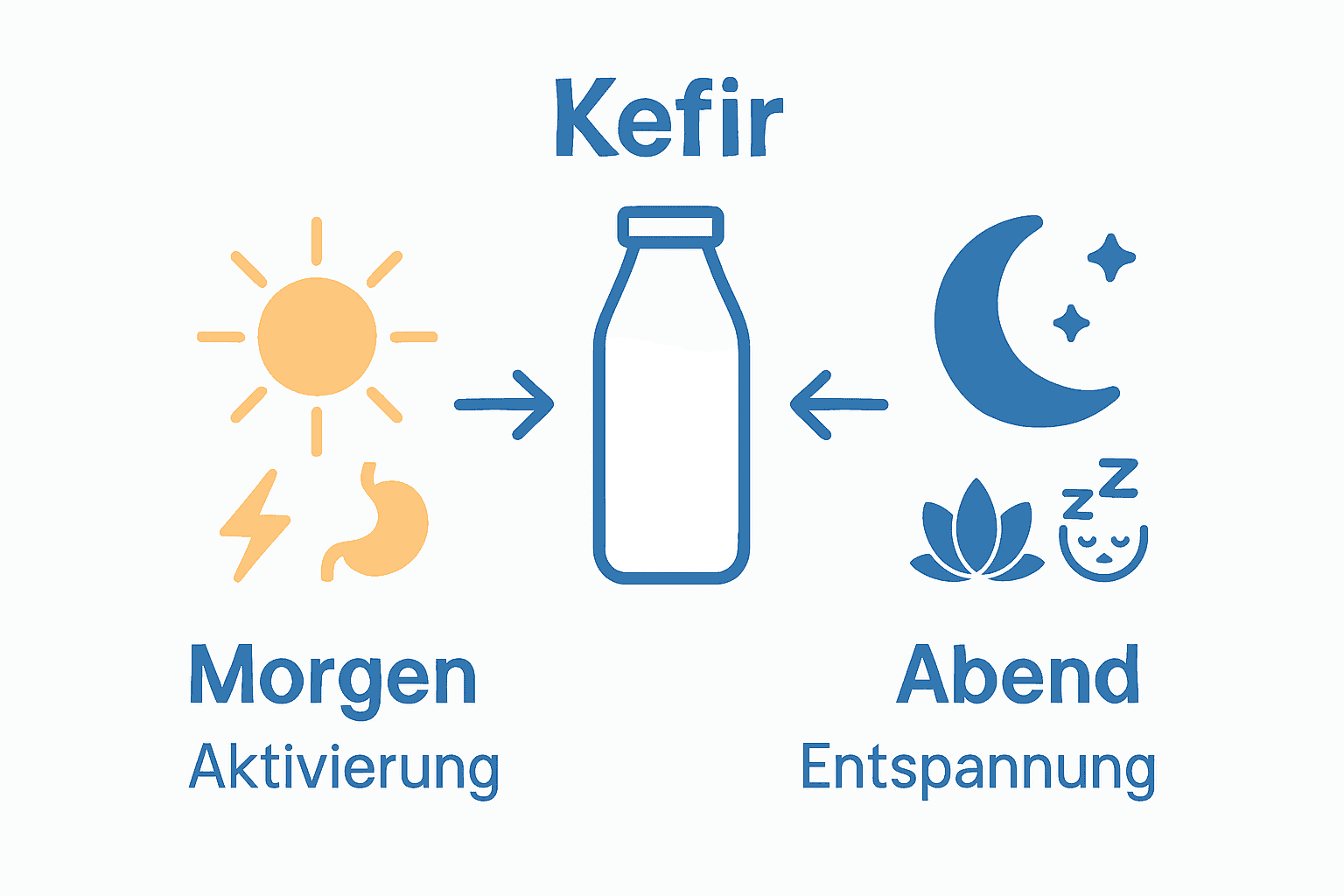
Keep in mind: Consistency is key. Whether in the morning or evening, stick to your chosen time to achieve the maximum health benefits.
Step 2: Prepare your body to consume kefir
Would you like to incorporate kefir into your daily diet? Here I’ll show you how to optimally prepare your body for this probiotic superfood.
According to scientific findings, the key is a gradual and mindful introduction. Kefir is not an ordinary beverage but a living food full of microorganisms.
Start with small amounts—around 50 to 100 milliliters per day. This allows your digestive system to gradually adapt to the new probiotics. Research shows that gradually increasing the amount minimizes intolerances.
Make sure to drink the kefir at room temperature. Temperatures that are too cold or too warm can damage the sensitive probiotics. The optimal time is in the morning on an empty stomach, about 30 minutes before breakfast.
Important: Listen to your body. Every organism reacts differently to probiotics.
Is kefir healthy for you? That depends on your individual constitution. If you are lactose intolerant or have sensitive digestion, start extremely cautiously and monitor your reactions.
Keep in mind: Successfully incorporating kefir takes patience. Give your body time to adjust and enjoy the process of discovery.
Step 3: Choose the right amount of kefir for your goals
Your individual kefir serving depends on your personal health goals. In this step, I’ll show you how to find exactly the right amount.
Kefir can have very different effects, depending on what you want to achieve. In general, an amount between 100 and 250 milliliters per day is considered ideal for most people.
Would you like to support your digestion? Start with 100 milliliters. If your goal is to strengthen your immune system, you can increase the amount to 150–200 milliliters. For intensive health goals such as restoring the gut microbiome, experts recommend up to 250 milliliters daily.
Note these important gradations:
Here is a comparison of the recommended kefir amounts for different goals:
| Goal | Recommended amount per day | Note |
|---|---|---|
| Support digestion | 100 ml | Suitable for beginners |
| Strengthen the immune system | 150-200 ml | For advanced users |
| Restore the gut microbiome | 200-250 ml | For intensive users |
| Gentle on sensitive stomachs | 50-100 ml | Increase slowly and monitor your response |
- Beginners: 50–100 milliliters
- Advanced users: 150–200 milliliters
- Intensive users: 200–250 milliliters
Important: Every body is unique. Monitor your individual reactions.
Water kefir can be an alternative if you’re looking for a lighter option. The amount remains similar.
For optimal results, I recommend monitoring your response continuously. Adjust the amount according to your needs and reactions. Successfully incorporating kefir is a personal process.
Step 4: Incorporate kefir consistently into your daily routine
The key to maximizing kefir’s effects lies in incorporating it regularly. I’ll show you how to make kefir an easy part of your daily routine.
According to nutrition experts, kefir is a nutrient-rich superfood containing protein, calcium, magnesium, and B vitamins. Its benefits unfold through consistency.
Make kefir part of your morning routine. It’s best to drink it on an empty stomach about 30 minutes before breakfast. It also works wonderfully as a snack or as part of your breakfast.
More clever ways to incorporate it:
- As a base for smoothies
- Mix with muesli
- As a drink after exercise
- Stir into overnight oats
Gut health is about more than just nutrition, but kefir can be an important building block.
Tip: Homemade kefir often contains a greater diversity of microbes than store-bought kefir.
Observe your reactions and adjust the amount. Consistency is more important than perfection. Your body will thank you.
Step 5: Review your individual reactions and adjust
Every body is unique and reacts differently to kefir. In this step, you’ll learn to read and correctly interpret your personal signals.
Health experts warn that initial digestive issues such as bloating or mild nausea can be normal. These symptoms are usually temporary and no cause for concern.
Follow this observation plan:
- Keep a food diary
- Record your daily kefir intake
- Document your physical reactions
- Pay attention to your digestion and energy levels
Intolerances can vary greatly from person to person. There is no universal time for consuming kefir optimally.
Important: Reduce the amount immediately if you notice persistent discomfort.
If symptoms such as severe bloating or diarrhea occur, try smaller amounts or speak with a nutritionist. Your body is communicating with you. Listen carefully.
Discover how to truly use kefir for your gut health
You’ve learned that the optimal time to drink kefir is highly individual. Yet despite all the advice, uncertainty often remains. Do you tolerate kefir better in the morning or evening? How does your digestive system respond to certain amounts? Every gut is unique. Inner restlessness, bloating, or intolerances in particular can take away your enjoyment of this healthy drink and slow your progress.
Take advantage of a personal analysis now and find out what your gut flora is really like. With a gut flora analysis – For a healthy gut flora, you’ll get clear results showing whether your gut is ready for kefir. Don’t leave room for uncertainty and also test for individual intolerances at home. You’ll receive scientifically sound recommendations on how to optimally align your diet and gut flora. Get started today at mybody®x and take your health to the next level in a targeted and safe way.
Frequently Asked Questions
When should I drink kefir to achieve the best health benefits?
The optimal time to drink kefir depends on your goals. In the morning on an empty stomach, it supports digestion and boosts energy, while in the evening it promotes relaxation. Experiment with both times and observe how your body responds.
What happens when I drink kefir in the morning?
When you drink kefir in the morning, it activates your gut flora and supports digestion. This can help you start the day feeling energized. Drink it about 30 minutes before breakfast for optimal results.
How can I optimally prepare my body for consuming kefir?
Prepare your body by starting with small amounts of 50 to 100 milliliters. Be sure to drink kefir at room temperature so as not to damage the probiotics. Increase the amount slowly and observe your reactions to avoid intolerances.
How much kefir should I drink daily to improve my health?
The recommended amount depends on your goals: 100 milliliters for digestion, 150–200 milliliters to support the immune system, and up to 250 milliliters to restore the gut flora. Start with the lowest recommended amount and adjust it to your needs.
How can I consistently incorporate kefir into my daily routine?
Make kefir part of your morning routine by drinking it before breakfast or as a snack. You can also use it in smoothies, muesli, or overnight oats. Be sure to drink it regularly to maximize the health benefits.
What should I do if I notice negative reactions to kefir?
Reduce the amount immediately if you notice persistent symptoms such as bloating or nausea. Keep a food diary to track your reactions and adjust the amount of kefir accordingly. Listen to your body to optimize the integration of kefir.



Share now:
SIBO Symptoms: Everything You Need to Know About Digestive Issues
Build up your gut flora: Step by step toward healthy digestion