
What the color of stool means: harmless or not
The essentials at a glance
The color of stool results from the food eaten over the past two days and from bile. Brown in all shades is normal, from light brown to almost blackish brown. Three colors are cause for making an appointment rather than a search query: persistently light to clay-colored stool, black stool without an explanatory medication or supplement, and red stool.
This article puts each color into context without making a diagnosis. It first names the harmless causes because they are the most common, then identifies the point at which a color should be medically evaluated. Whenever an institution provides a figure, it is given here along with its name and year. Where no figure is available, that is stated as well.
You will first read where the color comes from in the first place. This is followed by warning signs, an overview of all color groups, the individual colors in detail, three common misconceptions, and a week of observation to prepare for a discussion with a doctor. The limitations come at the end.
What to expect in this article
1. Where the color of stool comes from in the first place
2. When a color warrants a visit to a medical practice
3. What each color may indicate: an overview
4. Light-colored stool: from light brown to clay-colored
5. Yellow and orange: fat, transit speed, and what you ate yesterday
6. Dark brown, black, and red: where the line is drawn
7. Green and gray: two colors with very different significance
8. Three common statements about stool color
9. Observe for a week before making an appointment
10. What an intestinal analysis shows here and what it does not
11. Who can benefit from an intestinal analysis and who cannot
12. Limitations: what color does not reveal
13. What really matters about color
Frequently Asked Questions
Sources
Where the color of stool comes from in the first place
The brown color does not come from food but from bile. The liver continuously produces this fluid and releases it into the intestines, where it helps break down fats. As it travels through the intestines, its color changes.
According to the Institute for Quality and Efficiency in Health Care (IQWiG, 2023), liver cells produce around 800 to 1,000 milliliters of bile per day. The institute describes it as a yellow, brownish, or olive-green fluid. These three shades are the starting point for everything that later becomes visible in the toilet.
Key message
The color of stool depends on two factors: what you have eaten and the speed at which bile passes through the intestines. Both fluctuate in everyday life, so the color fluctuates too.
Why brown has so many shades
The bile pigment bilirubin, a breakdown product of the red blood pigment, is gradually transformed by intestinal bacteria. The further this transformation progresses, the darker the result becomes. A short route makes the color appear lighter and more yellowish, while a long route makes it darker.
According to IQWiG (2026), the large intestine is approximately 1 to 1.5 meters long. Along this stretch, water and salts are removed from the food pulp, causing the intestinal contents to thicken into stool. Less water simultaneously means more color in the same space.
This leads to an unremarkable insight: light brown and dark brown are not two different states, but two points on the same scale. Anyone who sees both within a week is not seeing a change, but a normal fluctuation.
What the food from the past two days contributes
Everything that strongly colors the stool and was eaten in a larger quantity affects the bile's contribution. Beetroot, blueberries, spinach, kale, carrots, licorice, and food coloring in drinks or sweets are among them. Activated charcoal and iron-containing supplements also significantly affect the color.
There are usually one or two days between eating something and seeing the result. Anyone who compares today's color with today's breakfast is therefore looking in the wrong place. The focus should be on the day before yesterday.
This delay is why so many questions about color remain unanswered. The cause was eaten and forgotten long ago by the time the result appears.
When a color belongs in a doctor's office
This chapter deliberately comes before the color table. A text that places the warning signs at the end reaches precisely the reader for whom they are intended.
IQWiG describes jaundice caused by stones in the bile duct as recognizable by a yellowish discoloration of the skin and eyes. Regarding this jaundice, the institute states:
Documented source
“The urine may also be dark and the stool may be light in color.”
Institute for Quality and Efficiency in Health Care (IQWiG)
Gallstones, as of 2023
The sentence explains the pattern this article is about. If bile cannot drain, the stool lacks its pigment and becomes light. At the same time, more bilirubin enters the blood, is excreted through the kidneys, and darkens the urine.
Together, these two observations explain why light-colored stool does not carry the same significance as yellow or green stool. It is the one color for which the absence of color is the information.
These observations belong in a doctor's office
persistently light, clay-colored, or almost white stool
over several days, especially together with noticeably dark urine
black, shiny stool
without iron supplements, activated charcoal, licorice, or blueberries as an explanation
red blood in or on the stool
regardless of the amount and regardless of whether it hurts
yellowish discoloration of the skin or eyes
together with a light stool color, even without pain
a change in color plus fever, weight loss, or severe pain
the combination matters, not the color itself
When it comes to blood, the interpretation is particularly clear. IQWiG explicitly cites blood in the stool—that is, red or black stool—as one of the reasons to seek medical help for diarrhea (2023). For this color, there is no waiting period.
This list does not replace an examination, and it is not a diagnostic framework. It marks the point at which continuing to read would be the wrong answer to the right question.
Many people who research this topic have already seen a doctor. They are not anxious but dissatisfied: they are missing context, not a promise. For them, this chapter points out that a second appointment with a specific observation often accomplishes more than the first one without one.
What else applies to children
Children's stool color changes more often than adults', and this usually has harmless reasons. Small amounts of coloring foods have a stronger effect, intestinal transit is faster, and children's birthday parties introduce food coloring at concentrations rarely encountered in everyday adult life.
Most abdominal complaints in children resolve on their own. The real question, therefore, is not which test might be appropriate, but when it is time to make an appointment with a pediatrician.
The answer is the same as above, only with shorter time limits. Black or bloody stool should be evaluated immediately. Persistent pale stool, diarrhea lasting several days, and any situation in which a child appears weak, drinks less, or has a fever also warrant an appointment. Everything else can initially be monitored.
What each color may indicate: an overview
The following table compares seven color groups according to the same three criteria. It provides context and is not a diagnosis: in each row, the common explanation comes first, followed by the period during which a color can persist without cause for concern, and finally the point at which it should be medically evaluated.
| Color | What is often behind it | How long this can be normal | When to see a doctor |
|---|---|---|---|
| Light brown to medium brown | the usual range; a high-fiber diet and rapid intestinal transit make it lighter | indefinitely; this is within the normal range | only if there are additional symptoms such as pain or weight loss |
| Dark brown | longer transit time in the intestines, a meat-rich diet, licorice, blueberries, iron-containing supplements | indefinitely, as long as the color and symptoms do not change | when the stool is also shiny, sticky, and smells like tar |
| Yellow to ochre | rapid intestinal transit, a high-fat meal, carotene-rich foods such as carrots or pumpkin | a few days after an identifiable cause | when the stool remains shiny, greasy, and noticeably foul-smelling for weeks |
| Orange | Beta-carotene from carrots, sweet potatoes, pumpkin, and apricots; some food colorings in beverages | one to three days after the meal that triggered it | if there is no cause in the diet and the color persists |
| Green | Spinach, kale, green food coloring, iron-containing supplements; very rapid transit during diarrhea | a few days, usually as long as the diarrhea | if the diarrhea lasts longer than two weeks |
| Gray to clay-colored, almost white | bile cannot reach the intestine; X-ray contrast agents containing barium can also cause temporary lightening | only as long as a contrast agent is the explanation | with any persistent light color, especially with dark urine or yellowish skin |
| Black or red | Iron supplements, activated charcoal, licorice, blueberries, beetroot, tomato paste; or blood | one to two days, if a medication or food is the cause | immediately, as soon as none of these explanations applies |
There is no reliable information from a German institution on the frequency of the individual causes. That is why this table contains no percentage, but rather the order: the most common explanation comes first.
Light-colored stool: from light brown to clay-colored
Light-colored stool is the most frequently searched-for color change of all. The problem with the search query is that it combines two completely different observations under one term.
Light brown is the lighter side of normal
A light brown bowel movement that is still recognizably brown is within the normal range. It typically occurs with a high-fiber diet and rapid intestinal transit, because the bile pigment has less time to be broken down.
The same applies to the search terms light brown stool and light brown diarrhea. With diarrhea, passage through the intestines is greatly accelerated, and so is the time available for the color to develop. The light color is therefore a consequence of the speed, not a separate observation.
IQWiG defines diarrhea as having very soft or watery stools at least three times within 24 hours (2023). According to the institute, acute diarrheal illnesses usually resolve within a few days to a week, and adults in Germany experience them on average once a year.
When “light” means something else
The second observation looks different. The stool is not light brown but gray, clay-colored, or almost white, and this color does not come from food. It occurs when bile does not reach the intestine.
IQWiG describes this process for stones in the bile duct: The bile pigment produced in the liver can no longer flow out with the bile (2023). What is missing from the stool instead accumulates in the blood and becomes visible in the skin, eyes, and urine.
Gallstones are more common than you might think, and most do not cause any problems. According to IQWiG, between 5 and 25 percent of the population have gallstones (2023). Of those affected, around 2 to 4 in 100 develop noticeable symptoms within a year.
That this nevertheless becomes a relevant figure is shown by another number from the same source: In Germany, the gallbladder is removed from around 175,000 women and men each year (IQWiG, 2023). This is not a reason for alarm, but the reason this color gets an appointment rather than a search query.
The harmless explanation that is often overlooked
After an X-ray examination of the gastrointestinal tract using a barium-based contrast agent, stool can become strikingly pale for one to two days. This is a known and temporary consequence of the examination.
Anyone who had such an examination in the preceding days has found the explanation. Anyone who did not has not. This exact distinction is what makes the observation week below so useful.
Why images from the internet are of little help here
Hardly any color concern prompts as many image searches as pale stool. The desire behind this is understandable: people want to compare what they see with something rather than having to describe it.
The comparison still has limited value. A photo is taken under specific lighting, with a particular camera setting, and against a particular background. Bathroom lighting, water in the bowl, and screen settings can further shift the perceived color in either direction.
A description in your own words is more reliable. The crucial question is not which photo your stool most closely resembles, but whether it is still recognizably brown or whether the brown is missing. Anyone can make this distinction without a comparison image, and that is precisely what matters.
The second anchor is your personal baseline. More important than an absolute shade is whether the color has changed compared with the past few months and whether it stays that way. That is why the observation week in Chapter 9 replaces image searches.
Yellow and orange: fat, transit time, and yesterday’s food
Yellow stool is the second most common color concern after pale stool. Three explanations account for most cases, and they can be distinguished fairly easily.
Explanation one: The pace
Yellow is the original color of bile before the intestinal bacteria do their work. If the intestinal contents pass through more quickly, there is less time for the transformation, and the original color remains visible. Yellowish stools during diarrhea follow this logic.
Explanation two: The food
Beta-carotene from carrots, sweet potatoes, pumpkin, apricots, and mango can visibly tint the stool when consumed in larger amounts. The same applies to some food colorings in drinks, puddings, and confectionery. When these are the cause, the color disappears again after one to three days.
The terms yellowish and ochre describe the same observation in different words. Ochre lies between yellow and light brown, and exactly where someone draws the line depends on usage. This does not change the classification: both belong to the yellow group as long as some color is still present.
Explanation three: Fat
After a very high-fat meal, undigested fat can end up in the stool and make it look lighter and shinier. Once is unremarkable. If the stool remains shiny, greasy, bulky, and noticeably foul-smelling for weeks, this is no longer a dietary issue and should be medically evaluated.
A single unusual color says very little. A week of the same color says something.
A single unusual color says very little. A week of the same color says something. This rule of thumb distinguishes the two cases more reliably than any description of a shade, because color perception already varies under bathroom lighting.
Dark brown, black, and red: where the line is drawn
At the dark end of the scale, the most harmless and the most urgent observation in this article lie close together. The difference is not the shade, but whether there is an explanation.
Dark brown stool is usually a matter of time
The longer intestinal contents remain in transit, the further the bile pigment is broken down and the darker the result becomes. A meat-rich meal, little fiber, and a sluggish bowel all work in the same direction.
Coloring foods also contribute. Blueberries, licorice, red wine, dark chocolate, and blood sausage visibly darken the stool. Here too, the cause and result are usually separated by one or two days.
Iron supplements are the most common explanation for black stool
People who take iron see its effect in their stool. The IQWiG explicitly states in its guide to treating iron deficiency that stool may become dark, which is harmless (2023). This statement comes from the context of iron treatment and applies to it accordingly.
Activated charcoal and bismuth preparations have the same effect. If someone takes one of them and knew about the color before it appeared, they have their explanation.
When black and red change their meaning
If there is no such explanation, the situation changes. Black, shiny, sticky stool with a striking odor is a sign that needs medical evaluation, without any waiting period.
Red behaves in the opposite way. Beets, tomato paste, paprika, and red food coloring produce a clear color, which disappears again within one or two days. If it remains or appears as visible blood on the stool, the kitchen is not the explanation.
This is not a call to panic, but to prioritize. When there is blood in the stool, making an appointment comes before any further observation, and a self-test is the wrong response at this point.
Chapter at a glance
At the dark end of the color scale, the explanation—not the shade—decides. Iron supplements, activated charcoal, licorice, and blueberries darken the stool; beetroot and tomato paste color it reddish; both effects disappear within one or two days. If black or red cannot be explained by anything, however, this observation should be medically evaluated, regardless of whether additional symptoms occur.
Green and gray: two colors with very different significance
These two colors are often mentioned in the same breath because both are considered unusual. In substance, they have almost nothing to do with each other.
Green almost always comes from food
Spinach, kale, chard, large amounts of herbs, and green food coloring can color the stool. Iron-containing supplements can also produce greenish tones. In all these cases, the color disappears again after a few days.
The speed effect from Chapter 1 is also present here in its strongest form. According to IQWiG, bile is naturally yellow, brownish, or olive green (2023). If intestinal contents pass through very quickly during diarrhea, this exact olive-green baseline color remains.
Here, the duration of the diarrhea—not the color—sets the limit. If it lasts longer than two weeks, IQWiG describes it as persistent diarrhea (2023), and it should then be evaluated, regardless of its color.
Gray belongs to the light-colored group
Gray stool is not, in substance, the neighbor of green stool but of clay-colored stool. It describes the same observation: the stool is missing color rather than having a new one.
The same recommendation therefore applies to it as to light-colored stool. If the color persists for several days without a contrast agent explaining it, it is time for an appointment, especially if the urine is dark at the same time.
Green is almost always from food. Gray is almost never from food.
Three common statements about stool color
The following three statements appear in many forums and advice articles. All three sound plausible, and all three withstand scrutiny only partially.
Checked against the evidence
Common
“Green stool means an infection.”
Documented
Bile is naturally a yellow, brownish, or olive-green fluid (IQWiG, 2023). Green is therefore a baseline color, not an independent signal.
Common
“Dark stool always means blood.”
Documented
Regarding iron supplements, IQWiG notes that stool may turn dark and that this is harmless (2023). The decisive question is whether such an explanation applies.
Common
“As long as nothing hurts, the color doesn’t matter.”
Documented
With stones in the bile duct, urine may turn dark and stool light (IQWiG, 2023). This discoloration may appear before the pain.
Anyone looking for an explanation for a color usually means something real: they have seen something that looked different yesterday. The concern is justified, but the hasty interpretation is not. A reliable approach is to observe it for a week and ask whether there is an explanation.
Observe for one week before making an appointment
The following four steps prepare you for a conversation at the doctor's office; they do not replace it. They explicitly do not apply to the signs from Chapter 2: In the case of unexplained black stool, blood, or persistently pale stool, the appointment comes at the beginning, not the end of the week.
Record seven days
Color, time, and consistency. One word per entry is enough; do not evaluate it.
The previous 48 hours
Coloring foods, medications, iron or charcoal supplements, and contrast agents.
Record accompanying symptoms
Abdominal pain, fever, weight, and the color of the skin, eyes, and urine.
Bringing the note to the appointment
Seven lines on paper shorten the medical history and replace memory.
The benefit of this week lies less in the result than in its ability to distinguish patterns. By writing things down, you can see on the seventh day whether a color was truly present continuously or appeared only once and seemed more significant upon reflection.
The note also helps during the conversation itself. When asked how long this has been happening, a piece of paper with seven lines is a better answer than a guess.
What a gut analysis shows here—and what it does not
This is where an honest statement is needed: A microbiome test measures bacteria, not color. It cannot answer why stool was yellow on a particular day, and it does not replace an appointment for any of the signs from Chapter 2.
An analysis is useful in a different situation. Anyone who has had recurring digestive problems for weeks, has been medically evaluated, and now wants to know how their gut flora is composed can use it as a starting point for their own observations. Which bacteria and markers are detected at all is explained in mybody®x's (MYBODY Lab GmbH) Gut Encyclopedia.
This article distinguishes itself from its two neighbors: White Pieces in Stool discusses visible substances in stool, while this article discusses the color of the stool itself.
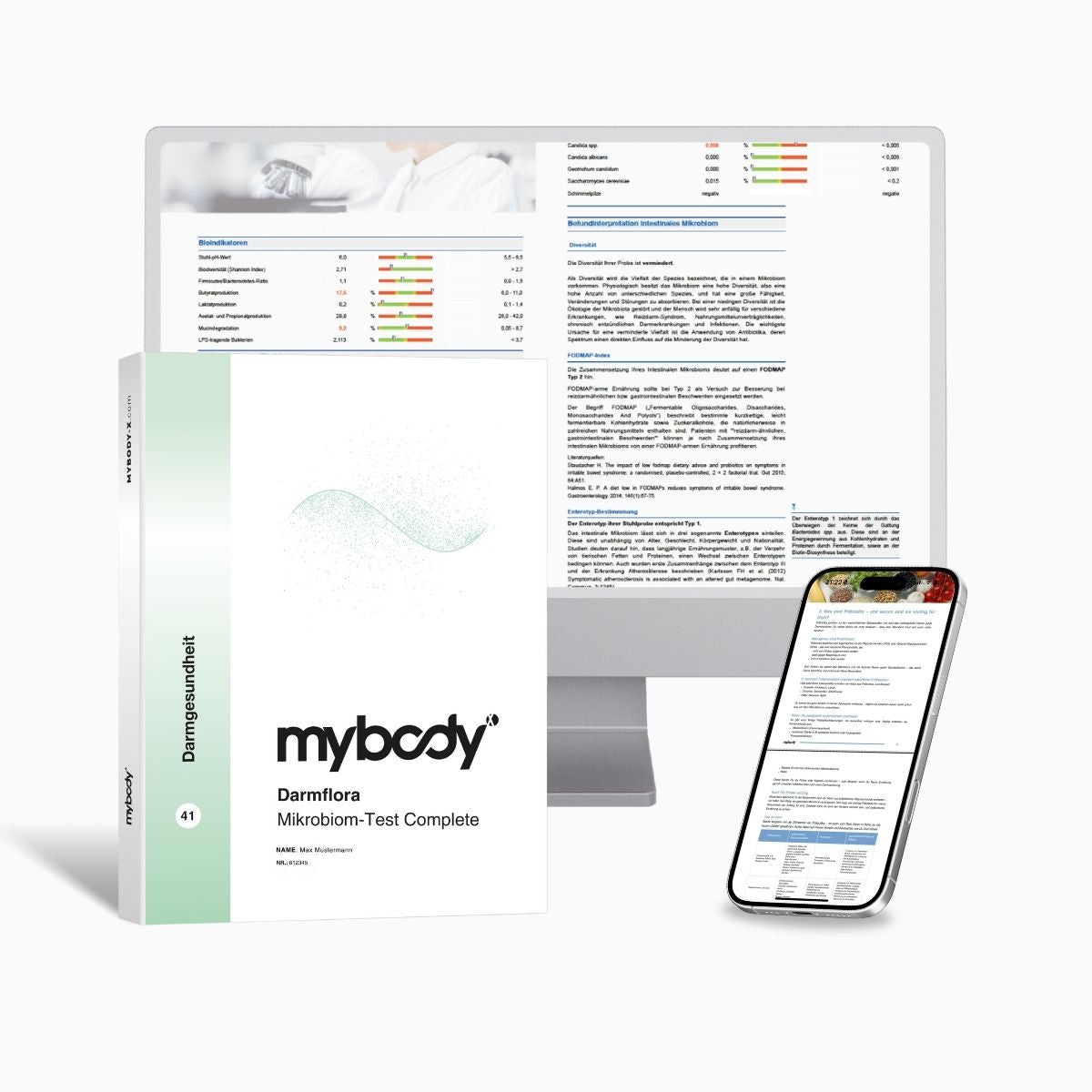
Gut test from a stool sample
Microbiome Gut Test | Complete
DNA sequencing of a stool sample with more than 1,500 detected bacterial species, plus biodiversity, enterotype, and indications of dysbiosis. What the test does not do: It does not assess stool color, measure bile pigments or stool fat, or detect parasites. It does not provide a diagnosis, and an abnormal result should be medically evaluated.
Laboratory analysis 5–10 working days after receipt of the sample
Information from the product page, accessed 27/08/2026
Who a gut analysis is suitable for and who it is not
A gut flora analysis is not an answer to a single color. It answers a different question, and the two columns below distinguish between the cases.
Useful for you if …
you have had recurring digestive problems for weeks, have been medically evaluated, and are now looking for a starting point for your own observations.
you want to change your diet and accompany the process with a measurement before and after.
you are interested in the composition of your gut flora, regardless of a single observation in the toilet.
Probably not if …
you notice one of the signs from Chapter 2 in yourself. Then making an appointment is the right order, not taking the test.
you are looking for an explanation for a single unusual color. That is not found in any microbiome report.
you expect a diagnosis. The test provides a composition, not the name of a disease.
Limitations: what color does not reveal
Color is a clue, not a finding. It says something about speed, food, and bile, but says nothing about what lies behind it in an individual case. That determination requires an examination, not an article.
The data also has limitations. IQWiG provides specific figures for gallstones, diarrhea, and iron supplements. There is no comparable figure from a German institution for how often a particular stool color has a particular cause. That is why this article includes none.
There is also a limitation in perception. Color depends on the light, the water in the bowl, and yesterday’s memory. Two people may describe the same stool as light brown and yellowish, without either of them being wrong.
And the test has the limitation stated in the product information: It measures bacteria. For a question about color, that is the wrong measurement, and even a detailed report does not change that.
What really matters about color
If you take away just one action from this article, let it be this: For seven days, write down the color and next to it what you ate and took the day before. Two lines per day, nothing more.
The reason is unremarkable. Most questions about color resolve themselves as soon as the delay of one to two days becomes apparent. What remains afterward is what can be discussed in a medical practice.
It all began with the question of what stool color means. The most honest answer is: usually dinner from the day before yesterday. And in the few cases when it means more, it says so early enough for someone else to find the answer.
Frequently Asked Questions
What Does Stool Color Mean?
It is formed from bile and the food from the previous one to two days. The liver produces about 800 to 1,000 milliliters of bile daily, which IQWiG describes as a yellow, brownish, or olive-green liquid (2023); intestinal bacteria convert the bile pigment to brown as it passes through the intestine. All shades of brown, from light to dark, are within the normal range. Persistent light, black, and red stool are unusual.
When Is Light-Colored Stool a Reason to See a Doctor?
Light brown stool that is still recognizably brown is within the normal range. An appointment is appropriate if the stool remains gray, clay-colored, or almost white for several days without barium-based X-ray contrast medium explaining it. If dark urine or yellowish discoloration of the skin and eyes is also present, this is even more important: With bile duct stones, the urine can become dark and the stool light-colored (IQWiG, 2023).
Why Is My Stool Yellow or Orange?
Three explanations account for most cases. First, rapid intestinal transit, in which the bile's original yellow color remains. Second, carotene-rich foods such as carrots, pumpkin, sweet potatoes, or apricots. Third, a high fat content in the meal. If the stool remains shiny, greasy, and noticeably foul-smelling for weeks, it should be medically evaluated.
Can an At-Home Gut Test Reveal the Cause of a Color Change?
No. The Microbiome Gut Test | Complete analyzes the composition of the gut flora using DNA sequencing and detects more than 1,500 bacterial species. It does not assess stool color, measure bile pigments or stool fat, or detect parasites. For a question about color, it is the wrong measurement; after medical evaluation of recurring digestive symptoms, it provides a starting point.
How Long Can an Unusual Stool Color Last?
Color changes caused by foods and supplements usually disappear within one to two days. If the color is related to diarrhea, the timeline of the diarrhea applies: According to IQWiG, acute illnesses usually resolve within a few days to a week; after two weeks, the institute refers to it as persistent diarrhea (2023). There is no waiting period for black stool without an explanatory supplement or for blood.
Next Step
Observe First, Then Measure
If, after the observation week, you are less interested in the individual color than in how your gut flora is composed, a microbiome analysis provides a starting point. It does not replace medical evaluation.
Microbiome Gut Test | Complete Go to the Gut EncyclopediaRead More
You Might Also Be Interested In
Visible inclusions rather than color: undigested residue, mucus, and when both should be checked out.
How a test works at home, what it shows, and where its limits are.
The open overview of which bacteria and markers appear in an analysis at all.
Sources
- Institute for Quality and Efficiency in Health Care (IQWiG): Gallstones (as of 2023) – gesundheitsinformation.de
- Institute for Quality and Efficiency in Health Care (IQWiG): How does the liver work? (as of 2023) – gesundheitsinformation.de
- Institute for Quality and Efficiency in Health Care (IQWiG): How does the intestine work? (as of 2026) – gesundheitsinformation.de
- Institute for Quality and Efficiency in Health Care (IQWiG): Diarrhea (as of 2023) and How can iron deficiency be treated? (as of 2023) – gesundheitsinformation.de
The verbatim quote about urine and stool discoloration comes from source [1], as do the information on bile pigment and all figures relating to gallstones. The amount of bile produced each day and its color description come from [2], while the length of the large intestine and water removal come from [3]. The definition of diarrhea, its duration, and the mention of blood in the stool as a reason to seek medical help come from [4]; the same source also contains the statement about dark stool discoloration when taking iron supplements, which comes from the guide to treating iron deficiency and applies in this context. Information on price, sample type, scope of analysis, and laboratory comes from the mybody®x product page, accessed on 27 August 2026; processing times follow the central specifications for intestinal tests. All sources were accessed and reviewed on 27 August 2026.

mybody®x Editorial & Specialist Team
Microbiome and gut science Laboratory diagnostics Nutritional science Nutrigenetics
This article was created by the mybody®x editorial and specialist team. The team combines microbiome and gut science, laboratory diagnostics, and nutritional science. The people who contribute to it are listed on the authors' page.
Published on 27 August 2026 · Last updated on 27 August 2026
The content is intended for general information and does not replace medical advice, diagnosis, or treatment. Reference ranges depend on the laboratory, method, and age; the information on your test report is always authoritative.



Share now:
Microbiome diversity in the report: what the value really means
Mucus in stool: when it is harmless and when to see a doctor